

The Mystery of the Missing Frenchman, page 1


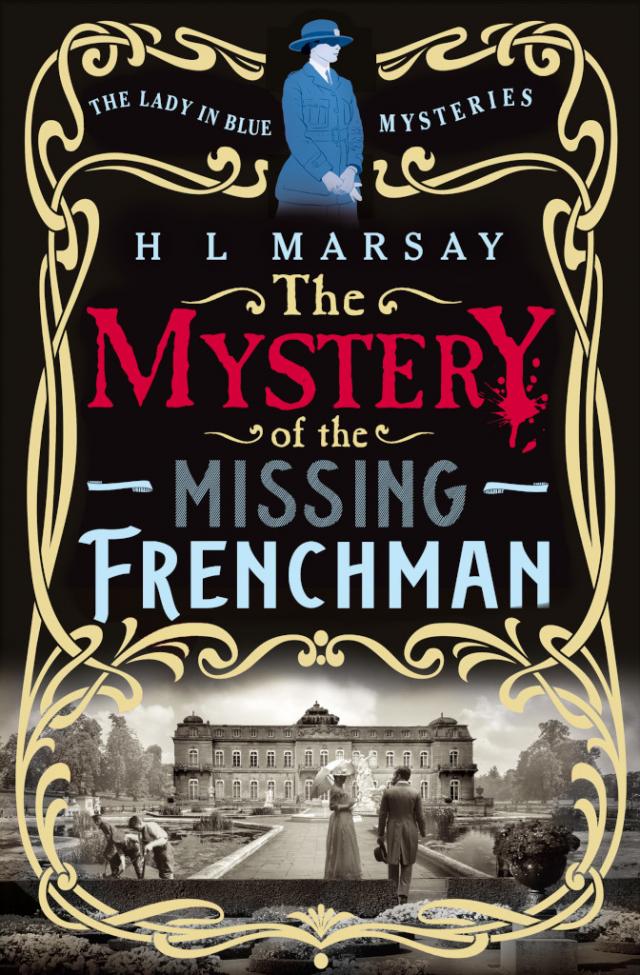
The Mystery of the Missing Frenchman
A Lady in Blue Mystery Novel
H L Marsay
The Mystery of the Missing Frenchman
Copyright© 2024 H L Marsay
EPUB Edition
The Tule Publishing, Inc.
ALL RIGHTS RESERVED
First Publication by Tule Publishing 2024
Cover design by Patrick Knowles
No part of this book may be used or reproduced in any manner whatsoever without written permission except in the case of brief quotations embodied in critical articles and reviews.
This is a work of fiction. Names, characters, places, and incidents are products of the author’s imagination or are used fictitiously. Any resemblance to actual events, locales, organizations, or persons, living or dead, is entirely coincidental.
AI was not used to create any part of this book and no part of this book may be used for generative training.
ISBN: 978-1-962707-63-3
Keep Up with your Favorite Authors and their New Releases
For the latest news from Tule Publishing authors, sign up for our newsletter here or check out our website at TulePublishing.com
Stay social! For new release updates, behind-the-scenes sneak peeks, and reader giveaways:
Like us on
Follow us on
Follow us on
See you online!
Table of Contents
Cover
Title Page
Copyright Page
Chapter One
Chapter Two
Chapter Three
Chapter Four
Chapter Five
Chapter Six
Chapter Seven
Chapter Eight
Chapter Nine
Chapter Ten
Chapter Eleven
Chapter Twelve
Chapter Thirteen
Chapter Fourteen
Chapter Fifteen
Chapter Sixteen
Chapter Seventeen
Chapter Eighteen
Chapter Nineteen
Chapter Twenty
Author’s Note
Acknowledgements
The Lady in Blue Mystery series
More Books by H L Marsay
About the Author
Chapter One
“Sergeant Taylor, I really don’t think she knows anything,” insisted Dorothy as the young maid in the chair next to her sobbed loudly into her apron. Sergeant Taylor frowned as he continued to pace up and down in front of them, his hands clasped behind his back. The hulking figure of Sergeant Brook with his bushy beard was also lurking in the corner, although he remained silent. Personally, Dorothy thought they would have had far more success if she had been allowed to interview the maid alone, or perhaps with the assistance of Sergeant Clark, the older detective they worked with. His grumpy but grandfatherly manner would surely have been an improvement on the shouting and threats coming from Taylor. However, she had kept these thoughts to herself. She knew she was lucky they had even allowed her to be present while they interviewed the female witnesses.
She had been working with this group of detectives, under the leadership of Inspector Derwent, for several months now and she could hardly believe her good fortune. When war first broke out, she—along with Nina Boyle, Mary Allen and Margaret Damer Dawson—had founded the Women Police Volunteers or Women’s Police Service as it was now known. However, traffic duty and training new recruits, although important, had soon lost their appeal compared to solving more serious crimes. Quite by chance she had assisted Inspector Derwent during two murder investigations and had been thrilled when he had requested that she was seconded to Scotland Yard permanently.
On the whole, the three male sergeants had taken a young woman joining them in their stride. They understood that with so many young men leaving the police to go and fight for their country, the empty roles needed to be filled by someone. If there weren’t enough old detectives willing or able to come out of retirement, then these eager young women would have to do. For her part, Dorothy had soon grown accustomed to her new colleagues and their individual quirks. Sergeant Clark had agreed to delay his retirement when war broke out. He was ruled by his stomach and planned his days around tea breaks and mealtimes. Calm and unflappable, he enjoyed grumbling quietly to himself or Dorothy about almost everything, from the weather, to how the war was going.
Brook and Taylor were both family men in their late forties, who hoped the war would be over before either of their sons were old enough to fight. Despite Brook’s slightly threatening appearance, Dorothy believed he had a kind heart. Although so far, he had only spoken precisely thirty-two words to her, he’d always helped when she’d asked him. Taylor was slighter and shorter than Brook but took great pride in his appearance. He was enamoured of everything modern from the police cars he loved to drive at high speed, to the new telephone system that had recently been installed.
Their boss, Inspector Derwent, was far more difficult to understand. He was in his fifties, tall with dark, slightly greying hair and walked with a stick thanks to an injury he had gained during the Boer War. Despite working closely with him, Dorothy still knew very little about his private life.
What she did know was that all her colleagues were irritable and frustrated at the moment. During the previous summer and early autumn, they had been investigating a spate of jewel thefts in and around the capital. The first had occurred in Kensington, the next in Belgravia, followed by two out in Surrey. Then over the long, cold winter, there had been a lull. It was as if the jewel thief had vanished into thin air. That was until ten days ago.
Lady Rimington had been staying with her niece, Mrs Adele Devere, in Mayfair. Mr Devere was a wealthy industrialist. There had been a dinner to celebrate Lady Rimington’s sixtieth birthday. By all accounts it had been a very grand affair. However, when the guest of honour had woken up the following morning, she’d realised her diamond tiara was missing from her dressing room. Like all the other thefts, the stolen jewels were extremely valuable and had been taken without any visible signs of a break-in. All doors and windows were locked from the inside and the jewels had disappeared while the occupants were sound asleep.
The detectives were convinced that in each case a servant must be involved and that whoever was behind the thefts was bribing them to help him gain access, yet they were still no closer to solving the crimes. All the servants at each address had been interviewed and their backgrounds checked. Dorothy had collected a large file of their names, ages, references and all other relevant details. The maid sitting next to her now was one Siobhan O’Neil, aged twenty, born in County Cork but employed by the Deveres as a parlourmaid for the last three years. The young woman blew her nose loudly. Taylor tutted and shook his head.
“Very well, Miss Peto. Take her out of here.” Then raising his voice and wagging his finger. “You’re free to go for now, young lady, but mark my words, we’ll be keeping an eye on you.”
He stomped out of the room followed by Brook, while Dorothy helped the girl to her feet and escorted her to the main door. She watched as Siobhan dashed across the street and into the arms of two other young women, who Dorothy guessed from their striking red hair must be related to her. It was the second time this particular maid had been brought in for questioning, but as far as Dorothy could see, her only crime was being Irish.
Sergeant Taylor had what Dorothy thought was an irrational but unshakable belief that it was Irish republicans who were behind the thefts and that they were using the jewels to finance their political fight against the British. Back in 1914, he had been involved in the arrest of several members of the Irish Republican Brotherhood. They had been caught stealing a shipment of rifles meant for the front from the arsenal at Woolwich. Every house that had been burgled employed at least one Irish servant and Taylor was certain there must be a link between them and the republicans. The previous year’s Easter Rising had cemented his conviction. Dorothy had attempted to argue that there were in fact plenty of brave Irishmen fighting for the British over in France and Belgium, but it did no good. Taylor was adamant he was right.
As well as getting used to her colleague’s quirks, Dorothy had also grown accustomed to their individual prejudices. They each had their own theories about who was behind the jewel thefts. Sergeant Clark seemed to think either the communists or the Germans were involved somehow, even though almost all ‘enemy aliens’, as they were now called, had been interred at the start of the war. When pressed on the matter, Sergeant Brook as usual said very little other than: “Plenty of villains in London without needing to import any, Miss Peto.”
Privately, Dorothy preferred the idea that the burglaries were being carried out by a gentleman jewel thief like Raffles, in the novels by E W Hornung, Sir Arthur Conan Doyle’s brother-in-law. It made more sense to her that someone familiar with the members of the upper classes and the houses they visited was responsible for the crimes than a bunch of hard-drinking, violent republicans or any other foreign political agitators. She hadn’t dared voice her thoughts though. The detectives seemed to have accepted her as part of their team and she didn’t want to give them or Inspector Derwent any reason to doubt their decision to let her work with them. Actually, the inspector hadn’t said who he thought might be behind the jewel thefts either. He simply listened to Taylor and Clark espouse their ideas, occasionally nodding or raising an eyebrow.
After watching Siobhan and the other two women disappear around the corner, Dorothy made her way upstairs. Taylor and Brook had already returned to the office they all shared and were reporting back to Inspector Derwent and Sergeant Clark who, judging by the outdoor coats they were still wearing, had only recently returned themselves.
“It was no good, I’m afraid, sir. She’s still insisting she didn’t see or hear anything unusual, even though we know she was the last servant in Lady Rimington’s room on the night of the party,” explained Taylor. “And another thing… It turns out she’s a cousin of Sean Ahearn. He’s always bad news. Remember we thought he was involved with the Woolwich robbery but couldn’t prove it. We should look into Siobhan’s background and see if she is really as innocent as she claims to be.” Dorothy was about to argue that she had already checked Siobhan’s and the other servants’ references with their previous employers, but the inspector was shaking his head.
“For now, that will have to wait, Taylor,” he said. “I want you and Brook to go down to Hatton Garden and see if anyone has been trying to sell the diamonds there or indeed any of the other jewels on our list. I can’t see why our thief, whoever he is, would want to hold on to the items he has taken. Surely he must need to sell them, so he must have a fence somewhere.” While Taylor and Brook reached for their hats and coats, the inspector turned to Dorothy. “Miss Peto, perhaps you would be kind enough to accompany Sergeant Clark and myself to Trafalgar Square.”
“Certainly, Inspector. Is this to do with the jewel thefts too?” asked Dorothy, relieved that she wasn’t going to spend the rest of the day dealing with yet more paperwork.
“No. This is a different matter. Assistant Commissioner Thomson has asked us to meet a Colonel Louis Lamarchant there. He is from the Deuxième Bureau in Paris and is over here investigating the disappearance of a French citizen. A young man named François Lamarchant. He is the Marquis de Nagay and a relative of the colonel’s.”
Dorothy frowned. “He’s disappeared? Where from? What was he doing over here? Is he a soldier?”
The inspector held up his hand against her barrage of questions. “I am afraid Assistant Commissioner Thomson did not furnish me with any further details. I am hoping Colonel Lamarchant will be able to answer all our questions. Although it may interest you to know that the assistant commissioner said Colonel Lamarchant requested you by name.”
Dorothy felt herself flush with pride.
“Gosh really? That’s rather flattering. Do you know why?”
“I do not,” he replied turning his attention to the copy of The Times lying on the desk next to him. Dorothy didn’t press him any further, but she was a little confused as well as excited. She was well aware, as was anyone who read the newspapers regularly, that Basil Thomson was in charge of Special Branch and most people thought that it was they who were in charge of catching German spies. Assistant Commissioner Thomson, a rather flamboyant man, revelled in the attention this belief brought his way. However, thanks to her brother Raymond’s work with the newly formed and very secret General Intelligence unit, Dorothy knew this wasn’t the case and it was actually Raymond’s branch of the foreign office that was keeping the country safe from spies and other foreign agents who wished them harm.
Raymond’s boss, the extremely private, Vernon Kell, was more than happy with this misconception, as it protected his own agents and allowed them to carry out their work more efficiently. It was rather odd though. The Deuxième Bureau was the French version of General Intelligence. If a member of the DB needed help, wouldn’t it have made more sense for him to seek the assistance of Raymond’s colleagues? Her thoughts were interrupted by the inspector looking up from the newspaper and clearing his throat. He seemed a little embarrassed.
“We are due to meet Colonel Lamarchant at two o’clock this afternoon. I wonder if I might ask you to change out of your uniform and into civilian clothing before our meeting, Miss Peto. It seems the colonel is keen not to draw attention to his presence here in London. He has requested that our meeting should look social rather than official, which is why he chose not to come here to Scotland Yard. Instead, I suggested the three of us meet him in Trafalgar Square. It’s a busy location popular with tourists.”
“Certainly, Inspector. I’ll go home and change immediately,” replied Dorothy with a smile although her heart sank a little. For a moment, she’d allowed herself to believe her presence had been requested because of good reports about her work. Now she feared she was being asked to go along merely to add to the pretence of them meeting socially. A woman, especially one not in uniform, would make their gathering look less formal.
“What’s a marquis when it’s at home anyway?” asked Sergeant Clark, fishing a bag of mint humbugs out of his pocket.
“It’s the English version of a marquess. In this country, he would rank below a duke but above an earl,” explained Dorothy, reciting the information her mother had instilled in her and her sisters. To Mrs Peto, such details as knowing that a baronet ranked above a knight was as important as knowing summer followed spring. “I imagine it’s the same in France, although I believe they have comtes, their version of counts, not earls,” she continued.
“Huh,” grunted the older detective, clearly not impressed. “I thought the guillotine did away with all that nonsense.”
“If you’re ready to leave now, Miss Peto, we can drop you at home on our way to Hatton Garden,” offered Taylor as he and Brook headed out the door. Dorothy grabbed her own hat and coat and hurried to catch them up.
After enduring a rather hair-raising drive with Sergeant Taylor at the wheel, she arrived at her flat in Bloomsbury in less than twenty minutes. She quickly changed into a maroon skirt and cream blouse. It had been such a long time since she’d worn anything other than her blue uniform, she almost didn’t recognise herself. Then she tidied her hair and pinned a velvet hat trimmed with feathers on her head in place of the WPS Norfolk one she normally wore. Finally, she buttoned up her warmest coat and collected her new fur muff, a Christmas present from her parents.
Although it was spring now and the sun was shining, as she stepped outside, the cold still stung her face. Taylor and Brook had offered to wait for her, but she’d declined, deciding to forgo saving a few moments’ travelling time for the sake of her nerves. Instead, she took the underground. Sitting alone at the back of her carriage, she enjoyed watching her fellow passengers. She almost felt invisible without her uniform. After Oxford Circus, the train seemed to slow down, almost crawling along until it reached Piccadilly Circus where it stood at the platform for over three minutes. She checked her watch impatiently. If it didn’t start moving again soon, it would be quicker for her to get off and walk.
As she looked up again, she noticed a large man wearing a dark green bowler hat boarding the train. It was Sean Ahearn, the man who was related to Siobhan. He was known to organise illegal boxing matches and card games. It was also suspected that he had links to the Irish Republican Brotherhood. She lowered her head and watched him puffing on his cigar as he moved along to the next carriage. She was thankful that Taylor wasn’t with her. He was sure to have insisted they follow Ahearn and see what he was up to, and it was almost two o’clock already.
Chapter Two
She finally arrived at Trafalgar Square at five minutes past two. Silently chiding herself for being late, she ran up the stairs of the underground station and into the daylight. She immediately spotted Inspector Derwent and Sergeant Clark on the steps of the National Gallery. Both were standing ramrod straight, sternly surveying the traffic and pedestrians below them.
“So much for looking like tourists on a jolly day out,” murmured Dorothy to herself as she hurried to join them.
“I’m sorry I’m late,” she apologised, slightly breathlessly.
“You’re not. At least not compared to Colonel Lamarchant,” replied the inspector.
“He can’t be much of a timekeeper,” grumbled Sergeant Clark, whose dislike of the French was second only to his dislike of Germans.


