

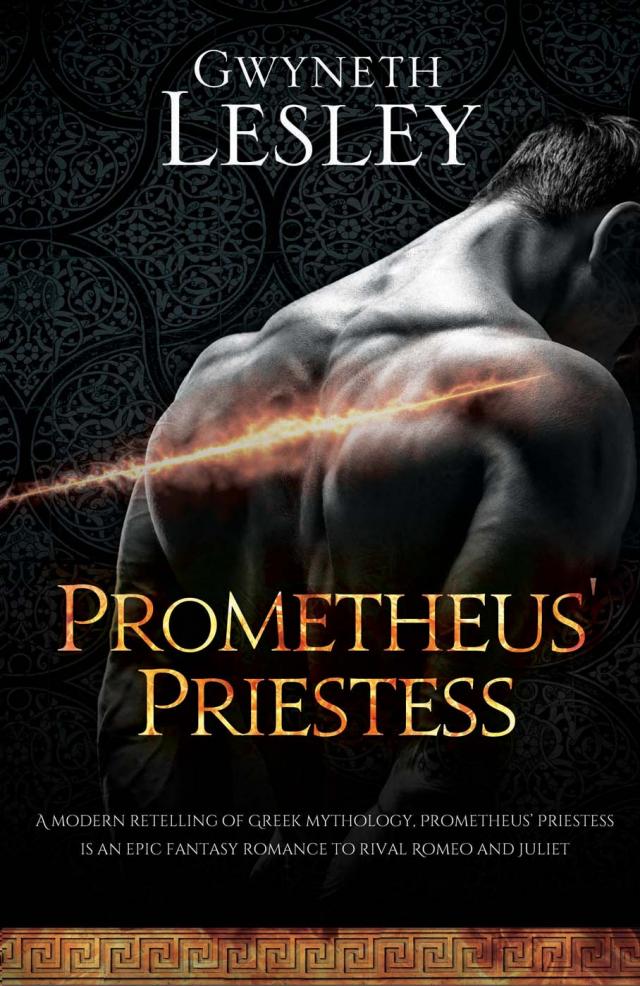
Prometheus' Priestess, page 1


OUTSPOKEN INK PRESS
First published in New Zealand in 2021 by Outspoken Ink Press
Text copyright © Gwyneth Lesley, 2021
Cover image copyright © Jem Butcher, 2021
Interior illustrations & formatting © Gram Telen, 2021
Editor: Jessica Brown
Author image: © Johanna Elizabeth, 2020
The moral rights of the author and illustrators have been asserted.
This book is a work of fiction. All names, characters, locations, and incidents – other than those clearly in the public domain − are products of the author’s imagination. Any resemblance to actual persons or things, living or dead, locales or events are entirely coincidental.
All rights reserved.
No part of this publication may be reproduced, distributed, or transmitted in any form or by any means, including photocopying, recording, or other electronic or mechanical methods, without prior written permission of the publisher, except in the case of brief quotations embodied in reviews and certain other non-commercial uses permitted by copyright law.
A catalogue record for this book is available from the New Zealand Library.
ISBN: 978 0 473 58688 1
Printed and bound by IngramSpark
THE FEMME FATALE SERIES
BOOK #1:
PROMETHEUS’ PRIESTESS
One for sorrow
Two for joy
Three for a girl
Four for a boy
Five for silver
Six for gold
Seven for a secret never to be told.
Seven.
Seven women are about to tell you their stories.
These are the stories that several women in your world know all too well.
We are the women they told you were misfortune, our myths distorted over time.
We are the women they kept silent for our secrets.
Where we were once considered fearlessness personified,
messengers, and guardians ... now you consider us unlucky.
Tainted.
Thieving.
Yet you forget. You stole our stories first.
For it is we who comforted Jesus on the cross.
We who survived outside of Noah’s ark.
We who drank the wine of gods.
Perhaps that is why you thought us made of the Devil’s blood.
But don’t you know by now?
The Devil is the dark shepherd.
Shepherding you through your own pain.
A rite of passage − in the hope you reunite with God.
You haven’t been listening.
So we’ll have to tell you the stories again.
THE GREEK GODS
AND GODDESSES
(AND THEIR ASSISTANTS)
YOU WILL COME ACROSS
Moirai (The Fates)
These three sisters are responsible for the threads of human life.
Clotho – Spins the thread and decides when a person is born and when a god or mortal is to be saved or put to death.
Lachesis – The measurer of the thread, who decides how much time is allowed for each being and is sometimes associated with destiny.
Atropos – Also known as Aisa, chooses the manner of death by cutting the threads. She is also the eldest of the Fates and often called ‘the inflexible one’.
Zeus
God of Gods, King, Father…
This god has a thing for thunder and lightning and has produced a fair number of children.
Hera
Goddess of women, marriage, family and childbirth.
Also known as the Queen of Heaven, Zeus’ jealous wife (and technically his sister).
Prometheus
Titan God of fire.
A good friend of Zeus, he created humanity from clay for his friend. He is known amongst the other gods as a champion of humankind and for his gift – foresight. At the time of our story he has been serving a 2,000-year solitude sentence for offering the humans fire, though this will not be his greatest crime.
Athena
Goddess of wisdom and war.
Known for her strategy and discipline, Athena is the Goddess that was born out of her father Zeus’ head after he swallowed her mother, while she was pregnant, whole. You could say that, quite literally, makes her the definition of ‘her father’s daughter’.
Aphrodite
Goddess of love, beauty, passion, and procreation.
Technically born of Uranus’ (Zeus’ grandfather) genitals and seafoam, Aphrodite should be considered Zeus’ aunt. However, to keep Zeus in his seat of power, and with her father dead, she was adopted as his ‘daughter’. It’s left her with a slight complex to prove herself right over others.
Artemis
Goddess of the hunt, the wilderness, wild animals, the moon, and chastity.
Her twin brother is Apollo, who we don’t meet here, and she is also the half sister of Athena, Aphrodite, Ares, Hephaestus, Hermes, and Dionysus. Due to events prior to this story, Artemis was responsible for the death of Adonis (Aphrodite’s favourite mortal lover or adopted son … entirely possibly both) and so the two of them aren’t on best terms in this book.
Ares
God of war, violence, male virility, and defender of the weak.
Lover (and technically great nephew or adopted stepbrother) of Aphrodite. Half brother of Athena, Artemis, Hephaestus, Dionysus, and Hermes.
Phobos
The son of Aphrodite and Ares, Phobos is the personification of fear and panic.
Hephaestus
God of fire and of craftsmen.
Son of Zeus and Hera, husband of Aphrodite. A hunchbacked, ungrateful metalworker who no one in the family particularly likes.
Hermes
The herald and messenger of the gods.
A wonderful mediator, guide, and protector. Also a half brother to Athena, Aphrodite (and lover), Artemis, Ares, Hephaestus … you get the picture.
Tyche
Goddess of fortune and chance.
Daughter of Aphrodite and Hermes, friend of Prometheus. This Goddess has repeatedly denied Dionysus’ flirtations in the past and why this is important will become clear in this tale.
Dionysus
God of the grape-harvest, fertility and divine madness.
Half brother along with all the rest of Zeus’ children, with a bitter crush on Tyche.
Others you may need to know …
Lysia (Lysimache I)
The high priestess of Goddess Athena Polias
Chief of the lesser officials, she is responsible for supervising the protective city deity of Ancient Athens.
Circe
Witch, enchantress, alchemist, and minor goddess.
Renowned for her vast knowledge of potions and herbs and transformational skills in the Greek world.
Gaia
The personification of the Earth and one of the Greek primordial deities, aka Mother Earth.
Also, technically, Zeus’ grandmother.
Hestia
Goddess of hearth and home.
Demeter
Goddess of the harvest, mother of Persephone.
Persephone
Goddess of agriculture, daughter of Demeter, wife of Hades.
She spends her time split between the Underworld (autumn and winter) and the Earth (spring and summer).
Hades
God of the Underworld and brother of Zeus.
Styx
The river of the underworld. The gods swear by her water as their most binding oath.
Pygmalion
A sculptor who had sworn off love, who then fell in love with his statue.
Eros
God of lust and primal sexual desire. Son of Aphrodite and Ares.
Adephagia
Goddess of gluttony.
Hybris
Spirit of insolence, violence, and outrageous behaviour.
Nemesis
The goddess who enacts retribution against those who succumb to hubris, arrogance before the gods.
Plutus
God of wealth.
Aergia
The personification of sloth, idleness, indolence, and laziness.
Phthonos
The personification of jealousy and envy.
Lyssa
The spirit of mad rage, frenzy, and rabies in animals.
Dike
Goddess of justice and spirit of fair judgement.
Iris
The personification of the rainbow and another messenger of the gods.
Chronos
Son of Uranus (Sky Father) and Gaia, King of the Titans, and the God of time.
Prometheus’
Priestess
I weep, my creations.
That you may know
The toil I took, the time, the care.
And yet my care, you “cured”.
Each masterpiece adorned with adoration,
Yet here you are, cracking, wilting, dying
A Blaming Creation.
I can’t help the poeticness of my profess,
Because how poetic your actions
How poetic your duress.
An artist disturbed by his living art.
Prometheus
To Mary-Kate,
For unlocking muse magic I had long thought gone.
PROLOGUE
The tapestry of humanity lay threadbare, metres and metres of it stretched out, until it lay unfinished, on the wooden hallway floor. One of the threads had caught on a nail, not quite embedded in the floor, and torn slightly, creating a little pocket in the tapestry. It would become a vacuum where nothing would exist for that part of humanity. Apparently, the humans called it a ‘black hole’.
Earlier in the work, much earlier, the tapestry had been full of life and colour. Emerald greens of the earth and lapis lazuli blues of the oceans were interwoven with autumnal reds, cherry-blossom pinks, and every colour in between. Recently though, the strings the Fates had been called to spin on the loom had been beige, dull greys, and obsidian blacks.
Humanity was dying.
The ends of the tapestry lay on the floor limply while the three sisters the Greek world knew as the Moirai, the Fates, stared at the ends of the threads, wishing them to spring to life of their own accord and knit together a new picture. Alas, the threads weren’t magical. It was the work of the three sisters that made the tapestry what it was, and while they could sometimes be swayed to tell a story a particular way, sometimes the threads spoke of their own free will.
Clotho hunched over, her black cloak and hood giving her the impression of Death rather than the life she was responsible for selecting. For it was her who chose the threads, her who decided who lived. She did, however, get the choice to not pick up the threads again, effectively ending life as easily as she gave it. It was a point of contention amongst the sisters.
She sighed. It wasn’t that she wanted humanity to die; it was simply the fact that something else was being called to be birthed forward. Fear.
“I have no desire to pick up another one of these wretched threads.” She stared at the beige silks and obsidian blacks beside her in disgust. She may as well have been sitting next to a pile of hay and chewing on cud, so bland and distasteful was her job at the moment.
“Well, you must.” Lachesis, her elder sister snapped as she measured out the latest thread with her rod and began to weave it into the tapestry. Unlike Clotho, she was dressed in a sheath of white as pure as the destiny she represented.
“The story is not finished and I cannot tease the tapestry out anymore until you pick up the next thread,” she continued in that pragmatic way of hers that spoke of her position as the middle child. Not that the sisters had been children for eons. Now they were old women, if you could even call them that, hunched over a loom that creaked with unfathomable age.
Unspoken remained the words that the tapestry would remain forever dormant, lying on the floor like an abandoned sweater.
“Atropos, what say you?” Lachesis asked.
The eldest, and smallest, of the three sisters scowled, deep grooves marring a long-ago smooth forehead.
“It doesn’t end nicely. How am I supposed to end something so ... unfinished?! No, you must continue Clotho.”
The youngest of the three, and perhaps that was why she was in charge of the youthfulness of birth, huffed. Really, she thought, Atropos had no right to tell her what to do after all these years. Just because she had always chosen the manner of death and cut the threads didn’t mean she got to be in charge of everything. But the eldest among them was stubborn to a fault and bossy with it. There was no changing her mind, Clotho grumbled, even as she admitted that her sisters were right.
While the beigeness of life had begun to bleed into most of the tapestry, the grey steel of the industrial and technological age of humanity apparent, the black obsidian had not yet taken over. Oh, at first it had just been wisps of black. That jagged edge of fear that was necessary for human survival. It gave the tapestry definitive structure as the scenes from history played out in real time.
Now ... now it looked like a thick oil stain had been smeared across the Fates’ work until it trickled through life, through the remaining threads and onto the wooden floorboards. But the tapestry wasn’t yet completely pitch black. Fear hadn’t yet cloyed and choked the living breath out of humanity completely.
The occasional thread of gold had still managed to sneak its way into the tapestry. There was hope yet.
“What do you suggest we do then, Aisa?” Clotho asked.
The eldest sister shot her a sharp look. “I told you not to call me that anymore.”
“Why ever not?” Clotho mused with a sly smile, knowing how her sister preferred her middle name that more accurately reflected her role of death in the family. “It’s your given name.”
Atropos pointed the pair of sharpened blades in her hand as if taking aim at her eye.
“Stop bickering like old women.” Lachesis interrupted them. “She’s clearly baiting you, sister. In all our eons you would think you would not fall for it every time.”
It was true. They often squabbled amongst themselves, even now, about how the tapestry should play out, but today the frustration between the sisters was palpable. While sometimes they could be fickle, today the Fates were decidedly not playing games.
“Well?” Clotho asked.
“They are not ready to die,” Atropos eventually replied. “We must call in another.”
“This fear, it is a human affliction,” Clotho pointed out. “Should we call in Prometheus? He did create them after all.”
“If you ask me, it looks more like war,” Lachesis said. “Maybe we should call in Athena instead.”
“It is both,” Atropos agreed, though her forehead remained in a deep frown. “But you know how awry the tapestry gets when Prometheus’ foresight gets involved.”
“I’d rather not have to keep unpicking and redoing the threads unless getting him involved becomes absolutely necessary,” Lachesis agreed.
“Then it’s settled. The threat of war is greater anyway. Let’s call in Athena.” Atropos decided.
Clotho nodded and picked up an olive-green thread.
CHAPTER I
Athena stared at the table in front of her, the words of the Moirai fresh in her mind. Before her was a browned-with-age spread, a map of the world ingrained into the fabric of the table. It was a large, ugly thing, taking up the majority of the room. The wooden top was scored with marks from the years Athena had planned, acted, and executed battle plans, while its dark wooden legs curled and gnarled their way to a sandy stone floor. The rest of the room was carved from stone too. Opposite the great doors, made of the same dark wood as the table, were huge archways that showed spectacular views of Athens from high in the mountains. There were no shutters, nothing to stop the elements from breaking in, but then Athena always said working with the elements was an essential part of strategy. Despite the exposure, the room was pristine. There were a few potted plants dotted around the room, and opposite the large war table on the east-facing wall, there, instead of a fireplace, stood a small freshwater fountain by the chaises where she would retire for the day, for she had always thought of water as far more intelligent an element than the bruteness of fire.
One of her tawny owls watched her with a cocked head, quizzically, for there were currently no war pieces, which were usually placed in a chess-like pattern, across the table that Athena was staring hard at.
“This is no ordinary battle,” she told her companion. “The humans aren’t fighting some known enemy. They’re actually fighting themselves, their instincts.”
The owl hooted.
“I have absolutely no idea how to win this battle,” she muttered to the only confidant she would ever say such a thing out loud to, for to admit weakness was to invite the vultures of her family to vie for her place.
“There is one who might be able to shed some light on the matter. Fetch Aphrodite for me.”
The owl hooted again, spread its wings the width of the windowsill, and took off with a powerful beat of its wings. Athena watched it until it was a speck against a light grey sky that reflected the colour of her own eyes.
An hour passed before Aphrodite appeared before her in a light white sheath that matched her hair − so translucent and dewy, it appeared as if she had walked out of the ocean ... again. Athena rolled her eyes.
Aphrodite raised an eyebrow. “You called for me while I was bathing. What did you expect?” She draped herself over one of the chaises as she squeezed droplets of water onto the floor.


