

Maud Martha, page 1


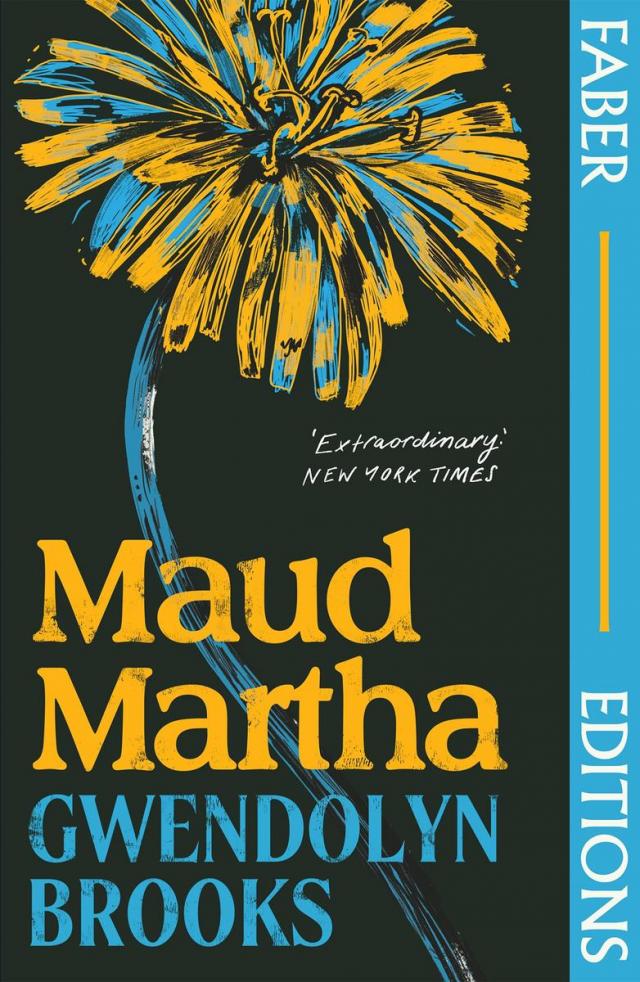
MAUD MARTHA
Gwendolyn Brooks
To My Family
Maud Martha was born in 1917.
She is still alive.
CONTENTS
Title Page
Dedication
Epigraph
Foreword
1: description of Maud Martha
2: spring landscape: detail
3: love and gorillas
4: death of Grandmother
5: you’re being so good, so kind
6: at the Regal
7: Tim
8: home
9: Helen
10: first beau
11: second beau
12: Maud Martha and New York
13: low yellow
14: everybody will be surprised
15: the kitchenette
16: the young couple at home
17: Maud Martha spares the mouse
18: we’re the only colored people here
19: if you’re light and have long hair
20: a birth
21: posts
22: tradition and Maud Martha
23: kitchenette folks
24: an encounter
25: the self-solace
26: Maud Martha’s tumor
27: Paul in the 011 Club
28: brotherly love
29: millinery
30: at the Burns-Coopers’
31: on Thirty-fourth Street
32: Mother comes to call
33: tree leaves leaving trees
34: back from the wars!
About the Author
By the Same Author
Copyright
Faber Editions adverts
FOREWORD
by Margo Jefferson
In the late 1970s, when I was writing earnest criticism and avidly reading women writers, I had to go to the New York Public Library to find a copy of Maud Martha. I’d been reading Gwendolyn Brooks’s poetry since the late fifties when she published Bronzeville Boys and Girls. How could you not if you were a Black reader, especially a Black girl reader growing up in Chicago with literary tastes and longings? All Black readers in Chicago knew that the passionate virtuosity and vision of Annie Allen had won Brooks the Pulitzer Prize for Poetry in 1950. And in 1963 my parents had given me a handsome new edition of her Selected Poems for Christmas.
But where was Maud Martha, her first and only novel, published in 1953? It was out of print in the seventies.* It had gotten respectful reviews, then settled into library catalogues to go largely unnoticed. I think what really happened is that it sank beneath the weighty canonical force of first novels by two of Brooks’s Black male peers. Ralph Ellison’s Invisible Man appeared the year before and James Baldwin’s Go Tell It on the Mountain appeared that very same 1953.
Somewhere amid the fierce quests and assertions of those male heroes, a seven-year-old girl named Maud Martha Brown sits on her Chicago porch looking at dandelions – ‘yellow jewels for everyday, studding the patched green dress of her back yard.’ (1) What does she want? She wants to give shape – form, order – to the varied materials of life around and inside her. The daydreams and duties, the nagging habits and treasured rituals, the knots of grief and surges of pleasure.
Maud Martha’s quest is to become the best possible version of herself; to grow up using her mind and heart intelligently, facing down her lacks and disappointments, seizing those moments when ‘one could think even of death with a sharp exhilaration, feel that death was a part of life: that life was good and death would be good too.’ (113)
In her 1972 memoir, Report from Part One, Brooks said of the book’s autobiographical element: ‘It is true that much in the “story” was taken out of my own life, and twisted, highlighted, or dulled, dressed up or down.’† That is, she dressed down her own choice to become an artist. But to Maud Martha she gave the sensibility and consciousness of an artist: the desire to probe her thoughts, feelings and experiences. ‘That was the offering, the bit of art, that could not come from any other,’ (14) Maud Martha thinks.
She wants be ‘cherished’ for this offering. Cherished. I remember how I winced at that word in the 1970s. The young feminist in me feared that the story would equate being cherished with total immersion in marriage and motherhood; I should have known better. Gwendolyn Brooks always chose her words with tenacious, even obsessive precision. Maud Martha wants to be, as the standard definition of ‘cherished’ goes, ‘held dear, treated with tender affection’. But ‘cherish’ also means ‘to indulge and encourage in the mind’. And Maud Martha cherishes her own mind, her sensibility: as a child, as a teen, and even as a wife and mother. This lacks the flagrant agonies of Ellison’s and Baldwin’s heroes. But it is quietly extraordinary.
Brooks takes care not to claim the privilege of narrative omniscience. She uses close-third narration, speaks with and of Maud Martha but not for her. Brooks calls the book’s thirty-four chapters ‘tiny stories’. Like a sonnet sequence, each story delights in sensory and emotional details and each reveals another aspect of Maud Martha. Poets take liberties with prose notions of a story arc. Every poem, however short, has its arc. This novel’s first words are: ‘description of Maud Martha’, followed by a lyrically detailed list of what she likes and wants. (pp. 1–2)
Readers, be attentive. Take nothing about this girl for granted.
She will question the standard consolation of a church hymn. (‘Were people really going to understand It better by and by? When it was too late?’). (17) She will envy the rapture aroused by her sister’s beauty. ‘My hair is longer and thicker, she thought. I’m much smarter. I read books and newspapers and old folks like to talk with me, she thought. But the kernel of the matter was that, in spite of these things, she was poor, and Helen was still the ranking queen.’ (22)
She berates herself for feeling grateful when a white friend condescends to visit her home. She savours the ‘tactfully shimmering’ (30) homes of rich New Yorkers photographed in magazines while surveying her family’s home with loving rue: ‘The chairs, that cried when people sat in them. The tables, that grieved audibly if anyone rested more than two fingers upon them.’ The pipes beneath the sink ‘that Helen said made her think of a careless woman’s underwear, peeping out.’ (24)
There’s not a scrap of self-deluding sentiment in her assessment of the marriage proposal she will get – and accept. ‘He is thinking that I am all right. That I am really all right. That I will do … I am what he would call—sweet. But I am certainly not what he would call pretty.’ (33)
Maud Martha is a novel by a Black woman about working-class Black life in the twenties, thirties and forties. What then of race, with its menacing reach and grasp? What of white people with their casual insults and focused bigotries? White people in the novel intrude on your thoughts as well as your actions; they leave ‘scraps of baffled hate’ (112) inside you when the department-store Santa Claus ignores your daughter. When you and your husband are the only Blacks in the movie theater, you fear they’ll punish you with suspicious looks. When a woman in the beauty shop tosses out the ugliest of racial slurs, you try to pretend you didn’t hear it.
Maud Martha doesn’t deny racism’s power, but she denies its power to rule her life. Her imagination claims its own rights and liberties. And – what a wise, generous choice by Brooks – she needn’t be an epic warrior-heroine to manage that. She claims imaginative space while fixing a chicken or failing to kill a mouse, while talking with neighbours, chafing at social pretensions or gauging the role of tragedy in the lives around her. ‘The truth was, if you got a good Tragedy out of a lifetime, one good, ripping tragedy, thorough, unridiculous, bottom-scraping, not the issue of human stupidity, you were doing, she thought, very well, you were doing well.’ (105)
The book ends as World War II does: the last chapter is titled ‘back from the wars!’ Maud Martha begins with the assertion of what a young girl liked and wanted for herself. As it ends, a young woman is asking herself: ‘What, what, am I to do with all of this life?’ (113)
It’s an exuberant question – hard won but nonetheless exuberant. It’s a challenge too. Reader, it says, what are you going to do with all the materials of your life?
Brooks began writing avidly when she was a child. (A child of seven, like Maud Martha.) Writing was a necessity for her, she said in a 1967 interview. ‘Ambition doesn’t seem a proper word to describe what I felt as I grew up and continued to write. I enjoyed it very much, and I was convinced that it would be good to “enchant” others with the products of MY MIND’ (her caps).
And that is exactly what she has done in this luminous, newly reissued American novel.
* Maud Martha was first reissued by Third World Press in 1993.
† Broadside Press, 1972.
MAUD MARTHA
1
description of Maud Martha
What she liked was candy buttons, and books, and painted music (deep blue, or delicate silver) and the west sky, so altering, viewed from the steps of the back porch; and dandelions.
She would have liked a lotus, or China asters or the Japanese Iris, or meadow lilies—yes, she would have liked meadow lilies, because the very word meadow made her breathe more deeply, and either fling her arms or want to fling her arms, depending on who was by, rapturously up to whatever was watching in the sky. But dandelions were what she chiefly saw. Yellow jewels for everyday, studding the patched green dress of her back yard. She liked their demure prettiness second to their everydayness; for in that latter quality she thought s
And could be cherished! To be cherished was the dearest wish of the heart of Maud Martha Brown, and sometimes when she was not looking at dandelions (for one would not be looking at them all the time, often there were chairs and tables to dust or tomatoes to slice or beds to make or grocery stores to be gone to, and in the colder months there were no dandelions at all), it was hard to believe that a thing of only ordinary allurements—if the allurements of any flower could be said to be ordinary—was as easy to love as a thing of heart-catching beauty.
Such as her sister Helen! who was only two years past her own age of seven, and was almost her own height and weight and thickness. But oh, the long lashes, the grace, the little ways with the hands and feet.
2
spring landscape: detail
The school looked solid. Brownish-red brick, dirty cream stone trim. Massive chimney, candid, serious. The sky was gray, but the sun was making little silver promises somewhere up there, hinting. A wind blew. What sort of June day was this? It was more like the last days of November. It was more than rather bleak; still, there were these little promises, just under cover; whether they would fulfill themselves was anybody’s guess.
Up the street, mixed in the wind, blew the children, and turned the corner onto the brownish-red brick school court. It was wonderful. Bits of pink, of blue, white, yellow, green, purple, brown, black, carried by jerky little stems of brown or yellow or brown-black, blew by the unhandsome gray and decay of the double-apartment buildings, past the little plots of dirt and scanty grass that held up their narrow brave banners: please keep off the grass—newly seeded. There were lives in the buildings. Past the tiny lives the children blew. Cramp, inhibition, choke—they did not trouble themselves about these. They spoke shrilly of ways to fix curls and pompadours, of “nasty” boys and “sharp” boys, of Joe Louis, of ice cream, of bicycles, of baseball, of teachers, of examinations, of Duke Ellington, of Bette Davis. They spoke—or at least Maud Martha spoke—of the sweet potato pie that would be served at home.
It was six minutes to nine; in one minute the last bell would ring. “Come on! You’ll be late!” Low cries. A quickening of steps. A fluttering of brief cases. Inevitably, though, the fat girl, who was forced to be nonchalant, who pretended she little cared whether she was late or not, who would not run! (Because she would wobble, would lose her dignity.) And inevitably the little fellows in knickers, ten, twelve, thirteen years old, nonchalant just for the fun of it—who lingered on the red bricks, throwing balls to each other, or reading newspapers and comic books, or punching each other half playfully.
But eventually every bit of the wind managed to blow itself in, and by five minutes after nine the school court was bare. There was not a hot cap nor a bow ribbon anywhere.
3
love and gorillas
So the gorilla really did escape!
She was sure of it, now that she was awake. For she was awake. This was awakeness. Stretching, curling her fingers, she was still rather protected by the twists of thin smoky stuff from the too sudden onslaught of the red draperies with white and green flowers on them, and the picture of the mother and dog loving a baby, and the dresser with blue paper flowers on it. But that she was now awake in all earnest she could not doubt.
That train—a sort of double-deck bus affair, traveling in a blue-lined half dark. Slow, that traveling. Slow. More like a boat. It came to a stop before the gorilla’s cage. The gorilla, lying back, his arms under his head, one leg resting casually across the other, watched the people. Then he rose, lumbered over to the door of his cage, peered, clawed at his bars, shook his bars. All the people on the lower deck climbed to the upper deck.
But why would they not get off?
“Motor trouble!” called the conductor. “Motor trouble! And the gorilla, they think, will escape!”
But why would not the people get off?
Then there was flaring green and there was red and there was red-orange, and she was in the middle of it, her few years many times added to, doubtless, for she was treated as an adult. All the people were afraid, but no one would get off.
All the people wondered if the gorilla would escape.
Awake, she knew he had.
She was safe, but the others—were they eaten? and if so had he begun on the heads first? and could he eat such things as buttons and watches and hair? or would he first tear those away?
Maud Martha got up, and on her way to the bathroom cast a glance toward her parents’ partly open door. Her parents were close together. Her father’s arm was around her mother.
Why, how lovely!
For she remembered last night. Her father stamping out grandly, dressed in his nicest suit and hat, and her mother left alone. Later, she and Helen and Harry had gone out with their mother for a “night hike.”
How she loved a “hike.” Especially in the evening, for then everything was moody, odd, deliciously threatening, always hunched and ready to close in on you but never doing so. East of Cottage Grove you saw fewer people, and those you did see had, all of them (how strange, thought Maud Martha), white faces. Over there that matter of mystery and hunchedness was thicker, a hundred-fold.
Shortly after they had come in, Daddy had too. The children had been sent to bed, and off Maud Martha had gone to her sleep and her gorilla. (Although she had not known that in the beginning, oh no!) In the deep deep night she had waked, just a little, and had called “Mama.” Mama had said, “Shut up!”
The little girl did not mind being told harshly to shut up when her mother wanted it quiet so that she and Daddy could love each other.
Because she was very very happy that their quarrel was over and that they would once again be nice.
Even though while the loud hate or silent cold was going on, Mama was so terribly sweet and good to her.
4
death of Grandmother
They had to sit in a small lobby, waiting for the nurses to change Gramma.
“She can’t control herself,” explained Maud Martha’s mother.
Oh what a thing! What a thing.
When finally they could be admitted, Belva Brown, Maud Martha and Harry tiptoed into the lackluster room, single file.
Gramma lay in what seemed to Maud Martha a wooden coffin. Boards had been put up on either side of the bed to keep the patient from harming herself. All the morning, a nurse confided, Ernestine Brown had been trying to get out of the bed and go home.
They looked in the coffin. Maud Martha felt sick. That was not her Gramma. Couldn’t be. Elongated, pulpy-looking face. Closed eyes; lashes damp-appearing, heavy lids. Straight flat thin form under a dark gray blanket. And the voice thick and raw. “Hawh—hawh—hawh.” Maud Martha was frightened. But she mustn’t show it. She spoke to the semi-corpse.
“Hello, Gramma. This is Maudie.” After a moment, “Do you know me, Gramma?”
“Hawh—”
“Do you feel better? Does anything hurt you?”
“Hawh—” Here Gramma slightly shook her head. She did not open her eyes, but apparently she could understand whatever they said. And maybe, thought Maud Martha, what we are not saying.
How alone they were, how removed from this woman, this ordinary woman who had suddenly become a queen, for whom presently the most interesting door of them all would open, who, lying locked in boards with her “hawhs,” yet towered, triumphed over them, while they stood there asking the stupid questions people ask the sick, out of awe, out of half horror, half envy.
“I never saw anybody die before,” thought Maud Martha. “But I’m seeing somebody die now.”
What was that smell? When would her mother go? She could not stand much more. What was that smell? She turned her gaze away for a while. To look at the other patients in the room, instead of at Gramma! The others were white women. There were three of them, two wizened ones, who were asleep, a stout woman of about sixty, who looked insane, and who was sitting up in bed, wailing, “Why don’t they come and bring me a bedpan? Why don’t they? Nobody brings me a bedpan.” She clutched Maud Martha’s coat hem, and stared up at her with glass-bright blue eyes, begging, “Will you tell them to bring me a bedpan? Will you?” Maud Martha promised, and the weak hand dropped.


