

You Only Live Nine Times, page 1


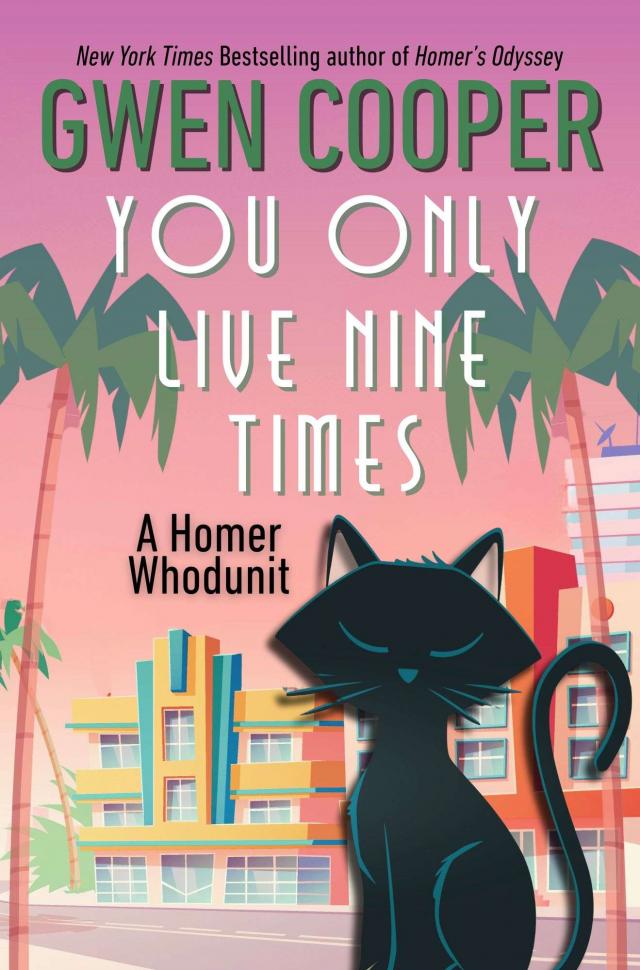
Copyright © 2025 by Gwen Cooper
All rights reserved.
No portion of this book may be reproduced in any form without written permission from the publisher or author, except as permitted by U.S. copyright law.
Cooper, Gwen.
You only live nine times, a "Homer whodunit" mystery
Fiction, mystery
Contents
Foreword
People & Places
1. Chapter 1
2. Chapter 2
3. Chapter 3
4. Chapter 4
5. Chapter 5
6. Chapter 6
7. Chapter 7
8. Chapter 8
9. Chapter 9
10. Chapter 10
11. Chapter 11
12. Chapter 12
13. Chapter 13
14. Chapter 14
15. Chapter 15
16. Chapter 16
17. Chapter 17
18. Chapter 18
19. Chapter 19
20. Chapter 20
21. Chapter 21
22. Chapter 22
23. Chapter 23
24. Chapter 24
25. Chapter 25
26. Chapter 26
27. Chapter 27
28. Chapter 28
29. Chapter 29
30. Chapter 30
31. Chapter 31
32. Chapter 32
33. Chapter 33
A Sneak Peek...
Acknowledgments
About the Author
It took me an absurdly long time to begin writing this book. What can I say? I was incredibly intimidated at the thought of writing a mystery novel. This now strikes me as particularly foolish, given that writing this book has been the most fun I've ever had in my entire writing career.
I'm so excited for you to begin solving mysteries alongside Homer and his crew!
You'll notice that while the cats—Scarlett, Vashti, and Homer—are the same cats you already know and love, their human friends have different names and faces than the ones you're used to. I wrestled for months with the decision of whether to write myself directly into this fictional series, or to create a character who my readers don't already know, but who would be free to make her own mistakes, solve her own mysteries, and live her own life.
It's pretty obvious which side I came down on. But in order to ease the transition, you'll notice that the protagonist and I do share a few superficial similarities. ;)
As for the other characters in the book, there are no direct one-to-one corollaries. No character in this book is anybody other than themselves.
This novel has been a great, great joy to work on. If you're one of those readers who's been with me since Homer's Odyssey, please know that I wrote this with you in mind. There's love for you on every single page of the book you're about to read.
Coacoochee, Florida , a small South Florida coastal town only ten minutes up A1A from South Beach, which it resembles in many ways. Tourists flock to Coacoochee for its iconic Art Deco buildings, pristine shoreline, and vibrant nightlife. But beneath the glamorous veneer of celebrity hotspots and sun-drenched beaches lies an intimate community, where locals navigate exclusive enclaves and whispered secrets the travel brochures never reveal.
Rachel Baum, the thirty-year-old manager of Coacoochee’s only bookstore, Title Wave Books; Rachel recently moved to town following a breakup.
Homer, Rachel’s one-year-old blind, black cat who gets into more trouble than is entirely good for him.
Vashti, Rachel’s two-year-old white cat, an acknowledged beauty and cleverer than most people give her credit for.
Scarlett, Rachel’s three-year-old, imperious gray tabby who sees it as her job to keep her two siblings in line.
Tommy “Mr. Nightlife” Duvall, originally from Savannah, GA and the gossip/nightlife reporter for glossy Palm magazine; Tommy is Rachel’s closest friend in Coacoochee
Daisy Locarro, a twenty-something scenester who’s worked as a part-time assistant for numerous Coacoochee notables (including Natalie Dunbar and Julian Singer-Adams), and who seems to know the entire town’s secrets.
Natalie Dunbar, an Australian investigative journalist, now living in Coacoochee, who tracked Australia’s most-wanted criminal to South America.
Hot Mike, Natalie’s eighty-pound German Shepherd who flunked out of police training but still views himself as a “working dog.”
Isabella Stuart, known around town as the “Queen of the Scene;” Isabella is about to leave her prestigious columnist position at the Miami Daily News to start her own PR business.
Marc Gottsegen, ambitious nightlife authority who writes the annual Coacoochee After Dark guidebook and views Tommy Duvall as his chief professional rival.
Danny Elliott, celebrity chef and owner of Sabrosa, one of Coacoochee’s hottest restaurants.
Griselda Carderas, the strikingly beautiful hostess at Sabrosa.
Laurie Castillo, one of the original Coacoochee “pioneers” and owner of Laurie’s Closet, a trendy boutique on Hibiscus Road.
Kotik, Laurie Castillo’s one-year-old tuxedo cat who has a tremendous crush on Vashti.
Dahlia Delgado, Director of Community Outreach for the Coacoochee Department of Tourism and an enthusiastic supporter of Title Wave Books.
Dorothea Wilson, owner of Title Wave Books, a former elementary school teacher, and a friend of Rachel’s mom.
Julian Singer-Adams, a high-profile real estate developer and philanthropist who owns half of Hibiscus Road.
Brock Winfield, an aspiring author and former manager of Title Wave Books, who resents both Dorothea for firing him and Rachel for being hired as his replacement.
Samkhat, a feral “tortie” cat of indeterminate age who lives in and around the alley and loading dock behind Title Wave Books.
Nick Torres, Coacoochee’s Chief of Police.
Jessica Martinez, a Coacoochee beat cop, relatively new to the force.
Dr. Edwidge Michel, Coacoochee's Medical Examiner
Evan Kirschner, sales rep for Daydouble Books who frequently does business with Rachel.
Nadia, a University of Miami graduate student and part-time clerk at Title Wave Books.
Stewie, a local mockingbird who frequently bedevils the five cats.
Title Wave Books, Coacoochee's only bookstore, and the setting for much of this novel!
It was ten-thirty a.m. exactly as Rachel Baum descended the wrought-iron staircase leading from the front door of her apartment to the back-office storeroom of Title Wave Books. Racing ahead of her were three cats—Scarlett, a plump and imperious gray tabby with a white chest and yellow-green eyes; Vashti, an emerald-eyed beauty with long, silky white fur and a gentle disposition; and, darting out in front of them all despite his blindness, a small and slender black cat named Homer.
“Stop pushing, Vashti!” Scarlett aimed a warning swipe at Vashti’s head with one white paw. “You’ll knock Homer down!”
Scarlett didn’t like to move fast. But that was only because, as far as she was concerned, Scarlett didn’t have to move for anybody. (It’s possible that Rachel and Scarlett had watched Goodfellas together one too many times.) Nevertheless, she hated being passed by her younger sister, and so perpetuated the fiction—despite all available evidence to the contrary—that Homer was apt to lose his balance if Vashti rushed ahead too quickly.
“As if!” Homer scoffed. To prove his point, he leapt from the step up to the staircase’s handrail. Balancing there for a precarious moment, he propelled himself upward once again and smoothly glided through the air, landing neatly in the precise center of Rachel’s desk in the shop’s back room, located several feet to the right of the staircase.
“HA!” Homer crowed triumphantly. “Nobody’s ever knocked me down, and nobody ever will!” He twitched his ears in Scarlett’s direction, to hear whether she'd been impressed by this latest feat of derring-do.
Rachel had rescued both Scarlett and Vashti when they were less than two months old. She’d adopted Scarlett three years earlier at her mechanic’s garage, out of a cardboard box on which someone had scrawled Found Kittens. Vashti had been discovered a year after that in pitiable condition, wandering alone on the playground of the elementary school where Rachel’s mother worked.
Dr. Andi, the kindly veterinarian who’d treated Scarlett and Vashti, was the one who’d performed the emergency surgery a year ago when Homer was only two weeks old—surgery that had saved his life but left him permanently blind. The couple who’d first brought Homer to the vet decided they no longer wanted the tiny black foundling. After a week of posting flyers and making increasingly desperate phone calls, Dr. Andi had been unable to find anybody else who did.
Until she’d called Rachel.
Homer had always been blind. He didn’t know what colors were, or what it meant to picture something in your mind. (He could smell and hear things in his mind, but he knew that wasn’t the same thing.) He had no frame of reference when humans remarked on how much smaller he was than other cats, or how much curlier Rachel’s dark hair was than most people’s, or how well the new cut she’d recently gotten showcased her dark-brown eyes. He’d never seen a face and had no idea what Rachel’s or anybody else’s might look like.
Nevertheless, Homer’s other senses were so finely honed, it was like he had his own kind of vision. Even Scarlett was impressed that Homer could smell the difference between a sealed can of tuna and a sealed can of tomato soup. When they’d still been living in Coral Gables—where Rachel had run a nonprofit dedicated to Everglades wildlife preservation—Homer had been able to pick out the sound of Rachel’s car heading home at the end of the day from among the hundreds of others whizzing down LeJeune Road, five whole blocks away.
And even though Homer himself couldn’t have told anyone exactly how he did it, he had a way of sensing the walls and objects even in an unfamiliar room, and mapping it all out in his mind, that usually kept him from bumping into things.
“Look at him go!” Title Wave customers would exclaim upon watching Homer leap from floor to counter without knocking anything over, or thread his way seamlessly through bookshelves and disappear like a shadow into the back storeroom.
“It’s sad how easily humans are impressed,” Scarlett often observed.
“You shouldn’t goad Homer like that,” Vashti chided Scarlett now, swishing her glorious white plume of a tail—like an Arctic fox’s—in mild reproach.
“Don’t worry about me," Homer said. “Anything Scarlett can do, I can do better!” With that, he sprang effortlessly from the desktop to the back of Rachel’s computer chair. He perched there for a moment, with the jaunty air of a parrot on a pirate’s shoulder, before jumping to the floor. Rachel had just reached the foot of the stairs, and Homer strolled over casually to rub his head against her shins.
To Rachel, all the meowing and feline acrobatics conveyed nothing more than three cats who were impatient to start their day. “Take it easy, guys,” she told them. “I’m moving as fast as I can.” Pulling a keyring from the pocket of her jeans, she opened the locked storeroom door, and all four of them entered Title Wave Books.
As always, Rachel paused to savor the quiet peacefulness of the store before it opened. Sunlight streamed through tall, south-facing Art Deco windows, and the wave-patterned terrazzo floor that had given Title Wave its name seemed to undulate in varying shades of blue and sand. The faint smell of salt from the nearby ocean permeated everything.
The cheerful cat calendar tacked to the wall behind the register declared that it was Friday, October 2nd, 1998. Tonight Rachel was hosting a book signing for Danny Elliott, the owner and head chef at Sabrosa, which was located only three blocks down trendy Hibiscus Road from Title Wave. His new cookbook, Miami Spice, had come out a week earlier, and copies were selling briskly thanks to a relentless round of local and national publicity.
Rachel knelt to give Homer a scritch under the chin. “Remind me to look for our black Sharpies later,” she told him, wishing as she so often did that her cats could actually talk to her.
Homer was delighted with the attention and pressed his face into Rachel’s hand. “I will!” he promised. He didn’t know why Rachel couldn’t understand him when he talked, when all three cats had no problem understanding each other or the humans around them. “Humans are slow,” was what Scarlett always said, although sometimes she’d grudgingly concede that Rachel was better than most of them.
As she flipped on the central AC, Rachel was grateful, not for the first time, that her apartment upstairs had its own separate unit. It would have been hard to justify air conditioning the entire building twenty-four hours a day in the blistering Miami heat, and Rachel didn’t want to get on the wrong side of her mom’s friend Dorothea. A retired teacher who’d once taught sixth grade at the elementary school where Rachel’s mother still taught first, Dorothea Wilson had had the foresight to invest her pension in Coacoochee real estate back when it was still cheap. She owned Title Wave Books, along with the building that housed it, and she’d come through with a new job and a new home just when Rachel had desperately needed both.
Rachel was a thirty-year-old Miami native who’d never lived anywhere else. It was only six months since she’d moved east to Coacoochee from Miami’s Coral Gables, where she’d shared a home with the fiancé she was now no longer engaged to. A ten-minute drive up A1A from South Beach (assuming no traffic, which in Miami was never a safe assumption), and a world away from Coral Gables, Coacoochee was a sun-swept spot right on the Atlantic Ocean.
Measuring two square miles in its entirety, Coacoochee was the very definition of a small town, albeit one that could hardly be described as “sleepy.” For most of Rachel’s youth, Coacoochee had been nothing more than a collection of dilapidated Art Deco buildings where, some thirty years earlier, entertainers who’d been famous during her mother’s youth had put on extravagant shows at the big hotels. Changing tastes and decades of neglect had left the town moldering into decay, its once-gorgeous Deco apartments mostly occupied by recent immigrants and broke retirees who couldn’t afford anything fancier.
Then the Eighties TV show Miami Vice had persuaded the rest of America there was still a hint of glamour to be found in South Florida. Artists and adventure seekers had flocked to Coacoochee, lovingly restored its shops and hotels, opened restaurants and nightclubs, and put the town back on the celebrity radar. These days, Coacoochee was practically overrun by the beautiful crowd. As Isabella Stuart, Coacoochee’s best-known gossip columnist, liked to say, it had become a playground for the genetically blessed.
It was also filled with plenty of the workaday types, like Rachel, who kept the whole thing running.
Rachel switched on the overhead track lights and got a pot of coffee started in the small café, carefully arranging muffins, scones, and croissants—delivered fresh that morning from Butterflake Bakery—in the display case. Homer, in the meantime, positioned himself atop the Local Authors display table, which was closest to the front entrance. The moment when the first customer of the day entered, and Title Wave’s front door opened onto Hibiscus Road, was always Homer’s favorite moment of the morning. He waited for it now—tail flicking, ears pricked, every ounce of him straining at attention.
Hibiscus Road was an open-air pedestrian mall that stretched twelve blocks east to west, from the Oceanside Drive boardwalk at one end all the way down to apartment-lined Jacaranda Drive at the other. It was a vibrant blend of Mediterranean Revival, Midcentury Modern, and Nautical Moderne architecture, lined with restaurants, art galleries, eclectic shops, jazz clubs, nightclubs, a performance theater, and Coacoochee’s last remaining cigar store, where elderly Cuban men in colorful guayaberas gathered to sit outside and play dominoes over medianoche sandwiches.
Minutes after Rachel had unbolted the front door and flipped the Closed sign to Open, the door swung wide with the day’s first customer and a cacophony of aromas from Hibiscus Road tumbled in. Homer smelled the tang of seaweed and salt water mingled with the sweetness of citrus blossoms from sidewalk planters; the woodsy fragrance of the royal palms that lined Hibiscus Road and the heady touch-up paint that city workers dabbed as needed on curbs and benches every morning; the fake-coconut smell of tourists drenched in sunscreen on their way to the beach; a profusion of exotic spices spilling from the back doors of trendy restaurants that wouldn’t open their front doors until later in the day.
Threading through it all: the aroma of the books around him, the fresh coffee brewing in the store’s café—and, most importantly, the reassuringly familiar scent of Rachel herself.
The day’s first customer turned out to be Daisy Locarro, looking slightly the worse for wear but still undeniably stunning in what was clearly last night’s party dress. Originally from Palm Beach, Daisy had arrived in Coacoochee five years earlier for vaguely defined reasons. “Palm Beach was dull,” was all she was apt to say when anybody asked. Daisy always seemed to be working as a part-time assistant for this or that celebrity or Coacoochee notable, collecting gossip wherever she went. But the gigs never lasted long, and nobody was quite sure where she got the cash to finance her “party all night, sleep all day” lifestyle.
“Here comes trouble,” Vashti observed from her favorite overstuffed armchair in New Fiction.
“Look at that dress she’s not wearing,” Scarlett added from her sunny spot in the front display window, one of two that flanked the store’s recessed entrance.


