

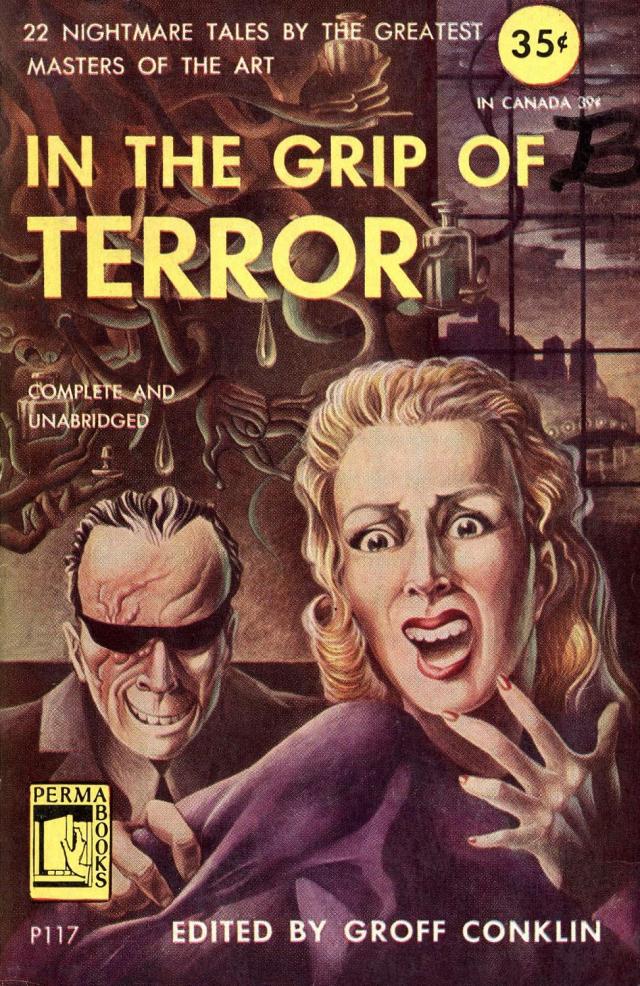
In The Grip of Terror, page 1


24-09-2023
The crawling shudder of fear—the sudden awareness of terror—a thousand years lived in one instant of impending doom.
.…A blind man etches his revenge forever on the face of his mistress.
.…The lonely drive over a deserted road—and beside her a murderer—ready to strike again.
.…A night in the vault with a man who should be dead—but isn’t.
Here is the suspense of the unknown and the terrifying fear of the all too frightening reality. Stories by Lovecraft, Poe, Bradbury and de Maupassant—a big collection of the most chilling stories ever written—by the greatest masters of the art, past and present.
IN THE GRIP
OF TERROR
Edited with an Introduction by
GROFF CONKLIN
PERMABOOKS
Garden City, New York
1951
PERMABOOKS
Copyright, 1951, by Doubleday & Company, Inc.
PRINTED IN THE UNITED STATES OF AMERICA
Contents:-
INTRODUCTION
IN THE GRIP OF TERROR
THE LAST KISS
THE ILLUSTRATED MAN
THE UPTURNED FACE
THE INCREDIBLE ELOPEMENT OF LORD PETER WIMSEY
THE HORROR HORN
NIGHT DRIVE
IN THE VAULT
THE DIARY OF A MADMAN
THE TOOL
BIANCA’S HANDS
THE CROSS OF CARL
HATHOR’S PETS
A TERRIBLY STRANGE BED
THE WELL
REVENGE
THE PIT AND THE PENDULUM
MACKLIN’S LITTLE FRIEND
THE EASTER EGG
PROBLEM IN MURDER
THE MOTH
A RESUMED IDENTITY
BUBBLES
COPYRIGHT ACKNOWLEDGMENTS
E. F. Benson: THE HORROR HORN. From Visible and Invisible, b> E. F. Benson, copyright 1924 by George H. Doran & Co. and, in Canada, by Messrs. Hutchinson & Co., Ltd. Reprinted by permission of the Executor of the Estate of E. F. Benson, by A. P. Watt & Son, and Hutchinson & Co. (Publishers) Ltd., London.
Samuel Blas: REVENGE. Copyright 1947 by Samuel Bias. Reprinted from Collier’s for January 11, 1947, by permission of the author.
Ray Bradbury: THE ILLUSTRATED MAN. Copyright 1950 by Esquire, Inc. Reprinted from Esquire for July, 1950, by permission of the author.
Stephen Crane: THE UPTURNED FACE. From Wounds in the Rain, by Stephen Crane. Reprinted by permission of Alfred A. Knopf, Inc. Copyright 1928 by Mary Alice Ludwig.
H. L. Gold: PROBLEM IN MURDER. Copyright 1939 by Street and Smith Publications, Inc., in the U. S. A. and Great Britain. Reprinted from Astounding Science Fiction for March 1939.
William Fryer Harvey: THE TOOL. From The Beast with Five Fingers, by William Fryer Harvey. Copyright 1947 by E. P. Dutton & Co., Inc., ana, in Canada, by J. M. Dent & Sons, Ltd.
W. W. Jacobs: THE WELL. From The Lady of the Barge, by W. W. Jacobs. Copyright 1902, 1930, by W. W. Jacobs. Reprinted with the permission of Dodd Mead & Co., New York, and, for Canada, by the Society of Authors.
Will Jenkins: NIGHT DRIVE. Copyright 1950 by Fawcett Publications, Inc. Reprinted by permission of the author from Today’s Woman for March 1950.
Maurice Level: THE LAST KISS. From Tales of Mystery and Horror, by Maurice Level. Copyright 1920 by Robert M. McBride & Co., New York,
H. P. Lovecraft: IN THE VAULT. Copyright 1932 by the Popular Fiction Publishing Company; copyright 1939, 1947 by August Derleth and Donald Wandrei. Reprinted by permission of Arkham House.
H. H. Munro (“Saki”): THE EASTER EGG. From The Short Stories of Saki, by H. H. Munro. Copyright 1930 by The Viking Press, Inc., and John Lane, The Bodley Head. Reprinted by permission of The Viking Press, Inc., New York, and John Lane, The Bodley Head, London.
Walter Owen: THE CROSS OF CARL. Published 1931 by Little Brown & Co., Boston, Mass. Copyright 1931 by Walter Owen, with whose permission it is reprinted.
Margaret St. Clair: HATHOR’S PETS. Copyright 1949 by Margaret St. Clair. Reprinted with her permission from Startling Stories for January 1950.
Dorothy Sayers: THE INCREDIBLE ELOPEMENT OF LORD PETER WIMSEY. From Hangman’s Holiday, by Dorothy Sayers. Copyright 1933 by Dorothy L. Sayers.
Wilbur Daniel Steele: BUBBLES. From The Man Who Saw Through Heaven, by Wilbur Daniel Steele, published 1927 by Harper & Bros. Copyright 1927 by Wilbur Daniel Steele, with whose permission it is reprinted.
Theodore Sturgeon: BIANCA’S HANDS. Reprinted by permission of the author from Argosy (British) for May 1947. Copyright 1947 by Theodore Sturgeon.
Howard Wandrei: MACKLIN’S LITTLE FRIEND. Copyright 1936 by Street and Smith Publications, Inc., in the U. S. A. and Great Britain. Reprinted from Astounding Stories for November 1936 by permission of Howard Wandrei.
H. G. Wells: THE MOTH. From The Short Stories of H. G. Wells. Reprinted by permission of the Executors of the Estate of the late H. G. Wells.
INTRODUCTION
I suppose that it is profitless, at this late date in the history of civilization, to ask why the human animal likes so much to be scared-on-paper, why he derives such a high degree of entertainment from reading about events which would literally frighten him out of his wits if he were actually confronted with them. The answer, if there is one, must lie within the province of the psychologist or the cultural anthropologist. We readers do not look for deep-rooted motives. We simply like to stretch out in a comfortable chair, safe and snug, and let somebody else’s hair-raising imagination scare the living daylights out of us.
Certainly there is not an incident in this book which one would actually like to experience in the flesh. It is a pretty gruesome collection of horrors, some more subtle than others, but all calculated to strike terror in one way or another. A few stories slash you across the side of the face with an axe; other slip in between your ribs delicately, like a poisoned darning needle; still others dangle you mercilessly over an abyss into which you eventually drop with a scream —only to come to and find yourself still safe and sound in the land of humdrum reality. Even those stories which “come out all right in the end” (and there are precious few of them in this book) take you on a tour of the miseries of the damned before you finally see the light of day. That’s the way it is with the tales in this book; don’t say I didn’t warn you.-
This is no place for a pedantic analysis of the various kinds of terror and horror stories, such as those dealing with the scheming murderer, the sex maniac, other types of madmen, the psychological horror, the catastrophe, the weird or unis known (of which the supernatural, represented hardly at all in this collection, is a large and motley section), the flight and pursuit, suspense, darkness and doom—for such analyses have been done by better (and windier) editors than this one. Suffice it to say that practically every type of terror story known to the connoisseur is represented by one or more examples in this collection.
The one great division of the terror story that is missing—the ghost, werewolf, black Sabbath and vampire narrative —is missing for the very good reason that tales so classified are not ‘“pure” terror stories. They lean on non-human interventions for their effect, thereby creating for themselves an entirely separate and distinct genre which has its own fanatic devotees and calls for its own separate anthologies. It is true that tales such as Bradbury’s Illustrated Man, and perhaps Sturgeon’s Bianca’s Hands, rely somewhat for their effect on happenings which cannot actually be explained by everyday laws of physics and chemistry. However, they are borderline cases, not true ghost or vampire stories, certainly, and therefore acceptable to the lover of the frisson (French for shudder, if one is to be what Russell Lynes would call a Language Snob), provided he has a fairly broad mind.
It is also true that science fiction items like St. Clair’s Hathors Pets and Wandrei’s Macklin’s Little Friend—and even, perhaps, Gold’s Problem in Murder—are representative of a relatively new form of terror story not yet accepted into the classical horror pattern. You have to assume some extraterrestrial mechanics (not necessarily supernatural) or some mad and unlikely inventions, to permit these stories into the arcane realm of pure horror. Frankly, I think that such tales as these add a new richness and variety to the type, and I have therefore set before you these excellent examples of the most recent development in terror stories.
An effort has been made to include largely unanthologized tales in this collection. It irks me, and I am sure that it must irk others, to find in practically every anthology of terror stories some of the hoariest chestnuts in the field, as if the authors of those stories had never written anything else worth using. For example, Ambrose Bierce’s The Damned Thing appeared in five out of the thirty-odd collections of terror and supernatural stories I have riffled through. Yet A Resumed Identity, surely an appalling little gem, has never appeared in any that I know of. E. F. Benson’s Caterpillars has been included in a good many; but his remarkable Horror Horn seems never to have been tapped for an anthology. Saki’s Open Window is another favorite, whereas The Easter Egg, though I suppose it has been picked by some literary magpie whose book has escaped my attention, certainly is not a common entry in collections of this sort.
On the other hand, I have not been able to resist using W. W. Jacobs’ The Well, and Wilkie Collins’ A Terribly Strange Bed, even though I know that they have been anthologized once or twice previously. They have not worn out their welcome, at any rate. I am certain they ar
I am particularly proud of half a dozen extra-special finds, many of them completely unknown to aficionados of terror, which I believe give this collection a unique flavor. The Cross of Carl, one of the great horror stories of all time, was published in the early thirties as a separate book. Probably because it was promoted as an antiwar tract rather than a horror story, it never really found an audience. I am delighted to be able to reintroduce it to a new and, I am sure, more appreciative public than it had when it first was issued.
Bianca’s Hands has a queer history. Turned down by nearly every magazine in the United States that could possibly be interested in it, it finally found a home in the British Argosy. And what a home! The author submitted it as an entry in a prize contest the magazine was running some years ago, not knowing whether—due to the vagaries of the transatlantic mails at that time—it would even reach its destination before the contest closed. The next thing he knew, it had been awarded first prize (a sizable sum, too), and was especially honored by having as runner-up a horrid little chiller by the famed Graham Greene! Other modern tales, such as Will Jenkins’ Night Drive (surely an odd tale to discover in an enormous-circulation woman’s magazine of the type that usually prints romances, often roseate) and Samuel Bias’ Revenge (which must have shocked the living daylights out of a couple of million Collier’s readers when they came across it a few years ago) are included not only because of their intrinsic merit, which is extra-special, but because they show that the mass audience is beginning to appreciate strictly off-the-beaten-track stories, even though they are as horror-striking as these two items certainly are. My special thanks, incidentally, to Will Jenkins for calling the Bias story to my attention.
For the record, I had my mind set on including John Collier’s Bird of Prey in this anthology, but I was prevented by the fact that Mr. Collier himself is planning to get out a new selection of his stories, including, in all probability, the one I wanted.
From this point on I shall let the tales in this book carry their own shock value. You need no more preliminaries from the editor, no explanations or defenses. Here they are —enjoy diem in your own terrorized way I
GROFF CONKLIN
IN THE GRIP OF TERROR
THE LAST KISS
by Maurice Level
“Forgive me…Forgive me”
His voice was less assured as he replied:
“Get up, dry your eyes. I, too, have a good deal to reproach myself with”
“No, no,” she sobbed.
He shook his head.
“I ought never to have left you; you loved me. Just at first after it all happened…when I could still feel the fire of the vitriol burning my face, when I began to realize that I should never see again, that all my life I should be a thing of horror, of Death, certainly I wasn’t able to think of it like that. It isn’t possible to resign oneself all at once to such a fate…But living in this eternal darkness, a man’s thoughts pierce far below the surface and grow quiet like those of a person falling asleep, and gradually calm comes. Today, no longer able to use my eyes, I see with my imagination. I see again our little house, our peaceful days, and your smile. I see your poor little face the night I said that last goodbye. The judge couldn’t imagine any of that, could he? And it was only fair to try to explain, for they thought only of your action, the action that made me into …what I am. They were going to send you to prison where you would slowly have faded…No years of such punishment for you could have given me back my eyes… When you saw me go into the witness-box you were afraid, l weren’t you? You believed that I would charge you, have you condemned? No, I could never have done that, never •…”
She was still crying, her face buried in her hands,
“How good you are!…
“I am just…
In a voice that came in jerks she repeated:
“I repent, I repent; I have done the most awful thing to you that a woman could do, and you—you begged for my acquittal! And now you can even find words of pity for me! What can I do to prove my sorrow? Oh, you are wonderful …wonderful…
He let her go on talking and weeping; his head thrown back, his hands on the arms of his chair, he listened apparently without emotion. When she was calm again, he asked: “What are you going to do now?”
“I don’t know…I shall rest for a few days…I am so tired…Then I shall go back to work. I shall try to find a place in a shop or as a mannequin.”
His voice was a little stifled as he asked:
“You are still as pretty as ever?”
She did not reply.
“I want to know if you are as pretty as you used to be?” She remained silent. With a slight shiver, he murmured: “It is dark now, isn’t it? Turn on the light. Though I can no longer see, I like to feel that there is light around me …Where are you?…Near the mantelpiece?… Stretch out your hand. You will find the switch there”
No sense even of light could penetrate his eyelids, but from the sudden sound of horror she stifled, he knew that the lamp was on. For the first time she was able to see the result of her work, the terrifying face streaked with white swellings, seamed with red furrows, a narrow black band round die eyes. While he had pleaded for her in court, she had crouched on her seat weeping, not daring to look at him; now, before this abominable thing, she grew sick with a kind of disgust. But it was without any anger that he murmured:
“I am very different from the man you knew in the old days—I horrify you now, don’t I? You shrink from me?
She tried to keep her voice steady.
“Certainly not. I am here, in the same place…”
“Yes, now…and I want you to come still nearer. If you knew how the thought of your hands tempt me in my darkness. How I should love to feel their softness once again. But I dare not…And yet that is what I wanted to ask you: to let me feel your hand for a minute in mine. We, the blind, can get such marvelous memories from just a touch.”
Turning her head away, she held out her arm. Caressing her fingers, he murmured:
“Ah, how good. Don’t tremble. Let me try to imagine we are lovers again just as we used to be…but you are not wearing my ring. Why? I have not taken yours off. Do you remember? You said, 4It is our wedding-ring.’ Why have you taken it off?”
“I dare not wear it…”
“You must put it on again. You will wear it? Promise me.”
She stammered:
“I promise you.”
He was silent for a little while; then in a calmer voice: “It must be quite dark now. How cold I am! If you only knew how cold it feels when one is blind. Your hands are warm; mine arc frozen. I have not yet developed the fuller sense of touch. It takes time, they say…At present I am like a little child learning.”
She let her fingers remain in his, sighing:
“Oh, Mon Dieu …Mon Dieu …
Speaking like a man in a dream, he went on:
“How glad I am that you came. I wondered whether you would, and I felt I wanted to keep you with me for a long, long time: always…But that wouldn’t be possible. Life with me would be too sad. You see, little one, when people have memories like ours, they must be careful not to spoil them, and it must be horrible to look at me now, isn’t it?” She tried to protest; what might have been a smile passed over his face.


