

Graveyard Reader, page 1


23-09-2023
Now I lay me down to sleep….
But if you do so with this book in hand, make sure you have your tranquilizers handy …
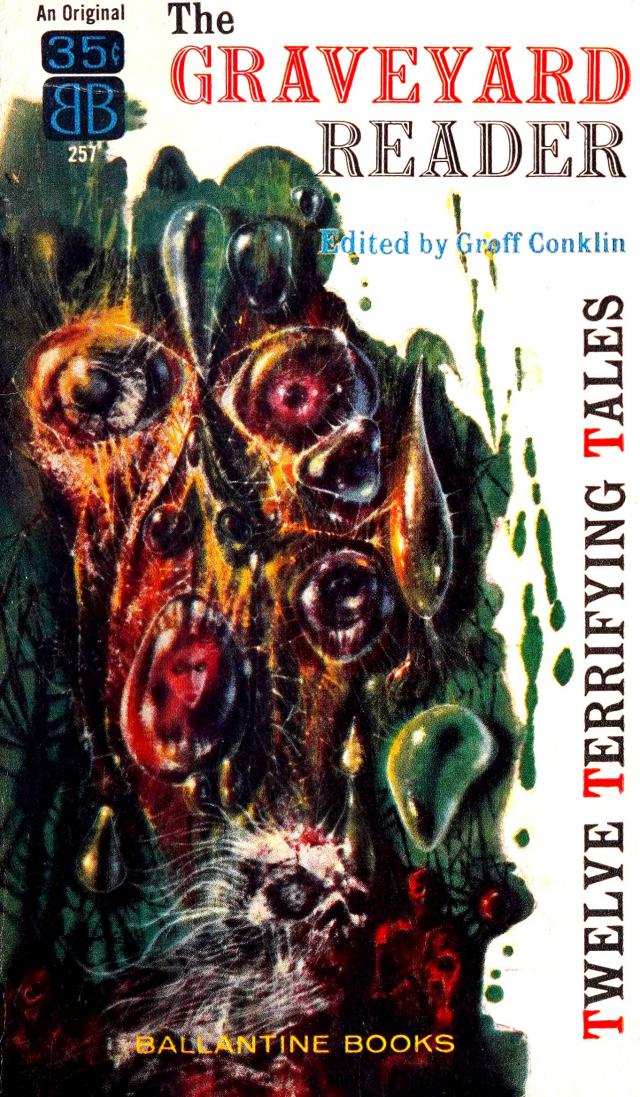
Richard Powers once expressed a wish to paint a really horrifying cover. The result produced this title, THE GRAVEYARD READER, and inspired Groff Conklin, noted anthologist, to unearth (no pun intended) some of the most frightful, and frightening, stories ever to be put together in one volume.
However, not wishing to completely paralyze the gentle reader, Mr. Conklin has included a leavening of tales of apparitions and ghosts, of weird manifestations, even of humor (although of a distinctly macabre variety). Any normally avid consumer of horror can tackle these without resorting to locked doors and bright lights.
The title also inspired a completely original story from Theodore Sturgeon which appears here for the first time, a story of implied violence, the creeping invasion of a personality after death—which makes for a subtly chilling coda to a violent form of entertainment.
One warning: read these stories in the order in which they appear in the book—and try not to read the whole book at one time… .
The
Graveyard
Reader
Edited with an Introduction by
GROFF CONKLIN
Ballantine Books . New York
For Alix
Charles Beaumont, FREE DIRT, from The Hugger, and Other Stories. Copyright 1957 by Charles Beaumont, and reprinted by permission of G. P. Putnam’s Sons.
Ray Bradbury, THE SCREAMING WOMAN, copyright 1951 by Triangle Publications, Inc., and reprinted by permission of Harold Matson Company.
John Collier, SPECIAL DELIVERY, reprinted from Fancies and Goodnights. Copyright 1941 by John Collier, and reprinted by permission of Harold Matson Company.
Elizabeth Counselman, NIGHT COURT, from Weird Tales, March 1953. Reprinted by permission of the author.
Roald Dahl, SKIN, from Someone Like You. Copyright 1953 by Roald Dahl and reprinted by permission of Alfred A. Knopf and The New Yorker magazine.
Richard Hughes, THE CART, from Richard Hughes: An Omnibus. Copyright 1934 by Harper and Brothers, and reprinted with their permission.
Henry Kuttner, THE GRAVEYARD RATS, from The Other Worlds, edited by Phil Stong. Copyright 1936 by Weird Tales, and reprinted by permission of Harold Matson Company.
H. P. Lovecraft, THE OUTSIDER, reprinted from Weird Shadow Over Innsmouth. Copyright 1926 by Popular Fiction Publishing Company; 1939, 1947 by August Derleth and Donald Wandrei. Reprinted by permission of Arkham House.
Theodore Sturgeon, THE GRAVEYARD READER, © 1958 by Groff Conklin. Here published for the first time by permission of the author.
Wallace West, LISTEN, CHILDREN, LISTEN! from Fantastic Um-verse, October-November 1953. Reprinted by permission of the author.
©, 1958, by
Groff Conklin
Printed in “the United States of America
Library of Congress Catalog No. 58-9906
Ballantine Books, Inc.
101 Fifth Avenue, New York 3, N. Y.
Contents:-
INTRODUCTION
THE SCREAMING WOMAN
A BOTTOMLESS GRAVE
THE CART
THE GRAVEYARD RATS
SKIN
NIGHT COURT
FREE DIRT
LISTEN, CHILDREN, LISTEN!
SPECIAL DELIVERY
THE CHILD THAT LOVED A GRAVE
THE OUTSIDER
THE GRAVEYARD READER
INTRODUCTION
I have always loved graveyards: country ones, in particular, but even city ones, too, if they are old and, to all intents and purposes, finished. These are the historic graveyards of the seventeenth and eighteenth centuries, with their small green demesnes full of weathered and crumbling tombstones, city oases set in the midst of deserts of paved streets and of stone and glass anthills full of too many people. Of country graveyards, only this need be said: that in diem is written the history that shall never be fully read: the history of simple people. And of all graveyards this can always be said: that though they may be sad places, they are also peaceful.
But this is not the tone of the present book. If it were, you probably would never have laid your hands on it. The days of ruminating on Old Mortality pretty well disappeared with the sentimentalities, so-called, of the Victorian era. Today we are used to more shocking and horrid symbols of death and decay, of man’s evanescence and time’s mutability. And of course I like that approach, too, or I would not have edited this litde collection of mortuary chillers. There are a few items in it, though, that recall the earlier mood—the nearly-hundred-year-old Fitz-James O’Brien morality, never before reprinted from its original 1861 magazine publication, is one; and the completely new Theodore Sturgeon, never before published anywhere at all, is another: both of an older, gentler persuasion—though I imagine you won’t believe it of the Sturgeon when you first begin it.
But on the whole, these tales are calculated to drive you—not “mad,” as certain famed Ballantine books both entitle and describe themselves—but at least indoors, away from cold, lonely paths beneath sullen clouds scudding across a midnight sky. And one or two may be upsetting enough to make you look to your sanity, as a matter of fact.
Actually, a book such as this is perfectly designed for reading beside an open fire, or snugly curled up in bed. Bedtime reading, though, it may not be—if you are subject to nightmares! But however you read it, I think you will find the twelve tales it contains little gems of their specific varieties. And the fact that most of them ate of recent vintage goes to show that the supposedly “unfashionable” genres of horror and the supernatural are still very much alive. As you may imagine, there are many more where they came from; and if your taste is whetted by this sampler, your public library or many of today’s popular magazines will supply you with rich banquets of similar fare.
I would like to thank that living encyclopedia of science fiction, fantasy, and the supernatural, Sam Moskowitz, for calling to my attention the Fitz-James O’Brien story, and also for providing me with a copy of Phil Stong’s hard-to-find The Other Worlds from his inexhaustible collection. It was from that book that I obtained printer’s copy for Henry Kuttner’s little monster of a story.* That tale was, incidentally, suggested to me by Frederik Pohl, the Master of Red Bank. It turns out I had read “Graveyard Rats” fifteen years ago and then (how could I?) forgotten it. And, of course, immeasurable thanks to Ted Sturgeon, for being inspired by the title of this book to turn out an unforgettable original tale under the same name for me. Don Congdon, old friend and splendid agent, receives thanks for the terrifying Bradbury item, and so does Liz Counselman for bringing her own tale to my attention.
Say—who edited this book, anyhow?
I did—sort of!
GROFF CONKLIN
* While this book was at press Henry Kuttner died, suddenly and still young. With his death we have lost one of our most brilliant and most loved fantasy and science fiction writers. You may have read some of his best work under his favorite pseudonym, Lewis Padgett.
Ray Bradbury
THE SCREAMING WOMAN
A more brutally horrifying grave than the
one you will find in this story has rarely if
ever been imagined before; and this, of
course, makes it a fit opener for a collection
of blood-chillers. … Incidentally, this
beautifully understated item shows Bradbury
at work with his most sinister type of character
—the young child. However, in this case it is
not the child who is the criminal— or the victim.
In a way that makes it an even more dreadful
narrative.
My name is Margaret Leary and I’m ten years old and in the high fifth at Central School. I haven’t any brothers or sisters, but I’ve got a nice father and mother except they don’t pay much attention to me. And anyway, we never thought we’d have anything to do with a murdered woman. Or almost, anyway.
When you’re just living on a street like we live on, you don’t think awful things are going to happen, like shooting or stabbing or burying people under the ground, practically in your back yard.
And when it does happen you don’t believe it. You just go on buttering your toast or baking a cake.
I got to tell you how it happened. It was a noon in the middle of July. It was hot and Mama said to me, “Margaret, you go to the store and buy some ice cream. It’s Saturday, Dad’s home for lunch, so we’ll have a treat.”
I ran out across the empty lot behind our house. It was a big lot, where kids had played baseball, and broken glass and stuff. And on my way back from the store with the ice cream I was just walking along, minding my own business, when all of a sudden it happened.
I heard the Screaming Woman.
I stopped and listened.
It was coming up out of the ground.
A woman was buried under the rocks and dirt and glass, and she was screaming, all wild and horrible, for someone to dig her out.
I just stood there, afraid. She kept screaming, muffled.
Then I started to run. I fell down, got up and ran some more. I got in the screen door of my house and there was Mama, calm as you please, not knowing what I knew, that there was a real live woman buried out in back of our house, just a hundred yards away, screaming bloody murder.
“Mama,” I said.
“Don’t stand there with the ice cream,” said Mama.
“But, Mama,” I said.
“Put it in the icebox,” she said.
“Listen, Mama, there’s a Screaming Woman in the empty lot.”
“And wash your hands,” said Mama.
“She was screaming and screaming …”
“Let’s see now, salt and pepper,” said Mama, far away.
“Listen to me,” I said, loud. “We got to dig her out. She’s buried under tons and tons of dirt and if we don’t dig her out, she’ll choke up and die.”
“I’m certain she can wait until after lunch,” said Mama.
“Mama, don’t you believe me?”
“Of course, dear. Now wash your Hands and take this plate of meat in to your father.”
“I don’t even know who she is or how she got there,” I said. “But we got to help her before it’s too late.”
“Good gosh,” said Mama. “Look at this ice cream. What did you do, just stand in the sun and let it melt?”
“Well, the empty lot …”
“Go on, now, scoot.”
I went into the dining-room.
“Hi, Dad, there’s a Screaming Woman in the empty lot.”
“I never knew a woman who didn’t,” said Dad.
“I’m serious,” I said.
“You look very grave,” said Father.
“We’ve got to get picks and shovels and excavate, like for an Egyptian mummy,” I said.
“I don’t feel like an archaeologist, Margaret,” said Father. “Now, some nice cool October day, I’ll take you up on that.” “But we can’t wait that long,” I almost screamed. My heart was bursting in me. I was excited and scared and afraid and here was Dad, putting meat on his plate, cutting and chewing and paying me no attention.
“Dad?” I said.
“Mmmm?” he said, chewing.
“Dad, you just gotta come out after lunch and help me,” I said. “Dad, Dad, I’ll give you all the money in my piggy bank!” “Well,” said Dad. “So it’s a business proposition, is it? It must be important for you to offer your perfectly good money. How much money will you pay, by the hour?”
“I got five whole dollars it took me a year to save, and it’s all yours.”
Dad touched my arm. “Pm touched. I’m really touched. You want me to play with you and you’re willing to pay for my time. Honest, Margaret, you make your old Dad feel like a piker. I don’t give you enough time. Tell you what, after lunch, I’ll come out and listen to your screaming woman, free of charge.” “Will you, oh, will you, really?”
“Yes, ma’am, that’s what I’ll do,” said Dad. “But you must promise me one thing?”
“What?”
“If I come out, you must eat all of your lunch first.”
“I promise,” I said.
“Okay.”
Mother came in and sat down and we started to eat.
“Not so fast,” said Mama.
I slowed down. Then I started eating fast again.
“You heard your mother,” said Dad.
“The Screaming Woman,” I said- “We got to hurry.”
“I,” said Father, “intend sitting here quietly and judiciously giving my attention first to my steak, then to my potatoes, and my salad, of course, and then to my ice cream, and after that to a long drink of iced coffee, if you don’t mind. I may be a good hour at it. And another thing, young lady, if you mention her name, this Screaming Whatsis, once more at this table during lunch, I won’t go out with you to hear her recital.”
“Yes, sir.”
“Is that understood?”
“Yes, sir,” I said.
Lunch was a million years long. Everybody moved in slow motion, like those films you see at the movies. Mama got up slow and got down slow and forks and knives and spoons moved slow. Even the flies in the room were slow. And Dad’s cheek muscles moved slow. It was so slow. I wanted to scream, “Hurry! Oh, please, rush, get up, run around, come on out, run!”
But no, I had to sit, and all the while we sat there slowly, slowly eating our lunch, out there in the empty lot (I could hear her screaming in my mind. Scream/) was the Screaming Woman, all alone, while the world ate its lunch and the sun was hot and the lot was empty as the sky.
“There we are,” said Dad, finished at last.
“Now will you come out to see the Screaming Woman?” I said.
“First a little more iced coffee,” said Dad.
“Speaking of Screaming Women,” said Mother. “Charlie Nesbitt and his wife had another fight last night.”
“That’s nothing new,” said Father. “They’re always fighting.” “If you ask me, Charlie’s no good,” said Mother. “Or her, either.”
“Oh, I don’t know,” said Dad. “I think she’s pretty nice.” “You’re prejudiced. After all, you almost married her.”
“You going to bring that up again?” he said. “After all, I was only engaged to her six weeks.”
“You showed some sense when you broke it off.”
“Oh, you know Helen. Always stage-struck. Wanted to travel in a trunk. I just couldn’t see it. That broke it up. She was sweet, though. Sweet and kind.”
“What did it get her? A terrible brute of a husband like Charlie.” “Dad,” I said.
“I’ll give you that. Charlie has got a terrible temper,” said Dad. “Remember when Helen had the lead in our high school graduation play? Pretty as a picture. She wrote some songs for it herself. That was the summer she wrote that song for me.”
“Ha,” said Mother.
“Don’t laugh. It was a good song.”
“You never told me about that song.”
“It was between Helen and me. Let’s see, how did it go?” “Dad,” I said.
“You’d better take your daughter out in the back lot,” said Mother, “before she collapses. You can sing me that wonderful song later.”
“Okay, come on, you,” said Dad, and I ran him out of the house.
The empty lot was still empty and hot and the glass sparkled green and white and brown all around where the bottles lay. “Now, where’s this Screaming Woman?” laughed Dad.
“We forgot the shovels,” I cried.
“We’ll get them later, after we hear the soloist,” said Dad.
I took him over to the spot. “Listen,” I said.
We listened.
“I don’t hear anything,” said Dad, at last.
“Shh,” I said. “Wait.”
We listened some more. “Hey, there, Screaming Woman!” I cried.
We heard the sun in the sky. We heard the wind in the trees, real quiet. We heard a streetcar, far away, running along. We heard a car pass.
That was all.
“Margaret,” said Father. “I suggest you go lie down and put a damp cloth on your forehead.”
“But she was here,” I shouted. “I heard her, screaming and screaming and screaming. See, here’s where the ground’s been dug up.” I called frantically at the earth. “Hey there, you down there!” “Margaret,” said Father. “This is the place where Mr. Kelly dug yesterday, a big hole, to bury his trash and garbage in.”
“But during the night,” I said, “someone else used Mr. Kelly’s burying place to bury a woman. And covered it all over again.” “Well, I’m going back in and take a cool shower,” said Dad. “You won’t help me dig?”
“Better not stay out here too long,” said Dad. “It’s hot.”
Dad walked off. I heard the back door slam.


