

Great Tales About Doctors, page 1


25-09-2023
Prescription for Entertainment
The Man without an Appetite—a view of surgery-from-the-inside-looking-out.
The Brothers—a gruesome voyage through the dark chambers of the supernatural, as a real ghoul stalks a modem hospital.
Compound B—a biting satire on the race problems of the future.
Bedside Manner—advanced medical science from a star culture eons older than ours is used to rebuild two victims of a space accident.
The Shopdropper—about a “narapoiac” who is convinced that he is following someone and that people are always plotting to do him good.
Bolden’s Pets—in which a “positive parasite” enjoys dying for you rather than living off you!
—And the many other delightful tales in this anthology.
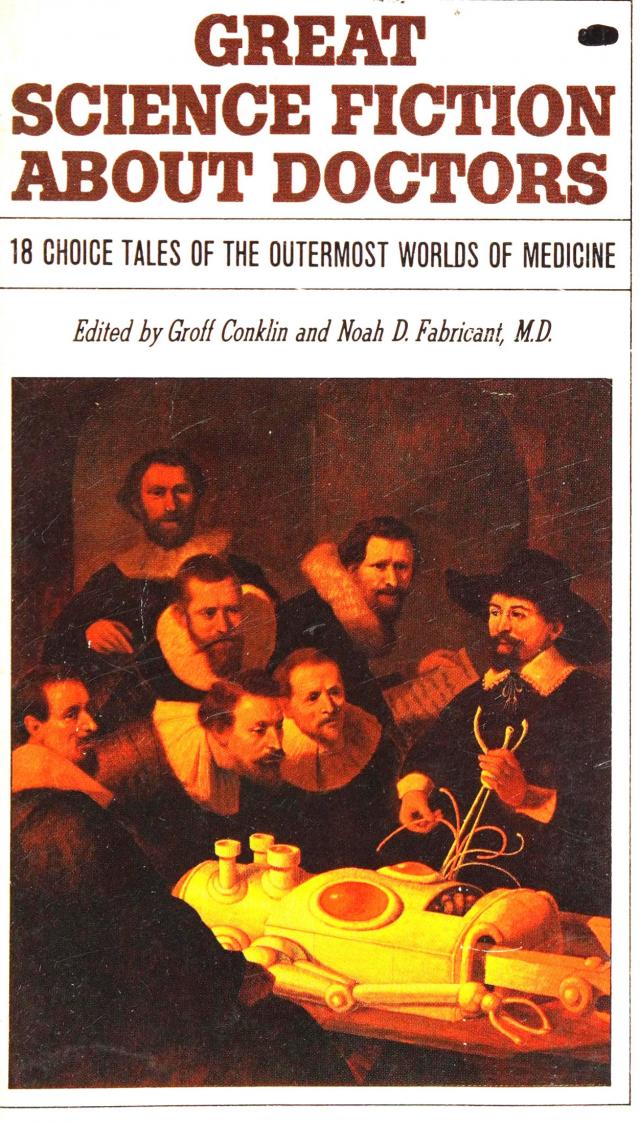
Great Science Fiction
About Doctors
Edited with an Introduction and
Story Prefaces by Groff Conklin and Noah D. Fabricant, M. D.
COLLIER BOOKS
COLLIER-MACMILLAN LTD. • LONDON
COPYRIGHT © 1963
BY THE CROWELL-COLLIER PUBLISHING COMPANY
All rights reserved. No part of this book may be reproduced or transmitted in any form or by any means, electronic or mechanical, including photocopying, recording or by any information storage and retrieval system, without permission in writing from the
Publisher.
Library of Congress Catalog Card Number: 63-12790
FIRST EDITION 1963
FIFTH PRINTING 1970
The Macmillan Company
866 Third Avenue, New York, N. Y. 10022
Collier-Macmillan Canada Ltd., Toronto, Ontario
Printed in the United States of America
ACKNOWLEDGMENTS
Miles J. Breuer, M.D.—“The Man Without an Appetite.” Copyright 1916 by Bratrsky Vesnik. Reprinted by permission of Julia E. Breuer.
Arthur C. Clarke—“Out of the Cradle, Endlessly Orbiting.” Copyright 1959 by Dude Magazine. Reprinted by permission of the author and Scott Meredith Literary Agency, Inc., from Dude, March 1959, where it appeared as “Out of the Cradle.”
Clifton L. Dance, M.D.—“The Brothers.” Copyright 1952 by Clifton L. Dance, Jr. Reprinted by permission of the author from Fantasy and Science Fiction, June 1952.
Arthur Conan Doyle, M.D.—“The Great Keinplatz Experiment.” Reprinted by permission of the Estate of Sir Arthur Conan Doyle.
David Harold Fink, M.D.—“Compound B.” Copyright 1954 by Henry Holt, Inc. Copyright 1962 by David Harold Fink, M.D. Reprinted by permission of the author from 9 Tales of Space and Time, edited by Raymond J. Healy, Holt, 1954.
David H. Keller, M.D.—“The Psychophonic Nurse.” Copyright 1928 by Amazing Stories (E. P. Company), now published by Ziff-Davis Publishing Co. Reprinted from Keller, Tales from Underwood, Pellegrini and Cudahy, 1952, by permission of the author and August Derleth, Arkham House.
C. M. Kornbluth—“The Little Black Bag.” Coypright 1950 by Street and Smith Publications, Inc. Reprinted by permission of Mary Kombluth from Astounding Science Fiction, July 1950.
Murray Leinster—“Ribbon in the Sky.” Copyright 1957 by Street and Smith Publications, Inc. Reprinted by permission of Will Jenkins from Astounding Science Fiction, June 1957.
Winston K. Marks—“Mate in Two Moves.” Copyright 1954 by Galaxy Publishing Corp. Reprinted by permission of the author and Scott Meredith Literary Agency, Inc., from Galaxy Science Fiction, May 1954.
William Morrison—“Bedside Manner.” Copyright 1954 by Galaxy Publishing Corp. Reprinted by permission of Joseph Samachson from Galaxy Science Fiction, May 1954.
Alan Nelson—“The Shopdropper.” Copyright 1955 by Mercury Press. Reprinted by permission of the author from Fantasy and Science Fiction, January 1955.
Alan E. Nourse, M.D.—“Family Resemblance.” Copyright 1953 by Street and Smith Publications, Inc. Reprinted by permission of Harry Altshuler from Astounding Science Fiction, April 1953.
Arthur Porges—“Emergency Operation.” Copyright 1956 by Mercury Press, Inc. Reprinted by permission of Scott Meredith Literary Agency, Inc., from Fantasy and Science Fiction, May 1956.
J. R. Shango—“A Matter of Ethics.” Copyright 1954 by J. R. Shango. Reprinted by permission of the author from Fantasy and Science Fiction, November 1954.
F. L. Wallace—“Bolden’s Pets.” Copyright 1955 by Galaxy Publishing Corp. Reprinted by permission of Harry Altshuler from Galaxy Science Fiction, October 1955.
J. A. Winter, M.D.—“Expedition Mercy.” Copyright 1948 by Street and Smith Publications, Inc. Reprinted by permission of Marjorie R. Winter from Astounding Science Fiction, November 1948.
Contents:-
ACKNOWLEDGMENTS
INTRODUCTION
THE MAN WITHOUT AN APPETITE
OUT OF THE CRADLE, ENDLESSLY ORBITING
THE BROTHERS
THE GREAT KEINPLATZ EXPERIMENT
COMPOUND B
RAPPACCINI’S DAUGHTER
Nathaniel Hawthorne
THE PSYCHOPHONIC NURSE
THE LITTLE BLACK BAG
RIBBON IN THE SKY
MATE IN TWO MOVES
Winston K. Marks
BEDSIDE MANNER
THE SHOPDROPPER
FAMILY RESEMBLANCE
FACTS IN THE CASE OF M. VALDEMAR
EMERGENCY OPERATION
A MATTER OF ETHICS
BOLDEN’S PETS
EXPEDITION MERCY
THE MAN WITHOUT AN APPETITE
Miles J. Breuer, M.D.
We had originally planned to use Dr. Brener’s famous piece of medical science fiction describing an operation through the Fourth Dimension, entitled The Appendix and the Spectacles, in this anthology. But while it was in the process of being prepared for publication, a collection entitled The Mathematical Magpie (a pun on tt), edited by Clifton Fadiman, appeared, and “Appendix” was in it. Whereupon we wrote Dr. Breuer’s widow and asked if she had a different medical story for us. She found the following remarkable tale in her husband’s papers, and wrote: “It was first published in the Czech language in the Bratrsky Vestnik in about 1916…1 think it was probably published in some science fiction magazine about 1924 or 1925, but l do not know.” And the same goes for us, too. Nothing with this title appears in any bibliography of Dr. Breuer’s short stories, and consequently we are unable to provide it with an American magazine credit. If anyone knows of its previous appearance in the English language, the editors would appreciate being informed about it.
The Man Without an Appetite
Upon my discharge from the Army after the close of the war, I remained for a year studying at universities in Vienna and Paris. Then I returned to Chicago and opened up an office on West 26th Street. Shortly afterwards I received my first professional caller, in the person of the fair wife and recent bride of my old chum, Doctor Volny. I greeted her warmly, as I had seen neither her nor her husband for many months. She seemed uneasy, but lost no time in coming to the point.
“Doctor,” she said, “I’d like to have you advise me as a physician and as a friend. I am afraid that my husband is ill in some way.”
“And of what does he complain?” I asked.
“He states that he never felt better than he does now, and he looks it. And yet, I am sure that he does not eat. He always turns the things over on his plate and dabs at them a few times, but when I carry the plate away, I can see that there is just as much on it as there was before. When I ask him what is the matter, he says that nothing is the matter, and pretends to eat, but I know that he eats nothing.”
“Doesn’t be perhaps eat elsewhere?”
She shook her pretty head.
“No. He would tell me about it if he did. He is not that kind. He confides everything to me, except his scientific work, which I do not understand. At first, naturally, I thought that it was my cooking that he did not like. But that is a foolish idea; I am not a silly sixteen-year-old girl. I am wise enough to be able to recognize the situation if that were the case; when I think it over, my common sense tells me that is not the reason. There must be some reason why he does not eat. He keeps making excuses—that he is not hungry; that he has eaten and I did not notice it; that he is dieting to avoid obesity; but it all sounds too thin.”
I was compelled to explain to the anxious wife that before I could help her, I would have to look into her husband’s condition more in detail, for which purpose I would have to see him personally.
“No—I am afraid to have you approach him that way. He would not like it. He insists there is nothing wrong with him, and indeed looks and acts perfectly healthy. I am only afraid lest it be the beginning of some terrible disease creeping upon him unnoticed. That would be quite possible; he is always working at strange things that would overtax the brains of a dozen ordinary people.”
“Well,” I said, “I’ll have to visit him. That is the only way to get at the truth. It is a long time since I’ve seen him anyway, and I would like to see what he is about. I shall say nothing whatever of what you have told me, but shall watch him carefully.”
She left me with an open invitation to dinner at their home whenever I could come. I sat for a while, immersed in a sea of recollections of my extraordinary friend. We had been roommates at college, where I had come to know his remarkable personality thoroughly. Since then, we had seen each other only briefly and rarely, but I had followed the newspaper reports about him during my European studies.
That such a hermit as I knew him to be could have blossomed out with as pretty a love affair as he had was a surprise to me. He had come into public notice in a romance such as I had thought was confined to the motion-picture screen; it was the last thing I would have expected from a mole like Volny. And yet, after I had thought the affair over and analyzed it, I was compelled to admit that it logically was just what could be expected. For, if there was any consistent characteristic that could be ascribed to him, it was that he invariably reached the goal he aimed at. He had a strictly scientific method of procedure in everything. He would define clearly just what it was that he wanted, learn all there was to be known about it, investigate all possible ways of accomplishing it, select the best, and then set about it with all his knowledge and strength. I have no doubt that his procedure in this affair of the heart could be classed with the rest of his scientific accomplishments in respect to the efficiency with which he carried it out.
I can omit a repetition of its details; my readers, if they live in the Middle West, have followed it all in the newspapers, which are my sole source of information. It first appeared in print when Winslow became involved, at which time various items leading up to the situation were published, including a description of the astonishing mental ability of Doctor Volny and his love for the pretty teacher at the Harrison High School —and she was indeed beautiful, as I knew from a long previous acquaintance with her. Her published photographs did not do her justice, for her charm lay not only in a pretty face, but in manner and carriage and speech, things that the camera cannot depict. The little love affair was like any other until Miss Holly, one Sunday afternoon, at a picnic at Riverside, met Winslow, son of the president of the Winslow Steamship Corporation. The newspapers had him accurately sized up, a typical worthless son of a busy wealthy father; he drank and gambled, associated with fast women, and had undermined his health with unmentionable diseases. Most of this came out later; at the start, this cultured, well-dressed, handsome, courtly young man made a pleasant and favorable impression on the young lady. Those who did not know him thoroughly thought him to be what his external appearance seemed to indicate: the perfect product of modern civilization. When it first seemed that he was about to win away the affections of Miss Holly, only a few cynics mentioned the fact that father’s dollars counted for more, where a girl’s heart was concerned, than the greatest brain the century had produced. Volny, however, needed no pity. He saw that it was time to act, and he acted at once. That he would be successful, I, who knew him the best, could readily have foretold. Winslow scattered money right and left in his efforts to maintain himself in the lady’s graces, but apparently Volny succeeded in meeting the fundamental requirements, for his sweetheart remained faithful to him in spite of the extravagant courtship of his rival. When Winslow finally realized that he had failed, he acted like a man who had lost his reason. My personal opinion was that this misfortune merely displayed a weak spot in his heredity; a well-balanced man would not act as he did. He swore that some day he would kill Volny. And in fact he did once attack Volny at night in a lonely spot in the park, but he got his eyes blacked and his nose broken for his trouble. These are things well known to the newspaper reading public. Only I knew things about Volny that others did not know.
Yes, I must visit him. Now, that we were both well off in the world, we must talk over those old times when we were students together, bound together mainly by ties of poverty. Besides the fact that he had such a wonderful brain, I remember him also because he was so poor, poorer than I; and I often went hungry. He was hungry most of the time; and often I had shared my slender resources with him. He frequently deplored the fact that a man must eat; he would say that not only was it uncomfortable on the occasions when one had nothing to eat, but from the standpoint of natural laws, eating was very inefficient; plants are much better off because they can live without eating.
He was the most brilliant scientific student that had ever gone through the university. My own achievements in the scientific field were not inconsiderable, but I always regarded his brain as some supernatural miracle. How could I wonder at his wife because she sometimes feared for his reason? His wide knowledge in numerous scientific fields, the originality of his ideas, the clearness of his reasoning, and the astonishing skill with which he worked were no less surprising and interesting than the determination with which he concealed his abilities and his work and kept himself from becoming conspicuous. Everyone but myself considered him an obscure “grind.”
I recollect a few incidents at the university which show what sort of a fellow he was. One afternoon, when the air was full of the excitement of the biggest football game of the year, and every one was wrought up to a keen pitch over the outcome of the game in progress, from janitors to professors, Volny was not to be found. I had not seen him since morning, but finally located him in a recess in one of the biological laboratories, surrounded by glass apparatus, with his head bent over a microscope.
“Football?” he mumbled absently. “Listen. Do you know what abiogenesis is? Look here” I was so excited over the football game that I thought little of the moving specks that I saw until much later; and then I wondered what connection they had with abiogenesis—with that talk that we were hearing so much of at the time in the scientific world, about the creation of life in the laboratory without the help of preceding life.
It was not unusual for Volny to get some strange idea and then spend all of his time in working it out, to the detriment of his studies and his health. Once he spent two weeks of laborious experiment in establishing an error in a textbook of which a professor of his was the author; and when he had proved it to his own satisfaction, he put away his notes, and said nothing about it. That was the way he usually acted; he made no particular secret of his work, but he was disinclined to talk about it. Once he borrowed a cat from the zoology laboratory; later I saw it moving over a table covered with electrical apparatus; he manipulated switches and the cat jerked about with stiff, hideous motions.
“What’s the matter with that cat?” I demanded. He looked at me with a smile.
“The assistant killed it last week for dissection,” he replied.
When he got out of school, he did not have to beg for a position. During the next few years his reputation grew apace, and lucrative positions beckoned to him. For many years he was biochemist on the faculty at the University of Chicago. Then, shortly after the war began, he accepted the medical directorship of the Waldo S. Hunt Pharmaceutical Company. The war had increased the price of many drugs to such an extent that the company thought it worth while to pay him twenty-five thousand dollars a year to make use of his unusual abilities in the effort to work out better and cheaper methods of preparing expensive drugs for the American public. And what he must be accomplishing in this present position, with unlimited resources behind him, not even the most vivid imagination could picture.
And now, his wife thought that he did not eat, that he might be ill, or that his reason was in danger. What sort of experiments has he on his mind? was the first thing that occurred to me. I knew him. During the week following her visit to my office, I saw him at a meeting of the Chicago Medical Society. Yes, there was that same, thoughtful, absent-minded air about him, as though he were really somewhere else instead of here. We talked a moment after the meeting.


