

The Supernatural Reader, page 1


26-09-2023
If the reader of this book occasionally feels a slight shiver running down his spine, or if his hair stiffens suddenly and he is reluctant to look over his shoulder, he need not he embarrassed about it. For in this he shares mankind’s innermost and oldest feelings—fear of the supernatural coupled with a tormenting curiosity that leads one on to seek its clammy touch—not first-hand, of course, but preferably through the medium of a well-told tale.
With these twenty-seven stones of the supernatural, the editors have aimed at presenting as wide a range as possible, from the gruesome horrors of the vampire to the gentle whimsy of the gremlin. Several unexpected names appear as a result—
M. Forster and E. Nesbit, for instance—though the regulars are here as well, with Ray Bradbury. A. E. Coppard. M. R. James and Saki ” at their brilliant and terrifying best.
This is a collection of constant surprises, of laughs and shivers.
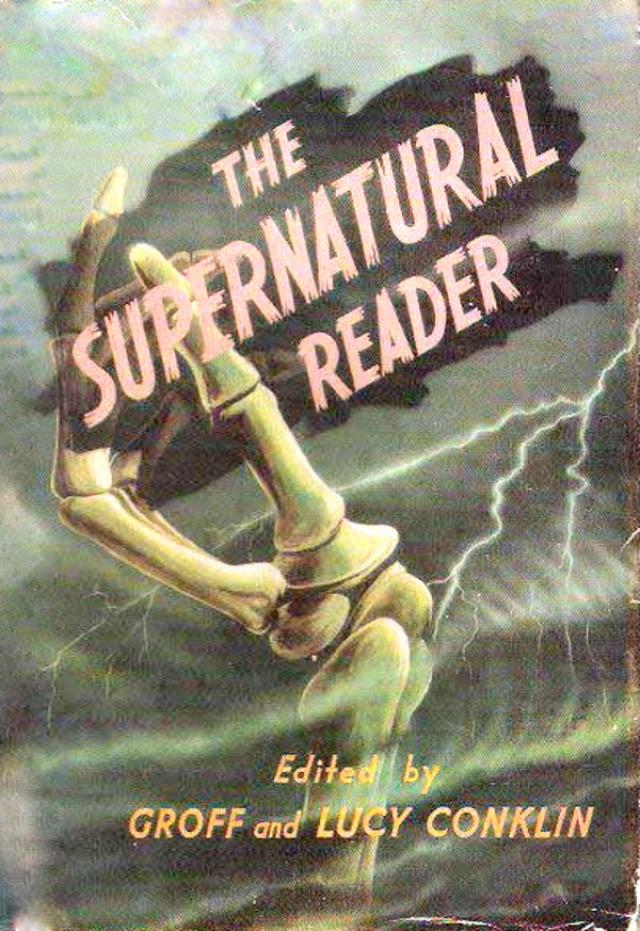
THE SUPERNATURAL READER
THE
SUPERNATURAL
READER
Edited by
GROFF and LUCY CONKLIN
CASSELL & COMPANY LTD
LONDON
CASSELL & CO LTD
37/38 St. Andrew’s Hill, Queen Victoria Street,
London, E.C.4
and at
31/34 George IV Bridge, Edinburgh; 210 Queen Street,
Melbourne; 36/30 Clarence Street, Sydney; 34 Wyndham
Street, Auckland, New Zealand; 1068 Broadview Avenue
Toronto 6; P.O. Box 375, Cape Town; P.O. Box 11190,
Johannesburg; P.O. Box 189, Bridgetown, Barbados; Munsoor
Building, Main Street, Colombo 11; 13/14 Ajmeri Gate
Extension, New Delhi 1; 15 Graham Road, Ballard Estate,
Bombay 1; 17 Chittaranjan Avenue, Calcutta 13; Macdonald
House, Orchard Road, Singapore g; P.O. Box 959, Accra,
Gold Coast; Avendia 9 de Julho 1138, Sao Paulo; Galeria
Gemes, Escritorio 454/59 Florida 165, Buenos Aires; Marne
5b, Mexico 5, D.F.; 35 rue Henri Barbusse, Paris 5c; 35 Nv
Strandvej, Espergaerde, Denmark; Kauwlaan 17, The Hague.
First published in Great Britain 1957
All rights reserved
PRINTED IN GREAT BRITAIN BY
LOWE AND BRYDONE (PRINTERS) LIMITED, LONDON, N.W.10
COPYRIGHT ACKNOWLEDGEMENTS
Ambrose Bierce, “The Moonlit Road.” First published in Can Such Things Bet, 1894. Reprinted from The Collected Writings of Ambrose Bierce, The Citadel Press, New York, 1946.
Ray Bradbury, “The Tombling Day.” Copyright 1953 by Groff Conklin. Here published for the first time by permission of the author and Harold Mat-son.
John Collier, “Bird of Prey.” Copyright 1941 by John Collier. Reprinted by permission of Harold Matson from Fancies and Goodnights, Doubleday & Company, 1951.
A. E. Coppard, “Piffingcap.” Copyright 1921 by Alfred A. Knopf, Inc Reprinted by permission of the author from Adam ir Eve if Pinch Me.
Mary Elizabeth Counselman, “The Tree’s Wife.” Copyright 1950 by Weird Tales Magazine. Reprinted by permission of the author and publisher from Weird Tales, March, 1950.
F. Marion Crawford, “For the Blood Is the Life.” Copyright 1911 by The Macmillan Company. Copyright 1939 by Elizabeth Tomasetti, Eleanor Rocca, Bertram Marion Crawford, Clare Marion Crawford, and Noreen M. Crosfield. Reprinted by permission of Ernest Benn, Ltd., from Wandering Ghosts.
Lord Dunsany, “Thirteen at Table.” Copyright 1916 by John W. Luce and Company. Reprinted by permission of the author from The Last Book of Wonder.
Philip M. Fisher, “Lights.” Copyright 1922, 1950 by Popular Publications, Inc. Reprinted by permission of the author and Flora May Holly from Famous Fantastic Mysteries, December, 1939.
E M. Forster, “The Curate’s Friend.” Reprinted from The Collected Tales of E. M. Forster by permission of Alfred A. Knopf, Inc. and from The Collected Short Stories of E. M. Forster by permission of Sidgwick & Jack-son, Ltd. Copyright 1947 by Alfred A. Knopf. Inc.
Stephen Grendon, “Mrs Manifold.” Copyright 1949 by Avon Publishing Co., Inc Reprinted by permission of August Derleth from The Girl with the Hungry Eyes and Other Stories.
James S. Hart, “The Traitor.” Copyright 1950 by Fantasy House, Inc Reprinted by permission of Ann Elmo and The Magazine of Fantasy and Science Fiction, Fall, 1950.
H F. Heard, “The Swap.” Copyright 1944 by The Vanguard Press. Inc. Reprinted by permission of The Vanguard Press, Inc., from The Great Fog and Other Stories.
Richard Hughes, “The Stranger.” Copyright 1931 by Harper & Brothers. Reprinted by permission of the author and William Morris Agency from An Omnibus.
M. R. James, “Lost Hearts.” Copyright 1931 by Edward Arnold & Co. and Longmans, Green & Co. Reprinted by permission of Edward Arnold & Co. from The Collected Short Stories of M. R. James.
Will Jenkins, “Devil’s Henchman.” Copyright 195a by Popular Publications, Inc. Reprinted by permission of the author and Harold Matson from Argosy, May, 195*.
David H Keller, “The Thing in the Cellar.” Copyright 193* by the Popular Fiction Company; 1952, by David H. Keller. Reprinted by permission of August Derleth from Tales from Underwood, Arkham House, 195a.
Nigel Kneale, “Minuke.” Reprinted from Tomato Cain by Nigel Kneale by permission of Alfred A. Knopf, Inc. and A. M. Heath & Co., Ltd. Copyright 1950 by Nigel Kneale.
Harold Lawlor, “The Silver Highway.” Copyright 1946 by Weird Tales. Reprinted by permission of the author and the publisher from Weird Tales, May, 1946.
H. H. Munro (“Saki”), “Gabriel-Ernest.” From The Short Stories of Saki by H. H. Munro. Copyright 1930 by The Viking Press, Inc. Reprinted by permission of The Viking Press, Inc., New York, and John Lane, The Bodley Head, London.
E. Nesbit, “The Pavilion.” Published 1923 by Hutchinson & Co., Ltd. Reprinted by permission of John Farquharson from To the Adventurotts.
Edgar Pangborn, “Pick-up for Olympus.” Copyright 1953 by Groff Conklin. Here published for the first time by permission of the author.
Herb Paul, “The Angel with Purple Hair.” Copyright 1950 by Fantasy House, Inc. Reprinted by permission of the author and The Magazine of Fantasy and Science Fiction, December, 1950.
Babette Rosmond and Leonard M. Lake, “Are You Run-Down, Tired—” Copyright 1942 by Street and Smith Publications, Inc., publishers of Astounding Science Fiction. Reprinted by permission of the authors and the publishers, from Unknown Worlds, October, 1942, where the authors appeared under the name “Babette Rosmond Lake.”
May Sinclair. “The Nature of the Evidence.” Copyright 1923 by The Macmillan Company. Copyright 1951 by H. L. St. Clair Sinclair and W. McNeile. Reprinted by permission of H. L. Sinclair from Uncanny Stories by May Sinclair.
Theodore Sturgeon, “Shottle Bop.” Copyright 1941 by Street and Smith Publications, Inc., 1948 by Theodore Sturgeon. Reprinted by permission of the author and Prime Press from Without Sorcery, where it was reprinted from Unknown, February; 1941.
Charles R. Tanner, “Angus MacAuliffe and the Gowden Tooch.” Copyright 1951 by Clark Publishing Company. Reprinted by permission of the author from Other Worlds Science Stories, March, 1951.
Contents:-
Introduction
The Angel with Purple Hair
For the Blood Is the Life
The Stranger
Mrs. Manifold
Piffingcap
Shottle Bop
Gabriel-Ernest
The Lost Room
The Traitor
Angus MacAuliffe and the Gowden Tooch
Are You Run-Down, Tired—
The Nature of the Evidence
The Tree’s Wife
The Pavilion
Pick-up for Olympus
The Swap
The Tombling Day
Minuke
Bird of Prey
The Thing in the Cellar
Devil’s Henchman
Lost Hearts
Thirteen at Table
Lights
The Silver Highway
The Moonlit Road
The Curate’s Friend
THE SUPERNATURAL READER
Introduction
If the reader of this book occasionally feels a slight shiver rippling down his spine, or if his hair stiffens suddenly and he is afraid to look over his shoulder, he need not be embarrassed about it. For in this he shares mankind’s innermost and oldest feelings—fear of the supernatural coupled with a tormenting curiosity that leads one on to seek its clammy touch, preferably not first-hand, of course, but rather through the proxy of a well-told tale.
The tale of unearthly beings and their frequent meddlings with man and nature is the oldest literary form known in the world. It is deeply rooted in the beginnings of humanity and probably had its origins in the magic of early man and in the first dim glimmerings of religion. But as the human being and his condition, his relations with his gods, his powers of rationalization have changed through the ages, so has his attitude toward those weird phenomena outside and above the natural order which he could not explain away. Until relatively recent times even the educated man has lived in terror of supernatural manifestations; often he has taken delight in living through them to tell the tale, but not even in this day and age has he been willing to give them up. The supernatural menace still stalks the steps of the more credulous segments of modern populations ready to grab them by the throat; the chilly horror tale, the fantastic yarn, the spectral tweak upon a ghostly nose are still the delight of our more sophisticated contemporaries.
Supernatural literature is likely to survive long after reason and scientific knowledge penetrate all corners of the earth and the Haitian no longer believes in voodoo, the Irish peasant no longer hears the banshee, the German is quite free of the poltergeist, and the backwoods Pennsylvania Dutch of “hex.” There are anthropological as well as psychological reasons for the persistence of supernatural tales. For one thing, they preserve racial memories from the most primitive times to ours, reflecting often the ways of life, the thought-habits, and the beliefs of various periods of history with symbolic fidelity. For another, man even as a rational individual seems not to be quite free from sudden irrational twinges of fear, puzzling dreams, odd previsions and vague intuitions, which will long continue to be the inspiration for weird tales and ghostly narratives.
Even if these aberrations of the psyche are exorcised in time by the widespread knowledge and use of psychiatry and everyone learns how to control his unconscious so that it will not play tricks, the weird yarn, the supernatural story, the tale of inexplicable horror will doubtless still remain a constant source of entertainment. It is very human to tickle one’s senses with fright, particularly when one feels quite safe in his very tangible easy chair and in his own imperturbable sophistication. Besides, the supernatural need not always be horrible. Even in ancient times there were good fairies as well as malevolent witches and a well-intentioned ghost can be found now and then at almost any period of history. In the last fifty years or so the English, for example, seem to have learned to live very cozily with some of their household haunts at least in fiction. As for modem other-world beings, you would be quite charmed with some of them. Read, for instance, Herb Paul’s story which opens this collection and see if you are not as much in love with the Angel as is the young pilot himself.
There is a curious continuity in the existence of all types of mystic beings throughout the history of supernatural literature. Not one of the horrid horde of ancient lore seems to have been abandoned even in contemporary weird fiction—ghosts, devils, sorcerers, witches, vampires, werewolves and ghouls with whom our ancestors lived on intimate terms are still commonly encountered on the printed page, but often with a difference. The modem writer sometimes looks at them with a certain amount of sympathetic insight, as does Richard Hughes in “The Stranger,” a story in which the rich humor of the contemporary Welsh countryside brings an unexpectedly pleasant resolution to the age-old argument between devil and angel. Again in James Hart’s “The Traitor,” the supernatural being who is most generally feared and loathed is himself not without fear, not without pity, and not without human impulse.
Stories of folk magic and witching never quite die down, nor will they as long as their legends strike a responsive chord upon our ancestral memories. In this volume we have several modern literary versions of this kind of folklore. Charles Tanner’s “Angus MacAuliffe and the Gowden Tooch” plays a Scottish tune on the Midas legend. A. E. Coppard’s “Piffingcap,” in which a spell is laid on the masculine population of an English village, achieves a solid sense of reality through its fine characterization and quiet wit. Will Jenkins’ “Devil’s Henchman” and Mary Elizabeth Counselman’s “The Tree’s Wife” are excellent contemporary examples of the gingery, humorous weird of our own Southern hills.
“The Tree’s Wife,” incidentally, is perhaps a distant descendant of the classic dryads, though our tree—being a man and a mountaineer—has learned a few new tricks. In A Fable for Critics James Russell Lowell has Phoebus Apollo say crossly, after he has “treed” Daphne by forcing her to change herself into a laurel in order to escape him—
“And for mercy’s sake, how could one keep up a dialogue
With a dull wooden thing that will live and will die a log?”
But our little Blue Ridge mountain wife has no such trouble with her husband at all, and neither has their baby.
The medieval preoccupation with the philosopher’s stone which would change common metals into gold, as well as the frantic search for the elixir of life which also engaged the minds of many of the best Dark Ages alchemists, are both somewhat out of fashion today. Scientific progress has outdated them. Transmutation of metals we already have through atomic energy. The formula for physical immortality has not been found yet, but at least we live on the average more than twice as long today as people used to a thousand years ago—an indication that some progress toward the discovery of “life elixirs” has been made. Steeped as these two medieval concepts were in magic, nevertheless they have served science well. They were perhaps the first scientific stirrings in that era and today they have been developed far beyond their naive beginnings both in science itself and in science fiction. Science fiction, however, is a separate branch of imaginative literature, outside the scope of our present volume.
As in other fields, a lively scientific curiosity in the nineteenth century led to great activity in the investigation of spiritualism and of other supernatural phenomena. Case histories of ghostly appearances were avidly reported and classified by the Society for Psychical Research, founded in England in 1882, and experiments in establishing contact with the spirit world engaged the interest of considerable sections of the intellectual society of the time.
The idea that the spirit is independent of the body and could attain higher mystic powers at will if one but knew the proper techniques helped to spur on a great deal of experimentation with hypnotism, mesmerism, and self-hypnosis. The passage of a soul into another body, an ancient Eastern belief which early spread into European legends, was made interesting to Victorians by the assumption that a spirit no longer had to wait to slip into the body of an infant just being born—it could be urged to move in on any body at all, under proper conditions of hypnotic trance.
Such phenomena offered endless literary possibilities for mystic horror as well as for romantic or humorous situations in fiction, and brought about a renaissance of supernatural writing, especially in England, which is well exemplified in this book. Most of the important writers of the time were intrigued by these notions and produced excellent psychic fiction for their readers’ shivery delight. Some of them gave their tales an even more terrifying effect by superimposing extremely ancient elements of supernatural lore upon the commonplace surroundings and the intellectual rationalizations of the time. Montague Rhodes James, for instance, himself a scholarly antiquary and a Provost of Eton College, achieved a pitch of almost numbing terror in his “Lost Hearts” by the use of the most horrifying ancient mysteries in the prosaic setting of a gentle British scholar’s home. A more modern tale, H. F. Heard’s “The Swap,” explores the anthropological and psychological aspects of the soul—or the “I”—being lodged in another’s body. The results are inconclusive, scientifically speaking, but the observations are fresh and amusing. Some readers may find it instructive, incidentally, to compare Arthur Conan Doyle’s treatment of the same theme in “The Great Keinplatz Experiment,” which was written about half a century earlier. The differences between the two stories are considerably more enlightening than are the similarities.


