

The Self-Healing Mind, page 1


Dedication
For Patsy, Trevor, and Tram-Anh
Contents
Cover
Title Page
Dedication
Introduction
Part I: A Change in Perspective
Chapter 1: Redefining Mental Health
Chapter 2: Your Beautiful Mind
Chapter 3: Healing beyond Medicine
Chapter 4: Survival of the Fittest
Chapter 5: Giving Up on Death
Part II: The Five Pillars of Self-Care
Chapter 6: Bringing Attention to Breath
Chapter 7: The Sleep Solution
Chapter 8: Tapping into Your Spiritual Self
Chapter 9: The Medicine on Your Plate
Chapter 10: Moving Your Body for Your Mind
Conclusion: Embodying the Five Pillars of Self-Care
Acknowledgments
Notes
Index
About the Author
Copyright
About the Publisher
Introduction
In early spring of 2020, a longtime patient reached out to shake my hand as our therapy session came to a close. Almost immediately, he realized his blunder.
“How long do you think we’ll be doing this?” he laughed, as he bumped his elbow against mine.
I could only shrug in reply. At the time, the United States was just beginning to see the rise of COVID-19 cases, but I had no idea the coronavirus pandemic was about to ripple across the world like an earthquake, changing the entire health-care landscape, including mental health delivery as we once knew it. I also could not have predicted that, because of infection control mandates, I’d have to close my office to in-person visits a few weeks later. Life was changing—and quickly. I began to see my patients virtually, doing what I could to connect with them through tablets and screens. I also had to put many of my favorite wellness practices on hold, including my regular visits to the yoga studio, and more carefully consider how to encourage my patients to continue their own self-care regimens.
As the novel coronavirus continued to spread across the country, I, like many other mental health professionals, noticed an uptick in requests for new appointments. There were many reasons for that. Some people felt increasingly isolated by stay-at-home orders and social distancing guidelines. Others were having trouble adjusting to working from home or struggling to manage their kids as they attended online school. Some were just worried about the virus and its potential long-term impact on their families or businesses. People were coping as they could; yet, for far too many, the situation lent itself to increased anxiety and negative thinking. In some cases, I also saw substance misuse relapses as people turned to alcohol or drugs to help manage their stress.
COVID-19 was far from the only problem haunting the country. In the wake of George Floyd’s and Breonna Taylor’s murders by police, xenophobia against Asian Americans, and a chaotic news cycle, images of brutality and overt civil unrest were delivered into our homes each day. Not only were we getting a daily dose of the thousands of people dying from this new and insidious virus, but we were also watching the cumulative physical and emotional trauma of millions of Americans of color being played out on our smartphones and television sets. The combination took a heavy toll on all of us, and soon mental health was on everyone’s mind. We thought about it more, even if we weren’t always talking about it. Although this book was years in the making, the turbulent events of 2020 led me to reassess the state of my own mental health, while simultaneously treating patients in my outpatient practice. It became even more vital that I record my thoughts about the importance of self-care and mental health maintenance on paper.
My work offers me the opportunity to hear so many stories—treating patients in my office, as well as hosting conversations about mental health with athletes, musicians, actors, and journalists in an effort to help reduce mental health stigma. Many of these discussions involve people who have grappled with depression or sleep difficulties, or have experienced a rocky relationship at home. Some people just need someone to talk to—a neutral sounding board, someone with whom they can safely blow off steam as they work through their thoughts and feelings.
Practicing psychiatry is humbling, even in the best of circumstances. No psychiatrist is omniscient, and as the mind is such a perplexing entity, we need to be open to different ways of thinking as well as different ways of addressing common issues. I learn quite a bit from my patients as well as from people outside my clinic that I have conversations with about mental health. I’d even go so far as to say, some days, these conversations are almost a form of therapy for me, the person who is supposed to be giving the advice. Sometimes one of my patients will share a personal insight and I’ll think: That’s an interesting idea, I haven’t thought about things quite that way before. Or: That’s a great approach to better managing that thought. It sounds like something I should try. I found myself listening for those nuggets of wisdom more than ever during the summer of 2020, as the Black Lives Matter movement and widespread protests against racial injustice seemed at their height. As one of the few Black psychiatrists in the United States—we make up less than 5 percent of the field, all told—it felt like everyone wanted to know my take on things. My patients, my friends, and even some reporters in the media wanted my insights about the effect race has on mental health, as well as how we might learn to better understand and communicate with one another in order to more effectively address racial injustice. Almost every day, when I was alone, I’d ask myself those same questions again and again—and struggle to come up with concrete answers. I tell you this because, in order to be in a better position to both give and receive advice, it’s important to admit that we don’t have all of the answers.
I don’t have all of the answers.
That said, my role is to help my patients find their own purpose, balance, contentment, and hope by sharing what I know about medicine, science, and faith. In doing so, I hope they will understand why living with mental health can bring them closer to fully experiencing the moments of happiness that come along with it. While professional mental health care can be a vital part of this journey, it is not the only factor at play. The bulk of patients don’t see their psychiatrist that often, for a number of factors including demand and health insurance restrictions.
Sometimes it’s once a week, but more often it’s once a month or even less. If you’re meeting with a therapist who isn’t authorized to prescribe medications, typically visits are more frequent, but they can also be expensive unless you have expendable income or exceptional health insurance. That’s why it’s so important to understand that the life you live off your therapist’s couch, in those days and hours between sessions, is really where the most important work takes place. That’s the place where acts of self-care can—and will—make a big difference to your overall mental and physical well-being.
Taking the Objective Approach
Mental health care is a nuanced field—to the point where some have argued it’s as much an art as it is a science. I remember, early in my training, I asked my favorite mentor which antidepressant I should prescribe for a particular patient. I was surprised when she replied with a confident grin and her warm, Southern drawl, “Six of one, half a dozen of the other. Doctor, you pick.”
I don’t share this story to suggest that practicing psychiatry is rolling the dice—or that all antidepressant medications are interchangeable. Rather, I share it because the brain is complex. People are complex. The different treatment options available are—you guessed it—also complex. So, as you work to help someone struggling with mental illness, there are a wide variety of options for determining how to best proceed. You quickly see that our thoughts, feelings, and behaviors are not solely the result of neurochemical shifts in the brain. It’s not that simple. The context matters a great deal, and it must be considered as we look for ways to help ourselves and the people around us feel better.
In medical school, I learned about the scientific method, how to read and interpret clinical data, and the importance of supporting my opinions with facts. Physicians are trained to think objectively. In fact, while I was rotating at a community hospital in Houston as a third-year medical student, the senior faculty members loved to quiz us about complex medical cases. As we presented to them—and tried to explain what we thought the issue might be—we could count on being asked, “What is your evidence for that assertion?” Trying to answer with a feeling, an inclination, a medical story, or even clinical experience was not the way to satisfy the gray beards in the long white coats. In fact, such a strategy would likely lead to quick and public embarrassment. It didn’t take long for me to learn that, in order to avoid humiliation, your best bet was to stock up on studies. Citing a credible source, say a clinical report from the New England Journal of Medicine, was the best way to support your theory and keep the critics at bay.
This objective approach to medicine is partly responsible for the Western health-care system’s status as one of the most advanced and trusted in the world. In the United States, medications are approved by the Food and Drug Administration, thoroughly tested, and then retested for safety and efficacy. Doctors do not heal based on intuition but prescribe evidence-based treatments based on what has been proven to work. If a particular regimen does not have verifiable proof to back up its use, it is almost immediately classified as wishful thinking or pseudoscience.
That’s why, historically, the idea of sel
A New Kind of Self-Help
If you have ever met with a psychiatrist—or even just thought about meeting with one—you understand that taking the steps necessary to make your first appointment isn’t easy. You likely were experiencing powerful feelings of hopelessness, or perhaps an unrelenting need for guidance, to dismantle the stigma or pride that previously kept you from such an encounter.
Each patient I have worked with, and the thousands of conversations those sessions have produced, has shown me that the mind is complicated. Much more so than I was led to understand when I was in medical school. The mind’s ability to dream, to love, to imagine, and to hope is a powerful force for good. Unfortunately, the mind is equally gifted at producing anxiety, self-doubt, and shame. Trying to balance these forces is not a simple task.
Psychiatric diagnoses for conditions like depression, anxiety, and post-traumatic stress disorder (PTSD)—just to name a few—come with guidelines for treatment. While there is no one-size-fits-all approach to helping people living with these issues, there’s at least a game plan. Many of us will never meet the diagnostic criteria for these diseases, but some of us still live with unhappiness, loneliness, disconnection, and a lack of purpose. These conditions can influence the quality of our lives just as much as a diagnosed mental illness. They all but ensure we are not living our best lives. Simply put, we can’t—until we find a way to live a life that embraces mental health.
Unfortunately, it’s often easier said than done. As we try to bolster our mental health, we tend to look for simple answers. We desperately attempt to identify three easy steps to happiness. We search for the keys to success. We want to believe there is one thing—one simple thing—that can turn our life around and make it all better. Unfortunately, such quests usually result in a dead end.
That said, I can relate. I, too, am a student of books about improvement. As someone who wants the answers to life’s quintessential questions—Who am I? Why am I here?—I find such books are almost irresistible. Certainly, self-help books played an important role in my upbringing. And, while reading them, they often did make me feel better in the moment. I thought they offered me an explanation for why I’m built the way I am, what makes me tick, what career would suit me best, and what kind of romantic partner I needed. I learned the habits of highly effective people. I grew to appreciate that there is courage in the ability to be vulnerable. I adopted the tools to win friends and influence people. I recognized the power of purpose.
Eventually, I found I had hit a self-help book wall. At a certain point, I found I could predict what was coming next, from the stories to the recommendations. I also found that I could follow the books’ advice without much effort on my part. Initially, I was a self-help sponge, soaking up all the advice I could. I thought that, when life got challenging or downright ugly, these books had given me the tools I needed to fix whatever mess might be in front of me. That may be why I was caught so off guard when, in my early twenties, I slid into an overwhelming depression that was uniquely my own.
Although I am a psychiatrist, I am not immune to mental illness. And because of this, I can tell you with conviction that it is possible to have a strong understanding of your higher purpose and still feel incapable. You can fully accept the challenge to be vulnerable and still struggle to connect with others or to find the motivation required to carry you forward. I can also say, with certainty, that even the most resilient people can and do fall—sometimes, in response to what may seem like a small or inconsequential issue. I can tell you this because I sit across from patients, each and every day, who have endured such challenges. I have listened to their stories. I am one of them.
I can also tell you that you have more power when it comes to your mental health and well-being than you think. This isn’t about trying to oversimplify the mind so you can feel good in the moment. There is no “happiness” pill a doctor can prescribe to you. These sorts of beliefs, too often, can lead to even more hopelessness down the line. We need to acknowledge that there are limitations to what science can explain about the brain, mental illness, and mental health. With that in mind, my aim is to provide you with the knowledge and tools that can help you make more informed decisions about how to best support your own resilience and overall wellness as you are out there in the world each day, living your life.
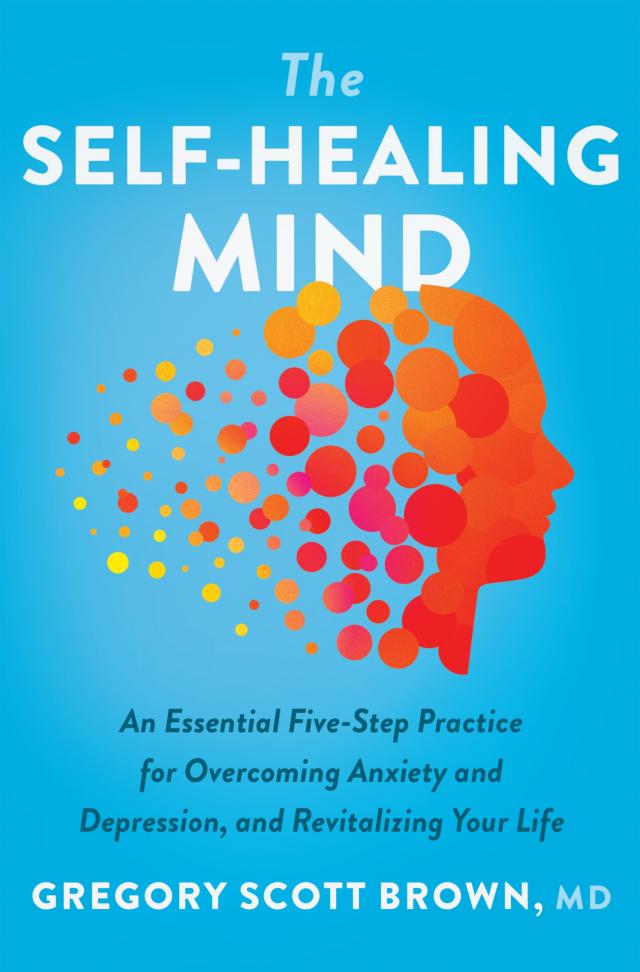
I was inspired to call this book The Self-Healing Mind to highlight ways evidence-based self-care improves mental health. Over time, I have learned that it’s what you do in between sessions that, ultimately, has the most impact on how you feel. That’s where you need to apply the different ideas or strategies we discussed in session to make positive changes. That said, this book is not intended to encourage anyone to replace professional mental health care, or to take medical treatment into your own hands. Rather, the aim is to show you how tools for sustainable wellness start and end with essential acts of self-care.
In the following pages, I will discuss a different way of thinking about mental health and the mind. It may diverge quite a bit from what you may have learned before. I openly challenge pervasive ideas about mental health, including that mental illness is a sign of weakness, that depression and anxiety are the result of a defective or injured brain, that knowing your purpose will automatically make your life easier, and that psychiatric drugs offer a quick cure. These ideas extend from my experience treating patients in my psychiatry practice, as well as my own personal life story. This composes Part I of the book—where I help the reader to look at these issues in a new way. That new foundational understanding sets up Part II, where I introduce practical techniques about how to use self-care to improve your mental health. Those topics will include how to give up on (let go of) the right things (like giving up on death), using breath work as medicine, moving your body to boost your mood, making the best food choices for your mind, and tapping into your inner spirituality that connects you with the world around you. My time as a psychiatrist—and a patient—has shown me what works and what does not. These are the lessons patients have taught me through hours of vital conversations, as well as those I’ve learned firsthand as I’ve pursued my own self-care journey for mental health.
My intention with this book is to provide you with the insights and skill set that can help you live with purpose, balance, contentment, and hope, regardless of what the world may throw your way. While I do not wish to suggest that all mental illnesses can be resolved outside the psychiatrist’s office—or that there aren’t situations where antidepressants or other drugs are both helpful and necessary—the truth is there are many things you can do outside of a clinical setting to help support strong mental health. That starts by reconsidering your definition of, as well as any preconceived notions you may hold about, what mental health actually is.
Part I
A Change in Perspective
Think about why you picked up this book. Some of you may have already seen a therapist or a psychiatrist in the past. Maybe you have even been diagnosed with depression or anxiety at some point, and you have been prescribed a medication or another form of therapy to help manage it. Perhaps the idea of potentially being labeled “mentally ill” has kept you from getting help altogether. Or maybe you don’t fit neatly into any of these categories. You’re just not fully satisfied with your life and are looking for ways to make some improvements. No matter who you are or what your experience has been, this book is for you.


