

Born to Walk, page 1


Praise for Born to Walk
A stunning account of a young woman’s resilience in the wake of the Rwandan Civil War.
“Alpha Nkuranga comes from a country where women are often forbidden to dream. As a thirteen-year-old, she entered the classroom illiterate. Her goal was so simple — just to read. Not even Alpha could have imagined how far her education would take her. Beginning in war-torn Rwanda, her harrowing journey carries her on to Uganda and, despite all credulity, continues in Canada. This is a spine-tingling, true story of determination and resilience that will change and inspire all who read it.”
— Sharon E. McKay, author of War Brothers
“A gripping tale of resilience, terror, trauma, and survival, Alpha Nkuranga's Born To Walk took me on a journey. Her story is essential: a testament to the scars, sacrifices, and steps that make us who we are. I'm in awe after reading this book.”
— Matthew R. Morris, author of Black Boys Like Me
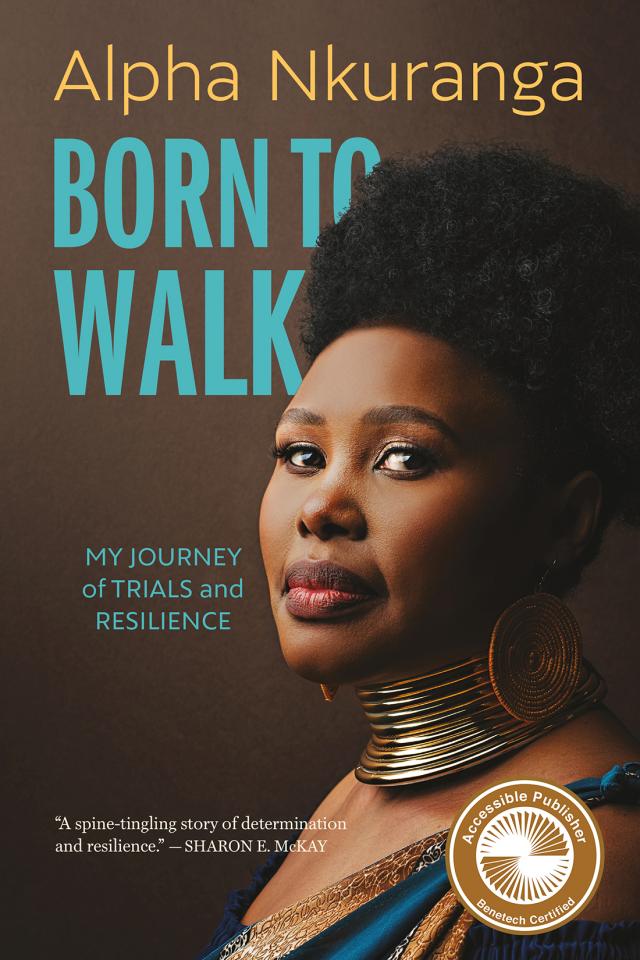
BORN TO WALK
MY JOURNEY of TRIALS and RESILIENCE
Alpha Nkuranga
GOOSE LANE EDITIONS
Copyright © 2024 by Alpha Nkuranga.
All rights reserved. No part of this work may be reproduced or used in any form or by any means, electronic or mechanical, including photocopying, recording, or any retrieval system, without the prior written permission of the publisher or a licence from the Canadian Copyright Licensing Agency (Access Copyright). To contact Access Copyright, visit accesscopyright.ca or call 1-800-893-5777.
Edited by Jill Ainsley.
Copy edited by Candida Hadley.
Cover and page design by Julie Scriver.
Cover photograph of Alpha Nkuranga by One for the Wall Photography.
Maps by Marcel Morin, Lost Art Cartography.
10 9 8 7 6 5 4 3 2 1
Library and Archives Canada Cataloguing in Publication
Title: Born to walk : my journey of trials and resilience / Alpha Nkuranga.
Names: Nkuranga, Alpha, author.
Identifiers: Canadiana (print) 20240351088 | Canadiana (ebook) 20240351258 | ISBN 9781773103341 (softcover) | ISBN 9781773103358 (EPUB)
Subjects: LCSH: Nkuranga, Alpha. | LCSH: Nkuranga, Alpha—Childhood and youth. | LCSH: Rwanda—History—Civil War, 1994. | LCSH: Victims of family violence—Rwanda—Biography. | LCSH: Rwanda—Social conditions—20th century. | LCSH: Immigrants—Canada—Biography. | LCSH: Resilience (Personality trait) | CSH: Rwandan Canadians—Biography. | LCGFT: Autobiographies.
Classification: LCC DT450.437.N58 A3 2024 | DDC 967.57104/31092—dc23
Goose Lane Editions acknowledges the generous support of the Government of Canada, the Canada Council for the Arts, and the Government of New Brunswick.
Goose Lane Editions is located on the unceded territory of the Wəlastəkwiyik whose ancestors along with the Mi'kmaq and Peskotomuhkati Nations signed Peace and Friendship Treaties with the British Crown in the 1700s.
Goose Lane Editions
500 Beaverbrook Court, Suite 330
Fredericton, New Brunswick
CANADA E3B 5X4
gooselane.com
For Mama and my children, Isaac, Jonathan, and Nathan. And for Buseka.
We talk about love, but do we really show it?
Content Note:
This memoir contains true accounts of intimate-partner violence, violence toward children, war, and sexual harassment.
Contents
Content Note
Map 1
Map 2
Prologue
Imigani
Girlhood
Kugenda Munda
The Long Journey
Finding My Aunt and Mama
The Man Who Fought the Leopard
A Twig Strike in the Eye Sharpens Your Gaze
The Magic Shoes
The Lost Girl
Engata
Lost and Found
The Long Road Home
Married Life
The Land of Milk and Honey
The Weather Shock
Heated Water Will Never Forget That It Was Once Cold
Giving Back
Epilogue
Acknowledgements
Prologue
They have a saying where I was born, “God sleeps in Rwanda.” My grandparents used to tell me Rwanda is a country unlike any other, and I knew they spoke the truth. It is one of the few countries on the African continent where all citizens speak one language, Kinyarwanda. Blessed with majestic mountains and breathtaking valleys, it is a sacred and spiritual land, and Rwandans carry the belief that God loves Rwanda more than any country in the world. And yet Rwandan men drenched the land in blood in acts of hate so horrific that the stains of those three years will not fade in one hundred lifetimes.
My story is not an easy one to share. Although I come from a storytelling culture, I have long tried to heal myself through dissociation from the events of my past. From time to time, I’ve shared an experience or two with friends or my husband, my closest friend. But the past pierces my broken heart like a spear. It is easier not to share. And yet I am. Friends have encouraged me to tell my truth. I want to tell this story for the people who died and for their children, and especially for the women from back home. Because I survived, I can share what happened to us.
This is my story, told as I remember it, but it is not the whole story. Some parts are still too painful for me to share.
One
: Imigani
I don’t know the date or year of my birth; it was never recorded. My mother gave birth to me at home. I was her third child, and it was only when someone told her that she looked pregnant that she knew she was expecting me. A few months later, she unexpectedly went into labour. She had given birth to my older brother and sister at her parents’ house because my grandmother was renowned for her midwifery skills, and Mama intended to travel to my grandparents’ place for her third baby, but I was born early. Because my mother didn’t know how to read or write, she had no way of documenting the dates of our births. The only sense I have of my birthday is from her saying, “I remember when you were born. It was morning, and it was raining.” While I cannot know for certain, I believe that when the Rwandan Civil War happened in 1994, I was eight years old.
In my culture, fathers named their children. My father chose Irafasha for me, but in our community, people called you what they liked based on your behaviour and appearance. For example, if you were short, someone might call you Ball, and if you had a loud voice, another person might call you Thunder. Some called me Short because I was short. Others called me Miracle. There were many other names as well.
My mother called me Lucky because I never caused her any trouble during her pregnancy. She told me that I was very healthy for a week-old baby. I had a strong neck compared to other babies, and I developed so quickly that she intentionally hid me from the neighbours. Our culture is both superstitious and wary of anything that appears out of the ordinary. She wanted to prevent people from seeing me as abnormal.
At about a month old, I attempted to sit without support from anyone. To discourage me from sitting at an age thought to be too young, she kept me wrapped up and carried me on her back using a wrapper, made from one of Africa’s traditional fabrics. One day, when I was around four months old, I was lying on the bed while my older brother, Bosco, was playing in the same room. He turned around and saw that I was sitting by myself. He rushed to call our mother. When she saw me, I was sitting up and giggling to myself. She immediately stopped me and ordered my brother not to tell anyone about it.
At five months, I was standing on my feet despite my mother’s efforts to keep me sitting. She was shocked because most babies don’t start walking until about ten months. At six months, I was running. My mother then had to stop me from going outdoors, fearful that people would think I was a cursed child. She cleaned the house, fetched water, cooked, and gardened with me on her back. She left me alone only during nap time and bedtime when everyone was asleep and she knew no one would see me walking.
My mother tried her best to hide it, but I had been kugenda munda, born walking. Every day, my feet were on the ground, ready to go somewhere. Because I started walking at such a young age, one of the names bestowed on me was Akaduri, which meant short walker. In time, this was shortened to Kadur, and it was the name I was most commonly called.
As a child, I walked so much that my feet sometimes cracked and bled. Eventually the soles became hard as stone. Perhaps even then God was preparing me for what lay ahead.
My mother is a brown-skinned woman, darker than me, with short hair and a birthmark next to her right eye. She has always been quiet and loving with a humble, contemplative disposition. When she stands, she stands with her back straight. Recently I asked her how she met my father, and she told me that one day, when she was a teenager, she was out walking when my father and his friends took her away and he raped her. Later, he took her a second time, and this time she became pregnant. She married my father. She had no other choice. She risked being killed for shaming her family if she refused. The word guterura means to lift or carry something, but to young women in our culture, it has a more sinister meaning. If a man becomes interested in a girl and her parents refuse his request to marry her, the man might recruit someone to stalk her day and night, waiting for a moment when she’s alone. At an opportune moment, they strike, gagging her with a cloth and taking her by force far from her family. The next morning, she wakes up married to a stranger, nursing wounds suffered during the abduction and ra
When my mother was pregnant with her firstborn, my brother Bosco, she was sickly and weak. All she could eat was clay. In my culture, when a woman gives birth, her parents will take care of her for the first two months after childbirth. Someone else takes charge of caring for the newborn so the mother has ample time to heal and recuperate. Once the baby is born, many of the father’s relatives will come to see if the baby resembles its father. If the baby does not, those mothers will have to stay forever in their parents’ house, as their husbands will never come for them. It’s not a good way to verify paternity since newborns sometimes don’t resemble either parent. Luckily for my mother, she had very few in-laws interested in checking up on her newborn son.
Babies remain nameless for several days until the father shows up with an official name. Naming ceremonies are a big deal. Friends and members of the extended family gather to celebrate, bringing money and other gifts for the mother and her baby. For the new mothers, the ceremonies celebrate their survival from the ordeal of childbirth. Despite the skills of midwives like my grandmother, many childbirths result in the death of the mother or the baby, and sometimes both. If a baby dies during labour, the mother is blamed for failing to push it out. Labouring women are sometimes flogged to get them to push.
My father is a tank in physical form — and in disposition. Rwandan men are supposed to be tough. There is a saying in Kinyarwanda, “Amarira yu’mugabo atemba Agana Munda” — “Tears of men flow inside.” I can’t remember ever seeing a man in Africa cry. My father has always carried himself as someone capable of causing harm. His face is the face of someone hostile to the world. When he was young, the villagers nicknamed him Ingwe Muntu, the Human Leopard. Our village was in northern Rwanda, near the forest, and houses in this area were prone to attacks from wild animals. One morning, my father and his brother were out walking. Near a tall ant hill, they found a leopard that had been caught in a trap. Even though it was injured and trapped, the leopard was still able to jump on my father. It dug its claws into his skull. He threw it against the ant hill, but the leopard attacked again. My father fought it while his brother ran for help. Some police with guns were nearby and came to assist, but they couldn’t shoot for fear of hitting my father. By that time, so much blood covered him that no one could have recognized him.
Some say the two continued to fight for an hour; others say it was two hours. Finally, one of the men was able to shoot the leopard. My father spent a long time in Kiziguro Hospital, recovering from several surgeries. People said he was the first man ever to win a battle with a leopard. He won the title of the village’s strongest man, and people feared him so much that no one would even touch his arm. To this day, my father wears this battle on his body. He has a large indentation in his skull, so large that it is clear to me that he suffered some sort of brain damage, and several long scars across the top of his head. He has gone through life bullying and forcing his will on other people, particularly my mother, who has never been able to escape him or his anger. All my life, he’s been prone to rages that cause my family to flee the house. At one point, he kept three long machetes under his bed. People are generally allowed to keep machetes because they use them for bushwhacking and other practical purposes, but my father threatened to kill my mother with them. The police confiscated the machetes, and I asked a village elder to try to reason with my father, to get him to change his violent ways, but to no avail. Whenever my mother leaves him, she always returns, and I remain fearful for her safety.
My mother had ten children all together: six before the war and another four after. I am the third child. I have one older brother and five younger, and three sisters, one older and two younger. Bosco, the first child, was around eight or nine years older than me and was nicknamed Brown because of his smooth brown skin. My older sister, Uwimpuhwe, is two years my senior. She is thin and tall with light skin. My sister Godance was born three years after me. She looks a lot like my mother. She was always my good friend when we were growing up. My other siblings are my brother Elijah, my sister Sharitina, and my youngest brothers, Nani, Joseph, and Friday.
My parents were living in Murambi, a small city in southern Rwanda, when Bosco was born. When he was young, they moved north to the village of Rugarama, a relatively new rural settlement near the forest and not far from the Tanzanian border, to have more space to raise their family. The trading centre for this tiny village was in Matimba. Rugarama was composed of small pockets of acreages among rolling green hills and winding dirt roads. Most houses were rectangular or square and made of mud with grass roofs. People who had more money roofed their homes with iron sheets. Most houses had doors made of wood with barrel bolts to lock them shut. The houses were spaced far apart, and it would often take ten or fifteen minutes to walk from one house to another.
On our acreage we had chickens and goats close by, while our cows grazed farther away in the fields. Christianity was a big part of my life. Our church was built with mud and had an iron roof. Inside were rows of traditional Rwandan church chairs made of mud and backless wood benches.
When I was young, my father deserted us for other women because after giving birth to my brother Bosco, my mother’s next three children were girls. When my sisters and I married, he would exchange us for cows or other valuable products, but a one-time dowry was nothing compared to sons who would inherit his land and other properties. He took a second wife, Dorosera, and began having children with her, but he also returned to my mother whenever he wanted. She gave birth to my younger brother, Elijah, when I was around four, and my father continued to come and go as he pleased. My father’s long absences made it difficult for my mother to care for all of her children, and from time to time she would send Elijah and me to live with our paternal aunt and grandparents in Murambi, a trip of about an hour and half by taxi.
Although I am Rwandan by birth, I grew up more fluent in Runyankore, the language of the Ankole people from Western Uganda, because when I was very young, my mother sent me to Uganda to live with my father’s sister Karuhanga. I didn’t return to Rwanda to see my parents and maternal grandparents until I was around six years old, and in the years before the Rwandan Civil War, I often returned to Uganda for extended periods. Crossing the border was easy then.
I grew up surrounded by beautiful and imaginative storytellers who passed down to us all of our history. I was taught to listen carefully and remember the words. One voice in particular still rings in my ears, that of my aunt Karuhanga. In my culture, paternal aunts play an enormous role in raising children and in teaching girls the way of women. They are the caretakers of girls’ morality. But Aunt Karuhanga was much more than a storyteller, guardian, and instructor in how to survive in a world created for men. She opened my mind and empowered me to think about and reflect on what is true for me. Her patient face, calm, searching eyes, heavy eyelids, prominent cheekbones, and healthy inner power embodied wisdom drawn from an inexplicable source.
When memory glides me down the rivers of my past, I see myself, a young girl, joyfully sitting on her lap with her arms wrapped around my waist. When she visits my dreams, I am relieved to hold her until I wake up. No matter the distance between us or how long we are apart in this life, she has a permanent place in my heart. She receives my love with every beat and will do so until the end of my time. I admire her loving spirit. I have trained myself to speak and to walk like her.
Before the Rwandan Civil War, my ethnically mixed family, like many others, met and told stories by the fire, a practice called imigani. The fireplaces of my youth were rock circles laid on the ground outside our homes, which allowed every family member to sit around the fire, connected to each other. At the fireplace my family found communion. The questions of the children prompted the elders to teach generational lessons through parables and proverbs, and we paid careful attention, knowing they would ask us to recall these stories later. Many of the stories privileged and protected the patriarchal culture in which we lived. Goat meat was considered delicious, and men sought to retain it for themselves, so young girls were taught that eating goat meat would give them beards and make them undesirable. My aunt inculcated this patriarchy in my mind and in the minds of my sisters and girl cousins. We were taught the proverb, “Ukandagira agahungu ntahonyora” — “Don’t step on a boy or treat him badly,” because he will remember and may use it against you when he grows up. Educated people never surrounded me, but I was raised by intelligent women with significant life experience.


