

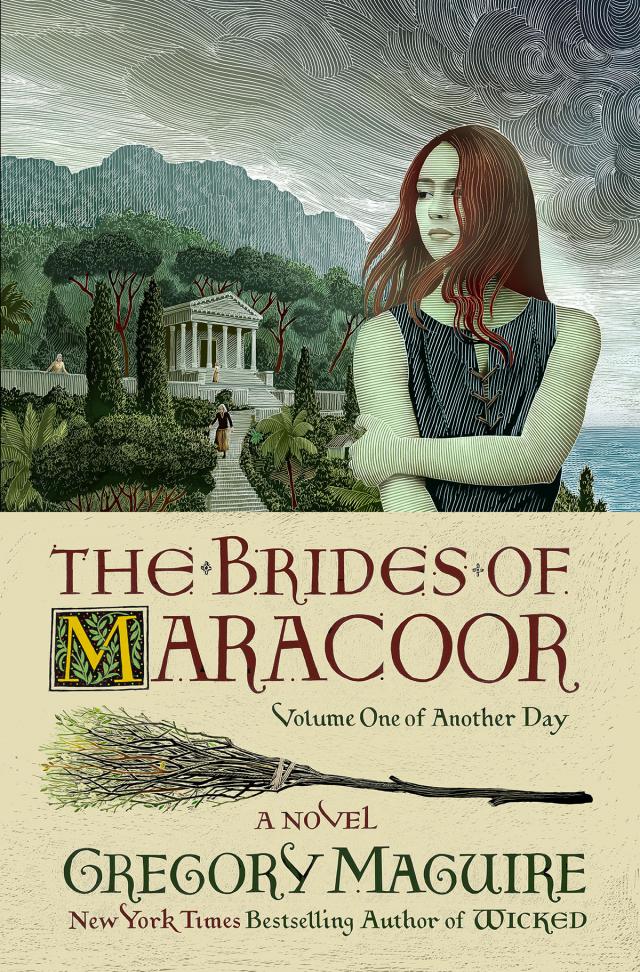
The Brides of Maracoor, page 1


Dedication
For Katherine Kleitz and Iris Lee Marcus
Epigraphs
. . . This rough magic
I here abjure. . . .
. . . I’ll break my staff,
Bury it certain fathoms in the earth,
And deeper than did ever plummet sound
I’ll drown my book.
—Shakespeare, The Tempest
An ending is no more than a point in sequence, a snip of the cutting shears. Benedick kissed Beatrice at last; but ten years later? And Elsinore, the following spring?
—John Fowles, The Magus
Rain, Rain, go away.
Come again another day.
—trad.
Contents
Cover
Map
Title Page
Dedication
Epigraphs
Part One The Brides of Maracoor 1
2
3
4
5
6
7
8
9
10
11
12
13
14
15
16
17
18
19
Lucikles 1
2
Rain 1
2
3
Cossy 1
2
3
4
5
6
7
Leorix 1
2
3
4
5
6
7
Part Two The Fist of Mara 1
2
3
4
5
Return of the Pious Enterprise 1
2
3
4
5
The House of Balances 1
2
3
4
5
6
7
8
9
10
11
12
13
14
Author’s Note
About the Author
Also by Gregory Maguire
Copyright
About the Publisher
Part One
The Brides of Maracoor
1
Sing me, O Muse, the unheroic morning. When the bruised world begins to fracture for them all. Sing me the cloudless dawn that follows a downright shroud of a night.
A long night, one that had lasted for days.
Rain had run along the edge of it, playing for time.
Wind had sounded, then silence sounded—in that uncanny, hollow way that silence can sound. Then wind picked up again.
A world waiting to be made, or remade. As it does every night.
Waves slapped the harbor sand with soft, wet hands.
At sea level, strokes of lightning silently pricked the horizon.
The seagrass bent double from wind and wet. Bent double and did not break.
Above the clouds—but who could see above the clouds?
Build the world, O Muse, one apprehension at a time. It’s all we can take.
With ritual dating from time out of mind, the brides on Maracoor Spot welcomed the first day after the storm. One by one they took up the whips of serrated seagrass from the basket in the portico. They wound the ends of the grass around their hands, using cloth mittens for protection. Each bride in her private nimbus of focus, they set to work etching their skin, laterally and crosswise. They flayed until the first drops of blood beaded up. Raw skin was better because it bled faster—the calluses from last week’s mutilations took longer to dig through.
Then the brides bound their bruises with muslin already dyed maroon. It cut down on the frequency of bridal laundering if the linen was a deadblood color to begin with.
2
Then the brides—the seven of them—picked their way down the path along lengths of salt-scrubbed basalt. The ledge dropped in levels, finishing at a natural amphitheater shaped to the sandy harbor.
The world today, as they found it, as they preserved it:
A few thornbushes torn up and heaved on their sides, their leaves already going from green to corpse brown.
A smell of rot from fish that had been flung ashore in tidal surge and died three feet from safety.
The brides sat in a row on the lowest step. After chanting an introit, they began their work of twisting kelp with cord into lengths of loose netting. One by one each bride took a turn to wade into the calmed water up to her ankles, where the salt stung her daily wounds and cleansed them.
The oldest among them needed help getting up from a sitting position. She’d been a bride for seven decades or maybe eight, she’d lost count. She was chronically rheumy, and she panted like a fresh mackerel slapped on the gutting stone. Her stout thumbs were defter than those of her sister brides. She could finish her segment of the nets in half the time it took the youngest bride, who hadn’t started yet this morning because her eyes were still glossed with tears.
Acaciana—Cossy, more familiarly—was the youngest bride. She wouldn’t be menstrual for another year or two. Or three. So she cried at the sting of salt, so what?—she still had time to learn how to suffer. Some of the others thought her feeble, but perhaps they’d just forgotten how to be young.
Helia, Cossy, and the five others. Helia and Cossy, the oldest and youngest, wore white shifts that tended to show the dust. Only the oldest and youngest went bareheaded at tide weaving. Their hair, though pinned up close to the scalp, moistened in the insolent sun that came sauntering along without apology for its absence.
Beneath their sea-blue veils, the other brides kept their eyes on their work. Mirka. Tirr and Bray. Kliompte, Scyrilla. Their conversation wasn’t as guarded as their faces. Mirka, the second oldest, muttered, “I don’t think Helia is going to last another winter.”
“Netting for drama already?” murmured Tirr, the bride to her right. “And it’s just come summer.”
The others grunted.
“No, I mean it,” continued Mirka. “Look at the poor damaged old ox. She’s forgotten how to stand by herself. Those waves are almost too much for her.”
“Well, these storms,” piped up Cossy, trying to air a voice unthrottled by tears. “A whole week of it! Did that ever happen before?”
The more seasoned brides didn’t answer the novice. The oldest woman did seem unsteady as she walked in. She’d looped her garment in her forearms to keep the hems dry. Her mottled shanks trembled while the sea pulsed against her calves.
“What happens if Helia dies?” asked Cossy.
The youngest one always asked this question, always had to.
The second oldest, who was proud of the pale mustache that proved her status as deputy-in-readiness, snorted. “You remember the coracle that comes round the headland now and then. If it beaches and fewer than seven brides are here to greet the overseer, he goes back to procure a replacement bride.”
“Goes back where?” asked Cossy. “Mirka? Where?”
This question went unanswered. Since each new bride always appeared in swaddles, arriving before her own memory could set in, the notion of anyone’s specific origins was largely hypothetical.
Though they all knew where baby animals came from.
Cossy was at the obstinate age. “Goes back where? Someone must know. Does Helia know? I will ask her.”
“Don’t bother Helia,” said the deputy-in-readiness. “Look at her. At that venerable age! She’s about to move on ahead of us, she can’t think backward.”
“You’re not the boss of me, not yet,” Cossy replied. “And don’t think you are, Mirka.”
Helia had finished soaking her wounds. Using her staff for balance, she picked her way back to her place. Once she’d taken up her portion of netting, she muttered, “I’m not as deaf as you think, Mirka. Don’t be getting airs. You’re not going to be senior bride anytime soon. Cossy, I don’t know much about the mainland but I know it exists, and it is where we come from. But listen: you can ask me anything you want. What little I know I share. That’s my last job before I die. All in good time, so Mirka, don’t go pushing me off a cliff.”
But that night at the temple Helia suffered some contortion, and the next morning, while she took breakfast, she didn’t speak at all. Cossy might ask all the questions she wanted, but to no avail. Helia was beyond answering.
3
But who could see above the clouds? Or from them? And descending through them, spy Maracoor Spot? Seeing, what, what—if you were to approach the place from above—say, as a traveler in a hot-air balloon, or a harpie out of the old stories? Looking upon this dollop of land in the midst of the great cold sea?
A spine, foremost. A spine to the island, heaving its rim-rock crenellations out of green wilderness. You might say: like a pivoting lizard with finned vertebrae on display.
On the east side, marine cliffs. Shellacked a glaring white, guano from cliff-dwelling rocs and gulls. At the base of this unapproachable break-front, rollers ate away at the ankles of the island, scooping them out. In a million years the ocean would snap the spine of the island at last, then pass over it to munch upon some farther shore.
Toward the west, the slopes were more relaxed. They tumbled upon one another like fresh, unfolded laundry. The climate here balmier, the winds less belligerent. Pine forests gave way to more relax
The harbor was deep enough to drown a giant out of prehistory, as far as anyone knew, but the mouth of it had been silted up for aeons. Ships couldn’t cross except once every few years, at a storm tide. This was access so unpredictable that no traders bothered. There was little to plunder, in any case, and nobody to trade with. Brides didn’t count.
Was Maracoor Spot beautiful? The brides who lived there couldn’t say. It was the only home they’d ever known. No one had ever left except in death. Standards of beauty—like those of truth, or justice—are arrived at by the practice of making comparisons.
Another word for poverty of choice is innocence.
By holy writ Maracoor Spot supported seven human citizens, no more, and no less, and made do with only one real building. The temple, or grange, was a boxy arrangement of pockmarked, smeary marble. It stood on a platform of large rectangular blocks and was flanked on three sides by ranks of grey-white stone columns, some of which had lost conviction and lain down. Inside, a single large chamber was divided by rattan screens. That was it, unless you counted the windowless, sacred space at the back of the building, which just about ran into the hillside.
At this stage in its unimaginable history, the columns supported triangular pediments front and rear. In their recesses lurked statues of writhing, blurred, and genderless humans. Their motivations remained vague and their lessons unknowable, the specifics thumbed away by wind and time. Above the sculptural drama, a roof made of logs and thatch. This fell or blew off every few years. The brides knew something about construction, but perhaps not enough. Their repairs were always temporary. But so were their lives.
Any scrutinizing eye aloft in the trade winds, looking down upon that whole world, would see the spine of Maracoor Spot hugging the island’s single harbor, its entrance channel so narrow that from certain viewpoints the sides could seem to be touching.
And opposite the harbor mouth, that tablet of temple roof: the only stamp of rationality in the organic blot and curl of nature.
If you were climbing the highlands on a certain day, you might see a coracle coming around the headland. That day couldn’t be predicted. It happened when it happened. Like the occasional ship with pale sails that, appearing and disappearing, proved the horizon had a future as well as a past. But little else.
4
Cossy claimed perhaps ten summers under her cincture. The adolescent bride nearest her in age had begun her menses a year ago. Oh, but Cossy’s former friend had grown aloof! Scyrilla the Scourge. Pimply and moody. Scyrilla didn’t like to talk about the secret wound. Old Helia had been brusque about the matter when Cossy asked. Herself was out the other side and a good thing too, Helia said. The other brides were opaque on the matter, or inept. Though Cossy tried not to show it, the mystery of that red flood terrified her.
The chores of the day were winding down. Cossy sat at the foot of Helia’s cot, rubbing olive oil into the senior bride’s wounds. Helia was sitting up so she could glance out the doorway. Not that there was much to look at—a scoop of sea, emerald green at this hour, and a peerless, watered-down sky without clouds. So welcome after those storms.
The aged woman cleared her throat. While words had fled today, her grunts and sighs, oh my. Opinions plenty. Cossy guessed they were riddled with bitterness and gratitude alike. And perhaps compassion—Helia didn’t shut out Cossy as the other brides so often did.
In sailed Mirka, folding back her blue veil. Though her hair was clasped at the nape of her neck with string, the long grey coils below had come free, an animal pulling from a snare.
“You’re dawdling here, Cossy.” A statement, not a question.
“I just finished with Helia’s salve.”
“It’s not suppertime yet. You’re still wanted in the garden. Turnips ready to pull. The moles will get them if we let them sit another night. And bring a bucket of water to sprinkle on the redweed. It’s looking peaky.”
Cossy sighed and squeezed Helia’s hand. The strong old thumbs pressed down in Cossy’s palm.
“We’re sorry to see you brought low, Helia,” said Mirka with icy formality. She was getting the clean pails used for milking the goats. “You’ve been a great inspiration to all of us. I want you to know this if your time among us is coming to a close.”
Behind Mirka’s back, Helia made a rude gesture at her. Cossy, who now was truly dawdling, tried to swallow a giggle. Mirka ignored it.
“Where will we bury Helia?” asked Cossy. “With the goat bones?”
Helia clapped her hands once and raised them to the ceiling.
“All in good time, Cossy, don’t be rude,” said Mirka. “Run along now. I have some things to say to Helia before I get back to the goats.”
“But she can’t answer you.”
“No concern of yours. Some statements require no reply. Go away.”
So Cossy left for the turnips, but she dawdled along the outside wall, listening. A time-honored custom among the younger brides. A year ago it would have been Cossy and Scyrilla together. Part of their schooling, you might say.
Mirka was purring in a low voice, but full of urgency. “You need to let me know where the key is hidden. There’s little time left, Helia. You could kick off this evening or tomorrow morning. It’s forbidden to take your knowledge to the grave. Would you threaten all our lives? If the key isn’t in the temple, point out which way it is, and I’ll help you walk there. I’ll bring a shovel if it’s buried somewhere. This is your final obligation, Helia. You are obliged to yield your authority. You may not deny me this.”
No doubt Helia had flashed another obscene gesture, for Mirka remarked, “How dare you be so rude to me. I could suppress your dinner portion for that.”
Though she couldn’t have said why, Cossy was glad that Helia was still too obstinate to obey Mirka’s commands. The youngest bride tiptoed away, skittered off the porch, and flew like a gull’s shadow toward the garden.
5
Along the path she stopped to collect the bucket of rainwater. It was nearly full. She peered at it. A mouse was paddling away, three inches from the rim, unable to get purchase. She left the bucket there—the redweed could manage. She wanted to see what a drowned mouse would look like. Maybe it would be dead by the time she came back from the garden. She could tip it out and see if it came back to life, the way fish sometimes did if you threw them back.
When she was nearly done with the turnips, she glanced up to gauge the sun’s position on the horizon. She saw a movement not unlike the flailing mouse, but larger, out there crossing the harbor mouth. It skirted on the safe side of the buoy, that bobbing knob of cork warning against the most treacherous of the submerged rocks.
A dolphin? But dolphins rarely came into the harbor, as if they were afraid they might beach themselves in the shallows.
On second glance, Cossy knew it was no dolphin. Nor was it the coracle of the overseer, though the other brides were saying, since the squash vines were in flower, that the time of his annual visit was nearing. Anyway, he always arrived in the morning.
Cossy didn’t speak, didn’t cry out. Even though two of the brides were working nearby beneath the stunted apple and sparrowleaf trees. In the bellies of their blue veils they were gathering wormy fruit for the donkeys.
The women were turned uphill, away from the harbor. “I’ve dug the last turnip,” Cossy called. “I’m off to the keeping-stall.” Her companions didn’t swivel to verify. Cossy had no history of lying. (That they knew of.)


