

Where All Paths Meet, page 1
part #3 of The Adventures of Holloway Holmes Series
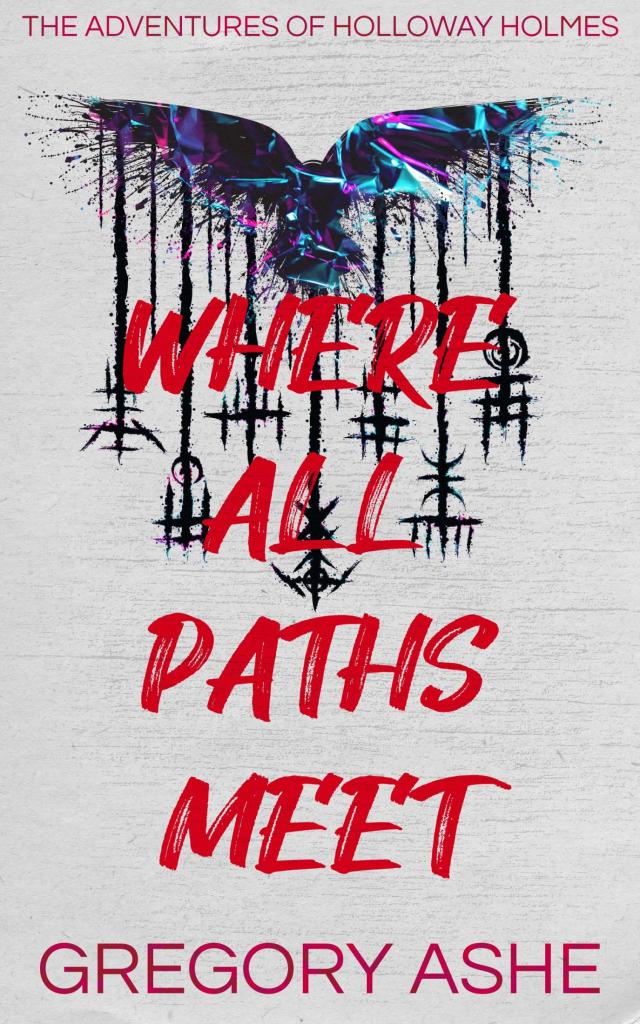


WHERE ALL PATHS MEET
THE ADVENTURES OF HOLLOWAY HOLMES
BOOK 3
GREGORY ASHE
H&B
This is a work of fiction. Names, characters, places, and incidents either are the product of the author’s imagination or are used fictitiously, and any resemblance to actual persons, living or dead, business establishments, events, or locales is entirely coincidental.
Where All Paths Meet
Copyright © 2023 Gregory Ashe
All rights reserved. No part of this book may be reproduced in any form, stored in any retrieval system, or transmitted in any form by any means—electronic, mechanical, photocopy, recording, or otherwise—without prior written permission of the publisher, except as provided by United States of America copyright law. For permission requests and all other inquiries, contact: contact@hodgkinandblount.com
Published by Hodgkin & Blount
https://www.hodgkinandblount.com/
contact@hodgkinandblount.com
Published 2023
Printed in the United States of America
Version 1.04
Trade Paperback ISBN: 978-1-63621-061-2
eBook ISBN: 978-1-63621-060-5
I found myself regarding him as an isolated phenomenon, a brain without a heart, as deficient in human sympathy as he was pre-eminent in intelligence. His aversion to women and his disinclination to form new friendships were both typical of his unemotional character, but not more so than his complete suppression of every reference to his own people.
— “The Adventure of the Greek Interpreter,” Sir Arthur Conan Doyle
Work is the best antidote to sorrow.
— “The Adventure of the Empty House, Sir Arthur Conan Doyle
My hand had drawn him back from that dark valley in which all paths meet.
— “The Adventure of the Greek Interpreter, Sir Arthur Conan Doyle
Chapter 1
The Incredible Growing Boy
I stared at myself in the mirror. “I’m going to do the mature thing.”
Dad didn’t exactly sigh, but he did rub his forehead.
“I’m going to do the only sensible thing,” I said.
“They don’t give out enough good parenting awards, you know that? And they never give them out for moments like this.”
“I’m going to skip prom, spend the rest of my life single, and die alone, at home, a virgin.”
“A little late for that,” Dad muttered.
I broke away from the mirror and rounded on him. “Excuse me?”
“It’s not that bad,” Dad said in a soothing voice. “You look very handsome.”
“That’s what parents say. Because they’re legally obligated.” I held out my arm, so he could see the tux’s sleeve sliding up past my wrist. I showed him the trousers hitting me above the ankle. I crossed my arms for emphasis, and in the silence, you could hear the seams in the shoulders straining. When I’d asked about renting a tux, he’d produced this abomination from under his bed. He probably thought I didn’t know what else he kept down there. The gun safe, for one. That was new.
“Ok,” Dad said. “You’re a little bigger than I was when Mom and I got married. God knows you’ve been working out enough.”
“I look like Frankenstein.”
“I thought Frankenstein had cut-offs.”
“Dad!”
“We’ll figure it out, buddy. We’ll get it tailored.”
“Tailored? No. This thing needs to be burned. And then somebody needs to perform an exorcism on the ashes. And then I can die at home, alone—”
“A ‘virgin.’ Yeah, I heard you.”
Proof of bad fathering: he even drew the air quotes with his fingers.
“I’m glad this is funny. I’m never going on a date again. I’m never going to fall in love. I’m never going to move out. I’m going to die alone, in your basement—”
“We don’t have a basement.”
I drew myself up—which, ok, was kind of hard because the jacket was so snug—and glared at him.
Dad was rubbing his chin suspiciously and refusing to look at me. “What about Glo? You two are cute together. Oh, wait—what about Rowe?”
“Don’t do that.”
“He’s a nice-looking guy.”
“You are not going to weasel out of this by pretending to be supportive of my bisexuality.”
“Hey, hold on, I am supportive—”
“Glo is dating Rowe!”
“Oh.” Dad rubbed his chin. Vigorously. “Well, how was I supposed to know that?”
“They sit on your couch and suck each other’s faces off!”
“What about Emma? You’re always hanging out with Emma.”
“Emma is going with Rowe and Glo. They’re together.”
“Why—
“If you ask me why I don’t go with them, I’m going to Hulk out!”
“You’re halfway out of the tux already.”
I was still trying to Hulk my way out of the tux when the knock came at the door.
“It’s not that I’m mad,” Dad said as he headed down the hall. “I’m just disappointed.”
“That’s not how you’re supposed to use that!” I shouted after him.
“Perfect timing,” Dad said at the other end of the cottage. “Will you please be a gentleman and ask my son to prom?”
I couldn’t stop my squawk of “Dad!”
“Sorry, Mr. Moreno,” Rowe said, his voice moving toward me. “I’m going with Glo and Emma.”
“Can he go with you?”
“Stop embarrassing me!”
Rowe appeared in my doorway. He was one of those obnoxiously masculine guys: he had a few inches on me, as well as probably fifty pounds of muscle, and he had that Minnesota-Scandinavian look of perpetually ruddy cheeks. Combined with puppy-dog brown eyes, an annoyingly full beard, and disheveled blond bangs, he was pretty much the whole package. So, if he’d asked, I probably would have said yes. To prom, I mean. Not that he was bi. And not that he would have asked me if he was. Not that I even thought about him like that.
He took one look at me and burst out laughing. “Holy cow, man. That’s hilarious!”
“It’s not a joke,” I snapped. I tried to squirm out of the jacket, but I couldn’t. “For fuck’s sake, help me!”
“Jack,” Dad bellowed from the front of the house.
Rowe was still laughing as he tugged off the jacket. When it came loose, I said, “Knock it off. It’s my dad’s fault.”
“Rowe, please tell him to be polite to his elderly father.”
“Stay out of this,” I shouted back. “You’re the whole reason I’m in this mess.”
“Dude,” Rowe said with a smile.
I glowered at him too because Rowe was like a teddy bear, and he could take pretty much any amount of glowering. It didn’t have any effect on him. I shucked the tuxedo pants, found a pair of shorts and one of Dad’s old Nirvana tees, and pulled them on. It might have been my imagination, but the shorts seemed to hit me higher on the thigh than I remembered, and the shirt might—might—have been a tiny bit too small. I considered changing again. But what if it wasn’t my imagination? And by then, Rowe was straddling my chair backward, waiting. He was already geared up: running shoes, mesh shorts, a Sin City t-shirt in a bro cut.
“Ready?” Rowe asked.
“Yeah, almost, hold on. Let me finish dying from parental neglect and internalized humiliation.”
Rowe worked a finger in his ear.
“Rowe’s not going to want to date you if you treat your father like that,” Dad called back.
“Everybody’s a comedian,” I said.
I flipped off the lights, and Rowe trailed after me. “So,” he said, “I was thinking we’d change things up. We’ll finish with sprints this time.”
I groaned. “No. I changed my mind. I’m not going.”
He bumped me, and I stumbled into a half-jog and caught myself on the counter. I stopped when I saw the envelope there—the kind of reinforced cardboard mailer that official documents might come in. Lord knows I’d seen enough of those in the year after the accident. Only instead of Dad’s name, it had mine, and there was no return address.
“What’s this?” I asked.
“Rowe brought it in,” Dad said from his recliner, where he was flipping channels.
“I found it on the porch.”
“What is it?” I asked.
“Well, son, there’s this thing called an envelope—”
“I’m going to run away,” I said as I grabbed the mailer. “I’m going to join the circus.”
“The incredible growing boy,” Rowe said. “No clothes in the world will fit him.”
Dad sounded like he was choking, but he managed to say, “It’s probably a college packet.”
“Yeah,” I said as I opened the envelope. “With my grades.”
Two pieces of paper lay inside. The first looked like a greeting card, but when I touched it, it was different—heavier, with a feel and texture that said it was seriously expensive. I pulled it out and gave it a closer look. It wasn’t a greeting card; it was an invitation.
You are invited to the Zodiac “Fabulous Five” Anniversary Party. Below that, it gave details—the party was Saturday, tomorrow, and I was allowed to bring a guest. The only people I knew at Zodiac, the tech conglomerate located at the north end of Utah Valley, were Maggie Moriarty and Blackfriar Hol
I shoved the invitation back into the mailer and took out the smaller piece of paper. It felt different from the invitation—cheap, like copy paper. On it was printed a single sentence: Come if you want to know the truth about your mother.
“Well?” Dad asked. “What is it?”
Giving Rowe a warning look—because, nosy, he’d seen the invitation—I dropped the paper back into the mailer. “Like you said. College stuff.”
“What college?”
“BYU.”
Dad snorted a laugh.
I took the mailer to my room and shoved it under the mattress. When I rejoined Rowe, he was giving me a look, which I chose to ignore.
“All right,” I said. “We’re leaving.”
“Go easy on the sprints,” Dad said. “If you puke on my porch, you’re cleaning it up.”
“See?” I asked Rowe as I ushered him out of the house. “See what kind of love I get?”
The May evening was soft in the twilight, the air sweet with the smell of the water from the sprinklers, the new growth of grass. Rowe was giving me that look again.
“We’re not going to talk about it,” I said. “And you’d better not say anything to my dad.”
“If you need to—”
“I don’t,” I said. And then, because I couldn’t help myself, “I’m not getting caught up in that mess again.”
Rowe made a face. Then he said, “Race you to the athletic center?”
“Are you stupid? We’re doing sprints—God damn it, Rowe!”
I tore off after him.
But as I ran, words thundered in time with my steps.
Come if you want to know the truth about your mother.
Come. Come. Come.
And the answer rose inside me: You’d better believe I fucking will.
Chapter 2
It Was Wonderful Meeting You
I was the proud owner of a 2000 Dodge Dakota (ok, it was still Dad’s, but I got to drive it), and I had my driver’s license, and I even asked permission to go to a party. So, I wasn’t breaking any laws or parental commandments as I drove north on I-15 Saturday night. I was lying by omission, that’s all. And running into whatever trap the Holmeses or the Moriartys had laid for me. And, if anything happened to me, it would kill my dad. I tried to balance the gut-clenching guilt of that against the hope, however small, that whoever had sent that invitation was telling the truth.
Almost two years ago, my mom had died in the same car accident that had left my dad coping with the long-term effects of a traumatic brain injury. Until a few months before, I had believed it was an accident. Now, I wasn’t sure. Now, I knew my mom was a Watson. And I was a Watson. And someone had tried to kill me in a car accident in December. And that made a guy wonder.
In May, Utah was at its most beautiful—the days were warm, the evenings cool, the cottonwoods and plane trees in the valley were coming back to life, and mountainsides were green with scrub oak and pine. Granted, I-15 was never beautiful. It was a hellscape morass of endless construction and bumper-to-bumper traffic, bracketed by the strange mixture of strip malls and fast-food restaurants and holdout agricultural and industrial buildings that told the story of a different time in Utah’s history—one that actually wasn’t all that long ago.
Lehi, a city at the north end of the valley, was one of the places that had changed the most. A number of big tech companies had come to Utah, taking advantage of the business-friendly state government and the natural beauty, and created what some particularly annoying people had taken to calling Silicon Slopes. Among those businesses was the multinational tech conglomerate Zodiac. It did something with social media and AI. And that was about the extent of what I knew, unless you counted the fact that Blackfriar Holmes was the majority shareholder and the CEO, and Maggie Moriarty was his chief of AI. A Holmes and a Moriarty working together. What could go wrong?
With the sun settling behind the mountains to the west, great raven wings of shadow closed over the valley, and I-15 became a pinball machine of lights and cars. It was hard not to think about the past. In September, I’d driven to Zodiac to confront Maggie, part of my investigation into the death of Sarah Watson—my distant cousin, it turned out. Or maybe my aunt eighteen times removed. Or something. I wasn’t sure how it worked. In the process, I’d become entangled with a boy named Holloway Holmes. He’d stowed away in the back of the Dodge, hiding under a tarp. And then he’d popped up like my own personal nightmare jack-in-the-box, and from that moment, we’d been tied together. Inseparable. The quantum reality, I guess, of a Holmes and a Watson finding each other. I’d been stupid enough to think it had been more than that.
When I reached the Zodiac campus, I followed the signs toward the Scorpio building, and that sense of déjà vu swept over me again. Scorpio was where Maggie Moriarty had her lab and office. Scorpio was where Holmes and I had gone all those months before. And tonight, Zodiac’s party would be celebrated in Scorpio. Of course it would be. Why not?
I parked and joined the people trickling toward the building. Cars and trucks and SUVs filled the lot, each one costing somewhere between five and ten times what the Dodge was worth. Ok, maybe even more than that. I mean, it was an old truck. The people heading inside the building looked fancy: an Indian woman in a pale linen dress, her neck strung with gold; a Latino guy in a tailored suit and shoes that had obviously been handmade; a pink-cheeked lady in a Chanel belt and Louboutin heels (I only knew what they were because Ariana had shown me a million pairs she wanted). I was wearing my only pair of black jeans, a white button-up that was (please, God, let it be my imagination) a little too tight across the shoulders, and one of Rowe’s blazers: a wine-colored velvet that he had pronounced fire and that, more importantly, Glo and Emma had signed off on. The Stan Smiths finished everything off. I’d even cleaned them up; I was classy like that.
The Scorpio building, like the rest of the Zodiac campus, was a future-tech hybrid of glass and concrete. At night, it glittered coldly, trapping the valley’s smaller lights in its reflection. Security at the main entrance required everyone to show their invitation, have their bags inspected, and then pass through a metal detector. My phone and keys and wallet went in a little basket, and I held my breath as a dour-faced woman scanned my invitation. Then she waved me through. The metal detector didn’t even beep, which was kind of amazing considering I felt like I had a steel plate in my head.
After stuffing keys and wallet and phone back into their respective pockets, I headed into the lobby. It was a vast space, and the concrete redoubled the echoes as people milled and chatted and congregated in the little pods of seating done in expensive, neutral-colored leathers. I kept my head down as I crossed the lobby, following the crowd down a hall. I hadn’t been this way on my last visit. That visit had been all about sneaking and snooping and getting to Moriarty’s offices without being stopped by security. This visit—well, I wasn’t sure what this visit was going to be like. I could go up to Maggie or Blackfriar and demand the truth about my mom, but I figured that probably wasn’t my best idea. One thing you could trust about the Moriartys and the Holmeses, though, was that they loved drama. I figured someone had brought me here for a reason, and at some point, there’d be a nice, big spectacle that would, doubtless, involve me somehow.
I watched the crowd in sidelong glances and quick, stolen looks, and after a couple of minutes, the knots in my shoulders began to loosen, and I brought my head up. I’d been worried I was going to stand out, but the more I looked around, the more I realized that I’d struck the jackpot. I knew I looked young, but then, a lot of these geeks looked young—they had that pale, slightly translucent look of people who got zero natural sunlight. Like Dad said, I’d been working out a lot this year. Ok, what he said was that I worked out like a psycho. And so, I’d added inches to my chest and arms that made me look, in some ways, at least, older than some of the pencil-necked tech bros in their quarter-zips and their dark-wash jeans. A lot of them looked visibly as uncomfortable as I felt, and they clumped together in little bands, talking with their backs to the crowd. Others stared at their phones or—in one case—tablet. Drag everybody out from behind their computer screens and force them to socialize. Overall, it was going about as well as you’d expect.


