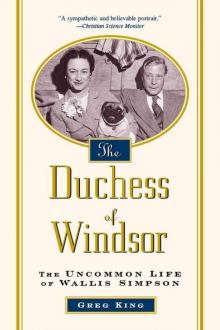
The Duchess Of Windsor, page 25


15
The Nahlin Cruise
IN THE SUMMER OF 1936, King Edward VIII once again left England to take his holiday on the European continent. There was a great deal of criticism over this decision. For twenty-five years, his father, George V, had followed a careful schedule of summer engagements and migrations and had never felt the need to go abroad for the holidays. Yachting at Cowes on the Isle of Wight was followed by stays at Windsor Castle and Holyrood House in Edinburgh and then an extended vacation at Balmoral Castle in Scotland. To many members of the court, Edward VIII’s European holiday was clearly another example of his disregard for tradition and determination to do exactly as he pleased. They conveniently forgot that the King’s grandfather, Edward VII, as well as his great-grandmother Queen Victoria had both regularly taken holidays in Europe.
Originally, David had wished to rent a villa in Cannes, but complications arose. In France, the Laval government had collapsed, and now the left-wing Léon Blum was premier; certain elements in the British government feared that if the King summered in France, radical left-wingers close to Blum might attempt an assassination of the monarch.
Instead, David decided to charter a yacht and cruise along the Dalmatian coast, through the Bosporus and the Greek Isles. He had wished to embark on the voyage from Venice; but this news sent members of the Foreign Office into a frenzy. Mussolini had recently invaded Abyssinia, and his intervention in the Spanish Civil War caused much unease among members of the British government. The Foreign Office eventually insisted that the King avoid Italy altogether, and reluctantly he agreed.
From Calais, Wallis and the King took a private car coupled to the Orient Express through Austria to Yugoslavia. Here they were met at the frontier by Prince Paul of Yugoslavia and took tea with him and his wife, Princess Olga, sister of Princess Marina, Duchess of Kent.
A crowd of some twenty thousand people, dressed in their colorful native costumes, waited in the Dalmatian port of Sibenik to see the royal group off at the pier. Here, where there had been no news blackout over the King’s romance, there was great curiosity over Wallis. As she strolled down the pier, she felt the inquisitive eyes of the gathered thousands upon her.
The King had the old royal yacht Victoria and Albert at his disposal, but for this voyage he decided that a more modern ship was in order. He had chartered a 1,391-ton yacht called the Nahlin, a 250-foot-long shining white beauty crowned with two tall masts and a low white funnel. Large awnings sheltered the teak decks, which were scattered with wicker chairs and tables; below were eight main staterooms, each with its own bathroom.1 Everywhere the yacht went, it was shadowed by an escort of two British destroyers, HMS Grafton and HMS Glowworm, whose presence ensured that the voyage would not remain a secret.
A number of friends joined David and Wallis on the cruise. This group included Herman and Katherine Rogers; Duff and Lady Diana Cooper, Lord Sefton; Mrs. Josephine Gwynne (an American friend of Wallis’s); Helen Fitzgerald; Colin and Gladys Buist; the Duke of Kent’s equerry, Humphrey Butler, and his wife; the King’s favorite golf partner, Archie Compston; John Aird, the King’s equerry; and the King’s two assistant private secretaries, Godfrey Thomas and Tommy Lascelles. 2 Lady Cunard and Lord and Lady Brownlow later joined the yachting party as well.
For a month, the yacht cruised up and down the coast; occasionally, it steamed into a deserted cove, and David, Wallis, and others would take a launch or paddle boat ashore, where they would swim and picnic on the beaches. There were also frequent visits ashore to small coastal towns where Wallis and David dined in sidewalk cafes and haunted the local shops for souvenirs.
Lady Diana Cooper recalled one of these visits on shore: “The King walks a little ahead talking to the Consul or Mayor, and we follow, adoring it. He waves his hand half-saluting. He is utterly himself and unselfconscious. That I think is the reason why he does some things (that he likes) superlatively well. He does not act. In the middle of the procession he stopped for a good two minutes to tie his shoes. There was a knot and it took time. We were all left staring at his behind. You or I would have risen above the lace, wouldn’t we, until the procession was over? But it did not occur to him to wait, and so the people said: ‘Isn’t he human! Isn’t he natural! He stopped to do up his shoe like any of us!’ “3
In Corfu, Wallis and David dined with King George II of the Hellenes, only recently restored to the Greek throne after a forced exile. Also present was the King’s mistress, Mrs. Britten-Jones, an Englishwoman who had just been divorced from her husband. This peculiar situation, with the two cousins who reigned over their respective countries sitting side by side with their respective mistresses, did not go unreported, and news of the luncheon caused a riot of gossip among London society.
The group spent a day visiting different sights on Corfu. The group toured Mon Repos, the royal villa which Queen Olga had copied from one where she had spent her summers in Russia at the imperial estate of Alexandra, Peterhof. There was also a visit to the empty white marble palace originally built by Empress Elizabeth of Austria and last inhabited by Kaiser Wilhelm II. They found the iron gates locked, and David happily climbed atop them and broke the lock so that his group could explore the gardens.4
They returned to the yacht at the end of a long day. Lady Diana Cooper, who was unwell and suffering from a violent bout of flu, recalled that a chair was accidentally placed atop the hem of Wallis’s gown, ripping it. David got down on his hands and knees to pull it clear, but Wallis seemed more irritated at the loss of the dress than pleased at the display of gallantry. She had not particularly enjoyed her day and began to complain of the way in which David had treated Mrs. Britten-Jones, perhaps overly sensitive about her paramour’s behavior toward another royal mistress.5
By this point, Diana was rapidly becoming disenchanted with both her own ill health and the trip itself. Something of her disillusion is reflected in the cutting comments she made about the King’s mistress. She reported: “Wallis is wearing very, very badly. Her commonness and Becky Sharpishness irritate.... The truth is she’s bored stiff by him, and her picking on him and her coldness towards him, far from policy, are irritation and boredom.”6
Many years later, when asked to reflect on the cruise, Diana declared: “I have constantly been asked if I thought they went to bed together on the Nahlin and so on. I tell them all, ‘I haven’t the least idea. How should I know?’ Though I’m perfectly sure they did.”7
One memorable evening, as the Nahlin lay anchored off the small fishing village of Cetinje, Wallis and David stood on deck, watching the sun set. Suddenly, hundreds of people appeared along the shore and climbed down the winding hillside paths leading to the beach, all carrying flaming torches. As they stood silhouetted against the night sky, they sang folk songs to the distant yacht, the sounds of their voices floating over the quiet waters. David assured Wallis, “It’s all for you—because these simple people believe a King is in love with you.”8
At the request of the Foreign Office in London, the royal party made its way to Istanbul. Britain had recently concluded a commercial trade agreement with Turkey, and the government was anxious to reinforce its willingness to forge stronger ties with the dictator there, Mustafa Kemal Atatürk. Atatürk treated Wallis as if she were a queen, seating her beside David during a celebratory parade and, later, at a magnificent state dinner. As evening fell, Atatürk ordered hundreds of small boats, covered with flickering lights which sparkled as they bobbed in the waters, into the harbor.
The royal party returned by train through Bulgaria, Yugoslavia, and on to Vienna. Here they visited old friends, stayed at their favorite hotel, the Bristol, attended a performance of Wagner’s Götterdämmerung in the company of Winifred Wagner, the composer’s daughter-in-law, and dined at the famous Three Hussars Restaurant. Society hostess Elsa Maxwell happened to be in the lobby of the Bristol when the royal party arrived. She recalled: “The clicking of heels by the manager and his staff sounded like castanets and a crew of porters scurried through the door with mountains of luggage. Then the King’s entourage entered, led by a small, beautifully dressed woman. Her sullen expression and the purposeful way she walked gave me the impression that she would brush aside anyone who had the temerity to get in her path. I took a second, startled look at her when I saw the King following a few paces behind. I had never seen Mrs. Simpson, but from pictures of her it was no feat of deduction to guess her identity.”9
After a short visit to Zurich, the King returned to London; Wallis went on to Paris to spend a few days alone. It was then that she began to learn just how much controversy her recent holiday with David had caused. This should scarcely have come as a surprise, given the very public manner in which David and Wallis had conducted themselves; they seemed oblivious of the crowds of curious onlookers and hordes of photographers that followed them around from place to place. Naively, they assumed that they would be left alone. Now no one could seemingly hear enough about this extraordinary voyage, which Michael Thornton has called “the most bizarre royal odyssey since the Prince Regent’s wife, Caroline of Brunswick, cavorted through Europe with her Italian chamberlain, Bartolomeo Bergami.”10
The reaction in English society was decidedly unfavorable. Osbert Sitwell, a typical aristocrat with strong anti-American views, wrote disparagingly of those who had accompanied the King on the cruise: “They were, for the most part, a wise-cracking team of smartish, middle-aged, semi-millionaire Americans, with the usual interchangeable names and over-life-size faces, customarily to be seen in bars and in hotels in Paris and the South of France—the rootless spawn of New York, Cracow, Antwerp, and the Mile End Road, with loud voices, never a doubt except of their own position and continual loud laughs bottled in alcohol and always on tap.”11 Sitwell, however—in common with a great many like-minded critics—seemed to have conveniently ignored the fact that more than half of the guests were, like himself, members of the English aristocracy.
The only mention made in the British press came in the London weekly magazine Cavalcade, which printed a front-page picture of the King, with Wallis, and captioned it: “The Duke of Lancaster and a Guest.”12 All American magazines and newspapers shipped to Britain had any references snipped by censors. But now, in Paris, Wallis read for the first time mail forwarded from her friends and family in the United States which informed her of the press she and the cruise were receiving in American newspapers. She was shocked; when she informed David, however, he assured her that the British press had agreed to maintain their silence.13
The Nahlin cruise, which Wallis had hoped would be a time for private romance, had instead turned into something of a string of strained appearances, culminating in the barrage of press attention around the world. Although her memoirs do not mention the fact, Wallis—weary of living her life in the public eye and fearful that she was damaging David’s position on the throne—now tried to sever her relationship with David. Ernest was living with Mary Kirk, and divorce proceedings had begun, but she believed that if she told him that the only way in which to save the monarchy was to return to her, he would comply and agree. With this thought in mind, she awoke from the dream into which she had happily allowed herself to sink and faced what could only be the unpleasant reality of her situation. Now she only wanted to escape her royal entanglement.
From the Hotel Meurice in Paris, she wrote what was intended to be a farewell letter to David: “I must really return to Ernest.... We are so awfully congenial and understand getting on together very well.... I know Ernest and have the deepest affection and respect for him. I feel I am better with him than with you—and so you must understand. I am sure dear David that in a few months your life will run again as it did before and without my nagging.... I am sure you and I would only create disaster together. I shall always read all about you ... and you will know I want you to be happy. I feel sure I can’t make you so and I honestly don’t think you can me.”14
But David refused to listen to Wallis. He pleaded with her, begged her not to give him up. She was too fond of him to hurt him by pressing her case. Things were moving too quickly for her, and she found herself dazzled by rapidly moving circumstances. Years later, she would tell author Gore Vidal: “I never wanted to get married. This was all his idea. They act as if I were some sort of idiot, not knowing the rules about who can be queen and who can’t. But he insisted.”15
When she returned to England, Wallis was forced to deal directly with her divorce. In July, her solicitor, Theodore Goddard, had lodged the case against Ernest. On Goddard’s advice, the divorce would be heard outside London and thus away from the press. He selected Ipswich, in Suffolk, as a likely spot; this required Wallis to take up temporary residence there, and she let a cottage called Beech House near Felixstowe. She had agreed to let the flat at Bryanston Court go and had to make the arrangements on her way to Ipswich.
Before taking up residence in Felixstowe, Wallis joined David at Balmoral in Scotland. Queen Mary had been delighted to hear that David was going to Balmoral, as his father had, and dared to hope that this marked at least some return to tradition; but then she discovered that Wallis was also to stay at Balmoral, a move which seemed to indicate the worst.
Herman and Katherine Rogers accompanied Wallis on the train north to Aberdeen; David met them at the station. This caused something of an incident. Previously, the lord provost of Aberdeen, on behalf of the authorities at a local hospital, had asked the King to dedicate the new Royal Infirmary buildings in the town. The King, however, had refused, saying he was still in mourning for his father, and he asked the Duke of York, who was staying at Birkhall, on the Balmoral estate, with his family, to perform the task in his place. But on the very day that the Duke was across town dedicating the hospital in his mourning brother’s place, David was seen as he greeted Wallis and her friends at the railway station and escorted them to Balmoral. On his orders, Wallis had not even gone as far as the royal station at Ballater, which would have offered more privacy than the very public railway siding in Aberdeen.
David naively thought that such an action would go unnoticed. That evening, the headline of the Aberdeen Evening Express read: “His Majesty in Aberdeen—Surprise Visit in Car to Meet Guests.” The article that followed was a masterpiece of understatement and made no comment on the invitation which the King had refused: “The King made an unexpected visit to Aberdeen today to welcome some of his guests who travelled from London by train.... His Majesty did not enter the station but received his guests at the entrance. Only a few people, mostly railway employees, were at the station entrance at the time but they immediately recognized His Majesty as he stepped from his car. They doffed their hats and caps, and their greeting was acknowledged by a salute from the King who was in Highland dress. He again saluted as the car drove off.”16
When the Duke and Duchess of York learned of that afternoon’s events, they were exceptionally angry, feeling—quite rightly—that David had used them.17 More to the point, no one was fooled by the King’s actions; court mourning had come to an official end in July If the Duke of York could be expected to perform his duties, there was no reason for his brother to remain in seclusion.
Wallis spent a week at Balmoral. At the King’s request, those guests traditionally invited to the castle—the prime minister, the Archbishop of Canterbury, and cabinet ministers—were excluded. It would not be correct, however, to say that David had abandoned established society entirely, for he filled Balmoral with guests that represented the cream of the British aristocracy. Among those present were the Duke and Duchess of Kent; Lord and Lady Louis Mountbatten; the Duke and Duchess of Marlborough; the Duke and Duchess of Buccleuch; the Duke and Duchess of Sutherland; and the Earl and Countess of Rosebery.
David’s decision to eliminate what had formerly been at least a semiofficial guest list caused much distress among both his family, who felt he was ignoring tradition, and certain members of the government, who saw it as evidence of his growing disinterest in the political side of his position. But David felt differently. His time at Balmoral formed the last few weeks of his holiday, and he had no desire to fill his leisure time with official meetings. Any necessary business, he declared, could be transacted through official channels via the red-leather dispatch boxes, which continued to arrive daily or by cable or telephone.18
He also had more personal reasons for excluding Cosmo Lang, Archbishop of Canterbury. For several months, he had been keenly aware of Lang’s disapproval over his relationship with Wallis. The Archbishop, an elderly, conservative, and narrow-minded man, made no secret of his feelings; rather than discuss the growing problem with the King himself, he preferred to confide his doubts in others in the Royal Family—particularly Queen Mary and the Yorks—as well as government officials and members of society. Not surprisingly, David had little patience for the Archbishop and no desire to spend the last week of his holiday under his inquisitive eye.19
Wallis enjoyed Balmoral and took long walks along the River Dee and through the surrounding forests. Wallis and Edwina Mountbatten accompanied the men on their shoots for grouse and pheasant, joining in the picnic lunches set up beside waterfalls and in forest clearings. Lord Louis Mountbatten’s new valet, Charles Smith, recalled: “Mrs. Simpson dressed smartly for the shoot. She changed into a warm tweed costume and boots. I found her very friendly and considerate, far from the dominating type of woman the public was led to believe she was.”20 Others, however, found her presence less welcome. In the evenings, there were games of cards in the drawing room or motion pictures in the castle’s ballroom. Afterward, Wallis arranged for triple-decker toasted sandwiches to be served, an unusual meal which the guests enjoyed but which the servants, who were thoughtlessly kept up quite late working in the kitchens, found intolerable.21