

Bastille Day, page 1


2023 First Printing
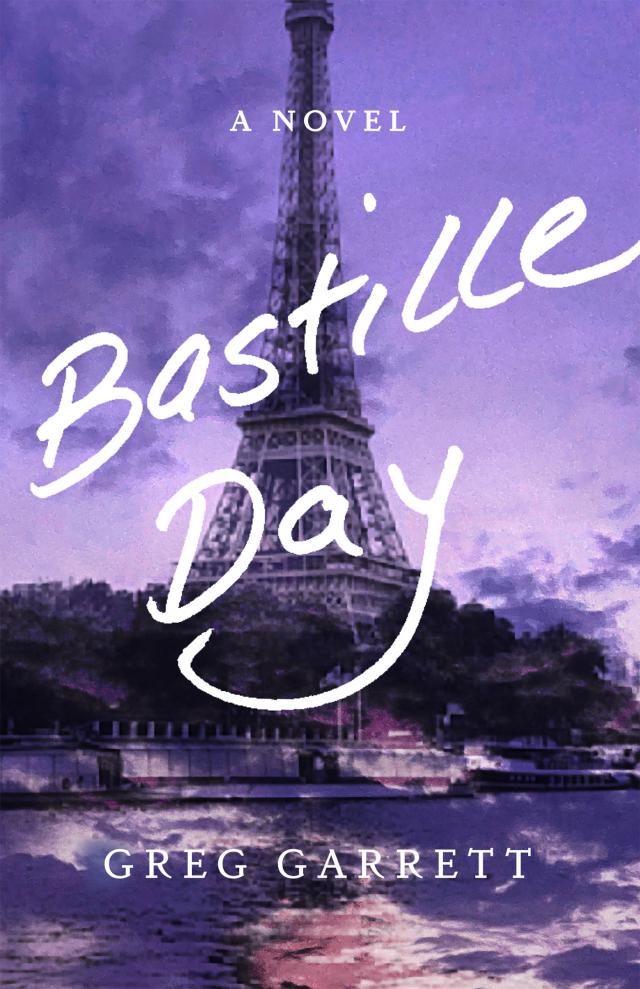
Bastille Day: A Novel
Copyright © 2023 by Gregory Todd Garrett
ISBN 978-1-64060-751-4
The quotation on page 4 is taken from “Fortunate Son,” written by Bruce Hornsby, published by Zappo Music c/o Downtown Music Services, and is used with permission.
The Raven name and logo are trademarks of Paraclete Press.
Library of Congress Cataloging-in-Publication data
Title: Bastille Day : a novel / Gregory Garrett.
Description: Brewster, Massachusetts : Paraclete Press, 2023. | Summary: “Garrett’s characters wrestle with the ghosts of their pasts, as they long for love, and faith in the present: Our histories can damage us, but hope can heal us.”—Provided by publisher.
Identifiers: LCCN 2022044089 (print) | LCCN 2022044090 (ebook) | ISBN 9781640607514 (trade paperback) | ISBN 9781640607521 (epub) | ISBN 9781640607538 (pdf)
Subjects: BISAC: FICTION / Christian / Contemporary | FICTION / Christian / Romance / Suspense | LCGFT: Christian fiction. | Novels.
Classification: LCC PS3607.A77 B37 2023 (print) | LCC PS3607.A77 (ebook) | DDC 813/.6--dc23/eng/20220913
LC record available at https://lccn.loc.gov/2022044089
LC ebook record available at https://lccn.loc.gov/2022044090
10 9 8 7 6 5 4 3 2 1
All rights reserved. No portion of this book may be reproduced, stored in an electronic retrieval system, or transmitted in any form or by any means—electronic, mechanical, photocopy, recording, or any other—except for brief quotations in printed reviews, without the prior permission of the publisher.
Published by Paraclete Press
Brewster, Massachusetts
www.paracletepress.com
Printed in the United States of America
FOR JEANIE
Je t’aime. Je t’adore. Now. Forever.
Contents
Prologue
1. London
2. Paris
3. Paris
4. Paris
5. Paris
6. Paris
7. Paris
8. Paris
9. Paris
10. Paris
11. Nice
12. Paris
13. Paris
14. Paris
15. Paris
16. Paris
17. Paris
18. Paris
Acknowledgments
About the Author
“Well I was always taught well, taught well
To be the strong one and keep it inside
But sometimes I sit beside the freeway
And howl out at the dark, dark sky”
Bruce Hornsby, “Fortunate Son”
PROLOGUE
Paris
July 14, 2017
My late father, Master Sergeant Calvin Jones, impressed on me that it was essential to always tell the truth, no matter the personal cost. He didn’t know he was forming me into a journalist, or that he was shaping me to tell this story. Seriously, he was just one of those straight-arrow Army types who believed that George Washington really did chop down a cherry tree but at least he told the truth about it. My father could only see the world in terms of truth and lies, good and bad, them and us.
True story: I cheated on a geography test in seventh grade. Only once. I hadn’t studied, and it looked like Dean Mottola was breezing through the quiz, so I looked over and stole his, although I ought to have known even then that Iran and Iraq were not interchangeable and that Saudi Arabia was not to be found in Europe. Dean Mottola was an idiot, and I was an idiot for copying his answers.
I cheated, and I got caught, and when I tried to lie my way out of it, my father beat my ass.
But it wasn’t the whupping that made the biggest impression. It was the way my father’s face crumpled as I tried to spin my ridiculous tale, as though I had failed him as well as my geography test.
Because I had.
Because I had.
I learned to tell the truth.
And to associate with a smarter class of people, for God’s sake.
I didn’t tell my father another outright lie until the biggest one, the ongoing one: that I didn’t worry about him when he deployed to Iraq.
Truth: I worried about him every time he deployed, every day of his life.
Truth: I worry about him to this very day.
I went to see him in country one time, a year or so before he died. I had arrived three days earlier, hadn’t been embedded with my unit yet, and I hitched a ride from the Green Zone in a Bradley with some guys I found out were heading to Fallujah. I was technically off the reservation and could have been sent home. This was not the unit I was going to be embedded with, just some decent Joes who wanted to help a guy see his father who was a career non-com, “one of the good guys,” as they put it.
I found my dad walking a shattered street with his men, checking house to house. He wasn’t surprised to see me; he was upset.
“You shouldn’t have come here, Cal,” he told me, right after he shook my hand. “This city is a powder keg. And if you get blown up, your mother will give me holy hell when I get to heaven.” Anne Johnson, my mother, passed when I was small, and exists now mostly in old photos and in the moment before I drop off to sleep.
“Assuming you even get to heaven,” I told him.
His boys thought that was funny.
“True that,” one of them said.
My father was right, of course. Just being in Iraq put me in danger every damn day. The network was spending something like $15,000 a month on my life insurance policy, and it got more expensive as the country became even more dangerous for journalists. Some bean-counter at Aetna was already pretty sure that I was not going to survive this assignment, and going to the Anbar Province was an astonishing risk. Fallujah was the worst, even early on, and it got worse still, as you will hear. But I’m glad I went. I’d do it again, even though I caught holy hell from the network when I returned. My producer, Callie, threatened to replace me. Said there were a lot of people who would kill to be where I was.
“Or get killed,” I told her, which shut her up.
It was worth it.
If I hadn’t gone to Fallujah that day, I’d never have known that my father was proud of me.
“This is my boy,” he said, introducing me to everyone we met, to his other boys and to Iraqi commanders and to the occasional shopkeeper. “He’s here to tell the world about what’s going on. He’s here to tell the truth.”
Well. True that.
That was over ten years ago. A lot has happened since that day, some of which I will have to tell for you to know the whole story. To understand what happened in Paris and before, and, maybe, after.
But all of it will be true.
You have my word.
As I write this, I live in Paris. Maybe I always will, although it’s too early to say where telling this story is going to leave me, if the city is going to feel to me like a place I lost myself or found myself.
But you probably already know: this story isn’t going to leave me or you where it found us, because that is the truth of all stories worth telling.
They always take us someplace else, always leave us trying to figure out what just happened.
So turn the page.
I’ve got a story to tell you, and it’s time we got started.
1.
London
July 9, 2016
Saturday
I shouldn’t be here.
And by “here,” I didn’t just mean the third floor of Selfridge’s Department Store on London’s Oxford Street, where I stood surrounded by wealthy Arab women in lavish veils and ornate burqas shopping for lingerie, although that had me feeling plenty uncomfortable. I haven’t had many great experiences with Arab women. Many of them wanted me dead.
Some of them have said so to my face.
But that wasn’t it, wasn’t what I was thinking, exactly. It was more like:
I shouldn’t even be alive.
A couple of days earlier, I had been face-down on a Dallas street, bullets flying over my head, people getting shot.
And someone died right in front of me.
Again.
Thinking about everything I had seen—or trying to stop thinking about it, I guess, which was what I had been doing for days—was maybe why I was standing, frozen, a lacy purple bra dangling from my hand for a length of time that probably made me an object of conjecture for others in the lingerie department.
Which was to say, a room full of Arab women covered head to toe in gorgeous fabric and, apparently, sporting push-up bras and lace panties beneath those coverings.
I didn’t think I could be any more disconcerted by Arab women, but I discovered that, actually, once you added that fact, I could.
Someone slid in beside me and spoke: “You are buying this for your mistress, yes?”
The voice was soft, low, humorous, beautifully inflected, and it shook me out of my reverie. The formal syntax suggested English was not her first language, although the accent was classic Oxbridge.
I looked to my right, where the speaker stood, herself covered head to foot in black. Her Selfridge’s badge, pinned to her shoulder, read “Anna.” Two brown eyes twinkled back at me.
I don’t know if it was her words—or her eyes—but I momentarily lost command of the English language. I put the bra down, then picked up another so my hands had something to do. “What? Um, no. I mean, I don’t have a mistress. No. A girlfriend. I guess. Yes. A
Her eyes drifted languidly left and right to see if she was needed elsewhere, then she began refolding the lacy underthings in front of her.
“Perhaps you should be very certain of that before you make any purchase.” Her eyes indicated the white push-up bra with breathtaking lace décolletage I was now holding. “Everything here is … expensive.” I guessed she was comparing my worn jeans and battered combat boots to my choices in lingerie and finding them wanting.
I sighed, nodded.
“That is how she prefers things,” I said.
She was Kelly McNair, who made her debut in Houston before coming to Dallas to do interior design and generally enjoy life. We’d been dating for two years, more or less, and I didn’t feel that I knew her any better than I did on our first date. Perhaps she’d say the same of me. I’m not easy to know, and it’s probably better if you don’t get inside my head and poke around too much.
“We make a nice-looking couple,” she liked to say, which was true enough.
I was on TV; she was pretty enough to be on TV. Maybe she felt like that was enough.
“Will you marry her? This girlfriend with expensive tastes?”
Anna was still folding lingerie. She picked up one of the bras in front of her, held it up, turned it side to side, shook her head, set it down.
I shook my head along with her. “No. I don’t think so.”
She looked left and right again, still satisfied that nobody needed her more than me at that moment, and so she turned to look at me full on.
“Do not marry someone you do not love,” she said. Two fingers on my forearm were punctuation. I could feel their imprint after her hand moved, after she turned her attention back to the lingerie.
“What?” I felt stunned, as though she had tased instead of touched me.
“Do not marry someone you do not love,” she repeated. It sounded as if she might have some personal knowledge of the situation.
“Um, okay,” I stuttered. “I mean, well, it doesn’t look like anyone is getting married. I’m going to Paris to start a new job. The girlfriend is staying in Texas.”
“Oh, Paris,” she said. I could hear the smile, although I could not see it. “You will meet someone there.”
“Of course,” I said. “I have seen that movie.”
A voice growled across the room: “Anna!” and both of us jumped.
An older Arab woman—guessing by her voice—clad head to foot in black, stomped across the room, looked at me with all the menace that two eyes can deliver, and took Anna by the arm. Judging by the heaping armful of lingerie, she was ready to check out. I looked right back at her, disdain for disdain.
I had seen those eyes before in the Anbar Province when American soldiers took someone’s son or husband or grandson away. When I followed a squad through a shattered front door to find a family quailing, on their knees, but one strong mother or grandmother fixing these invaders—fixing me—with the evil eye.
The woman and Anna spoke to each other in Arabic. I understood a little. Enough to know I’d been insulted. Anna pulled her arm gently free, soothed the older woman, who offered me another scorching look and turned toward the checkout desk.
“Goodbye, American boy,” Anna said over her shoulder as she walked away. “Remember what I told you.”
“Boy?” I wanted to say.
When I was just a boy, I spent three summers lifeguarding. I saved people who were drowning. When I became a man, I stood alongside soldiers in combat so I could tell their stories. I’ve seen men, women, and children blown to pieces. I just held a man as he died, and that was not an action for boys, let me tell you, sister.
But what I said, instead, in creaky but technically correct presenttense Arabic, was “I thank you, Anna. Actually, I will purchase these.”
And I followed her and the glaring woman to the checkout desk to spend a substantial part of my first paycheck from the new job in Paris.
2.
Paris
July 11, 2016
Monday
Rob, my new boss and my old friend, had proposed we meet at Harry’s New York Bar to celebrate my first day on the job. He said it was one of his favorite bars, and it might be a nice way for this American to step into Parisian life. I agreed. I had read about Harry’s in a James Bond story, “From a View to a Kill.” The 16-year-old James had told his taxi driver to take him to “Sank Roo Doe Noo,” as the ads have advised French-illiterate English speakers to do for a hundred years, and there had commenced what Bond described as “one of the memorable evenings of his life,” culminating in the loss of both his virginity and of his wallet.
I took the Metro from my new apartment on the rue Edmond Valentin, in the Seventh Arrondissement near the Eiffel Tower. I had already discovered that if I took to a chair on my sixth-floor balcony I could see almost the entire Tower, although I don’t think the network’s insurance provider would approve, and honestly, I could see plenty of the Tower without climbing. Heights got to me.
I stepped off the subway at the Opéra Garnier, loitered for a few minutes on the front steps of the baroque gilded opera house people-watching, then made my slow and tentative way down through the narrow streets to 5 Rue Daunou carrying my notebook and my battered paperback of Ian Fleming’s For Your Eyes Only to read while I waited, because I expected to wait.
I had never even been to Paris before I agreed to go to work for Rob. Truth to tell, if not for him, I would not have come. He’d told the higher-ups at his network that I had two years of French (which I did, indeed, in high school) to accompany the Arabic, Kurdish, and Pashto I’d picked up during three years’ reporting in Iraq and Afghanistan. And Spanish, from growing up with bilingual kids on the base and doing news in Dallas, Texas, for a solid decade. Who better, he asked the higher-ups, to report on terrorism in Europe?
Well. I could have named a dozen people without stopping to think, all of them also more stable than me at this moment. But the timing was good—I had nothing to look forward to where I was—and I did want to work with Rob again.
If he ever arrived, since he was always, always late.
Harry’s was all but empty at midday. I was supposed to arrive at 2, but as I stepped to the door of the bar at 2:15, Rob texted to say he was running late, 2:30 maybe. I suspected 3. Inside, the bartender, dressed in a white jacket, black tie, and white apron, leaned onto the bar talking to a young Arab woman with long lashes. She was wearing form-fitting running clothes and had a dog leash draped across her lap. A couple of beefy Americans, man and wife, maybe, sat in a booth at the back drinking what looked like a Bloody Mary and a French 75, both drinks reputed to have been created at Harry’s.
I was disappointed. I had expected Harry’s to be a party out of Scott Fitzgerald. Drinks should be flowing, a piano should be playing—didn’t Gershwin write An American in Paris here?—but this was just a dark and frankly tiny bar that was not dissimilar to the dive where I used to drink after work in Dallas with my cameraman, Ted.
I took a seat at the polished bar, two chairs down from the woman. She glanced over, then turned back to the bartender. I flashed back to Anna in London, the almond brown eyes, sure, the fact that she was Arab. Saudi, maybe, but very Western. She was wearing yoga pants and an oversized white top, with the straps of an athletic bra peeking at her shoulders. That middle-aged shopper in Selfridge’s would have slapped her silly for showing so much skin.
“Monsieur? What can I bring you?” the bartender asked, bringing me back to now. His English was accented. Eastern Europe. Maybe one of the former Soviet states. He had a thick black moustache, and unruly dark hair, cut short and spiky. The name badge on his apron read “Frederick.”
“An Old Fashioned, Frederick,” I told him. “With Bulleit, if you have it. And bring me another every fifteen minutes until my friend arrives.”
Frederick raised an eyebrow. He knew from long experience that this was not a recipe for a successful afternoon.
“Always late,” I sighed. “Our longstanding deal is, I drink on him. One drink every fifteen minutes. If he doesn’t want to pour me into a taxi, he’s got to arrive in some reasonable amount of time.”
“Very good, monsieur,” he said. “But almost you have to drink the whisky sour if you are going to sit on that stool,” he said, indicating with his head as his hands washed glasses in the sink. “It is Mr. Hemingway’s.”


