

The Holdout, page 1


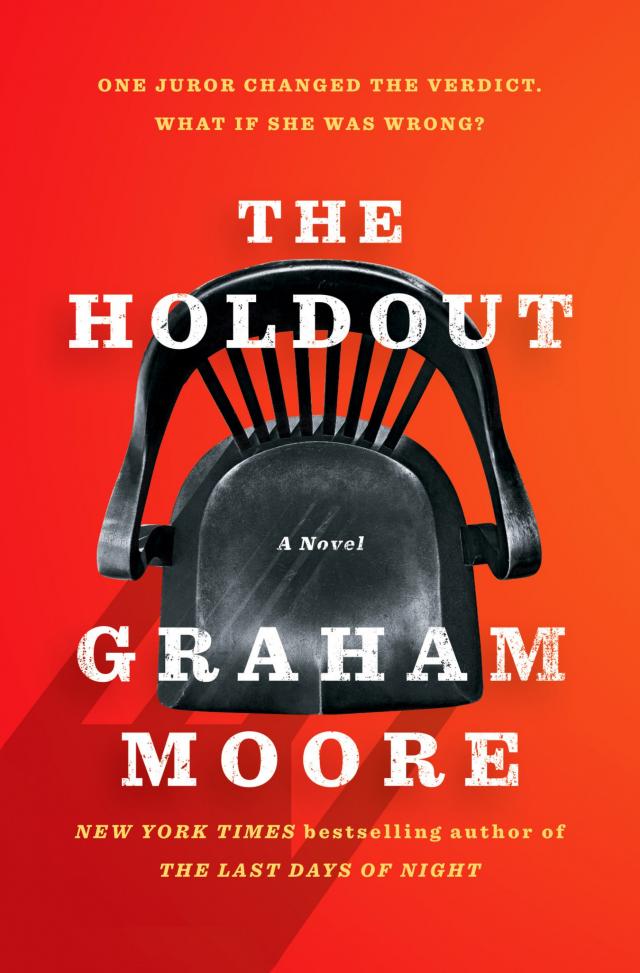
The Holdout is a work of fiction. Names, characters, places, and incidents are the products of the author’s imagination or are used fictitiously. Any resemblance to actual events, locales, or persons, living or dead, is entirely coincidental.
Copyright © 2020 by Graham Moore
All rights reserved.
Published in the United States by Random House, an imprint and division of Penguin Random House LLC, New York.
Random House and the House colophon are registered trademarks of Penguin Random House LLC.
LIBRARY OF CONGRESS CATALOGING-IN-PUBLICATION DATA
Names: Moore, Graham, author.
Title: The holdout: a novel / Graham Moore.
Description: First Edition. | New York: Random House, 2020.
Identifiers: LCCN 2019029712 (print) | LCCN 2019029713 (ebook) | ISBN 9780399591778 (hardcover) | ISBN 9780399591785 (ebook)
Subjects: LCSH: Race relations—Fiction. | African Americans—Fiction. | Trials (Murder)—Fiction. | Rich people—Fiction. | Missing persons—Investigation—Fiction. | GSAFD: Legal stories. | Mystery fiction.
Classification: LCC PS3613.O5575 H65 2020 (print) | LCC PS3613.O5575 (ebook) | DDC 813/.6—dc23
LC record available at https://lccn.loc.gov/2019029712
LC ebook record available at https://lccn.loc.gov/2019029713
Hardback ISBN 9780399591778
International edition ISBN 9780593138816
Ebook ISBN 9780399591785
randomhousebooks.com
Cover design: Evan Gaffney and Carlos Beltrán
Cover photograph: Evan Gaffney
v5.4
ep
Contents
Cover
Title Page
Copyright
Chapter 1: Ten Years in L.A.
Chapter 2: Rick
Chapter 3: H-O-P-E
Chapter 4: Wayne
Chapter 5: A Fool for a Client
Chapter 6: Maya
Chapter 7: How Many People Know All This?
Chapter 8: Cal
Chapter 9: He Didn’t Do This Alone
Chapter 10: Peter
Chapter 11: Miracle
Chapter 12: Jae
Chapter 13: I Might Be the Best Friend You’re Going to Get
Chapter 14: Kathy
Chapter 15: East Jesus
Chapter 16: Trisha
Chapter 17: Surrender
Chapter 18: Yasmine
Chapter 19: I’m So Sorry
Chapter 20: Fran
Chapter 21: The Week’s Freshest Rotten News
Chapter 22: Lila
Chapter 23: A Second Verdict
Chapter 24: Carolina
Chapter 25: Guilty Parties
Dedication
Acknowledgments
By Graham Moore
About the Author
CHAPTER 1
TEN YEARS IN L.A.
NOW
Maya Seale removed two photographs from her briefcase. She held them face-in against her skirt. This thing was all going to come down to timing.
“Ms. Seale?” came the judge’s voice, impatient. “We’re waiting.”
Belen Vasquez, Maya’s client, had suffered terrible abuse at the hands of her husband, Elian. There were extensive ER records to prove it. One morning a few months back, Belen had snapped. She’d stabbed her husband while he was sleeping and then cut off his head with a pair of garden shears. Then she’d driven around for an entire day in her green Hyundai Elantra with the severed head mounted on the dash. Either nobody noticed or nobody wanted to get involved. Eventually, a cop had pulled her over for running a light and she’d managed to stuff the head in the glove compartment.
The good news, from Maya’s perspective, was that the prosecution had only one piece of solid physical evidence to use against Belen. The bad news was that the evidence was a head.
“I’m ready, Your Honor.” Maya placed a reassuring hand on her client’s shoulder. Then she walked slowly to the witness box, where Officer Jason Shaw sat waiting, his Distinguished Service Medal displayed prominently on the lapel of his blue LAPD uniform.
“Officer Shaw,” she said, “what happened when you pulled over Mrs. Vasquez’s car?”
“Well, ma’am, like I was saying, my partner remained behind Mrs. Vasquez’s vehicle while I approached her window.”
He was going to be one of those cops who did the “ma’am” thing with her, wasn’t he? Maya hated the “ma’am” thing. Not because she was thirty-six, which she had to admit was probably “ma’am”-worthy, but because it was such a transparent attempt to make her seem stuck up.
She tucked her short, dark hair behind her ear. “And when you approached the window, did you observe Mrs. Vasquez sitting in the driver’s seat?”
“Yes, ma’am.”
“Did you ask her for her license and registration?”
“Yes, ma’am.”
“Did she give them to you?”
“Yes, ma’am.”
“Did you ask her for anything else?”
“I asked her why there was blood on her hands.” Officer Shaw paused. “Ma’am.”
“And what did Mrs. Vasquez tell you?”
“She said that she cut her hand in the kitchen.”
“And did she present any evidence to support her claim?”
“Yes, ma’am. She showed me the bandage across her right palm.”
“Did you ask her anything else?”
“I asked her to step out of the vehicle.”
“Why?”
“Because there was blood on her hands.”
“But hadn’t she given you a perfectly reasonable explanation for the blood?”
“I wanted to investigate further.”
“Why did you need to investigate further,” Maya asked, “if Mrs. Vasquez had given you a reasonable explanation?”
Shaw looked at her as if she were a hall monitor sending him to the principal’s office for some minor infraction.
“Intuition,” he said.
Maya actually felt sorry for the poor guy right then. The prosecutor hadn’t prepped him well.
“I’m sorry, Officer, can you describe your ‘intuition’ in more detail?”
“Maybe I saw some of the head.” He was only digging himself in deeper.
“Maybe,” Maya repeated slowly, “you saw some of the head?”
“It was dark,” Shaw admitted. “But maybe I subconsciously noticed some of the hair—like, the hair on the head—sticking out of the glove compartment.”
She glanced at the prosecutor. He silently scratched at his white beard while Shaw single-handedly detonated his case.
Time for the photographs.
Maya held up one in each hand. The two photos showed different angles of a man’s head stuffed inside a glove compartment. Elian Vasquez had a buzz cut and a thin, unkempt mustache, crusted with blood. There was a streak of crimson across his cheek. The head had clearly bled out elsewhere, and then later been stuffed into the compartment, on top of the worn Hyundai manual and old registration cards.
“Officer, did you take these photographs on the night in question?” She handed them to him.
“I did, ma’am.”
“Do they not show the head entirely inside the glove compartment?”
“The head is in the glove compartment, ma’am.”
“Was the glove compartment closed when you asked Mrs. Vasquez to exit her vehicle?”
“Yes, ma’am.”
“So how could you have maybe seen the head if it was entirely inside the glove compartment?”
“I don’t know, but I mean, we found it in there when we searched. You can’t tell me the head wasn’t in there, because it was.”
“I’m asking why you searched the car in the first place.”
“She had blood on her hands.”
“Didn’t you say, a moment ago, that you ‘maybe’ saw hair poking out of the glove compartment? I can have the court reporter read that back to you.”
“No, I mean—there was the blood. Maybe I saw some hair. I don’t know. Intuition, like I said.”
Maya stood very close to the witness box. “Which was it, Officer? Did you perform a search of Mrs. Vasquez’s vehicle because you saw some of a severed head—which you could not have—or did you perform the search because there was blood on her hands, for which there was a perfectly legal explanation?”
Shaw stewed angrily as he struggled to find an acceptable answer. He’d just realized how badly he’d screwed up.
Maya glanced over at the prosecutor, who was now rubbing his temples. He looked like he had a migraine.
* * *
—
THE PROSECUTOR MADE a heroic attempt to pin Shaw down to either one of his two stories, but the damage had been done. The judge ordered both sides to have briefs filed by the following Monday, at which point he’d make a final ruling on the admissibility of the severed head.
Maya sat down beside her client and whispered that the hearing had gone very well. Belen mumbled, “Okay,” but didn’t make eye contact. She wasn’t ready to
The bailiff escorted Belen out of the courtroom, back to lockup. Then the secretary called for the next hearing.
The prosecutor sidled over. “If you get the head excluded, I’ll give you man two.”
Maya scoffed. “If you lose the head, you lose the body in the kitchen and the shears in the drawer. You won’t have a shred of physical to connect my client to the death of her husband.”
“Her husband, who she killed.”
“Have you seen the ER records? The broken ribs? The broken jaw?”
“If you want to argue self-defense, be my guest. If you want to argue that her husband deserved to die, you might get a jury on board. But suppressing the head? Really?”
“She’s not doing time. That’s nonnegotiable. Today, you can have reckless endangerment, time served. Or else you can try your luck next week after the ruling.” Maya nodded toward the judge. “How do you think that’s going to go?”
The prosecutor grumbled something into his tie about needing his boss’s sign-off, then slunk away. Maya slid the photographs back into her briefcase and shut the clasps with a satisfying snap.
* * *
—
THE HALLWAY OUTSIDE was crowded. Dozens of conversations echoed off the domed ceiling. Courthouses were among the last places where all strata of society still brushed shoulders—rich, poor, old, young, people of every racial and ethnic background in Los Angeles walked across the marble floor. Hurrying to make it back to the office, she enjoyed being temporarily enveloped in the democratic crush.
“Maya.”
The voice came from behind her. She recognized it instantly. But it couldn’t be him…could it?
Forcing herself to breathe, she turned. For the first time in ten years she found herself face-to-face with Rick Leonard.
He was still thin. Still tall. He still wore glasses, though the silver wire frames he’d worn as a grad student had become the thick black frames of a sophisticated professional. He still dressed formally, today in a light gray suit. He must be in his late thirties now, just a bit older than she was. The decade’s wear had, cruelly, made him handsomer.
“I’m sorry,” Rick said. His voice sounded smooth. Assured. “I didn’t mean to sneak up on you.”
Maya remembered Rick’s awkward hesitancy. Now he carried himself like a man who’d finally settled into his own skin.
She, on the other hand, was flushed with anxiety. “What are you doing here?”
“Can we talk?”
There had been plenty of times, over the past decade, when she’d been sure she’d seen him: in grocery stores, restaurants, and once, even more improbably, on a flight to Seattle. Each time she’d felt her skin go cold before she’d been able to reassure herself that she was imagining it. What would the chances have been that she’d just bump into him in a Walgreens? But now he was really here. In the courthouse. This was happening.
She dumbly repeated her question: “What are you doing here?”
“I tried email, phone. Your office. But I never heard anything back. I came to talk to you.”
She hadn’t received any messages, but of course, she wouldn’t have. Her assistant was under strict instructions to hang up on anyone who called asking about the case. Maya kept a spam filter on her email that redirected any incoming messages containing the names of the case’s key figures. Her street address was unlisted. She’d purchased her house under an LLC to keep her name off the property records.
Maya had achieved the precise level of infamy at which total strangers knew exactly one thing about her. Sometimes she imagined what it would be like to be an actress embroiled in scandal, or even a politician in the throes of disgrace. Those people’s misdeeds were catalogued, public, keyword-searchable. They were open books of iniquity. But all of Maya’s sins remained blessedly private—with one exception.
Whenever anyone realized who she was, it was the only thing they’d want to talk about. Prospective paralegals had alluded to it during their job interviews. Prospective boyfriends had dropped hints about it on first dates. Maya avoided corner seats at birthday dinners so as to never again end up trapped at the table’s end, fake-laughing off some joke about it made by a friend of a friend. She had done everything she could to put it behind her, and it had not been enough.
Evidentiary hearings were public. Her name would have been on Belen Vasquez’s court filings. Showing up here had been Rick’s best way to find her.
“What do you want to talk about?” she asked, pretending not to know the answer.
“The anniversary is coming up,” Rick said.
“I hadn’t thought about it,” Maya lied.
“On October nineteenth, it will have been exactly ten years since Bobby Nock was found not guilty of murdering Jessica Silver.”
Maya noticed his careful use of the passive voice. But she knew all too well that someone had found Bobby Nock not guilty of Jessica Silver’s murder. Actually, twelve people had.
Maya and Rick had been two of them.
* * *
—
TEN YEARS AGO—before she was a lawyer, before she had ever seen the inside of a courtroom—Maya had answered a summons for jury duty. She’d checked a box and put a prepaid envelope in the mail. And then she’d spent five months of trial and deliberation with Rick and the others, sequestered from the outside world.
None of them had been prepared for the controversy that greeted their verdict. Only after they’d emerged from their sequester did Maya learn that 84 percent of Americans believed Bobby Nock had murdered Jessica Silver. Which meant that 84 percent of Americans believed Maya and Rick had let a child-killer go free.
Maya had searched to find another issue on which 84 percent of the population agreed. Only 79 percent of Americans, she’d discovered, believed in God. She’d been grateful to learn that at least 94 percent believed the moon landing was real.
Under the hot glare of public condemnation, Rick had been the first of the jurors to recant. He’d gone on all the news shows and apologized. He’d begged the forgiveness of Jessica Silver’s family. He’d published a book about their experience, claiming that their unjust verdict had been entirely Maya’s fault. He accused her of bullying him into acquitting a man he’d always been sure, deep down, was a murderer.
A few of the others had joined him in renouncing their decision. Most, like Maya, had stayed quiet. Hoping to wait out the storm.
Sometimes she still wished she’d chucked that jury summons in the trash like a normal person.
* * *
—
“ALL THE NEWS channels are planning retrospectives,” Rick continued. “CNN, Fox, MSNBC. Plus 60 Minutes, some of the other magazine shows. Of course they would, given all the attention the trial received at the time. Given what’s happened since.”
Over the years, she’d talked about the trial with her parents. She’d talked about it with her friends, of which, since her notoriety, there were fewer. She’d talked about it with a parade of therapists. She’d provided the broad strokes to her senior partners and recited anodyne details to some of her clients. But in ten years she had never, not once, discussed the case publicly.
“I’m not talking about what happened,” Maya said. “Not to CNN. Not to 60 Minutes. Not even to you. I’m done.”
“Have you ever heard of Murder Town?” Rick asked.
“No.”
“It’s a podcast. It’s very popular.”
“Okay.”
“They’re making a docuseries for Netflix. Eight hours. Adapted from the podcast.”
Maya thought about all the hours of her life that had been swallowed up by the Jessica Silver case. Four months of trial, followed by three weeks of heated deliberations. During the sequester, every waking hour of Maya’s life had been, in a sense, given over to the case. When she thought about the suite at the Omni Hotel in which she’d slept every night—how well she could recall every strip of fleur-de-lis wallpaper in that room, every inch of beige carpet—it seemed the case had consumed her sleeping hours as well. Sometimes, back then, to pass the time she’d done the math in her head. Twenty weeks times seven days a week times twenty-four hours a day was…She still knew the multiplication by heart.




