

A Scandal Has Wings, page 1


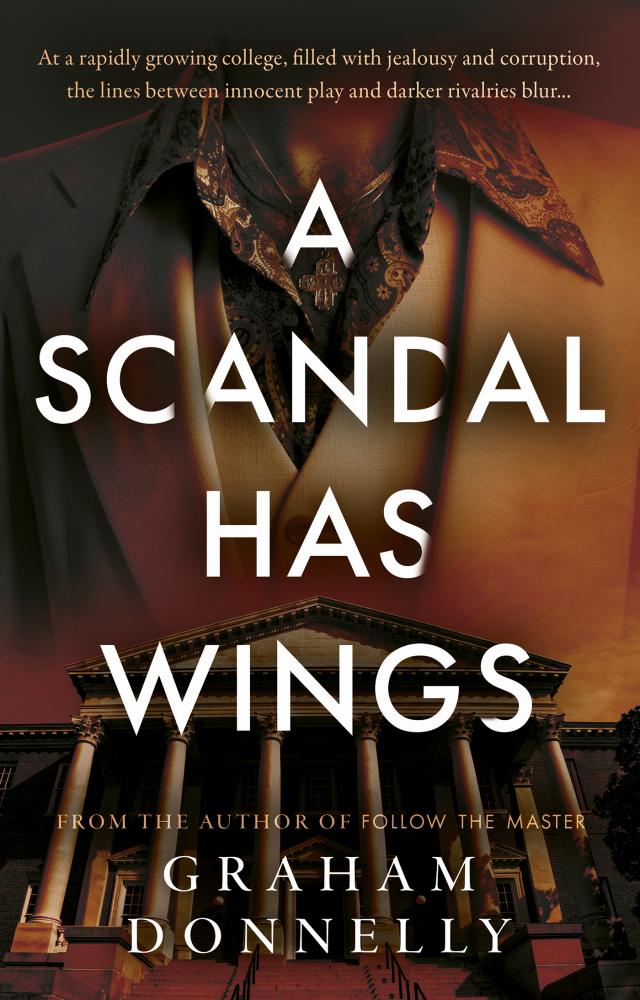
First published in Great Britain in 2025 by
The Book Guild
Unit E2, Airfield Business Park
Harrison Road
Market Harborough
Leicsestershire, LE16 7UL
Freephone: 0800 999 2982
www.bookguild.co.uk
Email: info@bookguild.co.uk
Twitter: @bookguild
Copyright © 2025 Graham Donnelly
The right of Graham Donnelly to be identified as the author of this work has been asserted by him in accordance with the Copyright, Design and Patents Act 1988.
All rights reserved. No part of this publication may be reproduced, transmitted, or stored in a retrieval system, in any form or by any means, without permission in writing from the publisher, nor be otherwise circulated in any form of binding or cover other than that in which it is published and without a similar condition being imposed on the subsequent purchaser.
ISBN 9781835742778
British Library Cataloguing in Publication Data.
A catalogue record for this book is available from the British Library.
For Roy and Robert
“A lie has no leg, but a scandal has wings.”
Thomas Fuller 1608–1661
Contents
Autumn
The Ladies’ Man
Witness for the Defence
Christmas
The Italian Job
O, to Be in England
Day One
Day Two
Day Three
Day Four
Friday
Rescue
Saturday
Gillian
Summer
The Promotion
Epilogue
1
Autumn
Let us begin with the college. An establishment of learning, a society where tutors and students work together for the growth of knowledge and expertise and therefore the betterment of the nation. If we had approached the grand entrance to this particular college, we could have been in no doubt that its purpose was just that. Its architect, Sir Branwell Chivers, had avoided the concrete, sometimes brutalist, designs of so many colleges erected in the 1950s. True to his Palladian sympathies and love of the classics, he had designed something more in tune with the Royal Exchange in the City of London than the robust plainness of most of its contemporaries. The result was a building that would not have been out of place in Vicenza, the home of Palladio, or in the schools of learning of Ancient Greece. The façade of the building had been cleaned over the summer and the name of the college, The Thomas Newcomen College of Technology, was proclaimed in new silver block lettering in the pediment above the Doric columns.
Like all the colleges of further education in the 1950s, it had opened with an emphasis on engineering in all its different branches: mechanical, auto, electrical, chemical and so on, but like the economy it served, it had later diversified into the service sectors: catering, hairdressing, business and management, the arts, social and health care, travel and tourism, etc. With this expansion came an ever-wider range of subjects and professions epitomised by the lecturers and students who made up this collegiate society: a place of learning, culture and progress. The college had grown rapidly in the last twenty years and many of the teaching staff were young, often only a few years older than their students; this was not an environment peopled by Mr Chips or Mr Crocker-Harris of The Browning Version. Like any place where the young and not yet middle-aged come together in large numbers; it would also be a playground where the immature become adults and adults might sometimes forget their claim to maturity; where for the teaching staff the prizes, ambitions and opportunities for aggrandisement invite competition, jealousy and corruption. For lecturers and students alike, innocent play and healthy rivalries may become something much darker.
It was the first day of the new academic year and one of the younger lecturers, Gillian Trevis, arrived punctually. She had driven into the staff car park in her racing-green Mini Cooper and pulled to a halt, the car shuddering slightly as if in anticipation. Twenty-eight with her black hair in a modern but not-too-exorbitant cut and dressed in a business suit with a cream blouse, she was aiming for a professional but not-too-severe look. She sat back in her seat and listened to the radio and the end of Showaddywaddy’s version of ‘Heartbeat’, remembering with affection the original of Buddy Holly and thought how quickly the pop music of her childhood had come round again. Her reverie was interrupted by Carl Malcolm singing ‘Fatty Bum Bum’ and she wondered how there could possibly be two versions of a song with that name in the Top Forty. She smiled and turned off the radio, getting out of her car with a metaphorical spring in her step. There was something special about the first day of a new academic year and, though this was not an entirely new experience, she could not help but feel that quickening of the pulse and sense of expectation which for her always accompanied a fresh start: new courses, new students, new possibilities.
Gillian looked up and admired with pride the new block lettering of the college’s name. Thomas Newcomen, as she had many times had to explain, was the inventor of the atmospheric engine, the first steam-driven engine to be produced. In the history of the Industrial Revolution, he had generally been overshadowed by later developers of his machine, like James Watt, Robert Stephenson and others. The college, though far from Newcomen’s birthplace of Dartmouth, had as its first, and so far only, principal: a professor of engineering from an old university who had served in the Royal Navy and had a special reverence for the great man. He had convinced the local education authority to name the college after a person of significance, rather than go for a bland geographical title.
Gillian was not an engineer; she was an economist, the only female lecturer in economics at the college since, here, economics seemed almost as much a male preserve as engineering. She was unperturbed by this since for her a subject should be a matter of choice, not predetermined by gender. Anyway, she could point to notable women economists in the past: Millicent Fawcett, Mary Paley Marshall and others, when it really had been difficult to make a career in a man’s world.
Reflecting on her sense of anticipation, not shared by all her colleagues or even most of them, Gillian supposed it was because she had a natural empathy with the academic year, which was itself derived from the agricultural year. Most professions had severed the connection between their working calendar and the agricultural cycle but the academic year remained inviolate and it shared many of the qualities of the agricultural one: a time for sowing in the autumn, nurturing and feeding of the crop of new students through the year, a harvest in summer and then the fallow period of the mid to late summer when there were no students. Then the lecturers could use the summer months from July through to mid-September to ‘recharge the batteries’ through the long holidays.
Her reflecting over, Gillian was now ready to face the future. She walked briskly up the stairs to her office, where she would undertake the first ritual of this bright new day: the renewing of acquaintanceships with her colleagues. Some of the conscientious ones would have come into college during the holidays to check the mail, prepare for new courses and update their reading. Others would have disappeared on the last day of the summer term, if not earlier, to their second home in France or their cottage in the country or, for an impecunious few, to casual work in the summer, none of them to be seen again until today. Gillian considered herself somewhere in between, though some of her colleagues thought she was too conscientious with her regular visits throughout the holidays, except when she was away. She called into the staff lounge to check her pigeonhole for mail and college circulars, waved hello to one of the admin staff who had worked through most of the summer, apart from a fortnight away, and went up to her office on the next floor. She shared this space with five others, all members of the business and management studies team. Two of them had yet to arrive but the others were settled at their desks and looked up when Gillian came in. They greeted her, two cheerfully with a smile and the other like a prisoner acknowledging another old lag who had returned to gaol after a brief period of freedom.
The one with the grim expression was Julian Wesley, a man in his early fifties who had forsaken long ago all hopes of progress in his career and had matched this lack of movement in his status with an equally moribund approach to the teaching of his subject. He was pleased to deliver his economics lectures to HNC business studies, A level and various other students, using the same notes he had used for well over twenty years without amendment. No texts since those of decades-old Samuelson and Nevin had ever impinged on his teaching aids and he avoided more modern introductions like the flip chart, case studies, the Banda machine and any other form of handout like the plague. He was witty and charming and generally admired by his students and, as his protégés changed each year or two years at most, none knew that they were receiving exactly the same well-delivered talks and being entertained by the same well-honed stories as scores of other students over the years. He would disappear to his villa in Portugal on the last day of the summer term, only to reappear on the first day of the autumn term, as he had now, scowling as he waded through the dozens of directives, memoranda and notifications from the principal or vice-principal, the welcome-back memorandum from the head of department and the copious letters, flyers and offers from professional bodies, educational publishers and other marketin
“Thanks for this, Julian,” Gillian said. “Very kind of you.”
“That’s OK,” Julian replied. He picked up some of the papers on his desk. “There are three different versions of the VP’s directive on work placement arrangements for HND students here,” he added, waving them in the air before throwing all of them into the filled-to-overflowing bin under his desk.
Gillian smiled and looked at Bill Rendell, a lecturer in accountancy subjects five years older than her. He returned the smile. “Good break?” he asked, removing his reading glasses and running his hand through his sandy-coloured hair.
“Yes, thanks, two weeks roasting in Malaga. Tan’s nearly gone,” she added, looking wistfully at her arm. “You?”
“Usual. Cornwall.”
Bill was a certified accountant and, probably more than most of the others in the room, earned far less educating future accountants as a lecturer of any grade than he would have done practising his profession. The question as to why he had chosen to teach when he undoubtedly was capable of actually doing the job was put to him at his interview and he answered that he believed in education and passing on his knowledge. Sincere or not, his statement of principle was of little consequence since a chartered or certified accountant in a college of further education is a rare prize to be savoured, evidence that, as in other subjects, accounting students might be taught by someone who knows more about the subject than they do. Consequently, Bill’s students appreciated not only the knowledge he imparted but also what he had learnt from his professional experience through real case studies. Unlike Julian, he did keep up with the latest developments in his subjects, and not only because it was a requirement of his professional qualification. He had a pleasant if taciturn disposition and was always willing to help others but nobody at the college could say they knew him well. There was a wife and two children whom he occasionally mentioned and he enjoyed the solitary pursuit of brass rubbing, which took up many of his weekends and was a subject of which he was something of an expert. If an outsider enquired about him, that was the limit of any of his colleagues’ knowledge.
The last person in the group was Roger Southwark, another economist, just turned thirty. “Hello, Gill, how are you?” he asked.
“Fine,” she said. “Have a good holiday?”
“Went to the Hebrides. Weather was lousy but what you’d expect in the North West. I enjoyed it but no wonder the population is in decline.”
“Inner our Outer Hebrides?” asked Gillian.
“Inner. I think I’ll need to get into polar-expedition training before I take on Harris, Lewis and the Uists.”
Gillian laughed and Roger, who could never make up his mind whether he found her attractive or not, but thought he probably did today, with her very dark hair, violet eyes and sparkling smile.
Like all the people in the room, Roger had worked in one occupation or more before coming into teaching. Gillian had been an economic analyst for an oil company while Roger had worked in banking in London and in Africa. Both had opted for a slower life or perhaps they had no longer been able to take the pace; only they knew the truth of that. Unlike Bill, neither were married nor had dependents, so their decision to take a lower salary was not influenced by concerns for others. Gillian always struck everyone as very committed, an avid reader of economic journals and papers and a regular attendee at study days and conferences, at Combe Lodge, the further education staff-training college, and conferences on economics elsewhere. Nor was she reluctant to revise and improve her lesson plans, unlike most of her colleagues who had only ever created a lesson plan to comply with a visit from an apprehensively unwelcome HM Inspector of Education. Gillian’s lack of a husband or of any other known romantic involvement was a source of considerable speculation among some of her colleagues, whose interest ranged from curiosity to inquisitiveness, suspicion, pity and even envy. All such hypotheses were made all the more florid by Gillian’s steadfast lack of comment to any fishing enquiries about her private life.
The paperwork of all four continued, interspersed with idle chatter or news about the likely intakes for the full-time courses in the new academic year; those for part-time and day release were always unclear until enrolment evenings.
Despite the usual comment that not much happened in August and that it was the so-called ‘Silly Season’ for the newspapers, the equivalent of It’s a Knockout on the television, they spent some time discussing current affairs. The sporadic IRA campaign which had involved the bombing of the London Hilton earlier in the month and the death of two people got a mention but, though horrific, it was nothing new: as for most people in Britain, it was part of the backdrop to life.
“There’ll always be another one,” said Julian. “Somebody ready to be a hero if they can plant a bomb far enough away from them when it goes off.”
There was silence for a few minutes. It seemed difficult to have a constructive conversation about a situation which appeared purely destructional.
From both a professional and a personal perspective, the economic situation was high on their agenda. The previous year, the government had increased the salaries of lecturers in further education by about twenty-five per cent in an attempt to make up the ground they had lost against comparable occupations over the last several years. All the people in the room were pleased to a greater or lesser extent at the time but the inflation rate, already accelerating, had now reached an annual rate of over twenty per cent.
“So, we are back where we started before the big pay rise,” said Roger, having read out the latest inflation figures from the Financial Times opened in front of him.
“Except that we received a substantial rise before the government brought the pay policy in,” replied Gillian. “Others will not have been so lucky.”
“Six quid a week pay rise for everyone this time round,” observed Bill.
“It’s the only solution. It is our misfortune to understand how the economy works,” said Julian. “We are aware of the damage a wage-price inflationary spiral will do and the futility of everyone chasing their own tail. That is our weakness as we will be inclined to be reasonable and moderate. Meanwhile, those who do not understand it or refuse to acknowledge they do, will be free to use whatever power they have to protect their interests, and, of course, they will.”
“The government couldn’t have done it without the support of the unions,” said Gill. “I’m not sure all their members will be as keen.”
“Good thing ‘Red Robbo’ isn’t here,” said Roger, referring to Robert Grainger, the politically very committed lecturer in sociology and politics who was based in another office up the corridor. Robert was quite proud of his nickname, taken from the indomitable union activist who had been for some time a key figure in industrial relations at British Leyland, the major British car manufacturer which had collapsed in the summer and been taken into public ownership by the government.
“Pity about British Leyland going under, but there it is,” said Bill.
“Buses were good but would you buy an Allegro or a Marina?” asked Julian.
This remark was greeted with mournful laughter. All of them were old enough to remember when the vast majority of cars sold in Britain were built by companies based there. Now the last mass car producer in British ownership was on life support and their conversation became even more maudlin.
“What a tragedy, though,” mused Roger. “A once-successful bus company brought down by its association with the British Motor Corporation.”


