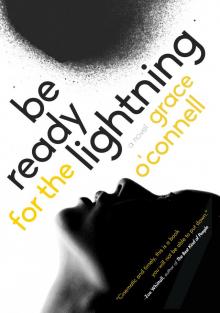
Be Ready for the Lightning, page 24


And what about Peter? Did he buy the gun and load it and shoot those people because of terrible things that had been done to him? Was it such a linear connection? Something bad happens when you’re young, so something bad happens when you’re older? If terrible things had indeed been done—I couldn’t know how much, if anything, of what Sunny had said was true. I don’t think even she knew. Or did he hijack the bus because of what Sunny said through his window? If that was it, then why did Conrad do what he did, small though those things now seemed, when our young lives had been bland and unremarkably safe, and when I’d never whispered anything?
Or maybe there was nothing, only choices, for both of them, choices made and simple algebraic results. Or maybe they were choices and not choices simultaneously, like me on the bus pulling my dress up to show my thighs to a murderer. No. To show them to Peter. Maybe it felt so fast to Conrad and to Peter that it was like which hand hits the ground first when you fall.
It wasn’t the questions that bothered me, about Peter and Sunny and Conrad and everything else. It wasn’t even the possible answers, the idea that maybe I could have done something for any of them but had failed.
It was not knowing—or the opposite, the knowledge. The knowledge that I’d never be able to figure it out, no matter how long I puzzled on it. Sunny’s intentions. Peter and Conrad’s motivations. The exact cause and effect of it all. That the only thing I could know was my inability to know. Maybe was a word made of fear, a bullet that exploded on impact.
Standing in the kitchen with my mother, I said, “Do you think he’s going to be okay? That he’s really changed? What if—?”
She held up her hand. “I don’t know,” she said. “I just know he has to be. But I’ve never really understood.”
“I’m glad to be home,” I said, and my mom got up and cleared the dishes, putting them in the sink quietly, so they wouldn’t clatter, and said, “You know you can always come home.”
And it didn’t matter that it wasn’t true, not anymore.
TWENTY-NINE
On the plane, I fell asleep and had terrible nightmares. Conrad, shot in the head. Or Ted. Or my father. Or Al. But never Annie, never my mother. Never Sunny. Never Peter. The cold dread of watching them fall, their chests blooming red, their kneecaps crunching as they hit the sidewalk. These dreams were mine now, mine for good, as much as the flying dream, I knew.
Then, when I got to New York, I met Al and Marie for dinner, walking from my hotel to a Vietnamese place they liked. No one on the street, in the restaurant, looked at me twice. Not even the vague Don’t I know you from somewhere? that had occasionally floated through stop-light crowds a month ago. I was long gone.
So was Sunny—she’d left Vancouver the same night she and Ted drove back. After he dropped her at the hotel, she told him she’d see him the next day, but she was checked out and unreachable when he called the front desk, the only number he had for her. He didn’t seem heartbroken; rather he seemed to regard Sunny as a badge of honour. “Your friend was nuts,” he said. “I’m too old to get mixed up with girls like that anymore.” He was back on the wagon and starting to slide into a slightly New Age-y self-care routine that Amelia would have approved of, but he couldn’t help but grin a little when he said nuts.
All Annie knew of Sunny was that she’d had some kind of breakdown. “Look,” she said. “I’m not going to tell you what to do, but people like that—you don’t need that in your life.” But she didn’t bring it up again, uncharacteristically gentle. I didn’t know if it was because of what happened in New York or if it was the pregnancy hormones, but Annie’s sharp edges seemed to be softening.
Once, in her new, small kitchen, after we’d installed the blown-glass knobs she’d bought for the cupboards, she grabbed my arm when I went to leave. “Can you just stay a few more minutes?” she said.
I waited for an explanation, but she just looked at me, and so we curled up on the couch together, watching TV for hours, until her eyes started to close.
As for Sunny herself, where she was, I had no idea. Her lawyer’s letter had made it clear she wanted no contact, that she didn’t need to give approval for whatever I chose to do, and it instructed me to call his office if I had any questions.
Sometimes I turned on “Pale Blue Eyes” in my headphones. I’d bought the song online, so I could listen to it wherever I wanted.
—
At dinner, Al told me he’d been interviewed by Gothamist about a condo with AstroTurf floors that he’d sold to an American actress. A producer had even tapped him as a potential host for a real estate reality show, a prospect that Marie and Al argued contently about over the spring rolls.
“Maybe I can get Annie a guest spot, where I can hit her in the face with a baseball, since that’s my main cinematic experience so far,” Al said.
I’d gone to my meeting with the hospital administrators after that and signed what I was there to sign, and now I was here. It was well past visiting hours, but I’d walked right in. It wasn’t hard; everyone was overworked and tired and indifferent.
I brought flowers. Even as I bought them. I’d laughed to myself, at the absurdity. The flowers were yellow ones, cheerful. I brought a vase too. There was no longer a guard outside the door. Evidently, Peter was past the news cycle too. In the intervening months, other men and boys had shot other people. A movie theatre, a backyard party, a small town hockey arena. Police officers had shot civilians, armed and unarmed. A man on an army base was disarmed before he managed it. A thirteen-year-old boy at his school, with his mother’s gun. I’d read about them, strangely detached. They had no connection, it seemed, to anything I’d ever experienced.
He looked the same, like no time had passed.
I put the flowers in the vase on the nightstand. His arms were bare from the biceps down. I touched his forearm with just the tips of my fingers. Even then, I could feel his skin, his living warmth.
I took out my copy of Peter Pan and put it on his chest, under the blanket. I thought of wartime legends of men whose pocket Bibles stopped bullets.
I put my hand on the book and said, “Sometimes he had dreams, and they were more painful than the dreams of other boys.”
He was more substantial than he’d seemed on the bus, or maybe his intravenous diet was heartier than whatever he’d been eating before. I watched his belly, his breath going mercilessly in and out.
“I have a theory. Wendy waited for Peter. In the book, she waited for him, but he took so long to come back, she was grown up and didn’t know how to fly anymore. But he doesn’t know how much time has passed. I don’t know if we’re supposed to like Peter or not. He’s not very likeable. But my theory is that he’s necessary. Even though he ends up hurting everyone. But he gave everyone something to hope for—that he would come and take them to Neverland. The hope is what matters, I think. Maybe. I think that what you hoped for was that she would come back. Or maybe she hoped you would. I just want you to know that she did come. I think she sent me because she thought I might make you happier. It’s all just theories, really. But I think she really loves you. I don’t know if it’s more or less amazing, loving someone when you’re both so fucked up.”
I brushed the hair off his forehead. It was longer now, and the blond looked darker.
“It’s funny that people kept telling me it was brave to talk to you on the bus. Because this feels a lot harder than that.”
I leaned down and kissed him. His lips were dry and soft, spread slightly open around his breathing tube, and almost hot.
Maybe it didn’t matter, the things I couldn’t know. That I couldn’t know the why of Peter or of Conrad, or anyone. That I couldn’t know how badly I could screw up my life and the lives of others until it happened, that I would just have to muddle through like everyone else in the world. That I couldn’t know the perfect word whenever I needed it. That I couldn’t be ready for the very bad or even the very good.
It would be easy to say that I was humanizing Peter, projecting onto him, just to avoid the horror of what happened, what he did, what I witnessed. But Peter wasn’t a blank canvas to me—he was a person who had touched me, who had seen me after a long time hiding.
I wondered what my niece would be like when she was born. Surely she’d be beautiful, between Annie and Conrad, and charming. What if she had Conrad’s compulsions? How would those even manifest in a girl? Already I loved her with the kind of love that sits like a heavy stone on your chest.
Tomorrow I would be here, when they took him off the machines. I would stay with him until he was properly dead, instead of just half-dead like he was now. A few months ago, I’d never even seen a dead person. Now I was going to make someone dead.
I touched the book once more and then walked away. In the hallway, I stood still for a moment, squeezed my eyes closed.
Long arms closed around me, and I reached to hold onto them.
“Thank you for coming,” I said.
“I always wanted to see the Big Apple,” said Conrad. “And I’m glad you asked.”
“All this hugging,” I said. “We’re going full Vancouver these days.”
“The hippies wore us down. We all give in eventually.”
I held him tighter, one hand on the back of his head, over the spot that had swollen so frighteningly after he flew off his bike. In a moment, we would walk out. We hadn’t told Al and Marie he was here; he’d spent the night hiding in the hotel, staying out of trouble. How would that work down the line, when he was a father? Or was he really different now? Sometimes I caught him looking at my ear, or his eyes sliding along the pale line on my forehead, his face abnormally blank. I didn’t know whether to hope he’d stop torturing himself about it or to be grateful that it might be enough to finally re-wire him.
He would be back with me tomorrow. He’d said yes before I even finished asking. I wouldn’t be alone when it happened, when Peter died.
Peter. It was a tall name, although he hadn’t been tall. Rectangular—a name shaped like a window, an open casement window, moving slightly in the wind. A shape that things came and went through, with a steep drop on one side.
THIRTY
He pulls me up from my knees with his free hand and very slowly, slower than a tree growing, I reach past him on his gun-less side and put my hand on the lever for the door, inches from the driver’s body, whose limp hand is stuck through the steering wheel. For a moment, my own hand sits just as still, and we both look at it. The radio console is still hanging, where Peter dropped it. “Thanks,” I say, and then I pull the lever. The doors open, and sunlight roars in like something white and opaque, like a noise. Fresh air rolls in with it, highlighting the paint and blood and sweat and piss and vomit and gun smells that I’ve already gotten used to. He’s holding my left hand with his right, the gun still in his left, half-raised but seemingly forgotten. Together we step forward into the fresh air and the blinding light.
The sidewalk is empty. The ground is covered in those white petals that I had thought were so beautiful before, and a few drift through the air and swirl along the pavement. They’re still beautiful. There’s a small tree with a black iron planter around its base, full of red tulips. It’s a sidewalk that looks like any other sidewalk in New York. It isn’t what I expect—but what did I expect? I expected to be somewhere else entirely. I expected Neverland.
Peter turns his face to me, and I can see the circles under his eyes, like bruises, and the veins under his skin. He isn’t smiling, but he looks happy somehow. His eyes are large, damp-looking. His lower lip and chin are split by an old scar. He is so close to me. He squeezes my hand.
“Put down the gun,” says a loud, steady voice.
I turn and see that though the sidewalk in front of the bus door is empty, there are people ranged along the side of the bus, police officers and other people. A buzzing like pulsatile tinnitus—the kind that goes along with your heartbeat—fills my ears.
“Put down the gun, and step away. Let go of her hand.”
Peter doesn’t turn away from me. He doesn’t even look away. It’s not clear whether he has even heard the man who spoke. He says, “No one is going to catch me and make me a man.” Then he says, “Are you afraid?”
I don’t say anything, but I almost smile at him, just one side of my mouth going up a tiny bit, and he raises his gun, his eyes on mine, his other hand reaching toward my face, only the tips of his fingers making contact, stroking my cheek, before the shot goes off. His gun arm isn’t even fully raised; the shot isn’t his. I catch him when he falls, or he falls onto me and my arms go around him automatically, but he is so heavy—no one ever said how heavy a person is, even a smallish person. Like lead, like moving a futon mattress. Impossible to hold onto. He slides down my body slowly, and I buckle and go down.
I’m on the ground, my arm twisted under him, touching his bare skin where his shirt and jacket have ridden up, his bare legs below his shorts touching mine. He is warm and slightly damp, and under my fingers, I can feel the puffy, unnatural smoothness of scar tissue that I’m so used to seeing on Conrad’s hands, to feeling now on my own face.
Someone comes forward and pulls me up and away, pulls my arm free, and ushers me toward the crowd of uniforms.
“Is there another shooter? Is there anyone injured? Is there another gun?”
I stare, open my mouth, close it. I shake my head no. I’m passed to someone else, a woman. I’m ushered into the back of an ambulance, wrapped in a blanket, and joined by other people from the bus.
Peter is gone. I don’t know where. I don’t know if he is alive or dead. I don’t know that he is neither.
An older woman with a brace and a brown leather collar on her green coat is sitting beside me. The woman has on ducky shoes. She is dressed like the queen on a day off, a hunting trip. She looks a bit like her too, white hair, smart eyes.
“You were very brave,” says the woman.
I realize the woman was on the bus; I remember her face from the crowd, like a photo has been flashed at me. Already the memory of everything that happened is being chopped into pieces, is being scrambled. Already the memory is like a deck of cards that I’ve dropped all over the ground. I remember thinking that Conrad and Annie and Ted were on the bus. I know they weren’t, and I think that maybe they were.
“Thank you.”
“Peter Pan,” says the woman. “I always did think that was the saddest book.” She seems quite serene.
“Peter Pan?”
The woman pats me on the arm. “You’re going to be all right,” she says. “You’ll be a hero this time tomorrow.”
I think my arm aches where she touched me, from the hard jerk of the bullet’s impact that yanked on me where we were linked, Peter and I, and from when it got twisted under him when he fell. But I touch it myself and find that, in fact, it doesn’t hurt. I’m not in any pain at all.
ACKNOWLEDGEMENTS
I’m deeply grateful to my agent, Martha Webb, who helped to shape this book and found it a happy home, and my editor, Amanda Betts, whose wise, insightful guidance truly brought Veda to life.
Thanks to Ruta Liormonas, head of the dream team, and Andrew Roberts, whose cover design is probably the reason you picked this book up. Thanks as well to the amazing PRH sales team, and to Anne Collins, whose essential support made a world of difference. My sincere thanks to Kristin Cochrane and Brad Martin for the energy and commitment they bring to developing new Canadian writers.
A big thank you to those who helped me get the little details herein right: Vanessa Crandle, who generously shared her time and expertise as an audiologist, and Kiavash Najafi, who filled me in on modern Persian wedding traditions.
I am also hugely appreciative of the support I received from the Toronto Arts Council, Ontario Arts Council, and Canada Council for the Arts while writing this book.
My heartfelt thanks to those who offered editorial feedback, advice, and/or encouragement during the writing process: Tanis Rideout, Evan Munday, Martha Schabas, Emma Ingram, Zoe Whittall, Hal Wake, Sandy Pool, David Leonard, Shaughnessy Bishop-Stall, and Vikki VanSickle; and to Ryan and Beau Roberts, for a room to write in London, and all else. Thanks as well to the lovely Sunny Teich, who let me borrow her name for this book.
Thanks to Tracy Pumfrey, Dani Couture, Sara Lefton, and Tina Fance.
Thanks, always, to my family, especially Mum, Dad, Kathryn, and Allison.
Thank you to Joseph, who read the final version of this book first, and who I hope will read all the books to come.
Grace O'Connell, Be Ready for the Lightning