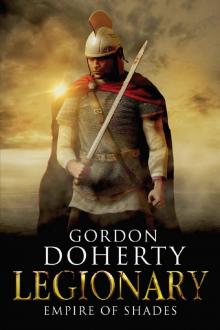
Legionary, page 40


He thought of the eccentric old warrior, and tried hard to envision his spirit somewhere in the beyond – with Gallus and his family. Past this cruel world of greed and violence.
Closing his eyes tight, he tried to focus on the gentle surroundings: the flowers, the hum of the bees, and the gentle merchant patois sailing up from the market near the foot of the third hill. Trade ships glided peacefully in and out of the many harbours, while the battle galleys lay docked and unused since the war’s end. Equally, the legions had been returned to their home provinces. It was a vision of peace and calm.
‘An illusion,’ he whispered quietly.
The Claudia – always a stub of a legion – numbered just over one hundred men, and had been reduced back to their old limitanei status. From here he could see them down in the barrack compound by the Forum of the Bull, Darik standing on the corner turret like a majestic dark lion, Libo slouching and asleep in a hammock like an unwashed goat – while Betto ran a book with Indus and Durio on who could ping the most grains of barley at him without waking him up. Rumour had it that they were going to be moved back up to the north Thracian countryside to patrol near the Gothic Haims as they had once before. Big Pulcher had met that news with a grin and a full-voiced “thank fuck for that.”
The big centurion’s bravado masked the unease felt by all: the truth was the Haims system in those parts was close to unravelling. Only Reiks Faustius’ followers seemed to be fully respecting the peace deal with the empire. The Goths who had not answered the emperor’s campaign call had subsequently grown uncommunicative – ignoring summons and failing to attend the agreed monthly council summits here at Constantinople. Then, just two days past, when Pavo had resigned from the Protectores, a Roman scout brought in news: that a band of Goths had been sighted in the north. They were riding not under the colours and emblems of any of the six Haims, but under a blood red banner, emblazoned with a serpent.
I followed them and listened in from the edges of their camp. They called themselves the Vesi, the scout had said, the Vesi Goths. They talked of a new leader who had arisen… a king.
Pavo had left the emperor’s courtroom with ice in his veins. He had not told anyone. To speak of it would be to make the whole thing real. The Vesi, not just active but rampant… and with a king? This could mean disaster – for him, for his family, for the Eastern Roman world.
Yet people did not want to talk of such things. Instead, all one could hear in the streets was proud chatter about how the victory over the West was a triumphant conclusion to the mightiest game ever seen. Pavo couldn't help but feel that the “victory” had been no such thing, and that a far vaster, darker game – kindled by Peregrinus – was only just unfolding. The Stranger had stirred up great chaos, first with the Goths, then by bringing the two halves of the empire smashing together like clay cups. He had aided the West and then – at the most critical moment – the East. He now thoroughly doubted his every theory about who Peregrinus was. A member of the sacred council? A shadowy operative? Perhaps someone who had been killed during the final battles with Maximus? Certainly, it seemed now that he had vanished like smoke. Whoever he was, he certainly had not gained the throne he apparently desired.
A thought crossed his mind then, like a stone becoming lodged in a cog wheel. He entertained the thought for a moment longer than was comfortable… before he pushed it away.
The bench shook a little as Sura thumped down beside him. He said nothing. These days, after more than a decade of comradeship, they could sit in silence for hours and enjoy it.
‘I did it,’ he said at last.
Pavo turned to him, cocking an eyebrow. He looked petrified – as if he had just signed up to wrestle the Hydra.
He gulped like a man about to dive deep underwater. ‘Asked Julia to marry me again, this time properly... and this time she said yes.’
Pavo felt a sudden flush of joy. ‘Ha!’ he rocked backwards, then wrapped an arm around his friend’s shoulders. ‘You’ll need a wine-bearer.’
‘Aye, that’ll be you,’ he said, nodding and rising, moving over to the balustrade at the garden’s high edge, gazing into the sun and out to sea. ‘And I’ll need to pick some of those reprobates too.’ He gestured down to the barrack area, where Indus’ latest barley grain pinged against Libo’s good eye. The primus pilus woke with a strangled yowl and fell in a tangle as he tried to leap out of his hammock. Pulcher, Darik and Betto howled with laughter as Indus ran for his life.
‘Did I hear correctly?’ said Izodora, walking with Marcus, hand in hand. ‘The untameable Sura, famed seducer of Adrianople, has deigned to take a wife?’
Sura gulped and nodded.
She smiled and hoisted Marcus up into her arms. ‘Soon you will have a few of these, yes?’
Now Sura began wringing his hands. ‘I… er… I suppose.’
Saturninus and Stilicho joined them too, hearing the conversation. ‘Three, at least,’ said Saturninus with an uncharacteristically ludic smile. Stilicho scoffed at this. ‘In the first few years, maybe. Six or seven overall though. It’d only be right.’
A bead of sweat burst from Sura’s forehead and his eyes darted maniacally. ‘Erm, I… we… we haven’t discussed.., er…’
‘Relax,’ Izodora said, kissing him on the cheek. ‘One step at a time.’
A low round of fond laughter rose from the group. Together, they gazed out over sunset-washed Constantinople, the warm breeze combing through their hair.
Pavo sighed, enjoying the moment. The worries about the Vesi, the West, the mystery of Peregrinus… they were not for now. He noticed the legionaries on watch around the imperial palace region – wearing pale blue livery. The Thervingi, Eriulf’s legion, he realised. He scanned the gardens and terraces and finally spotted Eriulf himself alone up on a turret – gazing to the horizon like them, his spiked topknot making him look tall as a tree. Yes, with good men like him, the crises of empire could be dealt with in time. But he noticed something then: the look on Eriulf’s face. It was wrought, lined. And his lips were moving. Speaking to someone… even though he was alone.
Old friend, what worries you?
Clopping hooves rattled out from the main way, drawing Pavo’s attentions: another imperial messenger, coming in from the countryside. The man’s speed screamed of one thing: trouble. His heart began to thunder and his right hand and left eye twitched again.
‘Brother?’ whispered Sura, noticing. ‘You look like you have seen your own shade.’
Pavo took a deep breath and half-smiled, settling his tremors. ‘Tonight, you, I and the Claudians… we should go to the taverns, aye? Now that we have something to celebrate.’
‘Ah, now you’re talking,’ Sura said with a grin: ‘I knew there had to be an upside to all this marriage business.’
Pavo laughed and imagined, beside him, the shade of Frugilo – the craggy old veteran, brother of Gallus, staring off into the distance with the others. Live, while times are good. Gods know, they do not last.
The hazy autumnal air over Augusta Treverorum shook as Christian chaplains sang and crowds cheered. Drums rumbled and cornua keened in triumph. Petals and sweet smoke floated through the air. The many thousands of eyes watched the purple robed young man’s procession towards the palace. It had all the air of an emperor’s adventus. Yet the young man was not an emperor, merely the warden of the West under the rule of Emperor Theodosius and his Magister Militum, Arbogastes.
Inside the palace, the clamour of the crowds fell away into a strange, muffled echo. It smelled odd in here too – of another man’s life, thought Valentinian. And this is how it had been. First, it had served as the home of his wicked brother, Gratian. Then of the tyrant, Maximus. But both were gone. He cast a look to the grand stairs leading to the upper floors. Up there was the Dark Eagle’s study. He had heard the rumours that Gratian’s body was still stuffed and mounted inside, but had no desire to see such a thing. So, it had been his first order as warden of the West that his brother should be buried with full Christian rites. So too the now desiccated heads of Maximus and his son, Victor. Bury the past, let it go, he mouthed, remembering Pavo’s words.
He walked on into the adjoining grand basilica, a cavern of polished marble with the Western throne at its end. He climbed the marble steps towards the Western chair of power and, for the first time in his young life, sat upon it. It was cold and uncomfortable. He could not help but remember that the last person to have sat here was Victor, Maximus’ son. An unpleasant fellow, but a victim too – beheaded on this very seat just when he thought he was about to engage in talks.
The golden Victores legionaries posted around the hall’s edge each stamped one foot, punched their spears high and called out in unison: ‘Domine!’
The throaty cry bounced around the hall impressively, settling after an age.
Valentinian beheld them: they were once Maximus’ elites, now they were his. It was the way of the empire: armies would commit atrocities one day then serve those they had injured the next. He drummed his fingers on the armrest. It was the way of the empire, he vowed, but not anymore. Things would change. He might only be a glorified governor, under the rule of Theodosius, but that did not mean he was powerless.
This would be the dawn of an age of justice, of truth. He thought of the good souls who had fought like lions to make this moment happen: Mother, Bauto, Merobaudes… Pavo.
Pavo, the last of those still alive. The sense of loss made him desperately sad.
A padding of soft leather boots sounded by the throne’s edge.
‘The parade went well, Domine,’ said the steel-clad General Arbogastes, dipping his head a little in respect – showing the angry scar on his polished pate. ‘The people are jubilant.’
‘All parades go well, Arbogastes,’ Valentinian half-smiled. ‘It is on the hard times that I will be judged. We have much planning to do. Much to rectify. Checks and balances to put in place. The West and the East must never again strike steel against one another. It is incumbent upon us to guide and teach this to the people of the West.’
Arbogastes sighed. ‘It was a senseless war, but for the ousting of the tyrant.’
Both stared out of the high, sectioned windows of the hall for a time, letting the joyous sounds from outside wash over them.
‘If I may venture, Domine,’ Arbogastes spoke again.
Valentinian looked to him, nodding.
‘I… I realise only too well that I once served your brother when he was emperor. And sometimes the things I did were to your detriment, but…’
‘This is a new age, Arbogastes. I will not begin my new role under a cloud of reprisals. In any case, you are my high general and my regent. What sense would there be in me punishing you?’
Arbogastes smiled. ‘Thank you, Majesty. Know this: I was appointed your regent because of the utter devotion I showed Theodosius when I served him. That is what I bring to you.’
A short silence passed.
‘When would you like to begin on matters?’ Arbogastes said. ‘Perhaps we should let the winter pass, let matters settle, and reappraise come spring?’
‘Tomorrow,’ Valentinian said. ‘We begin tomorrow. Justice has been made to wait for too long already.’ With that, he stood, stepped down from the throne dais and departed the hall.
Arbogastes watched the young man go, impressed. He had always thought Valentinian capable of great things, and the brightness in him was truly beginning to shine. He looked around the Victores troopers. ‘The emperor has retired for the night,’ he said to them. ‘There’s no need for you to be here. Fall out.’
This they did, with a rumble of boots.
Alone in the hall, he trod around the Western throne, for a time.
When he was sure there was nobody nearby, he sat upon it, and stroked one arm of the chair. With the other hand, he traced two fingers absently back and forth along his collarbone. He still was not used to the bareness there, where the bronze lion’s fang had once hung.
Try as he might, he had been unable to bring ruin upon the East or to topple Theodosius and his regime. In any case, he had begun to suspect that Maximus would not uphold his end of the bargain and grant him control of the East. Thus, with one catapult stone that night in Siscia, he had turned everything upon the Dark Eagle and ensured that the Western throne would be vacated instead. And careful words in Theodosius’ trusting ears in those final stages of the campaign had ensured that he – the Emperor’s Spear – would be granted this new, prestigious post.
He smoothed his hands over both arms of the throne, his ambitions soaring. What a web he had spun to get this close to the chair of power. Now, all that stood in the way of his ambition was a boy – a boy under his control.
Valentinian was right, he mused with a placid smile.
It was, indeed, the dawn of a new age.
The End
Author’s Note
The winter of 386/387 AD proved to be a challenging one for the Eastern Roman Empire. The Gothic War had ended four years prior, thanks to a peace deal that granted the Goths Roman lands on which to settle and farm, in return for their military service. This delicate system was only just beginning to bear fruit. So, the last thing Emperor Theodosius needed was for a huge host of erstwhile unknown Goths to descend from the north and appear at the River Danube, demanding entry to the empire. Such a new immigration so soon could have wrecked the whole framework of cooperation.
The early Byzantine century historian, Zosimus, is our main source for what followed. The new Gothic arrivals, under their king or high chieftain, Odotheus (or as Zosimus names him, Aedotheus), arrived at the river's northern banks in their multitudes. The Roman legions, under the command of General Promotus, were hastily arrayed along the southern banks. The Goths then proceeded to petition the Romans for permission to cross onto the river's southern banks and onto Roman soil, with the clear threat of invasion if this was refused.
The Roman response finally came one moonless night. Taking advantage of the poor visibility, General Promotus secretly sent Gothic-speaking agents across the river to bribe Odotheus’ noblemen, asking them to convince their chieftain of a false situation: that the Roman watch was lax this night and that he should seize this opportunity to try to force his way across immediately. Yes, it would mean defeat and death for their leader, Odotheus, the agents argued. But the noblemen were also assured that, after the action, the empire would recognise them as the new leaders of the tribes.
The nobles accepted the bribe and approached Odotheus. He took the bait, rallying his people and, in the dead of night, in almost complete darkness, setting across the river in a huge flotilla of crafts. The late 4th century AD poet, Claudian, describes their fleet as ‘three thousand vessels strong’. They must have felt invincible.
When they reached midriver, everything changed. General Promotus, lying in wait, sprung his trap. A fleet of Roman galleys, three tiers deep and twenty stadia wide, came speeding out to assault them. As Zosimus describes it:
Promotus here made such havoc that the river was filled with dead bodies, and the number which fell on the shore was almost too great to be counted. This produced an immense slaughter, greater than had ever occurred in any former naval action – Zosimus, Historia Nova.
Emperor Theodosius, who appears not to have been fully aware of Promotus’ designs, quickly saw how one-sided this slaughter was, and – realising that it might alienate both these new Goths and trigger revolt in those settled in his lands – apparently waded into the river shallows and called his ships and troops back.
Fraught as the whole incident had been, it was nonetheless a victory for the Eastern Empire. And there was more good news to come: the long-debated specifics of the Roman-Persian division of Armenia was finally agreed, ending the air of uncertainty on that eastern flank. Harmony in the East, stability in the north… so what of the West, only recently ridden of its previous Emperor, Gratian?
Magnus Maximus, Gratian's overthrower, was an enigmatic character – popular, devious, pious and ambitious in equal measure. Following Gratian's death, he quickly arranged to be baptised, a move that greatly increased his standing with the Orthodox majority in Rome’s growing echelons of Christian power (which included Emperor Theodosius himself).
Religious gestures of this sort were hardly uncommon amongst Rome’s politically ambitious. But at the same time, he made the rather unique and macabre decision to keep Gratian’s body unburied, and carried out the notorious and entirely unjustified execution of Bishop Priscillian – moves that were quite revealing of his dark side. And there was the unavoidable truth that his overthrow of Gratian in 383 AD had been an illegal coup.
Theodosius initially accepted Maximus as Gratian’s successor, though it was only ever a pragmatic and necessary tolerance, given the difficult times in the East (in this period before the troubles with the Goths and the Persians had been settled). A permanent and growing tension reigned, with Theodosius weathering accusations of weakness for his inaction against the usurper. Yet the alternative – heading straight to war against the new, well-supported Western supremo – would be catastrophic. Instead, he opted to bind Maximus to an oath that he would satisfy himself with the governorship of Gaul, Hispania and Britannia, leaving Italia and Africa to the young Valentinian II.
Maximus took this oath, but it was not long before he began pressuring Valentinian to leave his court in Mediolanum and join him in his Gaulish capital, Augusta Treverorum. “A father and son” relationship, is how he proposed it… but the intent was clear. When Valentinian persistently refused this underhand grab for power, Maximus set about swelling his already strong Western armies, raising numerous new regiments and inviting Germanic tribes into his ranks too.
Valentinian recognised the growing threat, and, in late 387 AD, he dispatched Domninus the Syrian ambassador to Maximus’ capital. Maximus apparently charmed the diplomat out of his wits: