

The Best of Glen Cook, page 1


Praise for Glen Cook
“Glen Cook single-handedly changed the face of fantasy—something a lot of people didn’t notice, and maybe still don’t. Reading his stuff is like reading Vietnam War fiction on Peyote.”
—Steven Erikson, author of the Malazan Book of the Fallen series
“Over the past 25 years, Cook has carved out a place for himself among the preeminent fantasy writers of his generation. . . . His work is unrelentingly real, complex, and honest. The sense of place that permeates his narrative and characters gives his ‘fantasies’ more gravitas and grit than most fictions set in the here-and-now.”
—New York Times bestselling author Jeff VanderMeer
“A master realist of the imagination.”
—Locus
“Glen writes a mean book.”
—Jim Butcher, author of The Dresden Files
“These books, like so many of Cook’s series, are epic in scale but intimate in focus . . . Cook is a brilliant writer.”
—The Green Man Review, on A Fortress in Shadow
“One of the defining fantasy series ever written. Glen Cook’s writing is a great flood that washes fantasy tropes and clichés away and in their place we are given three novels that make us reflect on what it means to be human. . . . On more than one occasion I found chills running down my spine. Words don’t do these novels justice.”
—The Ostentatious Ogre on A Cruel Wind
“Glen Cook is the author of some of my hands-down favorite books. I hold out his Black Company series as arguably the best military fantasy ever written. The early Garrett books set a standard for the blending of fantasy and hardboiled fiction.”
—Black Gate
“One of Cook’s strongest storytelling traits shines through, his ability to cast no judgment and show the opposing sides of a conflict with honesty, empathy, and resonance.”
—SFFWorld, on A Fortress in Shadow
“Glen Cook is a rare beast of a writer—he can vacillate between military fantasy, space opera, epic fantasy, mystery, and science fantasy with great ease. His writing is often marked by a purity; that he is depicting life in its most real sense, from the thoughts in a character’s mind to the wind rushing across his or her face.”
—Rob H. Bedford, sffworld.com, on Darkwar
“Cook’s talent for combining gritty realism and high fantasy provides a singular edge.”
—Library Journal, on Water Sleeps
“Cook provides a rich world of assorted races, cultures, and religions; his characters combine the mythic or exotic with the realistic, engaging in absorbing alliances, enmities, and double-crosses.”
—Publishers Weekly, on Bleak Seasons
“New and innovative. [Cook] blends the urban, intimate, slightly seedy tradition of sword &sorcery with the pastoral, epic, expansive tradition of heroic fantasy . . . this is the book that injected a shot of realism into the genre, and helped steer it on the course towards modern so-called ‘gritty’ fantasy.”
—Strange Horizons, on Chronicles of the Black Company
“Glen Cook changed the face of the fantasy genre forever . . . and for the better.”
—Fantasy Book Review, on The Black Company
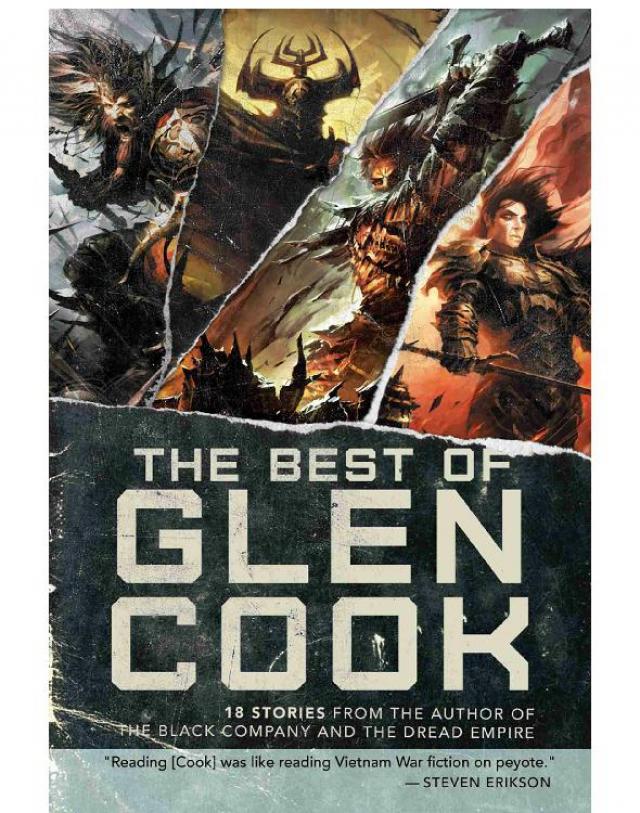
THE BEST OF
GLEN COOK
Books by Glen Cook
The Heirs of Babylon
The Swordbearer
A Matter of Time
The Dragon Never Sleeps
The Tower of Fear
Sung in Blood
Dread Empire
A Cruel Wind (Omnibus):
A Shadow of All Night Falling
October’s Baby
All Darkness Met
A Fortress in Shadow (Omnibus):
The Fire in His Hands
With Mercy Toward None
Wrath of Kings (Omnibus):
Reap the East Wind
An Ill Fate Marshalling
A Path to Coldness of Heart
An Empire Unacquainted with Defeat
The Starfishers Trilogy (Omnibus):
Shadowline
Starfishers
Stars’ End
Passage at Arms
Darkwar
Doomstalker
Warlock
Ceremony
The Black Company
The Black Company
Shadows Linger
The White Rose
The Silver Spike
Shadow Games
Dreams of Steel
Bleak Seasons
She Is the Darkness
Water Sleeps
Soldiers Live
Port of Shadows
The Garrett Files
Sweet Silver Blues
Bitter Gold Hearts
Cold Copper Tears
Old Tin Sorrows
Dread Brass Shadows
Red Iron Nights
Deadly Quicksilver Lies
Petty Pewter Gods
Faded Steel Heat
Angry Lead Skies
Whispering Nickel Idols
Cruel Zinc Melodies
Gilded Latten Bones
Wicked Bronze Ambition
Instrumentalities of the Night
The Tyranny of the Night
Lord of the Silent Kingdom
Surrender to the Will of the Night
Working Gods’ Mischief
THE BEST OF
GLEN COOK
18 STORIES FROM THE AUTHOR OF THE BLACK COMPANY AND THE DREAD EMPIRE
GLEN COOK
NIGHT SHADE BOOKS
NEW YORK
Copyright © 2019 by Glen Cook
Additional copyright information is available on page 525.
All Rights Reserved. No part of this book may be reproduced in any manner without the express written consent of the publisher, except in the case of brief excerpts in critical reviews or articles. All inquiries should be addressed to Night Shade Books, 307 West 36th Street, 11th Floor, New York, NY 10018.
Night Shade Books® is an imprint of Start Publishing LLC.
Visit our website at www.nightshadebooks.com.
10 9 8 7 6 5 4 3 2 1
Library of Congress Cataloging-in-Publication Data is available on file.
ISBN: 978-1-949102-17-8
eISBN: 978-1-59780-658-9
Cover illustrations by Raymond Swanland
Cover design by Claudia Noble
Printed in the United States of America
TABLE OF CONTENTS
Sunrise
The Devil’s Tooth
In the Wind
Quiet Sea
Ghost Stalk
Call for the Dead
Soldier of an Empire Unacquainted with Defeat
Filed Teeth
Darkwar
Enemy Territory
The Waiting Sea
Severed Heads
Winter’s Dreams
The Good Magician
Shadow Thieves
Shaggy Dog Bridge
The Bone Eaters
Chasing Midnight
A lot of people can’t believe that I, as a writer, may have forgotten details of a story I wrote before they were born. They reckon that I should recall every spoken word and twist, every minor character’s secret middle name . . . But I don’t. I’m sorry. It doesn’t work that way for me.
When I revisit my earlier writing I find, usually, that I don’t remember much at all. My novels, especially, are never anything like the romances that I think I remember writing. I tend to end up reading something that I consider to be pretty good stuff from somebody who isn’t me now and who maybe never was.
—Glen Cook, 2019
SUNRISE
I liked this story on re-reading but I don’t remember anything about it other than that it is set in the same future history as most of my science fiction and that it is a precursor to the novel Shadowline, first volume in the Starfishers Trilogy. It is included here because I thought it was cool when I reread it.
1
Kim the Piper, pale and thin, walked the silent streets of a judgement morning—a morning which was, of course, no morning at all but merely the beginning of another day-called period etched on an endless night. Never in all his eighteen hundred years, nor she in her ten thousand, had Edgeward City seen sunrise breaking the darkness besieging her protective dome. Blackworld was a one-face planet, lifeless and boiling on Brightside, frozen on Darkside, where were built the cities of men.
City of men, Kim told himself as he reached Dome Street, which encircled the City just inside the massive glassteel shield. The Star Fathers had made one small error in creating the world. They’d left it with a little spin. It rotated once every twenty-five thousand years, a mile a year, nearly fifteen feet each day. In a sacrilegious moment, Kim questioned the omnipotence of the Star Fathers. They’d been sloppy planet builders, not taking into account the long-term effects of the world’s spin.
Ancient books placed Edgeward City near the western terminator, in a vest, steep-walled meteor crater behind the Thunder Mountains. That morning, as Kim climbed stairs to an observation chamber thirty feet up, inside the glassteel of the dome itself, the eastern terminator lay fifty miles away, about to break over the White Mountains which hugged the crater’s eastern lip. A first real dawn, and doom, was creeping steadily closer.
Kim entered the chamber, seated himself in an ancient chair, wondered at the need for observation. There was so very little to see. Night, forever on. Stars immobile, untwinkling; frozen constellations. A hint o
There was a hint of coruscation outlining the peaks of the mountains, barely discernable, gaseous matter and stripped ions fleeing to Darkside from the sun-burned plains beyond, reflecting the sun’s electro-magnetic field and particular radiations. The matter solidified again this side of the mountains. Gradually, over the decades as sunrise drew nearer, the white snowfields darkened, the dust against the driftwell deepened . . .
The conical tractor field glowed pinkly, the pressor hemisphere glared into golden flame, the City shuddered on its foundations, grumbled. “Meteor,” Kim whispered to himself. “Big one.” High in the night above the City somewhere the meteor’s course was changed, directed away from the dome. Kim saw it, white hot from the heat energy gained during the sudden change, smash into the crater wall some miles away. The explosion was almost atomic in proportions. Dust boiled up, the City shivered, glowing bits of shattered rock streaked toward the White Mountains like a thousand tiny rockets.
“Magnificent!” he whispered. For the first time in a year, he was glad to be alive. Lately, he had been thinking much of voluntary termination, but this vindicated his reluctance. There was always one more new thing to be seen, if one could endure the overpowering boredom between happenings. Two new things, perhaps.
He was nearly blinded by the sudden spear of light exploding upward from somewhere in the White Mountains. Like a long and dissipating arm of fire, it reached toward the City. “Flame tongue.” He was awed. It was the first time he had seen this most spectacular of Blackworld’s few weather phenomena, the result of the sun’s rays falling suddenly on a patch of gas snow, converting it from the solid to gaseous states in microseconds. Sunlight reflected off the dust carried upward by the expanding vapors made the flame tongue.
Kim considered both manifestations with something like religious awe. They were omens, harbingers of the fiery doom the sun promised the City.
So said the Disciple of the Sun Cultists, whose word was presently law, both religious and temporal (conveniently ignoring the fact that the meteors were present only because Blackworld had entered their cometary orbits as they came in from deep space, as happened every nine hundred years; and sunrise was an event expected for millennia). Edgeward was the last of the great dome cities of Blackworld, farthest from the sun when the world was created (or colonized, as a small, atheist faction would have it), last to be destroyed as the world turned, her agony prolonged because, according to Sun Cult dogma, the Sun God had known she was the city to sink deepest into iniquity. For her wickedness and belief in the heresy of the Star Fathers, the jealous god would slay her with spears of light. One day soon the sun would rise above the White Mountains, The tractor and pressor screens wou1d be as nothing before the sudden storm of radiant energies. The top of the dome would melt, the City’s atmospheric temperature would soar three thousand degrees, and molten glassteel would be hurled into a burning sky.
So said the Disciple of the Sun, and Kim knew most of it was true. He had watched the destruction of The City of Night fifteen hundred years earlier, and had talked to men who had seen Darkside Landing die . . .
He sighed, tried to turn his thoughts to more pleasant subjects, could not. Well, thank the Star Fathers, the end, when it finally came would be swift. A lance of sunlight, a boom, and the structures of Edgeward City would like waxen images melt into a vast and bubbling pool—a lake of fire. The Disciple made much of that lake of fire.
A few structures would remain standing—skeletal grotesqueries with melting temperatures above those induced by Blackworld’s fierce little pre-nova sun.
Another shudder ran through the dome’s foundations. Meteor? He saw no evidence. Probably caused by tectonic activity in the White Mountains. Perhaps there should be some changes in old names. The Thunder Mountains were now silent and white with gas snows while the White Mountains were dirty and rumbling with the expansion effects of the sun’s heat. Once it had been the other way around.
The clicking open of the chamber door drew Kim’s mind from the sword extended over Edgeward City. But he did not turn. This was his private place, the place where an immortal could escape the crowds of anciently familiar faces, the place where he could be alone with his thoughts. He would recognize no intrusions.
“Kim?” Soft, feminine, a voice he knew well, a voice which was part of the laughter and tears of his recent past, a voice not entirely unexpected. A voice from the days—before the rise of the Disciple—when a Piper had been allowed to pipe, and a Dancer to dance. Illian Gey, a Dancer. Still a mortal, only twenty, undecided as to when she would begin taking the drugs—as if they mattered now. He and she had nearly been a couple once, when joy and entertainment had been unforbidden.
“Kim?” There was pleading in her voice this time, a soft little cry for support. “Did you hear? The Disciple sentenced my brother to the fire.”
He had no need to look to picture her face as it must be, surrounded by disheveled hair, her eye- and cheek-paints smeared by hands and tears. Thus she had appeared an hour earlier when, at the Temple, the Disciple had ordered the stake for her brother, guilty of trying to flee the doomed City. Kim had watched Illian from across the chamber. He remembered the sudden pallor, the sudden shriek, the struggle with Heaven’s Guard . . .
“Kim?” This time there was desperation.
“I know,” he replied, still not turning. “I saw a flame tongue this morning. My first.”
“How nice for you.” Her sarcasm overrode her sorrow. Soon she would be angry. Kim smiled at the night before him. “What’re we going to do?” she asked. “My father won’t help. You’re all I have.”
“I’ll watch the execution, perhaps,” Kim replied. “I’ve never seen one. I should before the end. One vision of all things . . .”
“You hate him!”
Smiling again, Kim said, “And not without reason. What did Walther the Dancer deny Kim the Musician, without cause?”
“Dancers don’t couple with Musicians!” she retorted. But her words had that ring of rote Kim remembered all too well. She had said those words before, and had denied them by her actions until her brother and father had threatened to stop her dancing—all pointless now, with the Disciple in power, entertainment denied, and sunrise but days away.
“Nor do devil worshippers, sun worshippers, cultists rule the City,” he replied. “If that tradition can be broken, how little meaning have the customs of Artists?”
“He didn’t do anything!”
“He denied me you.” Kim wished she would go away now. Her sorrow and self-pity had been replaced by anger. Fine. He had given all he was willing. Now let her take her problem to her own kind.
“That’s not what I meant. His crime. All he did was try to leave the City, to join the Nomads. They’re a people who’d appreciate him. He committed no crime.”
Kim frowned. This was growing tedious. Yet he answered her, “But he did. He tried to deny the Sun God retribution for his unbelief. As the Disciple said, he has to be given to the flames early, lest he escape punishment. It’s simple, Illian. Surely even you can understand.” His frown deepened. He had spoken her name, He had vowed never to do so again.
He did not believe his words. Sun Cultists were mad mortals, their religion insane. Enough, Illian, go away. He had no time for the frenzied affairs of mortals.
No time? He had had ages of leisure, ages of boredom, Edgeward City was automated to the nth degree. What work there was was play, with waiting lists hundreds of names long. Art was the reason most people lived. Music, sculpture, painting, dancing, writing, and each immortal Artist had an eternity in which to do nothing but polish his art.
Had, Kim reminded himself. No more. The sun was close. Works centuries in the creation were being savagely whipped to completion. His own Dying Star a vast, epic overture two centuries in the composition, had been claiming all his attention of late. Working under pressure, he had almost regained the urgency of Man the Mortal. Until he had gone this morning to see Illian’s brother’s judgement . . .





