

Impact Strategy, page 14
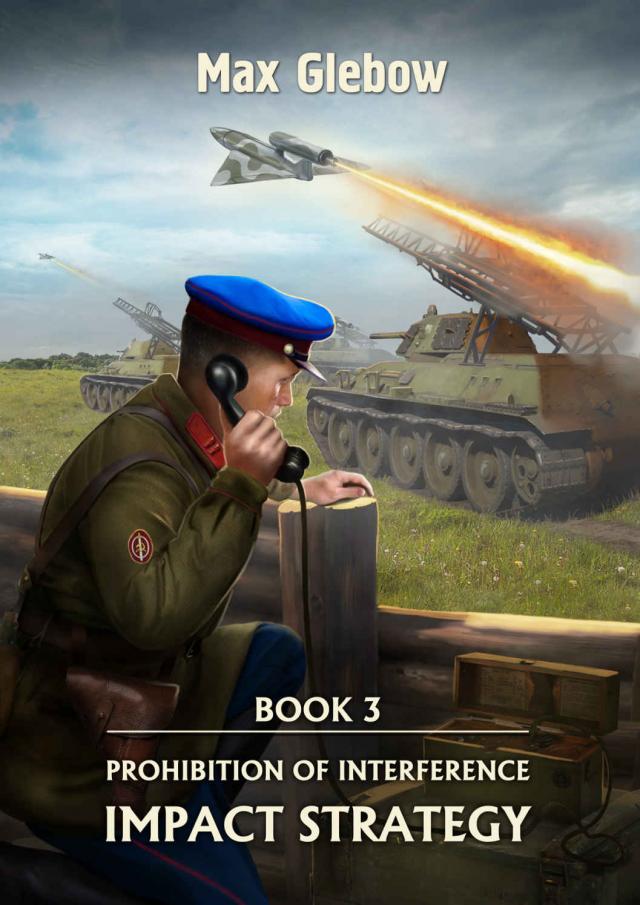


Well, at least to our own troops and not into enemy territory. Besides, in this case there was a striking difference from everything I had already seen in the pockets - the five infantry divisions, the tank brigade, two artillery regiments and the Independent Motorized Rifle Brigade of Special Forces, which had been encircled, were not about to give up their heavy weapons and break through. They continued to hold their positions, blocking the highway and repulsing the enemy's successive attacks, regardless of any, even the most unfavorable changes in the situation at the front.
The parachute caught on the crown of a tree. I was jerked sideways and flung into some bushes. Surprisingly, the odd landing didn't cause me any additional injuries. The branches softened the blow, and I managed to protect my face and head with my hands.
My appearance did not go unnoticed. The aerial battle seemed to be quite visible from the ground, and now the Red Army men with their guns at the ready were already running toward me across the small field. Well, that's right, they don't know who was shot down over their heads.
Chapter 9
“On the southern flank your armies are losing the initiative, General-Feldmarschall,” Hitler said categorically. In confirmation of his words, he tapped his pointer on the map, drawing the attention of the commander of Army Group Center to Tula, almost surrounded, but still not abandoned by the Russian troops.
“My armored divisions suffered significant losses,” the Führer's accusations did not embarrass Fedor von Bock, “We encountered an unexpectedly high efficiency of Russian artillery fire. In addition, Soviet units are stubbornly resisting, although a month ago intelligence assured us that the Red Army was finally defeated, and that the units remaining with Stalin were demoralized and would not be able to become a serious obstacle on our way to Moscow.”
“That is no excuse for your inaction!” Hitler abruptly turned away from the map and looked directly into von Bock's eyes.
“There is no inaction, my Führer,” the Field Marshal-General stepped back slightly. “In the center we are advancing with fights along the Minsk highway, and in the north, after taking Klin, we have surrounded a large group of Russian troops. At least six divisions are in the ring. This effectively opens the way to Moscow, but we need reserves. We simply no longer have enough strength to break through the last barriers lined by the Reds on the closest approaches to the city. I ask permission to engage General Rommel's Panzer Group in a decisive strike.”
Hitler continued to glare at von Bock, but it was obvious that he was intensely pondering the words of the commander of Army Group Center.
“My Führer,” General Yodl broke the pause, “Rommel is our last reserve. His tanks can repel Russian counterattacks if necessary. If we introduce these forces into the battle for Moscow, this possibility will disappear, and our infantry divisions might not be able to withstand an unexpected enemy strike.”
“All that the Soviets have been able to gather now stands against me,” von Bock objected with clearly audible irritation in his voice. “If we capture Moscow, the enemy would be deprived of such a significant transport hub that his further organized resistance will be impossible. Politically, the loss of the capital would be a disaster for the Russians - Japan and Turkey would immediately enter the war, and for Soviet Russia it would mean total and imminent defeat. We are on the verge of victory and do not dare to take the last step!”
“Your determination does you credit, General-Feldmarschall,” said Hitler softly; his mood had once again changed dramatically, “but circumstances force us to consider all options. We cannot lose this battle. The future of the Reich is at stake, and we are creating that future right now, on the outskirts of the enemy's capital. I want to know what measures are taken to counteract the enemy's new tactics, based on preemptive artillery strikes on the places of concentration of our mobile formations? Without resolving this issue, we cannot throw our main reserve into the fight. We need a powerful, concentrated strike, and nothing must stop us from delivering it.”
“In the last 24 hours the activity of Russian heavy artillery has decreased considerably, my Führer,” reported Colonel-General Halder. “Now its impact on our units is back to the level of the early fall. Presumably this was the result of the success of a joint operation by the Abwehr and Luftwaffe to destroy a unique Russian spotter plane, which played a key role in the effectiveness of Soviet artillery and which the enemy possessed in a single copy.”
“What forces does the enemy have on the flanks?” After listening to Halder, Hitler visibly revived.
“During the battle the Russians were constantly pulling combat-ready units from the Southwestern and Kalinin fronts to patch up holes in the defense near Moscow. Now they have no large reserves in the Tula and Kalinin area. This is evident from the strength of the counterattacks they tried to launch from these directions. Our infantry repelled them with minimal support from Rommel's tanks.”
After the words of the Chief of General Staff there was silence in Hitler's headquarters - the Führer received all the necessary information, and now the generals were waiting for him to make a final decision.
“Where do you plan to strike the main blow, General-Feldmarschall?” Hitler again focused his attention on the commander of Army Group Center.
“Here, my Führer,” von Bock went to the map, took the pointer and circled the area northwest of the Russian capital, “This is where we have had the most success. The Soviet defenses are disorganized, and the forces blocking the Rogachev Highway, are surrounded and deprived of supplies. Rommel's tanks would pass through them like a hot knife through butter and topple the barrier that the Russians had hastily created on the road to Moscow.”
Hitler stared in silence for a long minute at the map, which was dotted with markings of German and Soviet units, areas of concentration of reserves, and directions of strikes by divisions and armies. All of this the Führer did not see. His gaze kept slipping to the right, to the capital of the country he loathed, which was only a few tens of kilometers away. His tanks had already marched victoriously through Vienna, Warsaw, Prague and Paris, and now he saw in front of him not a paper sheet of a map, but the caterpillars of his combat vehicles leaving deep grooves on the paving stones of the Red Square...
“Prepare the order, General-Feldmarschall,” the Führer's gaze became meaningful and tenacious again, “I authorize General Rommel's Panzer Group to enter the battle.”
“Jawohl!” von Bock answered clearly, smiling to himself. He gave Rommel orders to move toward Klin even before he flew to Berlin, immediately after receiving a report that the Russian spotter had been destroyed. Now von Bock had only to throw his tanks into battle.
***
“Where and when did this happen?” Beria rose from the table and took a step toward Sudoplatov.
“An hour ago, at four-thirty, southeast of Klin. The Pe-2 radio operator managed to report that they were attacked by an enemy rocket-powered interceptor and were fighting. Immediately after that communication was cut off.”
“By a rocket-powered interceptor?” The Commissar asked, slightly furrowing his brow.
“These are the words of the radio operator,” Sudoplatov obviously had nothing to add to what had already been said, and Beria did not ask any addditional questions.
“What do the ground units report? Did they see anything?”
“Nagulin's Pe-2 was shot down over the territory occupied by General Zakharov's group, which was surrounded by the Germans. His headquarters knows almost nothing yet. They observed the air combat and the falling of the downed aircraft, but there is no further information. They are waiting for a report from the search parties sent to the crash site. The Germans seem to get mad: they brought in a dozen bombers and are bombing the area around the crash site with cluster bombs. The Senior Lieutenant must have hurt them badly, since they are trying so hard.”
“Did you have any doubts about that, Pavel Anatolyevich?” Beria wondered.
“No,” Sudoplatov shook his head negatively, “But frankly, this is the first time I've seen such efforts aimed at the destruction of one man.”
“The Germans do not believe that Nagulin died,” Beria grinned faintly, “And we will also assume that the Senior Lieutenant survived. And if so, we need to get him out of there right away.”
“We can't do it by plane - there are a lot of German night fighters there now. They'll shoot down our plane like a blind kitten. And in the daytime... you know yourself, Lavrentiy Pavlovich. Besides, there is no place for the plane to land in the territory controlled by Zakharov's group anyway - it is all shot through by German artillery.”
“Think, Pavel Anatolyevich!” said Beria sharply. “You are the best saboteur of the USSR, not me - the cards are in your hands.”
“What do I have at my disposal, Comrade People's Commissar of Internal Affairs?”
“All the resources of the People's Commissariat. If there's a real plan, I'll support it. And it must appear within an hour!”
***
I was in pain. I grimaced and tried to get out of the bush, but the slings were tangled thoroughly, and the canopy was firmly embedded in the crown of a tree growing on the edge, so I couldn't get out without help.
“I am Senior Lieutenant of State Security Nagulin from the downed Pe-2,” I shouted to the running Red Army soldiers.
“Come out unarmed! And put your hands up!” there was an immediate response.
“I can't! There's a shrapnel in my leg, and my parachute is stuck in the branches. Now I'll throw you my Nagant, don't mistake it for a grenade.”
“Sergeev, check it!” a command sounded as my revolver fell into the snow.
“It's all right! He's alone, and it looks like he's really wounded and stuck in the bushes.”
“All right, help him, but be careful. Don't let your guard down!”
“Yes!”
The soldier, whom the commander called Sergeev, came up close to me.
“You are not a pilot, Comrade Senior Lieutenant," he said with suspicion in his voice as he looked at my uniform. What are you doing here at night and with a parachute?”
“Take me to the commander, soldier,” I hissed, trying to get out of the bush with the help of the Red Army man. “This information is not for your level. But my documents are right here, you can read them.”
The vibration of the implant distracted me from my fascinating conversation with Red Army man Sergeev. What else is there? Haven't I had enough adventures today?
“Air!” I yelled as I looked at the virtual map, “Take cover! Quickly!”
But no one, unfortunately, followed my vigorous recommendations. It was good that in the darkness the Germans could see almost nothing on the ground, and the burning wreckage of the Pe-2 fell quite far from where I landed, so the focus of the Junkers' pilots' attention was somewhat off. But we got some damage, too.
Cluster bombs are trashy stuff. When dropped from a great height, they disperse over a considerable area, and the people below are invited to play a very unpleasant lottery with death.
German bombers wanted to cover as much ground as possible and dropped containers with SD-2 bombs from a height of one kilometer. Having in mind this scattering, it was not, of course, a saturation bombing, but the gift from the sky could fly to absolutely anywhere within the vast area that the bomb carpet was covering.
We were caught by its edge. The computer told me where the bombs were flying and where the safest places were. But now I was just not in a condition to run and jump. My leg didn't obey me well, and if it hadn't been for the implants, I probably would have passed out a long time ago, while one of the malignant bombs was falling right on Red Army Sergeev's and my heads.
“Soldier, if you want to live, run over there quickly!” I waved my hand in the direction of a wind-blown pine 20 meters away from us.
The Red Army men heard the hum of the engines, but no planes were visible, and my shouts had no effect. I was lucky that by the time the bombs dropped, Sergeyev had already managed to free me from the parachute and pull me out of the bush. I rushed for cover.
“Where to!? Hold it right there!” The fighter grabbed my arm, leaving me no choice.
A short blow to the solar plexus caused the Red Army man to fall to the ground and curl up into a fetal position, and I jumped forward, putting all my strength into pushing with my good leg. All in all, it turned out pretty good, except for the explosion of pain in my wounded limb, that almost knocked me unconscious. I had no time to be distracted by such trifles, and after landing, I immediately repeated the jump.
There was a pop of rifle shots, and a bullet whistled next to my head - Sergeev's comrades understood my actions unequivocally and opened fire. One more jump, and I I found myself behind the roots of a pine tree, twisted out of the ground, and tried to hide under its trunk overhanging a half-meter above the ground.
I managed to do it at the last second. The ground trembled with numerous explosions. The field and the edge of the forest were covered with a dense network of flashes, which occurred partly on the ground and partly in the branches of the trees, because the the bombs' fuses were very sensitive.
A splinter rumbled into the trunk of the pine tree, but, of course, it could not penetrate nearly half a meter of wood. I was in no hurry to get out of my hiding place. The Germans seemed to have flown away, but now I risked a bullet from the Red Army soldiers.
Nothing happened for a minute. I made sure that the German bombers were not going to make another run and, trying to to keep my head down, I shouted:
“Hey, fighters! I don't have a gun. Don't shoot, I surrender! I come out with my hands up!”
I heard only a faint moan in response, and after looking around in augmented reality mode, I realized that it was really bad. For a hundred meters around, I could see only one alarmingly flashing yellow marker. My blow knocked the Red Army man Sergeev to the ground, thereby giving him the opportunity to survive the bombing. This, however, did not save him from being wounded. A shrapnel hit the soldier in the back. Sergeev had a chance to survive even with the level of medicine here, but only with timely qualified assistance. Yeah, it wouldn't hurt me to get the shrapnel out of my leg, either.
Well, where are you? This unit came from somewhere, didn't it? The position of the battalion to which the men who found me belonged, were about a kilometer away, behind a small copse.
Sergeev had a personal bandage bag, and I bandaged our wounds as best I could. I had some serious work ahead of me, but my body obeyed me, even though every movement gave me a sharp pain in my leg. However, I feared for the Red Army man. He might not have survived almost two hours in the freezing cold, even if it wasn't very strong. Besides, I had to drag him, which could hardly do the wounded man any good.
I returned my revolver to its holster, and after some thought, I decided not to take Sergeev's rifle with me. since it was difficult for me to carry it. The first hundred meters were relatively easy for me, but after that... In general, after half the distance, I could not move anymore, even the implants did not help much.
I pulled out my revolver again and looked closely at the satellite image. There were no enemy markings around, and our fighters would already have to hear shots at that distance. I raised my revolver up and shot all the bullets into the sky. I had just enough strength to see that a squad of about a dozen soldiers had moved out in our direction. I could not wait for their arrival - my body, utterly overstrained, isolated itself from pain and external stimuli, shutting off my consciousness.
I came to my senses from the jolting. My leg was almost painless, and as I assessed my condition, I was pleased to see that the splinter in my thigh was gone and that the wound had been treated and bandaged, and it was obviously not done by an amateur like me.
It was almost dawn. I was lying in the back of the truck on something rather soft and warm, and was covered by a half-coat on top. A rather pretty girl, obviously tired and severely sleep-deprived, was sitting next to me on the bench, with a large medical bag over her shoulder.
“Your patient is awake, Tanya,” I heard a voice from the opposite side of the truck and turned my gaze to the speaker.
The older sergeant clearly had something to do with reconnaissance. His camouflage coat with white and gray stripes and his PPSh submachine gun spoke in favor of this assumption.
“Staff Sergeant Sychev,” the fighter introduced himself, “Reconnaissance company of the 133rd Rifle Division. We could hardly find you, Comrade Senior Lieutenant of State Security. It's dark, you don't answer... Good thing one of you moaned, that's when we got a direction.”
“How's Sergeev?”
“He'll live, but it's not an easy wound,” I heard the girl's voice and turned my head in her direction.
“Sanitary Instructor Sokolova,” Tatiana introduced herself, “How is your leg?”
“Thank you, it almost doesn't hurt,” I propped myself up on my elbows, “Did you remove the splinter?”
“No, I'm not a surgeon. You were operated on in the medical battalion, and I only did bandaging. It was a nasty wound, and the shrapnel was complicated, but, oddly enough, there was no inflammation and you didn't lose that much blood. What hurt you so badly?”
“Thank you for the excellent work - my leg is almost as good as new. And the shrapnel... was from the explosion of the warhead of an unguided air-to-air rocket,” I blurted out and immediately bit my tongue. Apparently, my injury had such an effect on me that I allowed myself to say too much. “I can't tell you more details, it's a secret.”
The Staff Sergeant, who was visibly tense at my words, nodded and relaxed. He knew what secrecy meant very well.
“Where are we going?”
“To the Operational Group Headquarters. Major General Zakharov ordered us to take you to him. We'll be there in ten minutes.”


