The Mudflats of the Dead, page 1
part #56 of Mrs Bradley Series


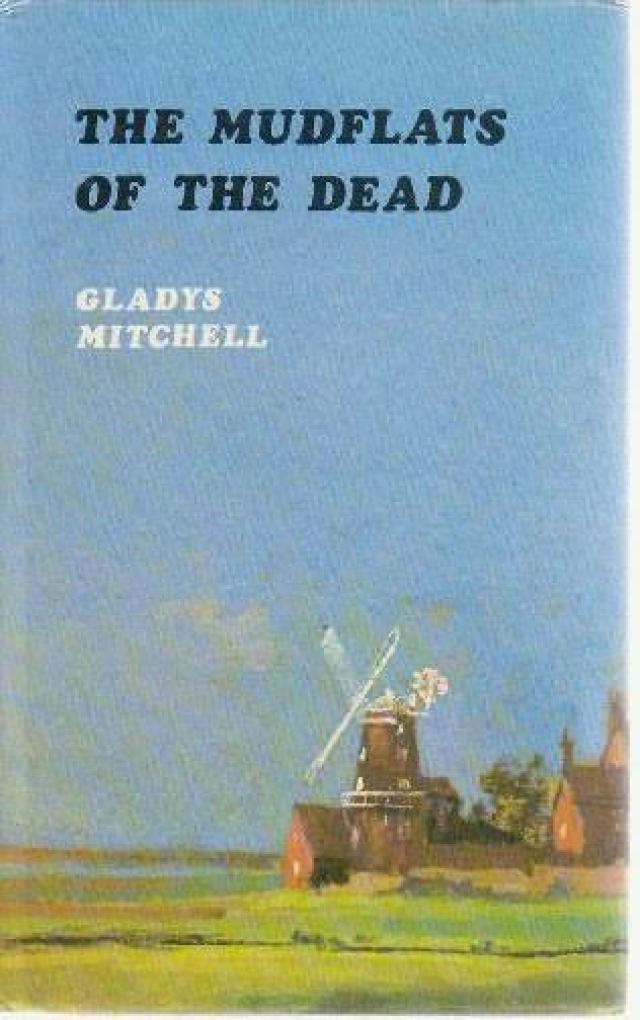
The Mudflats Of The Dead
Gladys Mitchell
Bradley 56
* * *
A 3S digital back-up edition 1.0
click for scan notes and proofing history
* * *
Contents
PART ONE: Colin Palgrave
chapter 1: the coast road
chapter 2: the mudflats, saltacres strand
chapter 3: menage a quatre
chapter 4: interlopers
chapter 5: the dead
chapter 6: serious doubts
PART TWO: Dame Beatrice
chapter 7: discreet enquiries
chapter 8: two interviews
chapter 9: further information
chapter 10: the witness
chapter 11: the old mole
chapter 12: palgrave again
chapter 13: interim
chapter 14: the flat-mates
chapter 15: the mudflats, london river
chapter 16: faint, but pursuing
chapter 17: a dead man speaks
chapter 18: the mudflats, ampletide sands
* * *
Also by Gladys Mitchell
speedy death
mystery of a butcher’s shop
the longer bodies
the saltmarsh murders
death at the opera
the devil at saxon wall
dead man ‘s morris
come away death
st. peter’s finger
printer’s error
brazen tongue
hangman’s curfew
when last i died
laurels are poison
the worsted viper
sunset over soho
my father sleeps
the rising of the moon
here comes a chopper
death and the maiden
the dancing druids
tom brown’s body
groaning spinney
the devil ‘s elbow
the echoing strangers
merlin’s furlong
faintley speaking
watson’s choice
twelve horses and the hangman’s noose
the twenty-third man
spotted hemlock
the man who grew tomatoes
say it with flowers
the nodding canaries
my bones will keep
adders on the heath
death of a delft blue
pageant of murder
the croaking raven
skeleton island
three quick and five dead
dance to your daddy
gory dew
lament for leto
a hearse on may day
the murder of busy lizzie
a javelin for jonah
winking at the brim
convent on styx
late, late in the evening
noonday and night
fault in the structure
wraiths and changelings
mingled with venom
nest of vipers
* * *
First published in Great Britain by Michael Joseph Ltd
52 Bedford Square, London WC1
© 1979 by Gladys Mitchell
All rights Reserved. No part of this publication may be reproduced, stored in a retrieval system, or transmitted in any form or by any means, electronic, mechanical, photocopying, recording or otherwise, without the prior permission of the Copyright owner.
ISBN 07181 1818 9
Typeset by Saildean Ltd. Printed and bound by Billing & Sons, Guildford.
* * *
To Gwen Robyns
with love and admiration
‘And to be read herself she need not fear;
Each test and every light her Muse will bear,
Though Epictetus with his lamp were there.’
John Dryden
* * *
PART ONE
Colin Palgrave
* * *
CHAPTER 1
THE COAST ROAD
‘The irresponsive silence of the land,
The irresponsive sounding of the sea.’
Christina Georgina Rossetti
^ »
Palgrave was in search of inspiration; that is how he put it to himself, although not to those of his circle who had asked him how he intended to spend his holidays. What he meant was that he needed a plot for his second novel. He had been overjoyed when his first book had been accepted, the more so when he signed a contract which called for another two novels. The signing, however, was six months old and, strive as he might, not a single idea which could form the basis of a second novel had come into his head.
‘And if not a second, how on earth can I manage a third?’ he had asked himself miserably on the eve of the school’s seven-week summer vacation, as he stared at the rows of empty desks in a form-room he had grown to hate. He had been reminded of himself at the age of nine, seated in a similar room, but in a pupil’s desk, not at the teacher’s table. The end of term examinations had been over, sports day had come and gone, the little boys were restless and fidgety, the form-master was bored and had run out of subjects for the weekly essay. Falling back on a well-tried but never very successful formula, he had told his class to choose their own subjects for composition. Having stifled the groans and the reproachful cries of ‘Oh, sir! which this shifting of his responsibilities had evoked, Palgrave’s form-master had spent the next twenty minutes on the boys’ reports and in trying to find alternatives to Works well on the whole or Could do better or the even less helpful, from the child’s or the parents’ point of view, Finds this subject difficult. Failing in this object, he had laid the blotter over the reports and resorted to his usual practice of strolling up and down between the rows of desks to see how his embryo and mostly unwilling authors were getting on.
When he had reached Palgrave’s desk he had found an unhappy small boy staring at an almost blank page. Palgrave had written the date in a fair, round hand and had added: My Own Choice of Subject. Otherwise the page was empty.
‘Well, Colin, old lad,’ the master had said, ‘what is your own choice of subject?’
‘Please, sir, I can’t think of one.’
Here he was again, once more in the same boat.
That time, however, rescue had been at hand.
‘What about Myself on Sports Day?’
‘Please, sir, I wasn’t there. It was my father’s holiday and I was taking my fortnight.’
‘And had the good sense to miss the maths paper, I remember. Well, imagine you were there. You can do that, can’t you? Pretend you won the four hundred metres.’
‘Yes, sir. Thank you, sir.’
‘All part of the service, so get a move on. The lesson’s half over.’
But now there was no kindly assistance forthcoming and Palgrave’s dilemma had reached the stage of giving him sleepless nights and a daily sensation of near panic.
‘I can’t have dried up already!’ he told himself despairingly. ‘If I have, bang goes my dream of giving up this miserable job and becoming a professional writer.’
He jettisoned his gloomy thoughts after giving a last glance of loathing at the ink-stained empty desks, smiled at the cleaner as she came in with her tea-leaves, broom and pail, and went whistling down the stone stairs to the masters’ lobby. Cheerful masculine voices were exchanging jests and holiday farewells and from the adjoining lobby came the inexorable clacking of female voices from the distaff portion of the staff.
Palgrave took his mackintosh from its peg, responded to one or two friendly quips and then went into the staffroom to collect his briefcase and a couple of books he did not want the cleaners to handle, and found the room in the occupation of his particular buddy, a young man named Winblow, who was clearing out a locker. He desisted when Palgrave came in.
‘Oh, hullo, Colin,’ he said. ‘Thought you’d gone. You’re off on the sacred quest tomorrow, then, are you?’
‘I suppose so.’
‘Meet me at the Dog and Duck at six and I’ll buy you a drink and wish you luck.
Meet me at gloaming at the Dog and Duck,
And in their witches’ brew I’ll wish you luck!
How’s that for a rhyming couplet?’
‘Lousy. All right, I’ll meet you when I’ve done my packing. Thank God for the invention of the internal combustion engine! One doesn’t any longer need to travel light.’
‘No. Even room for a dead body in a four-seater’s boot. Why don’t you write a thriller if you’re stuck for a plot?’
‘Because a thriller has to have a plot. That’s the one thing it can’t do without. See you at seven, not six. I’ll have all my gear marshalled by then, I trust. Six is too early to get all my packing done.’
‘Don’t forget the kitchen sink!’
Winblow was in his confidence, but in reply to other staffroom enquiries about his holiday plans, Palgrave had said that he was going to take his car and tour the roads, stopping for the night at any place which pleased him and staying longer if the neighbourhood was especially attractive. What he did not say (but it was his real objective) was that he wanted to find a setting which would suggest a theme for his second book.
He had thought of Cornwall and Wales, but it seemed to him that what he required was a part of the country which he did not know at all, so that he came to it with a fresh mind and no preconceived ideas. He thought, too, that it ought to be lonely, desolate and mysterious, although he wondered whether there could be such a locality on an overpopulated island.
However, by the beginning of his second week he began to think that he was on the track of what he wanted. His progress had been leisurely and he had been held up in Colchester for a couple of days while the car was in dry dock for repairs to a faulty clutch. In any case, he had decided that up to about a hundred and twenty miles a day, following by-roads and avoiding the motorways, would take him as far as he wanted to go in the four weeks he had allowed himself for research, and on the Monday of the second of these weeks he was on a coast road which left a large and a smaller town behind and ran almost due west, linking a number of small villages whose names he knew only from the motoring atlas which he kept in the car.
Again according to the map, they were seaside villages, but once he had left the cliffs behind him, the road was often two miles or more from the sea. The high cliffs had been formed of sand and gravel, deposits of the Ice Age, a series of moraines brought by the action of glaciers, but, after the first few miles, these cliffs had given place to huge banks of pebbles as the sea had receded from the land and left its own desposits behind. Between these pebble-ridges and the sand-dunes blown together by the bitter winter winds were the vast sea-marshes which accounted for the coast road having been made so far inland.
Palgrave pulled up just outside a village landmarked by a windmill and a magnificent church. He left the car and walked over the marshes. A channel broad enough to be called a creek ran seawards and the marsh itself terminated in dunes sparsely covered with marram grass. Beyond these was a brackish lake, its shores sun-dried, but a trackway at one end of it led down to a flat, muddy-looking shore.
On the dunes he found sea-holly and the green-white flowers and waxen leaves of sea-sandwort, and behind him the marshes themselves were covered with the pink and grey of sea-lavender and the small, yellow flowers of sea-purslane. He returned to the car and had a look at the map. A few miles further along the road there should be a larger village. He began to think he could do with some beer and bread and cheese.
The road made a long arc, almost a semi-circle. It crossed a small river to which the narrow creek he had seen formed the estuary. To his left were slopes too inconspicuous to be called hills. To his right were the seemingly never-ending marshes, sad and uninviting to some eyes, but to Palgrave’s they represented exactly what he thought he was looking for. Their melancholy charm, their appearance of being divorced from civilisation, of being part of a lost world, enchanted him. Surely they would suggest a plot for his book, he thought.
‘A combination of Thomas Hardy and Mary Webb,’ he decided. ‘What I shall aim at is a mixture of romantic tragedy and country lore, and, of course, I shall include the mystery of “the unplumbed, salt, estranging sea.” To hell with the moderns. I shall write a classic. All I need is a basic idea.’ He began to feel more cheerful than he had felt for months, and, as he gazed ahead and nothing was in his sights but the road following the bases of the green slopes and, to his right and ahead of him, nothing but the never-ending prospect of the marshes, he began to sing.
Then he saw another church tower in the distance and realised that he was approaching a village he had marked as his stopping place for a ploughman’s lunch. He slowed down as he approached it. He had not thought of making it his headquarters while he searched for what he thought of as inspiration, but there was always the possibility that it might prove to be the very setting he was looking for. He drove even more slowly, looking also for a pub.
The village, which was called, reasonably enough, Saltacres, consisted of a long, straggling high street with narrower streets opening off it. At one time it had been a place of some importance, a sea-port for boats to and from the Netherlands, but its harbour had gradually silted up until the channel which had once formed an estuary of some size was no longer suitable for anything but small yachts and motor-cruisers and the village had become a backwater, although, as evidence of more prosperous days, it retained a seventeenth-century town hall, now used once a week as a covered market, and the vast and lofty church he had already seen on his approach.
The houses and cottages were of all periods, a heterogeneous collection which had contrived, owing to the passage of time and the vagaries of the weather, to make of itself a picturesque, acceptable whole. The main street had not only retained its cobbled pavement, but many of the dwellings were of banded flint patterned after the fashion of a countryside which boasted no other indigenous stone.
‘This will do me,’ thought Palgrave, pulling up in front of an inn. ‘Get a drink and a snack here and ask where it’s possible to stay. I must see more of this place.’
The landlord was unhelpful. There was no hotel in the village; he himself had no accommodation for staying guests; he doubted whether there was a cottage to let on a fortnightly basis. Palgrave finished his meal and decided to stretch his legs again before he continued his journey. He was deeply disappointed. He felt there was nothing he wanted more than to stay in this off-beat village.
He walked along a roadside cobbled with unknapped pebbles of flint, turned towards the sea and came out once more on to the apparently limitless marshes. To his right, on the only spot of rising ground apart from the low hills behind the village, was the fifteenth-century church with a tall, square tower and a lesser, but still impressive, beacon light on the seaward end of the roof. Before him, but a long way off, was the pebble-ridge thrown up by aeons of relentless tides and between it and the spot where he stood stretched the grey-green landscape of unutterable desolation, interspersed with streams and ditches.
‘If only I could find lodgings here!’ he thought sadly.
To his left, a kind of causeway led to a little wooden bridge which crossed a narrow part of what seemed to be the main channel of a small creek which widened rapidly as it approached the sea. Palgrave followed the slightly raised path and stood on the bridge.
Palgrave’s work was in a London suburb, but he had spent many holidays in the Highlands. In that part of the country it was the mountains, ‘still and blanched and cold and lone’, which dominated the landscape and dwarfed and threw out of perspective all other natural features, but here, despite the apparently endless stretches of the sea-marshes, the dunes, the pebble-ridge and even the sea itself, it was Fitzgerald’s ‘inverted bowl we call the sky’ which dominated everything.
The endlessness of the flats, sad marshes, the ever-winding, ever-widening creek, the water-colour brushwork of the creaming, retreating tide, were all subservient, insignificant, unimportant and almost, it seemed, unnecessary in the face of that vast, unfathomable, bland, uncaring vault overhead. The quality of the light, too, was amazing. Palgrave was reminded of a holiday he had spent in Greece. How he wished he were a painter, not a writer!
The little bridge was made of broad planks covered with a fine layer of windblown sand. There were stout uprights on either side, joined together by an equally sturdy wooden rail. Palgrave leaned on this to survey the scene. Below him the creek, narrow here, was running out fast. At a confluence between the main stream and a lesser channel, a sailing dinghy was stranded on a mudbank, the bare mast of the boat lying slantwise, cutting across the umber banks of the creek so that the blue and white burgee at the masthead was almost lost against the blue and white of the wispily clouded sky.
Palgrave was about to leave the bridge and continue his walk towards the dunes when he was aware of a girl who was approaching the bridge. Having no mind for company while he was mentally roughing out a description of the scene for his book, he walked on, quickening his pace, but from behind him she called out, ‘Hi!’ and began to run.
Palgrave slackened his pace, then stopped and waited for her to catch up with him. She was a thinnish, leggy creature unattractively dressed in a large, long, shapeless sweater of the type which used to be called a Sloppy Joe. Faded blue jeans came halfway down the calves of her bare brown legs, and a pair of muddy, canvas-topped shoes brought her over the bridge to Palgrave’s side.
‘Hi!’ she said again, panting a little as she joined him. This second exclamation was not a call to him to stop, as the first had been. It was a greeting, American style.