

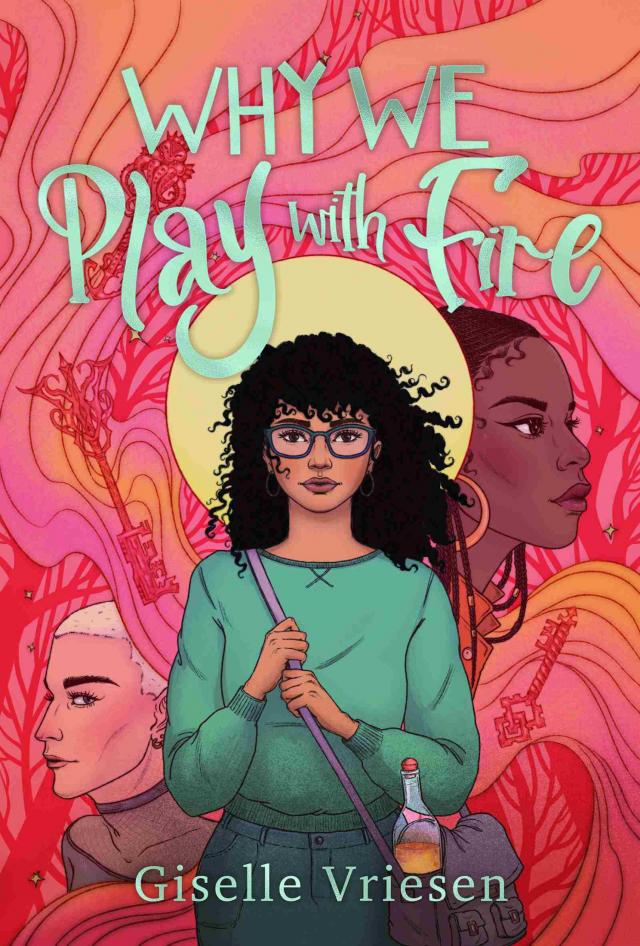
Why We Play With Fire, page 1


To Alexandria, I love you.
PART One
1
WHERE ARE THEY?
A plume of dust rises from one of Mom’s discarded dresses as I fluff it off the ground in her closet. It’s funny how such a small space can hold so many memories: the skirt she wore when we moved to Salt Spring Island from Toronto, the belt I coerced her into buying during our one-month stay in southern Saskatchewan—before she started going out less and less—before we settled down. There it is, the object of my desires. My heartbeat drowns out the sound of clinking pots and pans as Nana cleans up in the kitchen and the simultaneous sounds of her scolding my mother for throwing away perfectly good rice. All I see is the shoebox.
When Auden invited me to come to Matthew’s with her a few days ago, I wanted to give an instant no because I wasn’t technically invited. She assured me it “wasn’t a big deal” and insisted that I’m friends with everyone she’s friends with. What Auden doesn’t understand is that I’m not actually friends with anyone but her. She doesn’t notice the weird glances and withheld energy I get from our classmates. In such a small town, no one knows what to say or how to speak to me. Ever since we moved here, I can tell that all my classmates see when they look at me is “Black girl,” while Auden sees “girl who is Black.” Well, tonight I’m not going to let anything hold me back from having a good time.
I push aside the edge of my slightly too-long bangs as I look down at the box in question. It tingles with a forbidden energy. Inside are brown leather shoes with wooden soles, my mother’s favorite and the nicest pair of shoes in our whole house. I have coveted them for as long as I haven’t been allowed to wear them, forever. But, now that I’m sixteen and Mom is more forgetful than ever, what could the harm be in wearing them out just this once?
I imagine the faces of my peers as I, the Blerd, arrive at the party wearing these beautiful, vintage Fluevog shoes. In this daydream I’m lounging against the doorway acting as cool as a glass of ice water. I can practically feel the envy in mean-girl Emily’s eyes as I stride in, one leather-clad foot after another. Suddenly I’ll stand out for all the right reasons.
I lift the box up with two hot palms, pulling it onto my lap on the floor of Mom’s bedroom. Strange, this box is heavier than I remember. I can wait no longer; the hairs on the back of my neck stand as Mom’s and Nana’s voices rise in the kitchen. A little part of me wonders if maybe I should put the box back and wear my usual flats. Why are you overthinking this? I lift the top of the box with my breath held in the center of my chest, then exhale in a burst when I find something unexpected inside.
A statue, as long as my forearm and carved from smooth black stone, stares back at me. It has no eyes and no mouth, just large hands folded on top of one another. Its body is curved like a woman, though it has no discernible face. When I pick it up, its smooth exterior sends an electric shiver down the palm of my right hand. My shoulders sag. Where are those shoes?
Nana keeps statues all around the house, the Buddhas beside her easel in the corner of the living room where she does her paintings, the small African masks in the kitchen, even a Mother Mary statue in the bathroom. All stuff she collected when she and my mother were younger and traveled the world before I was born. I’ve avoided paying attention to any of it.
I’m about to tuck the statue away when something in its small face—or lack thereof—catches my attention. Looking at the space where eyes should be, a shiver runs down my spine, suspending my racing mind. Then I hear it, a prickly voice in the back of my head. Over my shoulder I find Mom’s room as empty as it was before, but still the whispering voice creeps like vines inside my skull.
There are tales of foes and fate, with heroes never asked to wait. A chance to come and sweep the stars aside at night with wanting arms.
But when a hero is born to earth, chased by a villain of shadow and mirth,
To steal and thwart a girl of age, to seal a tale of oppression and rage,
There will come a point in this young life when waiting could bring forth the knife.
I inhale; the voice continues.
The journey is long, and some will desire more, but she should not forget the key came before.
I balk at the strange rhyme and glance down at the innocent statue. This must be me cracking under the stress of winter break being nearly over and having to go back to class, or maybe it’s the lack of sleep given all my anxiety about this party—or it could be something more. I shove the statue and the box deep into Mom’s closet.
I power through and pack an overnight bag, get dressed, and find my ferry card. I let myself get lost in my routine: forgetting the strangeness of the little statue intentionally. Half an hour later I am tucking the edges of my bangs behind my ears, determined to get to the front door and out of the house, until a roadblock presents itself.
“Do you have your phone charger?” my mother asks. She stands between me and the sweet release of arriving ten minutes early to the ferry. I bite the inside of my cheek.
“I have everything.” I reach out to hug her. When my skin connects with hers, I feel a familiar wave of energy—her worry and love—but there’s also something else too, something darker and metallic. Frowning, I pull away and remind myself that I can’t actually feel her feelings. I’m just imagining it. A mantra I repeat to myself most days.
When I was little, I invented a game where I pretended I could feel someone else’s feelings by touching their skin: love, sharp distaste, cold anger. As I got older, it became less of a game, more of a habit. One I am ashamed to have not grown out of.
“I’ll be back in less than twenty-four hours, don’t worry.” I say this even though my mother never looks worried, just practical and hawkish. She surveys my clothes, internally assessing whether they’re weather appropriate, before nodding once.
“Okay, well, I want to talk to you when you get back, all right? There’s something—”
“Seriously, I have to go, I don’t want to be late.” Even the word late causes my already damp underarms to moisten, my breath to tighten in my chest. “And I have to work tomorrow, so I will see you after my shift.”
This is a conversation we have already had twice today; she forgot about it each time. Her memory slips away like the tide going out to sea: the conversation gone with it like a toppled sandcastle. Usually, I would spend at least another five minutes comforting her—this stage of menopause is a lot stronger than I think it should be—but as it stands, I cannot miss this ferry. I plant a kiss on either of her cheeks and rush for the door. I wave as I pass Nana where she sits at her painting station. She doesn’t look up at me as I make my exit.
Once outside, I hesitate, wanting to sprint off, but instead I look at my mother where she stands in her robe and slippers in the doorframe. We wave at each other in unison.
Mom’s hair is darker and longer than mine, unmarked by gray though slightly thinned with age, and her smooth brown skin holds the same freckles as mine. This is where our resemblance ends. Mom’s features are more prominent than mine, with wide, thick lips and intense piercing eyes. Her mix of Black and Chinese heritage gives her features a smooth, upturned look, while my features fall flat. Potentially a bit resting-bitch when I’m not smiling. I blow a kiss and set off.
The roads in Crofton are frozen and black. My flat boots skim the ice precariously as I slide down the hill toward the ferry. I have no idea where those Fluevogs are—a mystery for another day.
The houses all look the same here, light-colored stucco with closed curtains over the windows no matter the time of day. This is a place I think people go to die, no matter how old they are when they move in. When I get older, this is the last place I’d like to end up. This is the armpit of Vancouver Island. As much as I hate moving and as much as I want to belong, I can’t imagine staying here much longer. While I walk, I think about the future: exams, more studying, what comes after high school, if I can get my grades up high enough to get a good scholarship for university, and what happens after that? Each familiar thought barrels into the next, causing such internal chaos, I almost miss the figure on the road ahead of me.
The icy sidewalk, dark save for sparsely hanging streetlights, curves right as it slopes toward the ferry, but up ahead on the deserted street is one other person: a boy. There aren’t usually many people walking in Crofton at this time of night. Whenever I’ve walked to the 7:45 ferry, I have done so completely alone.
The boy stands beneath a broken streetlight. He isn’t dressed in the uniform of everyone who lives here (Costco jeans and Joe Fresh jacket). Instead, he has on a long black leather coat, unfit for this frigid weather, with dark hair tousled away from his face. Beneath the coat is a black-and-white-striped uniform that contrasts the casual fashion of this town.
I pause and he looks at me, and it feels like even from a block away he truly sees me. It’s an unfamiliar feeling. Usually when people register me, they either make it their abject mission to not see me, to stare over my head or just to my right, or to look at me like I’m a puzzle they can’t quite make out. It’s as if they’re always trying to pin down exactly where I “came from.” But this boy, obviously handsome despite the strange lighting and distance, stares me dead in the eyes with such force that I forget the icy condition of the road and take a confused step back. Like a deer when it hesitates in crossing the road, I rear back. Except unlike a graceful animal, I slip.
The edge of my foot glides over the hard ice, right off the side of the sidewalk. The
I’m seriously losing it, I decide. Now I’m both hearing voices and inventing a boy wearing a weird black-and-white uniform. What if my mother’s memory loss is rubbing off on me? What if this is yet another reason to feel like a freak? I bite the inside of my lip while the pit of my stomach, already wrung tight in anticipation of going to Matthew’s house, suddenly pitches right at the concept of hallucination. At least if I am losing it, I don’t have to worry about finals.
I can do this, I tell myself. I can go to this party. I can act like a normal person, and everyone will think I’m cool.
* * *
WHEN THE BOAT SWAYS jarringly as we pull into the Salt Spring harbor, I stand up from my seat and walk past seven rows of empty seats in this bright room that smells of pleather to the observation deck window. A twinge of pain slices up my ankle, so I glance down at the haphazardly wrapped Band-Aid I got from the kiosk upstairs. It’s tinged red at the edges. Less elegant than I hoped. I frown down at it before scanning the dock ahead for my ride.
The second I see Auden’s Jeep waiting for me, I take a deep breath and hobble down the narrow metal staircase to the car deck where I then weave through twenty cars all bearing THERE IS NO PLANET B stickers.
“What’s wrong?” Auden asks as soon as I slide into her passenger seat after disembarking the boat.
“Nothing, I just—nothing,” I say, shutting the door beside me. My hands are stiff from the cold.
“You have a weird look on your face,” Auden assesses as she pulls out of her parking spot and joins the rush of cars driving off the ferry.
I school my features into something blander. “I messed up my ankle on the walk to the ferry.”
“Oh, boo,” Auden says flatly, eyes glued to the road ahead of her.
Auden likes to dress like a Pinterest board come to life and spends most of her waking hours living up to the soft-girl aesthetic. To her credit, in this moment, she’s achieved it: vintage Redline Levi’s, little fur-trimmed knit pink shirt that matches her clutch purse, French tips, slicked-back auburn hair threaded with delicate gold pins, and the Celtic knot necklace she always wears no matter the occasion. I wish I could hold it against Auden, how seemingly perfect her life is. In reality, she basically lives alone because of how often her parents work. I know how anxious she secretly is in relationships too. When I don’t text her good night, she immediately worries we’re in a fight. Auden wordlessly unplugs her phone from the aux and holds it out to me as an apology for my twisted ankle. I avoid brushing her hand with my own, plug it into my phone, then shuffle my liked songs.
“If you don’t want to go, we can just head back to my house for the night and watch some movies.” She smiles and turns to look at me.
Auden’s pretty when she’s kind, so much so it often catches my breath. But she’s rarely kind when there are other people around. I like to think this version of her, the one I get when it’s just the two of us, is the real Auden, and that any other version is an amalgamation of every other high school “it” girl she watched on TV as a kid—not a real person, just an idea.
“No, it’s fine,” I say.
“Okay, cool, because I talked to Emily and she said that we can go to her house afterward and have like a midnight debrief of everything scandalous we saw at the party, and then tomorrow morning we can all go to the diner for breakfast. We’ll have a blast!”
I nod along since this is a discussion we have already had via text.
Auden continues chatting about who will be at the party, how excited she is to see Dom after they kissed for the first time last week. I itch the center of my right palm. Outside the window of Auden’s Jeep, the world is a wall of black, no streetlights, no houses, just dense forest. It’s so dark here. While Auden talks, I try to summon my earlier excitement, or at least my earlier determination, but all I can focus on now is the boy I saw in the dark and the pulling pain in my ankle. The lamp over him was dim and empty—so strange. I wrap my arms around my stomach, pressing my wrists into the puffy down of my winter parka. What would Auden think if I told her what I saw or what I heard? She’d probably tell me I was crazy or offer me a protein bar and blame it on low blood sugar.
When we pull up to Matthew’s house, Auden bolts, carrying her six-pack under one arm. I look up at the enormous compound, wide windows and four stories of sheer glass. If I had a house this big, I’d throw parties too. But with me, Mom, and Nana all cramped into a two-bedroom house, I’d be lucky to squeeze in three friends.
Outside the house is a group of about ten parents wearing Cowichan sweaters nestled under woven blankets. They smile at us as Auden and I walk up, hold out a wide bowl for Auden to toss her keys in, and ask us each how our parents are doing. I hang back for a second to answer, while Auden disappears into the party.
Inside Matthew’s house, every single one of my classmates dances to Frank Ocean while drinking from clear plastic cups. My regret spikes as I walk through the doorframe and not a single person looks my way. My stomach twists until I spy an empty corner of the room. I weave through the crowd, avoiding physical contact, and take a seat, pulling out my phone to scroll through Instagram in ten seconds flat. My entrance was less impactful than anticipated.
“Hey, there you are.” Auden approaches, having found Dom, her newest obsession, while I was talking to the parents.
Dom is the type of guy you’d find at the single local diner in town at three thirty in the afternoon, because that’s when he woke up. He smiles at me in a glazed way. The smell of alcohol and weed wafts off him in a gust.
“We’re going to go dance. Do you want to come?” Auden asks.
Suddenly, the music starts blasting louder. Dom starts bobbing his neck around, pretending to find the beat. As his mouth moves to the words, I realize it’s Frank Ocean’s “Chanel.” Just when I wonder if Dom is going to do what I hope he doesn’t, the n-word comes flying out of his mouth as he repeats the lyrics to the song.
I recoil. “What did you just say?” My tone is flat while his eyes remain misty with delight, though his singing voice tapers out.
“What?”
“You can’t say that word.”
Auden tenses and puts a hand on Dom’s shoulder. Either he doesn’t notice her signal or chooses not to. His eyebrows furrow.
“What are you talking about—oh.” Realization hits him, but he rolls his eyes. “It’s fine, it’s just a song, and it’s Frank, so it’s like canon.”
I squeeze my fist. “It doesn’t matter who it is or what song it is, you can’t say that.”
Dom shakes his head and looks to Auden for backup. She shakes her head at him and looks at me with a pained expression. “I mean, why do you even care?” Dom clears his throat, his eyes sharpening. “It’s not like you’re Black-Black,” Dom insists.
I want to reach my fist back and propel it outward and hit him in the face. I genuinely do.
“What does that even mean?” I ask.
Dom shakes his head, cheeks flushed. “You’re not like Black like Frank Ocean is Black, you’re like half, right? You’re barely darker than Auden. You’re taking this way too seriously. It’s a party. We’re having fun.”
I balk, then look over at Auden. Her eyes widen more than I thought possible, but she doesn’t say anything. She just reaches out toward me. I flinch even though I wish I didn’t have any reaction at all.
“Hey, let’s go get another drink?” Auden suggests to Dom, who doesn’t seem to hear her. He just stays staring at me, waiting for a response. I wish my chest weren’t so tight. It makes me sick knowing that being ambiguously Black means people like Dom get to both make me feel abnormal and discredit who I am.
“You’re a dirtbag,” I say to Dom, then turn and walk out the sliding door of Matthew’s house. This wasn’t at all what I wanted the evening to be.
On my way out, I skim past the shoulders of a few of my classmates and imagine that I’m feeling their mix of discomfort and intrigue at seeing what just happened: sharp and fizzy.


