

Fall, Bomb, Fall, page 8
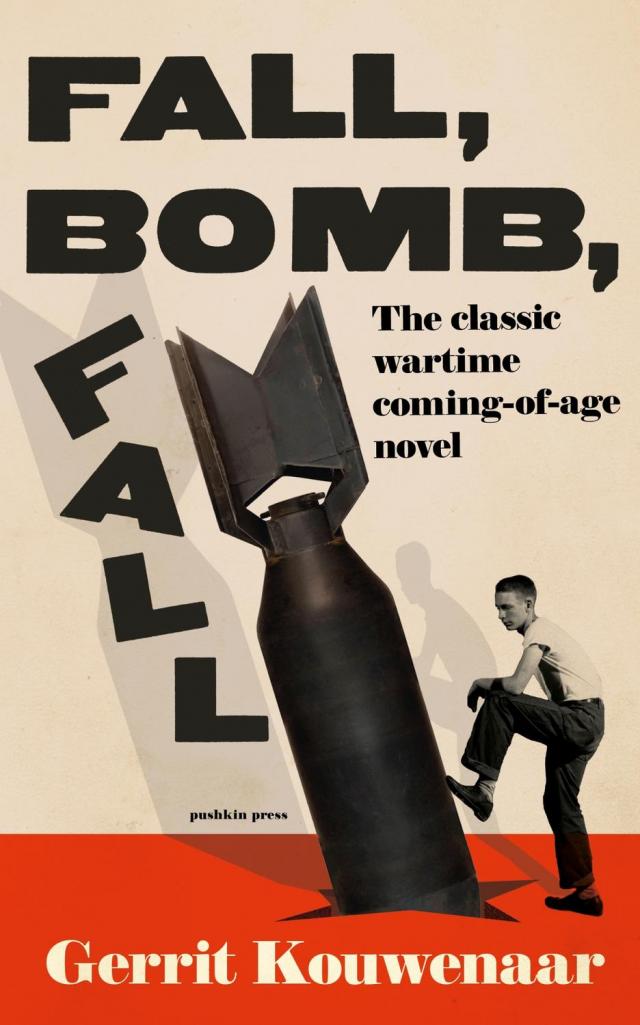


Like most readers in the Netherlands, I primarily knew Kouwenaar, who died in 2014, as a famous poet. I worked for a time for Poetry International Festival in Rotterdam and saw him on stage in 2009, an elderly dude with an impressive walrus moustache. His status was equal to that of the international guests, big names like George Szirtes, Matthew Sweeney, Yang Liang. Kouwenaar’s poetry has been much translated over the years, and is available in German, English, French, Farsi, Polish, Romanian and Swedish.
Gerrit Kouwenaar belonged to the Dutch-language Vijftigers movement. Vijftigers literally means ‘from the [19]50s’, when this group of Dutch and Belgian experimental writers were at their most active. The movement included Lucebert, Remco Campert and Hugo Claus, and was connected to a parallel movement in art: Cobra, which comprised Corneille, Karel Appel and Constant on the Dutch side, but also some Belgian and Danish painters. The Vijftigers’ drive for unhindered expression and spontaneity led them to abandon traditional forms such as rhyme and regular verses. They also often omitted punctuation and capital letters in their poems, an attempt to reduce the influence of logical thinking.
However, before he became a famous poet, Kouwenaar had penned three short novels, of which Fall, Bomb, Fall (Val, bom in Dutch) is the first. It was written when he was just twenty-three and published in a literary magazine, De Gids, in 1950. Like many a debut, some of the details in the book are autobiographical. Kouwenaar was born in Amsterdam and, like the novel’s young protagonist, he was seventeen when the German occupation of the Netherlands began. On 10 May 1940, Germany invaded the low countries: the Netherlands, Luxembourg and Belgium. The Battle of the Netherlands lasted for four days, until the Dutch forces surrendered on 14 May. Resistance would continue in the southern province of Zeeland until 17 May, when the entire country capitulated. Fall, Bomb, Fall takes place entirely within the space of these crucial few days, when confusion reigned and the Dutch still believed that the British were on their way to save them.
The United Kingdom and France had declared war on Germany in September 1939, after the invasion of Poland, but most of that winter (the period known as the Phoney War) was taken up with posturing and building up troops. The Netherlands, meanwhile, was hoping to remain neutral, as it had in the First World War. This attitude was reflected in its lack of military equipment or a properly trained manpower base. In fact, though they scrambled to improve their army and air force, the Dutch were mainly relying on their defensive waterline to repel the Germans.
During its War of Independence against Spain, the Dutch Republic had realised it could use the country’s geography as a defensive measure against enemy troops by flooding low-lying areas. In 1629, construction began of the original ‘Hollandic Waterline’, which protected the major cities located in the west of the country. The waterline soon demonstrated its value during the Franco-Dutch War.
Later, in the early nineteenth century, the line was moved eastward to include Utrecht, and modernised by adding fortresses. So, after the Germans started attacking Dutch airfields on 10 May, the ground in front of the fortifications, which was below sea level, was deliberately flooded with a few inches of water. It wasn’t deep enough for boats but it was deep enough to become boggy and impassable for troops. We see this detail in the novel, first from the train, as Karel notices the flooded polder, and later as he walks back home, sloshing through the water, before being given a backie by a farm boy.
Although Karel Ruis is not identical to the adolescent Kouwenaar, they have quite a few traits in common, as his biographer, Wiel Kusters, notes.* He quotes Kouwenaar as saying, ‘On the afternoon of 9th May 1940, I too was bored and stood looking out of my parents’ living room window. For me too, my life was invaded by chaos and destruction the next day.’ And though the outbreak of war was less of a surprise to him, ‘it nevertheless marked a complete rupture. I lived in a different world before 1940 than the one afterwards.’
Kusters notes some autobiographical similarities to a number of elements in the book. Uncle Robert, for instance, bears some resemblance to Kouwenaar’s uncle Gerrit, with whom he lived for a while. And the first name of the main character, Karel Ruis, bears the alias given to the writer by his cellmates when he spent six months in a prison in Utrecht in 1943. He’d been arrested by the Nazi regime for writing for an illegal underground newspaper, Parade der Profeten, which, incidentally, included pieces by W.F. Hermans – some of whose fantastic classic novels are also published in English by Pushkin Press.
The secret notebook that Karel rips up before running away from home to stay with his uncle also exists. Young Gerrit’s diary, kept as part of his estate, covers a fledgling crush on a girl he met ice skating in the winter of 1939–40. And the photo Karel remembers as he walks through the park is also preserved in the archive. He is about two years old in it, wearing a hat and holding a letter. He looks at the photographer with a slightly suspicious expression, as if in doubt about the letter, comments Kusters.
The novel’s superb dramatic turn is driven by Karel’s magical thinking about bombs, followed by the bombs falling. But are these incidents historically accurate? On 11 May 1940, a German bomber that had been hit by anti-aircraft fire over Sloterdijk flew on, but dropped two bombs which hit the red-light district. One landed in the Blauwburgwal canal; the other hit a row of houses. Forty-four people died and seventy-nine were injured.
A few days later, the entire centre of Rotterdam was destroyed by a massive air raid – reflected in the novel by the red glare over the city as Karel returns home. The setting of Fall, Bomb, Fall then seems to be an amalgamation of Amsterdam and Rotterdam.
I’ll end with a brief word about the translation challenges posed by this novel. Unlike the style of poetry that Kouwenaar would go on to adopt, the narrative isn’t particularly unconventional, and the style is hardly experimental. On the contrary, the writing is pared back and elegant, with a touch of irony. As the mother of a seventeen-year-old myself, I find Kouwenaar’s rendering of the adolescent Karel spot on. I often found myself chuckling away as I translated his words, and I found Mrs Mexocos’s collage of Uncle Robert downright hilarious: His lips and ears were made of thick red felt and his cheeks of a natural-coloured shantung silk. His torso was naked and shiny pink too, and below it was a loincloth which was just an ordinary towel, a kitchen hand-towel, blue and grey checked.
I wanted to convey the book’s subtle humour, often dependent on rhythm, and maintain the simplicity of the prose. At the same time, since this is a book from 1950, I needed to aim for a timeless style without any disturbing anachronisms. To create this effect, I avoided any all-too-contemporary slang and Americanisms in my British English.
My translation was produced in January 2024 during a stay at Flanders Literature’s Translators’ Residence in Antwerp. I worked in tandem with the Spanish translator Gonzalo Fernández Gómez, sharing research, textual interpretations and solutions to the challenges of turning a Dutch text into something accessible to foreign readers. The Spanish edition (Ojalá cayera una bomba, published by Gatopardo Ediciones) can therefore be considered a sibling creation.
As well as a writer, journalist and poet, Gerrit Kouwenaar was also a translator. In 1967, he was awarded the Martinus Nijhoff Prize for his translations of plays by Brecht, Goethe and Sartre, among others. I hope my own attempts do his work justice.
michele hutchison,
amsterdam, april 2024
* Wiel Kusters, Morgen wordt het voor iedereen maandag. De oorlog van Gerrit Kouwenaar [It’ll Be Monday for Everyone Tomorrow: Gerrit Kouwenaar’s War], Uitgeverij Cossee, 2023.
Available and Coming Soon from Pushkin Press
Pushkin Press was founded in 1997, and publishes novels, essays, memoirs, children’s books—everything from timeless classics to the urgent and contemporary.
Our books represent exciting, high-quality writing from around the world: we publish some of the twentieth century’s most widely acclaimed, brilliant authors such as Stefan Zweig, Yasushi Inoue, Teffi, Antal Szerb, Gerard Reve and Elsa Morante, as well as compelling and award-winning contemporary writers, including Dorthe Nors, Edith Pearlman, Perumal Murugan, Ayelet Gundar-Goshen and Chigozie Obioma.
Pushkin Press publishes the world’s best stories, to be read and read again. To discover more, visit www.pushkinpress.com.
THE PASSENGER
ULRICH ALEXANDER BOSCHWITZ
TENDER IS THE FLESH
NINETEEN CLAWS AND A BLACK BIRD
THE UNWORTHY
AGUSTINA BAZTERRICA
SOLENOID
MIRCEA CĂRTĂRESCU
THE WIZARD OF THE KREMLIN
GIULIANO DA EMPOLI
AT NIGHT ALL BLOOD IS BLACK
BEYOND THE DOOR OF NO RETURN
DAVID DIOP
WHEN WE CEASE TO UNDERSTAND THE WORLD
THE MANIAC
BENJAMÍN LABATUT
NO PLACE TO LAY ONE’S HEAD
FRANÇOISE FRENKEL
FORBIDDEN NOTEBOOK
ALBA DE CÉSPEDES
COLLECTED WORKS: A NOVEL
LYDIA SANDGREN
MY MEN
VICTORIA KIELLAND
AS RICH AS THE KING
ABIGAIL ASSOR
LAND OF SNOW AND ASHES
PETRA RAUTIAINEN
LUCKY BREAKS
YEVGENIA BELORUSETS
THE WOLF HUNT
AYELET GUNDAR-GOSHEN
MISS ICELAND
AUDUR AVA ÓLAFSDÓTTIR
MIRROR, SHOULDER, SIGNAL
DORTHE NORS
THE WONDERS
ELENA MEDEL
GROWN UPS
MARIE AUBERT
LEARNING TO TALK TO PLANTS
MARTA ORRIOLS
THE RABBIT BACK LITERATURE SOCIETY
PASI ILMARI JÄÄSKELÄINEN
BINOCULAR VISION
EDITH PEARLMAN
MY BROTHER
KARIN SMIRNOFF
ISLAND
SIRI RANVA HJELM JACOBSEN
ARTURO’S ISLAND
ELSA MORANTE
PYRE
PERUMAL MURUGAN
RED DOG
WILLEM ANKER
AN UNTOUCHED HOUSE
WILLEM FREDERIK HERMANS
WILL
JEROEN OLYSLAEGERS
MY CAT YUGOSLAVIA
PAJTIM STATOVCI
BEAUTY IS A WOUND
EKA KURNIAWAN
BONITA AVENUE
PETER BUWALDA
IN THE BEGINNING WAS THE SEA
TOMÁS GONZÁLEZ
Copyright
Pushkin Press
Somerset House, Strand
London WC2R 1LA
Copyright © The Estate of Gerrit Kouwenaar, 1950, 2023
Original title Val, bom
Published by Em. Querido’s Uitgeverij bv, Amsterdam
and Uitgeverij Cossee bv, Amsterdam
English translation © Michele Hutchison, 2025
First published by Pushkin Press in 2025
Published by arrangement with Cossee International Agency
eISBN 13: 978-1-80533-339-5
All rights reserved. No part of this publication may be reproduced, stored in a retrieval system or transmitted in any form or by any means, electronic, mechanical, photocopying, recording or otherwise, or for the purpose of training artificial intelligence technologies or systems without prior permission in writing from Pushkin Press
The publisher gratefully acknowledges the support of the Dutch Foundation for Literature
A CIP catalogue record for this title is available from the British Library
Gerrit Kouwenaar, Fall, Bomb, Fall


