

The Legend Is Born, page 1


Copyright © 2022 Gerald R. Knight
Iguana Books
720 Bathurst Street, Suite 410
Toronto, ON M5S 2R4
All rights reserved. No part of this publication may be reproduced, stored in a retrieval system or transmitted, in any form or by any means, electronic, mechanical, recording or otherwise (except brief passages for purposes of review) without the prior permission of the author or a licence from The Canadian Copyright Licensing Agency (Access Copyright). For an Access Copyright licence, visit www.accesscopyright.ca or call toll free to 1-800-893-5777.
Publisher: Meghan Behse
Editor: Shelley Egan
Cover designer: Jonathan Relph
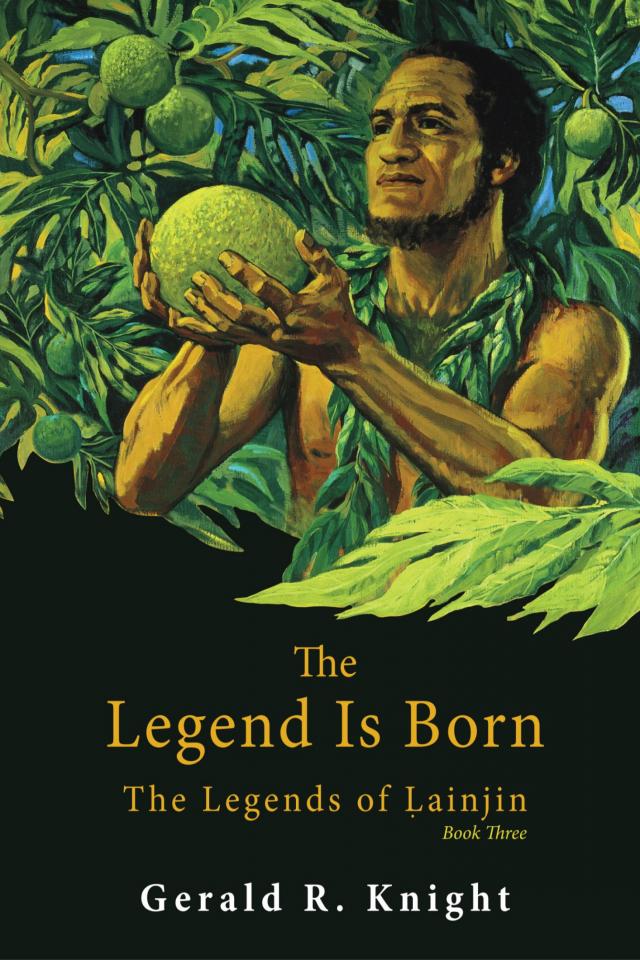
Cover image by Herbert Kawainui Kane, with permission from Herbert K.Kane, LLC.
“Knowledge of the past gives us a rudder to navigate the present” — Herbert Kawainui Kane
Issued in print and electronic formats.
ISBN 978-1-77180-586-5 (paperback). 978-1-77180-585-80 (epub).
This is the original electronic edition of The Legend Is Born: The Legends of Ḷainjin.
The legend is born
He cried, seeming to say, “Where is she? You don’t smell like her. You don’t hold me the same way. I want my mother!” He was in a panic now and showed it with every wrinkle of his screaming red face.
His nervous but determined surrogate mother held a polished coconut shell full of boiled jekaro1 and placed its eye to his mouth to see if he would suckle the sweet nourishing juice, but he was obviously having a tantrum. He kept turning his head and would have none of it. “I want my mother now!” he seemed to insist.
The young, bare-breasted woman bounced him gently in her arms and then swayed him from side to side, knowing he wanted the familiar smell he was used to. He wanted his mother to cuddle him close and wrap him in her warmth and peace. He turned his head from side to side as though searching through the blur for her. But the girl held him nonetheless and, despite his incessant crying, continued to hold him in her arms until he cried himself back to sleep. Then, after carefully wrapping him in the worn pandanus half skirt his mother had brought him in earlier that evening, his surrogate mother left him under the watch of her sister. The thatched house had been creaking from the force of the persistently growing storm, and Helkena was frightened and wanted to talk to her father. She climbed down the ladder through the single exit in the middle of the pole-house floor to the open space below.
The storm outside raged. Coconuts wrenched from the trees fell about the pebbled, leaf-strewn courtyard. The rain blew slanted through the open space under the house, forming puddles amid the thick pandanus matting that covered the beach stones spread beneath them. She hunched as she walked to the lee side of the home, where her father and the rest of the family had congregated to peer through the darkness at the bending coconut trunks with their nodding, rustling crowns. Leaves, and even limbs, had blown off the surrounding breadfruit trees. Luckily, there were no limbs above the house and no coconut trees next to it.
“Is this a typhoon, Father?”
“I think so.”
“How’s the boy?” her mother asked.
“Not good. He cried himself to sleep. Wouldn’t drink his jekaro.”
“He’ll get used to it. They all do. It just takes one taste,” she said.
Helkena spoke to her father again. “How did his mother know a typhoon was about to strike?”
“I saw her come back from the ocean side before she gave her command to set sail. She shouted, ‘Emejjia wa ilọmeto!’2 I heard her myself.”
“But what did Tarmālu3 see that alerted her?” Helkena was curious.
“The tide there must have told her something. It’s the night of no moon, and you’d expect a high tide. But everyone this evening said they’d never seen a tide so high! It took the flotsam lining the shores up and over the strand.”
“The high tide caused the typhoon?”
“No, of course not,” her father said. “But maybe it’s a characteristic. Listen to the waves falling there on the lagoon shore.”
“They’re very loud!”
“Yes, but the tide is low there now. And the waves pound hard even though the wind isn’t coming from that direction. That tells me that, if the back side of this storm slaps us at high tide, the lagoon water might wash over the shore and flood the island,” he said, worried.
That was an eventuality old people talked about around fires in the evening.
He went on. “That same broad opening in the reef across the lagoon that allowed Tarmālu’s fleet to escape the atoll will allow a west wind to whip kāleptak4 into a giant swell. It will pour through the passage and break upon our lagoon beach. It might even suck our house into its backwash.”
“Jeej!5 Where would we sleep then?”
“Let’s hope the storm holds off a bit and comes ashore a little later tomorrow, once the tide is low again. That’ll put more beach between our house and the shore. Better get back to the boy and hope for the best. But be prepared to tie yourself!”
Helkena went back up the ladder into the loft. She remembered the old people talking about tying themselves but had never thought such a thing would occur in her lifetime. It was cozy up here compared to the turbulence they faced below. The tightly folded thatch she and her mother had made, and that her father and the others had tied, kept the wind and rain outside. The window flaps that lined the house below the eaves and overlapped the walls were also tightly thatched. The simple wick of the coconut-shell lamp in the corner flickered, undisturbed.
“What did Father say? Are we going to die?” her sister, Jorkan, joked.
Helkena responded seriously. “Father says the wind will switch, come from the lagoon, whip up the waves, and threaten the village. But maybe it won’t get that bad. I guess it depends on the timing of the storm and the tide.” She glanced at the baby in her arms. “Look at him dreaming there peacefully, oblivious to all this.”
The baby was content and at rest now, his face glowing in the lamplight.
“Well, he knows his mother is gone,” replied Jorkan.
“He does, for sure, though he’s not thinking of that now. But she wouldn’t have left him here if she thought he was going to die. She was thinking about her boats and wanted them off that shore.”
“Where will we go if…?”
“Inland, I suppose. To the middle of the island. Maybe it’s best you go below and get used to the storm like everyone else,” Helkena suggested.
“Will I have to get wet?”
“No. Everyone is on the lagoon side, where it’s still dry.”
Jorkan went below, leaving them alone in the ever-creakier house. Her family had folded each pandanus leaf over a strip of coconut frond and threaded it with a coconut-leaf midrib that secured each leaf of the thatch shingles. Each shingle was the length of a man’s arm. They had then tied and staggered these, one on top of the other, from ridge to eave.
The house stood on posts made of seasoned hardwood coconut trunks. The islanders had made the walls of the same materials as the roof, tied in the same way, and had lashed the thatch shingles to the poles that framed the structure. They had built these pole houses this way for ages, to be as flexible as their proas were on the ocean. The houses mimicked the proa’s ability to rise and fall with the swells and to withstand the twisting force of the wind. Although their house still stood there, creaking but flexible, it would be no match against kāleptak swells pounding the shoreline if it came to that.
“The backwash could suck the sand and beach stones from around the posts, and the whole house could topple,” Helkena thought, glancing at the house around her.
She laid her head next to her charge. His face was beautiful when it wasn’t contorted and crying. There he was now, without a care in the world. “Ḷainjin.” She said his name out loud. Then she drifted into favorite thoughts about Tokki, a boy from Medyeron6 she’d had her eye on. Not exactly a rijeḷā,7 that one, but there were so few boys her age she wasn’t related to. She mulled over these favorite sentiments and drifted into a well-deserved nap.
Her sister awakened her a while later. Helkena was so tired she had no idea how much time had lapsed. All was surprisingly quiet now. The house no longer creaked, and that alone gave her spirits a lift, until her sister dropped her mood-changing words.
“Father says to bring the child below. He says it’s time to tie ourselves!”
The words shocked her. They weren’t what she had prepared herself for. She had expected to stay where she was until it all blew over, like so many times before. Then she remembered the stories of a lull before the strike. Was this what they had talked about?
She had lived on the shores of Wōtto,8 the principal islet of this atoll, her whole life. With the predominant wind direction from the east, she had looked west, at the mostly peaceful lagoon, every day. The islet was so small she could walk its circumference in one morning. But it didn’t seem small to her. At high tide, the surface of the lagoon rose right up to the beach’s strand. The atoll was just a ring of flat coral islets, like a cup filled to its brim and ready to spill. But it didn’t seem low in the water to her. Maybe, were she a bird that could fly high above and gain perspective, she might see things differently. She often tried to imagine that.
Hearing the lagoon waves thumping on the shore more clearly now that the weather had quieted, she knew what her father’s words meant. The eye of the storm had passed over them, but its wind would come back from
“Do you want me to take the boy?” her father asked.
“No. Please, I’ve got him.” His life would be in her hands, she thought.
“Okay, we’ll head inland and find a thick coconut tree that’s a little slanted and off by itself. The water will come from the lagoon, so we’ll get to the middle of the island.”
Her charge was crying again, but now Helkena was on a mission. She realized that everyone was abandoning the village. All the villagers were moving inland, and other children were crying. She wasn’t alone. Her sister, father, mother, brothers… They moved as one group, as did the others. The rain had stopped, and she was glad for that. Looking up, she was surprised to see stars. To the unsuspecting eye, the storm was over. “Was this movement inland really necessary?” she wondered. She kept stumbling in the dark. There were so many broken limbs, and no real path to where they were heading.
Her father, always the leader, took his family to a spot he had in mind and started pointing out trees to each of them. He let her continue to hold the baby while he tied her to a tall coconut tree.
“Right over left,” he said out loud, always teaching. “Left over right. Done.” Then she saw him in the distance, tying himself to the same tree as her mother. “What was the sense of that?” she asked the baby in a singsong voice. “If she stays protected behind the tree, he’ll be exposed to the weather!” Her mother, being her mother, must have insisted, and her brave, ever-suffering father had complied.
Ḷainjin hadn’t stopped crying, so she lifted his face to hers and baby-talked to him in as carefree a voice as possible. He wasn’t amused in the least and wanted his mother, but she had long since gathered her fleet, crossed the lagoon, sailed through the broad passageway, and got her craft safely to sea. Suddenly, it turned dark again as clouds covered the sky.
She remembered that first day well. Ḷainjin’s mother, Tarmālu, fat with child, had brought hundreds of bundles of bwiro10 to trade for Wōtto logs of jāānkun and jaki.11 Right off, she had asked for a midwife, and everybody pointed to Helkena’s mother’s house. So, that’s how it started. She gave birth and, as the moons passed, the jaki and the jāānkun piled up as she distributed the bundles of bwiro. The jāānkun would supply nourishment during the trade-winds season when food was scarce, and the women of Wōtto made very fine jaki, and their men dried fine jāānkun as well. Sunlight they had in abundance.
So, the women of the island had gathered ever more pandanus leaves and made more mats. As Ḷainjin had grown, things slowed down. Helkena had helped her mother gather various leaves, which they heated with water in a jāpe12 for Tarmālu’s baths. Yesterday had been the second day of the storm, and then that evening, she decided to leave and off they went.
And here in Helkena’s arms was Ḷainjin, the infant left behind. She held him between the tree and herself so she could brace him in her arms against the trunk. Peering into his little face and smiling, she said, “You’re a heavy boy! Too much mother’s milk.” The storm, it seemed, was restarting, or at least clouding over again, and she was already tired of holding him. She looked over at her sister, who acknowledged her by raising her arm.
She remembered again what her father had said: “When the back side of this storm slaps.” As if to emphasize that thought, a light breeze brushed her face, and just as her father had predicted, it came from the lagoon side this time.
Her mother had mentioned that Tarmālu had the ṃōjọliñōr.13 “Too much sky inside,” her mother had said. Tarmālu had been on the ocean too long. For her, land was just a resting place. Somewhere to stop on her endless journey back and forth among the atolls. She nearly always slept outside. Most people wanting air at least slept under the house, but she slept on her boat sometimes. Not a good sign. Maybe Tarmālu wasn’t cut out to be a mother. In that case, she should have returned to her home island, where the boy could be adopted by a family member.
“Who wouldn’t want such a beautiful boy?” Helkena baby-talked again. “He’s a beautiful boy. Yes, he is.”
When it started to drizzle, her first thought was to protect the baby. With some difficulty, she unrolled the jaki, folding it lengthwise because the rope that tied her limited its width to that of the tree. She slid the folded jaki up the trunk of the tree behind the boy and inside the rope that tied them. The jaki bent around them like a wall and bent over them, forming a roof of sorts. “That should help keep the rain off him,” she thought, just as the wind picked up a little.
What a decision the boy’s mother had made. But at this point, how could Helkena judge whether she was right or wrong?
“To Tarmālu, life was all about trading,” she thought. On Wōtto, it was bwiro for jāānkun and jaki. Somewhere else, she heard it was something else for yet another product. But perceptively, Tarmālu would always take plenty of other things to give away — usually pandanus or breadfruit cuttings, mostly from the southern atolls to the northern ones. Her father had been ecstatic with the Ajbwirōk and Utōttōt varieties of pandanus cuttings she’d given him. He had planted them right off and watered them every day. Tarmālu had been to Wōtto several times. Being in the north, it was one of the drier islands, so perhaps she had felt it needed more of her help.
The people always welcomed her. This time, she had brought a full belly and asked Helkena’s mother to help her give birth. Just like that. As though it was no big thing to bear a first child.
“And out popped Ḷainjin,” Helkena said out loud, kissing Ḷainjin’s forehead. “Your mother is a brave one. No doubt about that!”
Ḷainjin looked at her as though trying to decide whether he should keep crying until his mother returned. She imagined him saying to himself, “Surely, she got my point by now! Mother must have gone away. Can mothers do that? Why did this woman take me from that warm place and bring me here?” He decided to keep crying.
Just then, a gust hit them with a swoosh of rain. Luckily, the tree and the folded mat protected them from most of it. Yet water started dripping from her face and seeping into the mat skirt he was swaddled in.
Tarmālu was a woman impossible to emulate. They all said that. With her cuttings and plantings, she had her eye on their future. Everyone could see that. She would show up one day on the horizon with twelve or so proas, which would tack across the lagoon. The village men would cut pāp14 rollers and help them beach their proas. She’d meet with the elders and pass out her gifts to them from each boat. The elders were the first to hear the news she brought from the other atolls. Then she would meet with whomever would host her stay and present more gifts there. And almost always, she brought fish as well. The other boat rijelā and crew would meet with their hosts and distribute their gifts. Then, usually the next day, she would lay out her trade items beneath the house of her hosts and begin trading off the rest of what she had brought.
The wind was gusting now as it had before the lull, only from the opposite, more dangerous direction. Previously, the huge swells created by the fierce winds had crashed onto the broad ocean-side reef that protected the islet, but there was no reef protecting the lagoon side. Now, according to her father, it was just a matter of time before the wind built the swells rolling across the lagoon through the broad passageway on the other side to the point that they would crash over the lagoon beach and swamp the islet itself.
“How high will I be able to climb?” she wondered, looking up the trunk of the tree.
That juncture, she knew, would test her preservation skills to the limit. How much of this cold rain could she and the boy survive? Yes, the mat would help to shield them from the force of the wind, but she realized that the thick force of the constant rain would drench them and the wind would suck the heat from their bodies as they stood against it. “We’d be better off swimming,” she thought. “At least the motion would heat us.” This wasn’t the warm rain of a cloud passing through an otherwise bright afternoon. Nor was it ocean water, which was warmer than the air of the storm. It was rain as cold as this typhoon could cough up, and it would leave them both shivering for their very lives.





