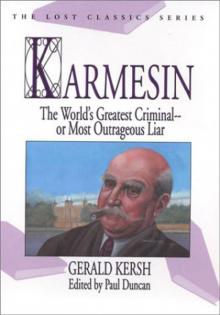
Karmesin, page 3


“ ‘You would have to modify all your meters,’ I insinuated.
“We compromised at 10,000, and he went with me back to my room.”
“Well?” I asked.
“The whole thing was so simple. I pointed to the bottom of the meter and showed him a dny hole, no larger than a pinhole. That was number one, then I showed him my cake of soap; apparatus No. 2. ‘Well?’ asked the gas director. I took him to the window and opened it. Lying in the window sill were two or three cakes of soap; in each cake an indentation of the size of a silver franc.
“It was so childishly simple. Into my little soap moulds I had poured water; the night frost turned the water to ice; the one—franc piece of ice was just hard enough to operate the mechanism of the meter; the gas thus obtained heated the room, the heat turned the ice back to water which dripped out at my little pin hole. Result? Invisibility!”
“That’s extraordinarily clever,” I said. “And did you get your 10,000 francs?”
“Yes,” said Karmesin. “But what the devil was 10,000 francs? £500? £500! Chicken feed! —”
Karmesin rolled some of his twice—used cigarette tobacco into a kind of mahorka-cigarette, in a bit of newspaper, and fumigated his gigantic moustache with a puff of frightfully acrid smoke.
Karmesin and Human Vanity
Karmesin was looking at himself in the mirror. The mirror measured some few square inches. Karmesin’s surface measurements must have run to some almost astronomical number of square feet: he had to take four looks to see the whole of his face. He passed a hand over his cropped white head, which gave out a noise such as you might make by rubbing together two pieces of sandpaper; scowled at himself with his ponderous eyebrows, and then, with a deft gesture, divided into two parts his gigantic Nietzsche moustache and gave the ends a twirl; slapped himself in the chest, tried to look at the back of his neck, dragged down his cuffs, polished his shoes on the backs of his trouser-legs, and, in general, indulged in such an orgy of titivation that I could not help asking: —
“Are you going to meet a woman, or something?”
“No. My day is finished. Observe my hair, how white it has gone. Also this moustache. There was a time when no woman could resist this moustache; a certain duchess used to tie little pieces of ribbon to the ends of it. But it is all vanity ...”
“Bits of ribbon!” I said.
Karmesin swung round his big, plum-like eyes, and glared at me. “The trouble with you, my fine fellow,” he said, “is that you are a sceptic. You believe nothing that you do not see. Therefore you are a fool. ‘Seeing is believing!’ Pfui, I say; and again, Pfui! It is thirty years since I last saw my own knees. So am I therefore to refuse to believe in them? There is no fool quite so foolish as the sceptic, the Wise Guy. I know. I know all about fools. So listen to what I say. The greatest blockhead on earth is the clever man who thinks himself cleverer. Hence, I could extract a hundred thousand francs from a man of whom it was said: — ‘The banknotes trickle through his fingers like flypapers.’ ”
“Who was that?”
“A man called Medved, a crook.”
“How did you swindle him?”
Karmesin chuckled. “Listen,” he said. “You might have thought,” said Karmesin, “that the man was not born who could swindle Medved. There was no under—handed trick that he had not thought of first. He was more slippery than a basinful of eels, and subtle with a fantastic subtlety — almost as subtle as myself.
“There was no dirty business with which he had not soiled his hands. He had dipped his fingers in a thousand different pockets. He was clever, and he knew it. First teach a skunk how to make a smell, then teach Medved a new trick! Ha, it was for Karmesin to do that; yes, chort vozmi, me, Karmesin, by heaven!
“He was one of those men who can both get money and keep it. He must have been a millionaire. He kept accounts. He introduced a post- office atmosphere into his shady dealings. Not a stamp, not a pen—nib escaped him, and he would stay up half the night to figure out what had happened to a mislaid farthing. You cannot conceive the caution and the meanness of that man! He would have made a Syrian pawn—broker appear like Diamond Jim Brady. But he had brains, and also nerve. At the same time, he was as smooth as glycerine. He looked like an octopus — he had a dirtyish pallor, no shape, evil eyes, and a beak. In shaking hands with him, you felt that six or seven other hands were investigating your pockets while a dozen eyes watched you. He was feared. He made money out of everything. But he was still unknown to the police.
“I met him in Paris. I was very prosperous at this time. You could have seen me in an overcoat with a sable collar and a stud worth a thousand pounds, looking like a magnate. And it entered my mind that it would be an achievement to separate this Medved from a few of his carefully hidden thousands. I took him to Olsen’s Bar, gave him champagne, and let him see that my wallet was packed with beautiful new five-hundred-franc notes. I could feel his wicked eyes crawling all over me.
“After a while he said: — “You are doing well.’ I replied: — ‘Very well.’ ‘And might one ask which branch of business you have decorated with your unquestionable talents, Monsieur Schall?’ I smiled, and said, quite openly: — ‘Undoubtedly, my dear Monsieur Medved, I shall be very happy to tell you. I have a mint.’ He laughed. I took out my wallet, showed him its contents, and selected a five—hundred-franc note, which I threw across the table to him. ‘What do you think of that note?’ I asked. He was not the man to be deceived by a forgery. He handled the note, held it to the light, and said: — ‘I think it’s very nice. In fact, genuine. It is genuine.’ I smiled, and said: — ‘And what would you say if I told you that it was not?’ “Why, then,’ he replied, ‘I should say that you have found a genius of an engraver, a master of printing, and the greatest paper-maker in the world.’ I said: — ‘You would be wrong. I have found no such things. One genius, yes. But that is neither here nor there. You must excuse me. I have to go.’
“ ‘Wait,’ he said. ‘This note: it is certainly genuine.’ I replied: — ‘Keep it as a souvenir. It is not genuine. Take it into any bank. Tell the cashier: I have ever}' reason to suspect that this note is a forgery. Have it scrutinised. And still they will pronounce it genuine! And still the fact will remain that it was made in a hotel bedroom, in Vienna, with an apparatus not much larger than a typewriter.’
“His heart must have turned over at this, but he simply blinked, and said: — ‘We might do business together.’ ‘Forgive me,’ I said, ‘but there is no business that I have to discuss with you.’ I gave him my card, and left him.
“As I expected, he followed me. He telephoned every day. Once or twice, I took him to dinner, always paying the bill with a new five— hundred-franc note. I let a month pass, six weeks. We talked of everything — except the apparatus not much larger than a typewriter, although his tongue was itching to discuss it. Once I showed him a German hundred-mark note; on another occasion, a new American hundred-dollar bill. To cut it short — in the end, he begged me to tell him about it, and I did.
“The process, as I explained it to him, was simple. I did not involve myself in the innumerable technical complexities of bank-note manufacture. No. I ran no risk of detection through faulty inks or engraving. No. I had, I told him, a method of transferring the imprint of a note on to a blank sheet of paper. Hence, I could interleave blank paper and real banknotes, and, within twelve hours, double the number of the notes.
“He asked: — ‘And the apparatus?’
“I told him: — ‘A sort of metal bath, combined with a heater and press. It is exceedingly simple.’ ‘May I see it, Monsieur Schall?’ ‘No, you may not, Monsieur Medved.’ ‘Did you invent it, Monsieur Schall?’ ‘No, not entirely. The combination of chemicals essential to the process was invented by an Austrian chemist who works in a dye factory. I helped to elaborate the press. The greatest difficulty is the paper, but I am able to obtain that.’ ‘And is it a costly process?’ he asked. I told him: — ‘There is a certain cost. It would cost one about five shillings to duplicate five thousand notes of five—hundred francs each. What more do you want?’ He thought for a while, and said: — ‘I should like to see such a machine working.’ I laughed, and said: — ‘I find your company very pleasant, my dear Medved, but I have not yet the honour and pleasure of knowing you well enough for that!’ He hastened to assure me. ‘My motive is not merely curiosity, Monsieur Schall. If this machine works, I would be prepared to make an offer.’ ‘No doubt, Monsieur Medved, but I should not be keen to sell.’
“So it went on, for two weeks more. At length, I agreed to give him a demonstration, on the understanding that, if he was satisfied, he would be prepared to buy the press and the formula for two hundred and fifty thousand francs.”
Karmesin laughed. I said: — “But Karmesin, you’re not going to tell me that you really could turn one note into two?”
“Aren’t I? You’ll see, my friend. I arranged to show Medved what my machine could do. I told him: — ‘Have ready at your flat one thousand new notes of a hundred German marks.’ He protested: — ‘Why German marks?’ ‘Because the only paper I have is German bank paper, and of that, at present, I have no more than twelve hundred sheets. I’ll show you whether this machine works or not! In eight hours, I shall turn one hundred thousand marks into two hundred thousand; in your presence, and before your very eyes.’ He said: — ‘Very well. Be at my flat at mid-day tomorrow, with your machine, and everything else necessary. The money will be there.’
“Good. Next day, I took my machine, and went to Medved’s flat — a grim and filthy place, over a grocer’s shop off the Boulevard Rochechouart. I went upstairs. Medved was there, with another fellow, a sort of ape, with a broken face and tremendous shoulders, whose right hand was perpetually in his coat pocket. ‘Just in case,’ said Medved, very sweetly. ‘Not that I distrust you. God forbid. Only nothing could be easier than to knock me down and walk out with my hundred thousand marks.’ I said to him: — ‘Medved, if I wanted to rob you, the last thing I should stoop to would be robbery with violence. I would swindle you if
I could, yes. But knock you down? Pfui! ‘ He said: — ‘Let us see the machine.’
“I took it out of its case. It looked like a common black tin box. I opened it and showed Medved the inside. ‘Look well,’ I said, ‘it is very simple. This is a sort of tank of thick glass. This top plate is simply a press, to hold the contents down firmly. Here, as you see, is a spirit- lamp, which heats the surrounding water-jacket. The entire secret of the process is in the compound which transfers the imprint of the real note to the blank paper, and with which we thoroughly moisten every note and every blank sheet before putting them into the press. I will show you, now ...’
“I picked up the bundle of bank-notes, and examined them, one by one. Medved’s ape-man watched me so closely that his breath tickled my neck. Medved, also, was all eyes. They thought that I might perform some trick of legerdemain, and palm a few notes. Fools! Fools, to rest so confident in their own knowledge of low crime!
“I damped every note and every sheet of paper, and built up a neat pile composed of alternate banknotes and blanks. The smell of the secret compound was preposterous — it conveyed memories of ancient battlefields in hot sunlight, questionable eggs, and the odour of the fish that goes into the Cafe Nouilles in wooden boxes, which makes even strong fish—porters unwell — and mingling with it came the ape-man’s breath, charged with garlic and Brie cheese and twistgut brandy. It was not by any means a garden of roses. Still, I built up my tower of beautiful new notes and nice clean paper, and then wrapped it in strong vellum, which I carefully sealed.
“ ‘Watch,’ I said, ‘I now place the parcel in the press. I tighten the clips ... one, two, three, four. Good. Now I light this spirit-lamp, and very firmly close the lid. Now we wait.’
“ ‘How long?’ ‘Four hours. The temperature must be kept at about eighty—eight centigrade. After that it must be allowed to cool slowly for another four hours. Then we open the parcel, and your money is doubled.’ Medved paced the room. ‘It seems too good to be true,’ he said, ‘but if the worst comes to the worst, I shall have lost only eight or nine hours of time. Pedro, stand guard over that machine!’ Pedro took from his bulging pocket an indescribably sinister revolver. Then we waited. Medved smoking cigars; Pedro picking his nails.
“Two hours passed. I fussed with the thermometer. Three hours passed. The atmosphere was tense. Four hours. ‘Ten more seconds,’ I said, looking at my watch — ‘One ... two ... three ... four ... five ... six ... seven ... eight ... nine ... ten — open up!’ and I tore off the lid and pulled out the bundle, steaming and hot. ‘Blankets!’ I shouted, ‘Blankets!’ Medved tore three thick blankets off his bed, and we wrapped the parcel in them and put it in front of the fire.
“ ‘Pedro, guard that parcel!’ Pedro squatted over the parcel like a cannibal guarding a victim. Another hour passed. ‘Is all this waiting essential?’ ‘Yes, it is. Let that bundle cool too quickly, and you’ll get only half an impression, and the money will be spoiled, too. Besides, the paper must also dry' slowly. You must have patience.’ Medved helped himself to another cigar. An hour and a half more went by. I began to manifest signs of nervousness. I paced the room, biting my nails.
“Footsteps sounded in the passage. Pedro rose, and cocked his revolver. Medved went over to his bundle of money and prepared to defend it with his life. The footsteps passed. We all sighed with relief. I locked up my little machine and put it back in its case, together with all the little botdcs. ‘Another half-hour to go.’ ‘Thank God,’ said Medved.
“And at that very moment, there was a thunderous knocking at the door — heavy truncheons; we all recognised the sound — and an unmistakable voice roared ‘Open that door! In the name of the law!’ I had hysterics. ‘The money!’ I said to Medved, in a terrible whisper. ‘Hold it! Guard it! Don’t open it! It will all be spoiled!’ He clutched it to his bosom. Then I said: — ‘My God, the machine!’
“Open that door or we break it down!’ shouted the police. I seized the machine, and rushed out by the fire-escape. ‘Guard the money with your life!’ I shouted. Just then, the panels of the door began to crack. Ho—ho—ho—ho—ho—ho—ho—ho!”
Karmesin stopped for breath.
“Well?” I asked.
“Well! What do you think? When Medved opened his parcel, he found two thousand neat pieces of newspaper. I found a hundred thousand marks — very damp and malodorous, it is true, but very' acceptable. It was the oldest trick in the world — switching similar parcels. Bah, fools!”
“But the police?”
“Police? They were three men whom I had employed to come in at that moment. But Medved did not realise that until he opened the parcel. Then he saw that he, Medved, the fox, had been taken in by an ancient swindle and a common Chinese-puzzle cabinet. He could do nothing, not even complain to the police. But it shows you how, by means of an atmosphere, you can get even blood out of a stone. It all goes to show the folly of human vanity.”
Karmesin and the Tailor’s Dummy
Karmesin nudged me, and said: — “Look at this.”
I looked. A young man was walking towards us — a beautiful young man, dressed like an actor in a tight grey suit, a silk tie that made my mouth water, a hat that must have cost three guineas, and a magnificent pair of crocodile—skin shoes. As he passed, I caught a whiff of violet scented brilliantine.
“Ekh!” said Karmesin, “Barbarians! Is there any animal more absurd than man? No. Observe me that youth. Pfui! He encases himself in the wool of a sheep; knots about his neck the guts of a worm; has a reptile flayed to cover his feet; skins a rabbit to put on his head; and smears his hair with the fat of dead bullocks impregnated with the juices of squashed plants. Can you imagine an ape being so stupid as to want to cover itself in the skin of a debutante, and wear round its neck a string of beads composed of the teeth of a politician? Only among men is it considered a symbol of virtue, to hang oneself with such dead animal matter — silks, feathers, bits of stone! — Tcha! Yet for these things, nearly all crimes are committed. Only man is vain.”
I could not refrain from saying: — “All the same, I watched you trying to take the shine off the seat of your trousers by scraping it with a razor-blade, the other day; and you raised blue murder when you cut the cloth.”
Karmesin gave me a frightful look, and said: — “You had better be careful! Nature has placed an enemy in your mouth, to steal your brains away. If I attach some importance to dress, it is because I know that the world is full of fools who worship it. I use clothes: I am not their slave. Yet the desire for clothes, when it gets hold of a man, may be as destructive as drunkenness, drugs, or the woman—fever. I knew a man who used to starve himself in order to buy expensive neckties. Having bought one, he would put it on, and then stand in an elegant attitude outside the Cafe Anglais, ostentatiously picking his teeth. Indeed, one of my very earliest essays in crime was inspired by the clothes—fever of a bank—clerk.” “Were you very young then?”
“No, not very young. If I were writing a textbook of crime, a Guide to Easy Money, I should say, first of all: — If you wish to become a successful criminal, never start too young. Lay your plans. See much of life and men. Observe human behaviour. Work alone. Choose, first of all, a fool-proof scheme; then start, coolly and cautiously, as one starts any other commercial enterprise. Of course, I was an exception. I am a creative genius. I first conceive a crime-story, then make it come true. Besides, I started with one great advantage: I was a lawyer.”
“Were you?”
“Yes, fully qualified, and even with something of a practice. If I were running a training-school for criminals, I should article all my pupils to solicitors. Nobody has less respect for the law than a solicitor. He has uncovered its nakedness: he has peeped under the sombre robes and observed the corsets, trusses, superfluities, hollownesses, and blemishes on the body of Justice. I was practising in Paris, and doing tolerably well. I was, as you may imagine, a very shrewd young man: clear-sighted, clear-headed, full of commonsense, subtle, quick to seize opportunities — a perfect young attorney.