

Group at the Grand Cafe, page 1


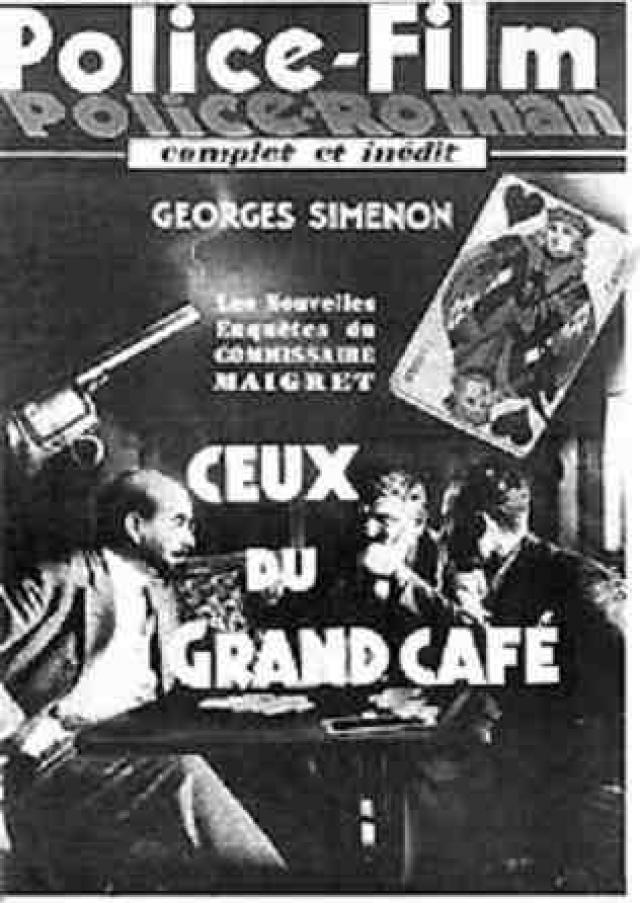
Ceux du Grand Café
by Georges Simenon
* * *
First published in Police-Film/Police-Roman magazine in August, 1938.
First published in book form in 1967 in
Œuvres Complètes, Éditions Rencontre, Gilbert Sigaux, ed., Lausanne, 1967-73.
in Tout Simenon, tome 25, Presses de la Cité, 1992.
TRANSLATED FROM THE FRENCH BY STEPHEN TRUSSEL AS:
The Group at the Grand Café
published at
Maigret on the Web
Bibliography Statistics Bulletin Texts Simenon Gallery Shopping Film Links
* * *
CONTENTS
Chapter One
Chapter Two
Chapter Three
Chapter Four
* * *
CHAPTER ONE
Contents - Next
It had started that winter. As soon as it got dark, Maigret didn't know what to do with himself. He had barely amused himself for a month turning the knobs of his wireless, and it didn't take him but half an hour to read his three newspapers. Then he'd desert the dining room, his usual lair, and make a small tour of the kitchen.
"Haven't you finished yet?" he'd ask his wife. "What are you doing?"
He came back, left, came back again, incapable of understanding what kind of work could keep a woman in the kitchen all day long, to the extent that Mme Maigret had finally said to him one day, "You don't know what to do with your great big self. Why don't you go down to the Grand Café and play cards with them?"
Maigret had resisted for weeks, nearly months. Certainly, he knew everybody in Meung-sur-Loire, where he had retired to. He was not ashamed to be to retired, to cultivate his garden and to tinker close to his cabin at the edge of the river. He sometimes entered the Grand Café — quite modern, close to the bridge — to drink a demi there, or on occasion, an aperitif with water.
The fact remains that it was for him, in his heart of hearts, a kind of defeat, the day when, at the insistence of Mme Maigret, he settled himself before the green baize of the card table, and asked like a beginner, "How much do we play for?"
"Drinks, as usual. Shrewd as you are, you shouldn't have to take your wallet out often."
He had decided to play just once. But the following day, they sent a boy to tell him that they were waiting for him.
Gradually, he adopted the special vocabulary of his partners, became part of their free-masonry and, strictly speaking, one of the group at the Grand Café, of whom Angèle never asked what they took, as she knew in advance; one of those who, as they marked the score, didn't fail to sigh, "Well, Angèle! Won't you stand us to a round? Don't be so stingy!" And after all it was hard to say whether she enjoyed the constant teasing or not.
That winter, when there was mud on the paths, Maigret didn't mind putting on his varnished boots to go to the bridge, and at the time of the grape harvest and for another month after that, they drank half bottles of new white wine. December and January, and sometimes February, saw grog and hot wine, and spring called forth anise aperitifs, which were replaced, in summer, by the fresh light white country wines…
"Thirty six…"
"If you say thirty six, you've got forty… I say misère."
"Forty-one…"
"With what?" The three others addressed each other as tu, used their first names or more often their profession.
"To you, Butcher!" The butcher came there in his work clothes, his apron sometimes spattered with blood. He lost more often than the others, was often bawled out for his mistakes and paid up without ever grumbling, seemingly happy to be allowed into this holy-of-holies, this favored band which constituted the cream of Meung-sur-Loire. Sometimes his son came to call him when a customer required his presence opposite, at the red-painted gates of his shop, at which time he always found a neighbor to hold his cards, and from which he usually profited by adding points to his score, or making a joke.
"To you, Citroën!" He was the mechanic, who played seriously and always won, but who was relentless when a partner made a mistake in his play. The third who could be called one of the principal pillars was Maigret, whom everyone called 'Superintendent' and with whom they only joked timidly. As for the fourth, it varied. When the mayor, who was a veterinarian, didn't come, it was Urbain, the owner of the Grand Café, who took his place, unless the blacksmith happened to be there. By five to five, one could be sure that the butcher was on the threshold of his shop, awaiting the signal. Maigret would arrive, puffing his pipe, his hands deep in his pockets. Opposite the Grand Café, there was another, the Commerce, narrower and darker, which made it a second-class establishment not worthy of note.
"Go get your father, little one. Tell him we're waiting for him." And the son of the blacksmith, the mechanic or the veterinary surgeon left his comrades for a moment to go shout at his door, "Papa! It's the group at the Grand Café…"
"Tell them I'm coming!"
A little politics, of course, but only after the game, when it finished early, or when the butcher won and they called him a "fascist."
As for the women, they were nothing to speak of. The wife of the owner, Mme Urbain, was pale and sad like a leek, always occupied with her intestinal disorders and her heaps of medicines, and sharing the information with whomever she could find, none of whom found it the slightest bit interesting.
Which left Angèle, the waitress, who was twenty.
"A real piece," the mechanic had whispered to Maigret, "but Urbain keeps his eye on her…"
"Ah! He's…"
"Too bad!"
Was it true or not? Maigret hadn't paid particular attention and hadn't shared the mechanic's opinion of Angèle, finding her a little pushy and not particularly frank. But undoubtedly the others were more interested in the contents of her blouse, which was particularly well-filled.
During the game, people entered, drank a glass, sat down for a spell behind the players, shook their heads, approved or disapproved of a play, but they were all of little account.
The real ‘group at the Grand Café’ were those four or five of the card table, those for whom, after 4:30, the table was wiped, and for whom, every two weeks, a new deck with gilded corners was bought, since Maigret had once noticed that the cards were sticking.
Was it possible to imagine that there could be, in this set of which there could hardly exist a more peaceful in the French provinces, a drama which could concern Maigret, professionally, not peripherally, as in an accidental and more or less remote way, but literally at his side? And can you imagine his situation, the former superintendent of the P.J., when the news was hawked by all the town that, "One of the group at the Grand Café is a killer!"
It was in April, when the game started with the sun in the street and on the bridge, and finished in darkness…
It was surely at the beginning of the month, for the butcher had gone the day before to the Vendée and had returned the very same day. Once a month he went over to Luçon. He had explained — and Maigret was not particularly interested in these affairs of the butcher — that he rented some marshes in the Vendée, and there he grazed animals that he had bought thin…
He always went in his van, and he always wore a hunting outfit, brown leather spats and corduroy breeches with his butcher's blouse.
It is only afterwards that the smallest details came back to mind, for at the time there was no reason to think anything of it, considering that it was an evening like any other, with its sunset on the sands of the Loire. But Maigret remembered later that he had thought, "Curious that he didn't stop for a moment at his place…"
For from the windows of the Grand Café, one could see, almost directly opposite, the gate and marble walls of the butcher shop, where the butcher had not stopped at all. It was at the time of anise aperitifs, which Angèle had brought for everyone without being asked, except for the blacksmith, who drank Vittel-fraise all the year round.
The veterinarian, a small, bearded man with a mustache, was always fidgeting, a complainer when he lost and bawdy when the conversation fell to women. He was the only one to make lewd proposals to Angèle, in a loud voice, and seemingly confirming the thesis of the blacksmith: Maigret had noticed that at those times, Urbain, if too much a businessman to say anything, darkened noticeably.
Anyway, the game had been formed, with some hesitations.
"Play!" said the veterinarian mayor to Urbain.
"Not on your life! You play!" the owner of the Grand Café answered. There was an old wireless to which no one paid any attention, so much did it form part of the atmosphere.
Urbain's two-year-old crawled close to the stove where Mme Urbain, more constipated than ever, embroidered a cushion for her living room, where nobody ever set foot.
"Thirty six…"
"Thirty seven…"
"Fifty six…"
The rays of the setting sun illuminated the russet-red hairs on the face of the veterinarian-mayor, and Maigret thought that the little man would make an extremely presentable faun. "If he were a doctor, I wouldn't send my wife to him." he thought to himself.
At his side was the butcher, silent and undoubtedly tired from his voyage, for this morning the weather had been bad. Moreover, he was worried and didn't hide it long. "I have to see the notary…" he had announced while playing.
"This evening?" asked the blacksmith, whose skin was spotted with black. "You think he'll wait for you?"
"I'll ring at his house. I've done it before. I don't like to keep large sums at home."
"That was crafty! If you'd played the seven of hearts instead of the ace of clubs, I would have thrown my ten of diamonds and it would have been all over… Angèle!"
She came over. No one gave it a thought.
"Bring me an ice floe, won't you?"
Urbain had sat just behind Maigret, as he usually did, and after watching two plays, he couldn't help shaking his head in disapproval.
"Stop giving things away!"
"Never, Mister Mayor…"
Had they only heard the butcher's words? Gradually, as chips accumulated in front of the players, (for the rounds had to be paid, like any other evening), the air became blue, and finally the lamps were lit. The street on the other side of the panes was no more than a black hole behind which the bulb of the butcher shop shone.
"What do you want with the notary? You still thinking of buying Jules' house?"
"Why? You want to buy it yourself?"
"Not me… But I know somebody…"
Maigret, who already knew about it, wasn't interested in the conversation. He had his heart set on making one successful misère sur table.
"You know what the Belgian wants to do?"
"Someone told me… A cinema!"
"Are we playing or what?," protested the blacksmith, who had announced forty-six.
"Misère sur table!" finally risked Maigret. He made it! It was the first time he'd been able to do it in months! "Mark yourselves five…" he told the others.
"Are you really the buyer?" insisted the veterinarian.
"Why, no…" sighed the butcher with a certain embarrassment.
"I should be told. I promised the Belgian that nobody would bid on it. It's in the interest of everyone to have a cinema…"
The play began again. Maigret thought he saw the pharmacist and the doctor come in, probably going to play billiards in the back room — they never dawdled with the card players.
"Twenty six!"
"If you pass, I pass…"
He threw in his cards. Angèle served the second round, for it was their ritual to drink two rounds after two games had been played. Why did the superintendent look at Urbain just at the moment when Angèle had leaned over at the head of the table? And why had Urbain seemed sad, as after a lovers' quarrel?
Parbleu! he said himself. Yesterday was Angèle's day off, and she'd gone to Orléans again. If she really was his lover, he must be jealous of these weekly trips…
The cards were dealt. There was no time to think about it. Then the taste of the anise aperitif and pipe after pipe… Wasn't it admirable how Mme Maigret didn't need anyone else to make herself happy and could spend her whole day in the kitchen or linen room, with only her thoughts! But did she really think about anything?
Enough! No reason to be mean. But there were days like this, when the atmosphere of the Grand Café was particularly dull and when he felt like a dog on a chain. Was it to come to play with these good imbeciles that he had left the Quai des Orfèvres? They never gave him five minutes respite, for if he were late, that odious kid with the sharp voice — the veterinarian's son, redheaded like his father — came to shout at the garden gate:
"The group at the Grand Café is waiting! Come on!"
He had nothing left to play. He never did! Besides his misère sur table…
"What is it?" Urbain asked his wife, who had called him.
He went over to her and they talked in a low voice. Maigret thought that poor Urbain had married a rather unpleasant woman, and that his affair with Angèle, if it really existed, couldn't always be such a pleasure.
That's life! If you looked at things through the small end of the glasses, in the countryside, whether on the Loire, the Cher or the Rhone, there'd only be minor changes of details.
Had they been in the Midi, Maigret would have played bowls, or in Lille, skittles…
"You lost, so go ahead!" said the mayor, rising and stroking his mustache, which was always damp like a spaniel's. As for the exact order of their departure… The butcher and Maigret were the two losers. The former superintendent had approached the counter, where he had counted his change and given a franc to Angèle as a tip. The others left only ten sous, but since he had gotten into the habit of it, so much the worse. Just one small detail, however… The butcher, when he had gone to pay, had taken out his wallet and mumbled while making a big show of how stuffed it was, overflowing with thousand franc notes, "You can see I have to go and visit the notary."
The doctor and the pharmacist, both young, one blond, the other brown-haired, played their billiards, and later in the evening met with their wives for bridge.
"Good night, Superintendent!"
"Good night everyone!"
And after that?
Maigret walked down the dark street, hands in his pockets. There was still a light in the grocery, but the lamps in the windows had been extinguished. He would go down the street to the third gas lamp, then turn to the right. He was just about there when the butcher's car passed, stopped, and waited. It was total unprecedented. The former superintendent assumed that the other had something to tell him.
"Do you think I can stop in at the notary's when his office is closed?"
"Well I'd certainly think so, seeing as he knows you…"
"I'll be off then! Good evening…"
Maigret would remember it. The body of the van was painted a speckled green. He watched the tail-lights moving off into the darkness.
He himself turned to the right, as usual, and before long was pushing open his door with a familiar gesture and sniffing, as he did each evening, the odors of the kitchen. There was wild rabbit, a rare thing at that time: a landowner at Cléry had had a drive the day before to destroy some hundreds of rabbits which had been causing serious damage.
"Did you win?"
"I lost."
"Don't you think you lose more often than you should? Are you sure the others don't cheat?" Honest Mme Maigret, who was wary even of the group at the Grand Café!
"If you consider that it costs me exactly four francs fifty for an evening…"
"Well, if you're enjoying yourself for your money…"
Actually, he didn't exactly enjoy himself, but he couldn't have explained it to her. It had become a passion, a need, when you came right down to it, a need which had a regular schedule, and of which he was not far from feeling shame, like a cocaine addict or an inveterate drunkard.
"What do they say?"
"Nothing. When we play, we hardly speak…"
"You know what someone told me?"
"How would I know?"
"That Angèle, the little maid at the café, had got pregnant, and that she'd got rid of it."
"I didn't notice anything."
"Of course not! It was hardly three months. She told the pharmacist's maid who…"
After the wild rabbit and the almond tart (one of Mme Maigret's specialties), the local newspaper and the Paris newspaper, his same armchair for three years already, close to the stove, even though it was summer and not lit…
Suddenly, like a thunder clap in the sky, an invasion of the lane, voices, knocks on the door, where someone rattled the clapper.
"Superintendent! Quickly! Superintendent!"
It was the blacksmith, the one who only drank Vittel-fraise, and who at this moment seemed drunk. He was accompanied by people who Maigret knew on sight, and by children threading between the legs of the grownups.
"Someone's killed the butcher!"
"What?"
"You have to come. The mayor's calling the gendarmerie…"
"His van was found at the edge of the road, with a burst tire. As for him, he had a bullet in the chest."
"But where? Where did it happen?"
"Just outside of Meung. Surely just a few minutes after he left us. It was the coal merchant, passing in his truck, who noticed the car, the headlights still lit. He brought the butcher back to his place…"
Obviously! In other words, everything had already been moved. But before he found himself getting annoyed, he had a sudden fit of rebellion.
"This has nothing to do with me… You say that someone has notified the gendarmerie?"
"But don't you understand?"
"Don't I understand what?"


