

The Curious Lives of Nonprofit Martyrs, page 1


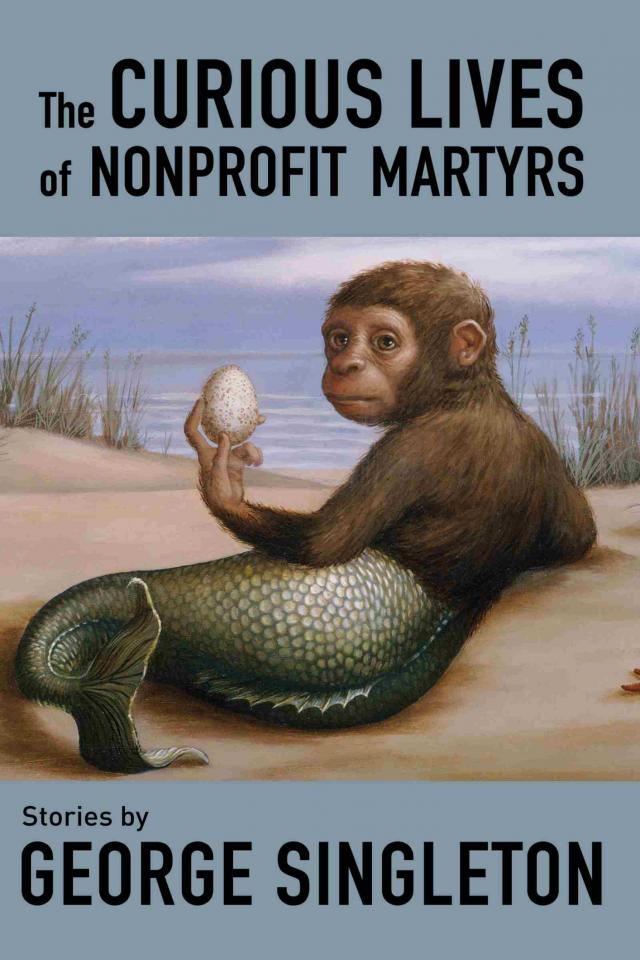
The CURIOUS LIVES of NONPROFIT MARTYRS
The CURIOUS LIVES of NONPROFIT MARTYRS
— STORIES —
GEORGE SINGLETON
52580 Craig Rd.
Ann Arbor, MI 48103
www.dzancbooks.org
The Curious Lives of Nonprofit Martyrs. Copyright © 2023, text by George Singleton. All rights reserved, except for brief quotations in critical articles or reviews. No part of this book may be reproduced in any manner without prior written permission from the publisher: Dzanc Books, 2580 Craig Rd., Ann Arbor, MI 48103.
Library of Congress Cataloging-in-Publication Data Available Upon Request
ISBN: 9781938603082
First US edition: August 2023
Interior design by Michelle Dotter
Some of these stories first appeared in Story, the Georgia Review, Sub tropics, Compressed, Reckon, Cutleaf, New World Writing, Tampa Review, Carolina Quarterly, Arts and Letters, South Carolina Review, Pangyrus, Epoch
Printed in the United States of America
10 9 8 7 6 5 4 3 2 1
CONTENTS
WHAT A DIME COSTS
COCK RESCUE
STANDARD HOLE
THE ARBITRARY SCHEMES OF NAMING HUMANS
DISPENSERS
ECHOES
HERE’S A LITTLE SONG
WHY I QUIT READING
PROOFS OF PURCHASE
PROTECTING WITNESSES AND WITNESSING PROTECTION
THE CURIOUS LIVES OF NONPROFIT MARTYRS
YOU’RE SUPPOSED TO BE WHERE YOU ARE
I HAVE THIS THING ABOUT BEING WRONG
SEMINAR
LOCKS
WILD ME
HOW YOU END UP CHOOSING SUCH A PATH
For Steven Gillis and Dan Wickett for longtime belief.
“Dad, get me out of this.”
—Warren Zevon
WHAT A DIME COSTS
One afternoon when I might’ve been thirteen years old my father came home in his paint-splattered truck, more than intent. He limp-stomped inside the house—this was summer, and I sat at the kitchen table drinking Kool-Aid sloppily so as to dye my upper lip red—and he jerked his thumb toward the door. I looked up scared, as I did at least once a day. Did I forget to cut the grass, clean the gutters, wash yesterday’s brushes, or let my mother pass out in the lounge chair she set up in the back yard on the edge of where she believed we needed a swimming pool? I should mention that my father was a house painter, and if he’d’ve lived in a time where every student got free psychological tests he would’ve certainly been diagnosed with ADD, ADHD, all those others. I doubt another house painter in the South had placed so many of his half-filled gallons of Sherwin-Williams in the back of the truck, forgotten to tamp down the lids, then driven off fast toward home as many times as my father. You could drive all over Dreytown and see where my father had been, from the streaks of latex that toppled over in the bed of his truck, then drained out the bottom of his tailgate like so much bulldog flews-slobber. Dreytown homeowners had a thing for light blue and yellow back then. I wasn’t much of a sports fan, but I would bet that anyone following a college team with such colors would’ve felt welcomed in the town of my upbringing.
That’s right: Dreytown. A “drey” is an old-fashioned word for a squirrel’s nest. According to legend—and it’s now on Wikipedia because I put it there—some Scottish-Irish settlers came through the area hungry, looked up, got out their muskets or long rifles or slingshots, killed a couple score of fox and gray squirrels, celebrated with a good stew, then settled.
My father kept his thumb pointed toward the carport. I said, “What? What did I do? I didn’t do anything.”
“You got to come look at this,” my father said. “I need to teach you a lesson.”
I licked my upper lip over and over. One time a lesson involved how no one ever trusted a red-mustached man or woman. That lecture turned into something about Erik the Red—I’m not sure how he knew about a Viking—and then a guy named Boyt Lott my mom dated in high school, who had red hair and ended up being a funeral director.
I got up out of the gold paisley vinyl-backed kitchen chair and hopped the one step down into the carport. Did I leave the mailbox door open, forget to pick up the paper, or leave the hose running when I was supposed to spray my mom hourly in her lounge chair so she could feel as if she stood near a waterfall? My father’s pickup wasn’t dripping paint on the cement driveway, which would make my mother happy enough. If I’d’ve been a skateboarder back then I could’ve practiced on the short vert wall of dried paint, like a rubbery multicolored stalagmite, that led to the carport.
He said, “Look in the back what I got today.”
I peered over the bed’s rim and saw thirty box turtles in various realms of distress. Some of them had turned over and wiggled their legs in that internationally understood fauna language of turn-me-over! Others remained anchored. All of them owned slight blue or gold paint on their shells. It took some years for me to understand that my father hadn’t worked a lick that day, that he’d plain driven the countryside, on the lookout for tortoises wishing to cross a two-lane.
I said, “Where’d you get all these?”
My father smiled, finally. He nodded his head up and down about ten seconds too long. He said, “Let me tell you something, Cock. I need to teach you something about amphibians on the move.”
I didn’t say, “They’re reptiles.” A wooden paint stirrer hurts more than a belt or switch.
“I read something the other day,” he said. And looking back all these years, I truly believe that if he’d never read this particular article, which ended up being printed in the Dreytown Herald’s Friday edition that always featured Fun Facts to Know and Tell on the opposite side of Beetle Bailey, Charlie Brown, the Born Loser, Ziggy, and that one about a guy named Leroy—all comics that featured men who’d never amount to anything—I would not’ve spent five years in a single-parent household. My father said, “I read about how you shouldn’t ever pick up a turtle and take it away from where it’s going. Turtle like this? It roams around like a square mile all its life. If you take it out of its habitat, it’ll get confused and quit eating and die.” He spent about a half minute saying the word “habitat,” stressing every syllable equally.
My father called me Cock. My real name’s Julian. We are Walkers. My mother wanted to name me after her favorite uncle, Uncle Julian. My father thought it sounded like a girl’s name. I don’t know what made him relent, but he always called me “Cock”—Cock Walker.
I said, “Are you going to take these things back to where you got them?” How could he remember which were which and where he picked them up, I thought even then.
My father shook his head. “That’s my lesson. One, life is not fair.”
I looked at the turtles. I wasn’t tall enough to reach over in order to flip the upside-down ones. I said, “You need to take them back.”
My mother came out of wherever she’d been hiding. She yelled, “We’re out of Dr. Pepper, goddamn it,” talking to my father. She yelled, “Did you remember to stop by the store?” She yelled, “You don’t like the way I want to spend my days? I need some Dr. Pepper.”
My father didn’t look her way. I did. She’d spread some kind of avocado spread on her face and wore thin cucumber slices plugged into her eye sockets. My father said to me, “You either realize that you need to stay in the place where you were born, or you take the chance of dying out there elsewhere.” He said, “Yep. Yep. Yep.”
I said, “Tonight’s Hungarian goulash night,” because that’s how we lived.
“Never trust a plumber around your refrigerator. Never trust a roofer around your women. Never trust a painter around your liquor cabinet. There are probably more,” my mother said as I drove the pickup truck from Aiken, South Carolina, back to Dreytown. I’d gotten the thing into second gear, but couldn’t find third. This was two years before I could legally drive with a daylight permit. I sat on top of a drop cloth folded once more than necessary.
My mother said, “I’m sorry about this, Julian. I’m sorry. In my defense, I didn’t know today would be the day your father disappeared. If I’d’ve known, I wouldn’t’ve let y’all go into the hotel. I wouldn’t’ve stayed out in the car alone. I didn’t know!”
She said all of this during a long straight road with pecan trees on both sides, forming a tunnel. We couldn’t’ve been going much more than thirty miles an hour, and the engine sang hard in second gear.
We’d been to the Aiken polo matches, as we’d done at least twice a spring since I remembered. My father obsessed over many things, but two stood out: the sport of kings, and pay toilets. As always, my father got us into town three hours before the match and parked his streaked truck in the far parking space at the Willcox Hotel, a place that had hosted such luminaries in the past as Franklin D. Roosevelt and Winston Churchill. This was one of those gigantic Colonial-looking inns with a dining room the size of basketball court, or so it seemed to me back then. Drapes straight out of any movie set inside a funeral home hung down twenty feet. My father parked there, I learned later, so that no one would see his workingman’s vehicle on the sidelines of the polo match. He parked, we pulled three mesh-covered aluminum lawn chairs out the back, and off we walked the half mile or so to the field, set up on the sidelines, and waited for everyone else to show up in their Mercedes-Benzes, Cadillacs, and a couple of Rolls-Royces. My job was to
More than a few times my father would strike up a conversation with someone seated nearby, and invariably that person would say, “What line of work are you in?”
“Painter,” my father always said.
Because of the venue, the person would smile and nod, maybe say, “Abstract? Realism?”
My father wouldn’t blink. He’d say, “Yeah, mostly realist. American Gothic? Like that,” he’d say, which was true, if he meant painting that white house in the background.
On the day that ended with my driving my mother and me home, the three of us walked back to the truck parked there at the Willcox Inn, where a knot of millionaires would drink and dine afterwards. My mother said, “I’ll just sit in the truck. Y’all go in and use the bathroom.” She knew it would be an hour wait, at least. My father liked to go up to strangers and say, “Are you in the Turtle Club?” I never even thought about his love for Turtle Club membership and that episode with his captured box turtles earlier.
Here’s the Turtle Club, its international association’s location at 21 South Jefferson in Sheridan Wyoming, 82801: One had to answer four questions correctly. The answers were Shake Hands, Talk, Legs, and His Head. The questions went, “What does a man do on two legs, a dog on three legs, and a woman sitting down?” “What four-letter word ends in K and means ‘intercourse?’” “What does a cow have four of, and a woman two?” “What’s hard, round, and sticks out of a man’s pajamas so far he can hang a hat on it?”
My father thought these were the wittiest questions in all the world, and couldn’t wait to ask any one of his new clients if they knew the answers. On top of this, if my father were to say, “Are you a Turtle?” and the person said, “Yes!” then my father earned a free drink, for the proper answer happened to be, “You bet your sweet ass I am!”
Later on I figured out that a small group of mostly friendless men, ridiculed in high school, had formed the Turtle Club. I imagine a group of men who couldn’t find a Moose Club sponsorship probably needed another way to feel exclusive.
“Let’s go check out those fancy toilets,” my father said to me.
My mother pulled a paintbrush used for trim out of the truck’s glove compartment, retrieved a half-gallon of latex from the bed of the truck, and got to work on next year’s ornaments. She said, “Y’all take your time.”
When my father and I reached the door to the Willcox, I turned to see my mother back outside of the truck, shaking the hell out of a silver martini shaker.
My father started right in with “You a Turtle? You a Turtle? You a Turtle?” to everyone, from maitre’d to innocent well-dressed post-polo diner. He walked through the center of the restaurant, helping himself to dinner rolls left over from the tables’ previous guests. I followed him straight to the men’s room, noticing that, when he walked, he kept his right index finger pointed down to his double-shined Nunn Bush wingtips, as if to cue onlookers, “I belong here—who would not belong here, wearing fancy shoes?”
It wasn’t so much that my father obsessed over dime-charged pay toilets as that he gloried in getting away with rooking anyone who charged a man to urinate. We entered the men’s room, my father’s seersucker coat pockets filled with yeast rolls. We looked at what stalls’ locks didn’t advertise Occupied, then I slid down beneath the door first. There was a gap between door bottom and tiled floor, maybe eighteen inches. I had no trouble, and that’s why I went first. When I got inside, I spread my legs wide, reached down, and pulled my father’s arms until he got in enough to bend his knees.
Then we stood there like idiots. My father handed me a dinner roll. He pulled a flask out of his inside pocket, took a pull, then extracted two more rolls out of his pocket and shoved them in his mouth. I said, “Do you have to pee?”
He said, “Not yet.”
I said, “We should save a couple of those rolls for Mom. Are you hungry?”
He said, “You bet your sweet ass I am,” I guess as a way to stay in practice.
•
It’s not like I keep a diary. I’m no Samuel Pepys, or Pliny the Younger. And it’s not like I possess some kind of extraordinary memory, unaffected by three decades of booze-thrill, like I need to be shipped off to the Mayo Clinic so someone can study my brain pre-rigor mortis and end up with a “scholarly paper” published in one of those medical journals concerned with anomalies and misdiagnoses. It’s quite the opposite. When I look back to my childhood, there’s a vague blur of nothingness, followed by getting yelled at for not cutting the grass, then that live turtle episode, then the day I drove my mother back home to Dreytown and we never saw my father again.
My father ate those two rolls. Men came in and out of the bathroom, picking stalls on either side of us, or down the row. I tried to imagine where all the dimes went—was the door hollowed out and filled with coins? Was there some kind of tube that ran beneath the restroom floor and ended up in the basement of the Willcox where a stooped-over Black man—never told that the Civil War ended, that the Civil Rights movement changed some things—placed them in paper tubes so that someone on Monday could lug them over to the nearest bank for deposit? I stifled giggles when fellow visitors, unabashed, released their gastrointestinal noises. I should mention that my father directed me to stand on the toilet seat whenever someone deposited a dime adjacent to us, so it didn’t look like the four feet of two men performed untoward acts there in a fancy hotel pay toilet stall. I did as told, carefully balancing and not knowing exactly what he meant.
“Hey, Cock,” my father whispered. “Why don’t you go check on your momma? I’ll save your spot here in case you have to pee later. Go on back through the dining area—I’ve taught you how to do it, right?—and spy out any unused food, like these dinner rolls. Snag a couple for your mom, and just wait out there in the parking lot until I come back. Unless you need to come back here and use the bathroom for real.”
I said okay and got down to slide back out beneath the door, even though I could’ve just opened the latch and walked out normal. I thought nothing of my father’s request. Sure, looking back, I think it odd that he would abandon our plan—even though I never understood the plan, except to keep a rich person from receiving a dime. When my head was outside, my body still with my father, he said, “Cock, listen. Remember that if you know how to paint a house, you’ll never be out of work. People always need housepainters.”
I didn’t know that those would be his last words to me, that I’d go back to Julian always and never hear myself referred to as Cock Walker again. Cock of the Walker. That, all these years later, my wife the Gender Studies professor would insist on calling me Jules, as a way to eradicate, or even out, the years of a more studly, profane name.
I left the men’s room proud to wear shined patent leather dress shoes, though they weren’t fancy Nunn Bushes. Like I said, I didn’t keep a diary ever, but they were better than goddamn Buster Browns. I think I had to get them at Belk, or Ivey’s, or Meyers-Arnold, or JC Penney to wear to my grandfather’s funeral. These were shoes I’d worn once to a funeral, and once to a men’s room pay toilet. A boy’s feet grow faster than anyone knows, outside of mothers, I guess. They had laces, I know that. They didn’t have Velcro straps like the kids wear today, Velcro straps that can be directly connected to a child’s mismanagement of mathematics, literature, love, and music. If I’d’ve ever kept a diary, somewhere along the line I might’ve mentioned how Velcro-strapped shoes held back children from growing up into people who could appreciate the blues, chicken livers, a good thunderstorm, a crying mother, a boy with a makeshift scraper unhinging latex paint from a cement driveway, a hand-dug swimming pool six feet deep.





