

Shadow Twin, page 1


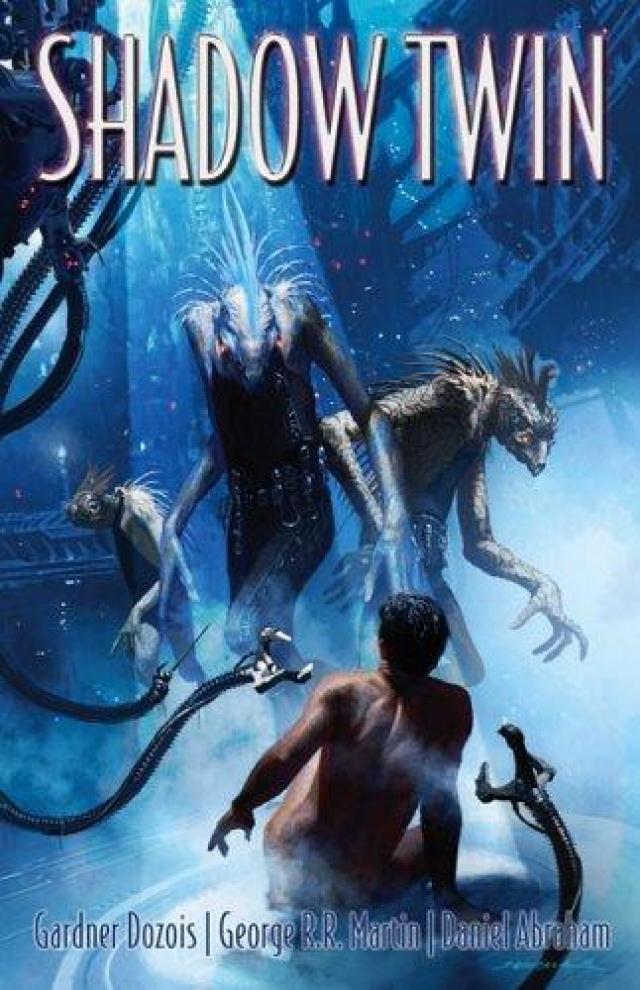
Shadow Twin
Published: 2005
Rating: ★★★
Tags: Fiction, Thrillers, General, Fiction - Science Fiction, Science Fiction, Science Fiction - General, Science fiction; American
Fictionttt Thrillersttt Generalttt Fiction - Science Fictionttt Science Fictionttt Science Fiction - Generalttt Science fiction; Americanttt
* * *
"Shadow Twin" is a finely crafted science-fiction novel that was started in the mid-1970s by Gardner Dozois. A few years later, Dozois passed the unfinished manuscript on to George R.R. Martin to complete -- but while both writers agreed the story had promise, neither could work up the initiative to finish it. Over the next 20-some years, the story languished in a creative limbo between them; both worked on it now and again, but neither could or would finish it. Then, in 2002, young turk Daniel Abraham got his mitts on it and finally polished the thing off. Whew!
An especially nice thing about this novel is that it doesn't read like a story assembled piecemeal over the course of three decades. Nor does it read like the work of three writers with their own voices and styles. "Shadow Twin" is a short science-fiction novel that packs a punch and leaves you thinking, and the three authors involved deserve kudos for a successful -- if long delayed -- collaboration.
Shadow Twin
by Gardner Dozois, George RR Martin
and Daniel Abraham
Act I
· · · · ·
One
· · · · ·
Ramon Espejo awoke floating in a sea of darkness. For a moment, he was relaxed and mindless, drifting peacefully, and then his identity returned to him desultorily, like an unwanted afterthought.
He was Ramon Espejo. He was working a prospecting contract out of Nuevo Janeiro. He was … he was …
Where he had expected the details of his life to rush in—what he had done last night, what he was to do today, what grudges he was nursing, what resentments had pricked him recently—the next thought simply failed him. He was Ramon Espejo—but he did not know where he was. Or how he had gotten there.
Disturbed, he tried to open his eyes, and found that they were open already. Wherever he was, it was a totally dark place, darker than the jungle night, darker than the darkness in the deep caves in the sandstone cliffs near Swan's Neck.
Or perhaps he was blind.
That thought started a tiny spring of panic within him. There were stories of men who'd got drunk on cheap synthetic Muscat or Sweet Mary and woke up blind. Had he done that? Had he lost that much control of himself? A tiny rivulet of fear traced a cold channel down along his spine. But his head didn't hurt, and his belly didn't burn. He closed his eyes, blinking them hard several times, irrationally hoping to jar his vision back into existence; the only result was an explosion of bright pastel blobs across his retinas, scurrying colors that were somehow more disturbing than the darkness.
His initial sense of drowsy lethargy slid completely away from him, and he tried to call out. He felt his mouth moving slowly, but he heard nothing. Was he deaf too? He tried to roll over and sit up but could not. He lay back against nothing, floating again, not fighting, but his mind racing. He was fully awake now, but he still couldn't remember where he was or how he had gotten there. Perhaps he was in danger: his immobility was both suggestive and ominous. Had he been in a mine cave-in? Perhaps a rockfall had pinned him down. He tried to concentrate on the feel of his body, sharpening his sensitivity to it, and finally decided that he could feel no weight or pressure, nothing actually pinioning him. You might not feel anything if your spinal cord had been cut, he thought with a flash of cold horror. But a moment's further consideration convinced him that it could not be so: he could move his body a little, although when he tried to sit up, something stopped him, pulled his spine straight, pulled his arms and shoulders back down from where he'd raised them. It was like moving through syrup, only the syrup pushed back, holding him gently, firmly, implacably in place.
He could feel no moisture against his skin, no air, no breeze, no heat or cold. Nor did he seem to be resting on anything solid. Apparently, his first impression had been correct. He was floating, trapped in darkness, held in place. He imagined himself like an insect in amber, caught fast in the gooey syrup that surrounded him, in which he seemed to be totally submerged. But how was he breathing?
He wasn't, he realized. He wasn't breathing.
Panic shattered him like glass. All vestiges of thought blinked out, and he fought like an animal for his life. He clawed the enfolding nothingness, trying to pull his way up toward some imagined air. He tried to scream. Time stopped meaning anything, the struggle consuming him entirely, so that he couldn't say how long it was before he fell back, exhausted. The syrup around him gently, firmly, pulled him back precisely as he had been—back into place. He felt as if he should have been panting, expected to hear his blood pounding in his ears, feel his heart hammering at his chest—but there was nothing. No breath, and no heartbeat. No burning for air.
He was dead.
He was dead and floating on a vast dry sea that stretched away to eternity in all directions. Even blind and deaf, he could sense the immensity of it, of that measureless midnight ocean.
He was dead and in Limbo, waiting in darkness for the Day of Judgment.
He almost laughed at the thought—it was better than what the Catholic priest in the tiny adobe church in his little village in the mountains of northern Mexico had promised him; Father Ortega had often assured him that he'd go right to the flames and torments of Hell as soon as he died unshriven—but he could not push it away. He had died, and this emptiness—infinite darkness, infinite stillness, trapped alone with only his own mind—was what had always waited for him all his life, in spite of all the blessings and benedictions of the Church, in spite of all his sins and occasional semi-sincere repentances. None of it had made any difference.
But how had it happened? How had he died? His memory seemed sluggish, unresponsive as a tractor's engine on a cold winter morning—hard to start and hard to keep in motion without sputtering and stalling. He began with what was most familiar, imagining his room in Deigotown—the small window over his cot, the thick pounded-earth walls. The faucets in his sink, already rusting and ancient though humanity had hardly been on the planet for sixteen years. The tiny scarlet skitterlings that scurried across the ceiling, multiple rows of legs flailing like oars. The sharp smells of iceroot and ganja, spilled tequila and roasting peppers. The sounds of the transports flying overhead, grinding their way up through the air and into orbit.
Slowly, the recent events of his life took shape, still fuzzy as a badly aligned projection. He had been in Diegotown for the Blessing of the Fleet. He had eaten roasted fish and saffron rice from a street vendor and watched the fireworks. The smoke had smelled like a strip mine from all the explosions, and the spent fireworks had hissed like serpents as they plunged into the sea. But that was before … yes, before.
There had been a fight. He'd fought with Eleana. The sound of her voice—high and accusing and mean as a pitbull. He'd hit her. He remembered that. She'd screamed and clawed at his eyes and tried to kick him in the balls. And they'd made up afterwards like they always did. Afterward, she had run her fingers along the machete scars on his arm as he fell into a sated sleep.
He remembered now.
He'd left her before first light, sneaking out of a room heavy with the smell of sweat and sex while she was still asleep so he wouldn't have to talk to her, feeling the morning breeze cool against his skin. Flatfurs scurrying away from him as he walked down the muddy street, making their alarm cries like panicked oboes. He'd flown his van to the outfitter's station because he was going …
His mind balked. It was not the nauseating forgetfulness that seemed to have consumed his world, but something else. There was something his mind didn't want to recall. Slowly, gritting his teeth, he forced his memory to his will.
He'd spent the day realigning two lift tubes in the van. Someone had been there with him. Sanchez, bitching about parts. And then he had flown off into the wastelands, the outback, terreno cimarron …
Had his heart been beating, it would have stopped then in remembered terror. He had gone to the mountains—and he had seen it.
· · · · ·
Two
· · · · ·
"This going to be the big one?" Old Sanchez asked, the way he always did.
"Yes," Ramon said as he clamped down the cowl on his left-rear lift tube. "This time, I'm coming back with enough good claims to make the pinche lawyers start working for me."
The outfitters shop was a mix of junkyard and clean room—great scraps of the vans and transports Old Sanchez had gathered up over the years to strip for parts or else retool into cheap buys for people even more desperate than themselves lay among storage units of picocircuitry that it would have taken Ramon half his life to pay for. Old Sanchez himself waddled through the work bays with a glass of iced tea in his hand. When Ramon had first known him, it had been whiskey. Never say that times don't change.
"You better hope not," Old Sanchez said. "Too much money kills men like you and me. God meant us to be poor, or he wouldn't have made us so mean."
Ramon tested the tubes. The yields were balanced and good enough, and the hum from them was like a promise of escape.
"God meant you to be mean, Sanchito. He just didn't want me taking any shit."
"Eleana know you're going out? Last time she came here looking for you two days after you left. You're go
The knot in Ramon's belly went a notch tighter. He wasn't sure if it was dread at leaving her behind or the need to be gone. Both, maybe.
"She knows I'm going this time. And when I get back, she'll be happy to help me spend what I get. You watch. This is going to be the big one."
· · · · ·
It was a crisp clear day in Octember. He flew his beat-up old van north across the Fingerlands, the Greenglass country, the river marshes, the Océano Tétrico, heading deep into unknown territory. North of Fiddler's Jump were thousands of hectares that no one had ever explored, or even thought of exploring, land so far only glimpsed from orbit during the first colony surveys.
The human colony on the planet of São Paulo was only a little more than ten years old, and the majority of its towns were situated in the subtropic zone of the snaky eastern continent that stretched almost from pole to pole. The colonists were mostly from the Brazilian Commonwealth, Mexico, Jamaica, and Hispaniola, and their natural inclination was to expand south, into the steamy lands near the equator—they were not effete norteamericanos, after all; they were used to such climates, they knew how to live with the heat, they knew how to farm the jungles, their skins did not sear in the sun. So they looked to the south and tended to ignore the cold northern territories, perhaps because of an unvocalized common conviction—one anticipated centuries before by the first Spanish settlers in the New World of the Americas—that life was not worth living any place where there was even a remote possibility of snow.
Ramon, however, was part Yaqui and had grown up in the rugged plateau country of northern Mexico. He liked the hills and white water, and he didn't mind the cold. He also knew that the Sierra Hueso chain in the northern hemisphere of São Paulo was a more likely place to find rich ore than the flatter country around the Hand or Nuevo Janeiro or Little Dog. The mountains of the Sierra Hueso had been piled up many millions of years before by a collision between continental plates, the colliding plates squeezing an ocean out of existence between them; the former seabottom would have been pinched and pushed high into the air along the collision line, and it would be rich in copper and other metals.
The Sierra Hueso had been mapped from orbit by the colony ramscoop, but no one Ramon knew had ever actually been there, and the territory was still so unexplored that the peaks of the range had not even been individually named. That meant that there were no human settlements within hundreds of miles, and no satellite to relay his network signals this far north; if he got into trouble he would be on his own.
It was probably better that way. Although he was reluctant to admit it, he'd finally come to realize that it was better if he worked someplace away from other prospectors. Away from other people. The bigger prospecting cooperatives might have better contracts, better equipment, but they also had more rum and more women. And between those two, Ramon knew, more fighting. He couldn't trust his own volatile temper, never had been able to. It had held him back for years, the fighting, and the trouble it got him into. No, it was better this way—muleback prospecting, just himself and his van.
Besides, he was finding that he liked to be out on his own like this, on a clear day with São Paulo's big soft sun blinking dimly back at him from rivers and lakes and leaves. He found that he was whistling tunelessly as the endless forests beneath the van slowly changed from blackwort and devilwood to the local conifer-equivalents: iceroot, creeping willow, hierba. At last, there was no one around to bother him. His stomach had stopped hurting, for the first time that day.
Mountains made a line across the world before him: ice and iron, iron and ice.
The sun was setting, pulling shadows across the mountain faces, when he brought the van to rest in a rugged upland meadow along the southern slopes of the Sierra Hueso range. It took him only moments to set up his bubbletent, light a small fire, and set his simple dinner—a filleted fatfin, rubbed with garlic and habenaro—to grilling. While the fish cooked, he lit a cigaret and watched the stone of the mountains darkening with the sky. Other nights, on other trips, he'd have broken out a bottle of tequila or rum or whisky to keep himself company, but he'd deliberately left such distractions behind this time; this time, he needed to be all business. Truth be told, with the immense view spread to the horizon around him, and the stars beginning to show in the cold, blue-black sky, he found, to his surprise, that he didn't miss the tequila all that much anyway. A flapjack moved against the sky, and Ramon roused up on one elbow to watch it. It rippled its huge, flat, leathery body, sculling with its wing tips, seeking a thermal. Its ridiculous squeaky cry came clearly to him across the gulfs of air. They were almost level; it would be evaluating him now, deciding that he was much too big to eat. The flapjack tilted and slid away and down, as though riding a long, invisible slope of air, off to hunt squeakers and grasshoppers in the valley below. Ramon watched the flapjack until it dwindled to the size of a coin, glowing bronze in the failing light.
"Good hunting, amigo," he called after it, and then smiled. Good hunting for both of them, eh? Quickly, he ate his dinner—briefly missing the tequila after all—and then sat by the fire for a few moments while the night gathered completely around him and the alien stars came out in their chill, blazing armies. He named the strange constellations the people of São Paulo had drawn in the sky to replace the old constellations of Earth—the Mule, the Cactus Flower, the Sick Gringo—and wondered (he'd been told, but had forgotten) which of them had Earth's own sun twinkling in it as a star. Then he went to bed and to sleep, dreaming that he was a boy again in the cold stone streets of his hilltop pueblo, sitting on the roof of his father's house in the dark, a scratchy wool blanket wrapped around him, trying to ignore the loud, angry voices of his parents in the room below, searching for São Paulo's star in the winter sky.
In the morning, he ate a small breakfast of cold tortillas and beans, consulted the survey maps, and started up the southern slopes, looking for the collision line. He didn't expect it would be hard to locate; ocean floor rocks were unmistakable—a mangled, kneaded layer of pillow lava, basalt, and gabbo. He found it before the sun had reached its zenith, and surveyed it almost with regret; he'd been enjoying the climb for its own sake, pausing frequently to enjoy the view or to rest in the watery sunlight. Now he'd have to get to work
With a sigh, Ramon unslung his backpack. It took him only minutes to rig the small charge for the coring sample. He had done it a thousand times before, it seemed. Still, he walked slowly, stringing out the det cord to a safe distance, finding a boulder that would shield him from the blast. He found himself, strangely, procrastinating about setting it off. It was so quiet here, so still, so peaceful! From up here, the forested slopes fell away in swaths of black and dead blue and orange, the trees rippling like a carpet of moss as the wind went across them—except for the white egg of his bubbletent on the mountain shoulder below, it was a scene that might not have changed since the beginning of time. For a moment, he was almost tempted to forget about prospecting and just relax and unwind this trip, but he shrugged the temptation away—he needed money, the van wouldn't hold together forever, and Eleana's scorn when he came back empty-handed again was something he wasn't anxious to face. Perhaps there will be no copper here anyway, he told himself reassuringly, and then wondered at the tenor of his thoughts. Surely it could not be a bad thing to be rich? His stomach was beginning to hurt again.
He rubbed his hand over the boulder in front of him, tracing the aquatic fossils, ancestors of the fatfins and butterfish that were the mainstay of the Nuevo Janeiro fishing industry, that were another indicator of the collision line; the fossils were grotesquely distorted, as though seen in a funhouse mirror—squeezed out of shape by the slow heat and pressure of the continental collision. How long had it taken for that to happen, for fish to turn to stone and be lifted from the bottom of the sea thousands of feet into the thinning air? The crash of stone and stone had taken an inconceivably vast time, pushing the mountains toward the sky at a rate of only a few inches per century, slowly enough so that the big river to the west had been able to saw its way through the range as it rose, keeping pace inch for inch. Millions of years. And what had taken millions of years to become as it was, he was about to change in an instant, and afterward, it could never be undone. The untouched vastness was about to be touched, altered irrevocably, by the hand of man. By his hand. There was regret in that, and a kind of melancholy—but also an oily sort of pride that swelled his heart even as it made his belly twinge.


