

I Dream with Open Eyes, page 1


PRAISE FOR I Dream with Open Eyes
“George Prochnik is our great biographer of émigré writers, chronicling lost-and-found souls such as Heinrich Heine, Gershom Scholem, and Stefan Zweig as they flee from (and sometimes toward) disaster. In I Dream with Open Eyes, Prochnik turns his exilic gaze on his own departure from New York City in the wake of the Trump election, an ambivalent leave-taking that has inspired this extraordinary reflection on ‘home.’ What is it exactly? A brownstone filled with mementoes of a family whose members range from early Puritans and friends of Emerson to Southern Confederates and associates of Freud to émigrés, like Freud, from a Vienna on the cusp of catastrophe? A Brooklyn neighborhood whose rich mix of people is threatened by a mercilessly unequal economy? A country that seems thrilled to death by nihilistic behavior of all sorts? A language that is everyday more corrupted by a bullshit artist turned President and a social media complex fueled by inflammatory takes? In the midst of this conflagration, heightened by a raging virus and a suffering environment, Prochnik seizes on almost utopian moments in which alternative ways of living and loving suddenly appear. This book offers hopeful respite in that unexpected home too.”
—Hal Foster, author of What Comes After Farce? Art and Criticism at a Time of Debacle
“In this thrillingly candid book, Prochnik examines his decision to leave his home—the United States—and addresses questions that are becoming all too familiar and all too pressing for more and more of us: How do we proceed, how do we think, how do we understand ourselves and even our existence on Earth when social and political convulsions shatter our sense of belonging to something—to a nation or culture? Prochnik delights us with his transportive eloquence, kindness, and erudition, the originality of his thought, and astonishing reflections on his family and background. The book shines, and in the darkness where we live now, it leaves us with an orienting and invigorated sense of possibilities.”
—Deborah Eisenberg, author of Your Duck Is My Duck
ALSO BY GEORGE PROCHNIK
Putnam Camp: Sigmund Freud, James Jackson
Putnam and the Purpose of American Psychology
In Pursuit of Silence: Listening for
Meaning in a World of Noise
The Impossible Exile: Stefan Zweig
at the End of the World
Stranger in a Strange Land: Searching for
Gershom Scholem and Jerusalem
Heinrich Heine: Writing the Revolution
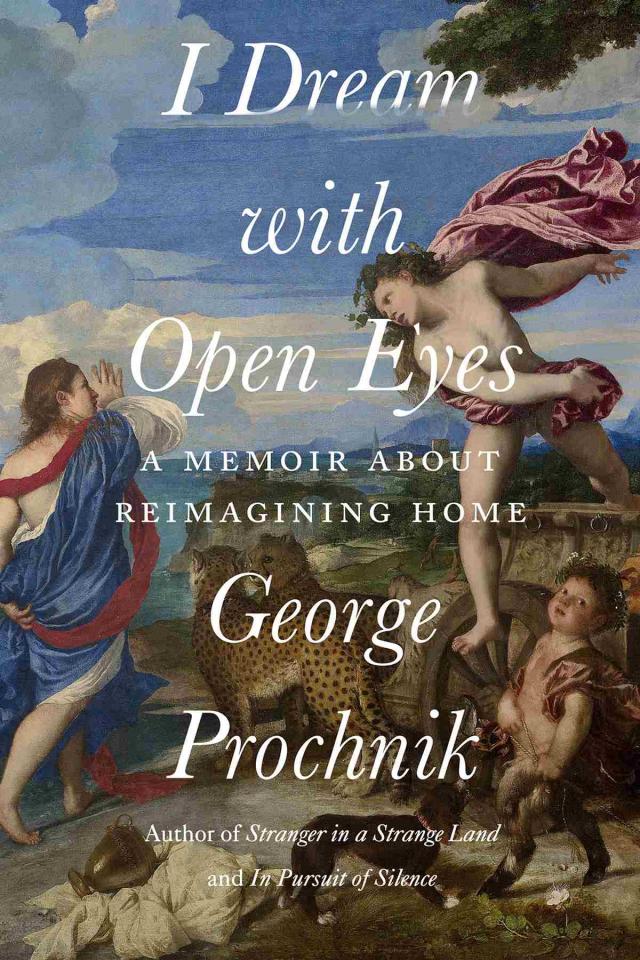
I Dream
with
Open Eyes
A MEMOIR ABOUT
REIMAGINING HOME
George Prochnik
Counterpoint
Berkeley, California
For Elisabeth, James & Ethan
But suppose that the intelligible world is “the city of words,” say Utopia; and suppose that the world of that city is not a “something” that is “outside” (i.e., beyond the world of sense) but is, as it says, “no place,” which perhaps suggests no place else, but this place transfigured.
—STANLEY CAVELL
Table of Contents
Prelude
1. Furies
2. Vocabulary Test
3. Cartographies of Need
4. Place & Time
5. Future Forecast
6. Zodiac Roulette
7. Hunters in the Underworld
8. The Happiness of Pursuit
Acknowledgments
I Dream
with
Open Eyes
· Prelude ·
Part of my mother’s family came over on the Mayflower, and there’s a story that one of this branch—a girl named Mary Chilton—was the first of the Pilgrims to set foot on the ground of the New World. She was still only a child, just twelve years old. I like to think of her springing off that boat where they’d been confined for sixty-six days. Whatever apprehensions the adults may have been freighted with, despite the exhaustion they were certainly laboring under, I want to imagine that in the moment of watching the girl leap from the frame of the vessel, they soared through the air with her. Winged and uncontainable. This grave assembly had made the astonishing, fanatical decision to abandon civilization in order to follow commands they’d scoured from their old holy book. They were staring out at a lonely strand bordered by dead trees and harsh tangle. But the instant of absorption in that child’s flight to freedom transformed their consciousness. They saw the world through her eyes, recovering a sense of unknown, boundless prospects.
The manuscript in which my mother’s mother painstakingly recorded the tales of our family history vanished in the course of my journey from America. On arriving in England, I worked my way through stacks of boxes, month after month, certain that I must be on the verge of finding the slender brown volume in which she’d kept the fruit of her researches, but over and over I slit open cardboard flaps to discover with a pang that it was still missing. At last I was forced to try and reconcile myself to the absence. Perhaps the chronicle had never come with us to begin with. Lost, having been set aside for safekeeping, in the last frantic phase of packing when it had seemed the task of preparing to move from our large, overstuffed house couldn’t be finished, though we were on the verge of having to vacate the premises. Those days laced with little nightmares of departure: the disappearance of a beloved animal who never strayed; the discovery of a ruinous “ghost mortgage” taken out on the house before we acquired it; precious objects suddenly gone missing; copied identity papers found to have shed their originals. As if America itself had kept a grasp on some vital part of my being, which would mean that I’d have to go back again, or would learn that I’d never really left.
Sometimes I feel I’ve spent my life fleeing the United States, then being swept back into the country’s wide, pillowy, warm, hot, flaming, writhing embrace. Long before I could knowingly escape, I was propelled from the place by main force. Born in Grand Junction, Colorado (I treasure that town name, evoking a theatrical crossroads, brashly colored light bulbs sizzling on and off around a cosmic marquee), I was barely six months old when my father gave up prospecting for uranium on behalf of the Atomic Energy Commission in the Southwest to try his hand at diplomacy with the State Department. He landed a post in Edmonton, Canada, after the station chief there succumbed to drink. We returned to the U.S. a couple of years later, only to leave again almost immediately for Santiago, Chile. This post lasted longer, but my mother finally put her foot down against that whole career track; fed up, my father later said, with the fuss of being a diplomat’s wife: all the hostess duties, twinkling in high heels and Marilyn lipstick between swells of laughter and fragrance.
“It just wasn’t her,” my father would say with a slightly bemused shrug, arching his heavy brow.
But I see now how she couldn’t stop turning her gaze back over her shoulder for the United States, all the time we lived abroad.
What was it she pined for so inconsolably? The crisp promise of real fall? A handful of chatty, eloquent friends in New England and New York whose drawling, smoky voices and dauntless, sly grins I remember rising over glasses in which the ice clacked like dominoes? A certain strain of decent gaiety? Impregnable optimism? The English language, to which her letters and speech bore such a lyrical, shape-shifting relationship—marbled with cadences from her Bostonian mother, her Carolinian father, Edwardian children’s literature, and peak Golden Age Hollywood? Her gentle parents in their white, columned house on Main Street in Cooperstown, where she’d grown up sailing turnabouts on the Glimmerglass, skiing woodland trails named after characters from the Leatherstocking Tales, going to elegant dances in technicolor dresses at the country club that I picture from her albums like a lush Douglas Sirk set? The whole storybook upbringing: true-blue beaux, ice cream socials, bonfire sing-alongs, and self-sacrificing, self-realizing charity—one endless Fourth of July firework bouquet of earned freedom, which she spoke about matter-of-factly as a slice of paradise lost: All That Heaven Didn’t Quite Allow?
Did she miss America when she longed to return, or her early history in the village—a past that was anachronistic even as it was happening? Or was she just fleeing the foreign-ness of other parts? Those subtleties of everyday being in faraway places that continually divert the heart’s search for an echo? Unfamiliar materials. Wayward plants in the garden. The manner in which things open and lock. Anomalous ingredients of ordinary recipes. What morning means. When night begins. The way the walls of your new residence never quite seem to enclose you.
And have I now left America because the country became alien to me, or because I believe that somewhere out there in the great beyond I might still find a place that sings home?
By the time I was six, my father had taken a desk job with the Department of the Interior and we’d moved to a suburb of Washington, D.C. My first memory of living in that development is of getting lost, over and over. Staring helplessly down the ranks of homogeneous dwellings lining blank streets. It wasn’t that our house was very distant from the school, or off on some tricky cul-de-sac, but I remember the façades multiplying as I walked, becoming ever more indistinguishable, as if I were caught in a bad dream. Sometimes I recalled the street markets in Santiago: enormous, light-spangled fish and bunches of bright, scented blossoms like the frills on the dresses of women who’d come down from the Andes to trade—something festively disordered, unpredictable—and felt a sadness that I couldn’t put words to.
As soon as I was old enough to leave home, I started traveling whenever I
The world falls apart—what do we do?
What should we do with our physical beings? With our minds, our loved ones, our former cares and belongings? Falls apart how: storms, disease, fires, war, bankruptcy, social mayhem? A change in leaders? Crumbles to what degree? How far gone must the world be to qualify as fallen? Which world? Where do we start or stop drawing its circumference out from the needle of our individual selves? And why begin revolving the spread arm of the compass out from the axis of our own persons—why not from those who’ve inspired us, those we care for, who cared for us, our most significant institutions—a promise, a memory, an irreducible ideal?
Our reality collapses—what do we do?
Where do we turn in space? What if we turn only to find we then must simply keep turning again and again? Should we instead remain exactly where we were until the earth beneath our feet gives way entirely, our own flesh dissolves, or we find ourselves returned to the place we began? How can we know, before it’s too late, whether we’re being histrionic in deciding the crisis must impel us to action, or stupidly blasé in determining that the event should be stoically endured without changing anything personal? This last question can’t be answered without examining the confidence we felt about the way we’d been living before the disaster. For there’s no reason—even resolving that a given event must drive us to do something—that the something we do must involve transforming our individual existence. That’s obvious. There’s no inherent reason whatsoever. No reason . . . Irrational. Unreasonable. But suppose what we call reason really has failed us? Was our understanding of the term flawed, or did the concept itself prove illusory? And what then, either way? What now?
After the 2016 presidential election, my wife, Rebecca, and I began debating whether to leave the United States. Not questioning our life in New York exactly—we’d been doing that intermittently, more or less rhetorically, for years, in the parlor-game fashion many people with options, or who imagine that they have options because they are not destitute and know they do have advantages—of education, of experience, of class, race, and connections—periodically ask themselves whether they ought to leave New York or Los Angeles, London, Paris, Hong Kong, Tokyo, or some other global metropolis, in order to start life again somewhere simpler or more exciting—somewhere more beautiful affordable, authentic, or just different from wherever they’ve been eddying in the same stagnant life patterns for years.
This current questioning was unlike that pastime, however, because of the specificity of the dilemma we posed ourselves: Should we go into exile? We were asking if what had happened politically, whether understood symptomatically or as the illness itself, meant that an irrevocable change had occurred in America—one that would determine the country’s character for, at the least, the better part of whatever life remained to us. We were asking whether, in consequence of a singular event, we ourselves could not continue living in the country as we had been. For a long time after the election, the precise nature of what we would do in response to this change was uncertain. But from then onward, when we spoke about leaving New York, our dialogue carried an edge of emergency.
As the direction of our thinking began to gain definition, friends we respected would say to us, “But you’re not actually going to leave America because of Trump, are you? Come on. You’re not going to dignify that garbage con man with power over your destiny, are you?”
We didn’t like how the question made us feel—weak, incoherent, or just patently wrong. But we would end up shrugging, compressing our lips, opening our hands, and helplessly nodding. “Well, kind of. Partly. Yeah. Truthfully—yes.”
He was indubitably the match to the fuse. The gilded whip. The Primetime Mover. The symbol that signified an actual, irreclaimable loss. And certainly also, I knew, the excuse.
When people would say to me, “But he’s a joke, a clown, a narcissistic pig, a nothing,” I would find myself remembering the moment in 1932 when Klaus Mann, Thomas Mann’s son, happened to find himself seated near Hitler’s table at the Carlton Tea Room in Munich. Mann described watching Hitler cram his mouth with strawberry tartlets. He was “much more vulgar” than Mann had anticipated. “Why and how did he manage to make people lose their minds?” Mann wondered. Hitler looked like “a gluttonous rat. He was flabby and foul and without any marks of greatness, a frustrated, hysterical petty bourgeois. It was a most unpleasant experience to have him so close to me, but at the same time it meant something like a relief.” The sight of Hitler in the flesh made plain that this man could not possibly conquer Germany, Mann decided, let alone the world. Hitler was “just a louse with a bit of magnetism.”
Mann understood too late, he confessed, that his mistake wasn’t that he’d underrated Hitler, but that he’d overrated his fellow countrymen. “They were smitten with his grammatical howlers and brassy lies, his slimy humor, his illiteracy, his bullying, his whining, his nervous fits, his half-crazed megalomania. Everything that made him revolting to me beguiled and inspired them.”
What is wrong with my compatriots? Mann asked himself, deciding that they were “mangled by resentments and foiled ambitions.” He could see the “swollen Philistines, neurotic demagogues, hardboiled intriguers” and so on, but “did not perceive the tremendous challenge all those pitiful characters collectively represented.” When it finally struck him that Germany’s new leader was not a “problem,” but a “plague,” Mann was among those who left home voluntarily, or rather “were forced away by our own disgust, our horror, our forebodings,” he wrote. “We left because we could not breathe the air,” and “the fear of suffocation is a plain, cogent reason for any preventative action.”
That resonated. For all the ways that Trump was no Hitler, the two men occupied analogous positions in a roiled substrate of the popular imagination. When Mann described how people’s thoughts had become “profoundly muddled” by arrogance and bad conscience, causing them to spy conspiratorial encroachments on the nation’s honor and true interests in every aspect of modern civilization, from trade unions and contemporary art to the League of Nations and Black music—investing all such heralds of a new age “with the diabolic design of insulting and impoverishing the valiant folk” in the country’s heartland—it was easy to feel tremors of vertigo.
I thought from time to time of Mann at the Carlton, and also of a party in Manhattan I’d been to during the summer of 2017 in the company of an older, eminent sociologist who, when the subject of Trump came up (as the subject invariably came up), abruptly remarked, “You know, I bet there are more people talking about Trump right now all over the globe than have ever talked simultaneously about another individual in the whole of human history.”
We all fell dead silent. “My God, it’s probably true!” someone cried at last, horrified by the contribution our own conversation had just made to that triumph—by the complicity of the entire world in Trump’s spectacular omnipresence.
On the one hand, one couldn’t possibly overstate his boorish, vacuous absurdity. On the other hand one couldn’t overstate his world-historical significance. These and these are the words of the living God. It was as though humanity at large had become hypnotized by the idea of its own fascination with someone they knew to be a bottomless void. The man might have been just a bad joke, but he was an infinitely bad joke nonetheless.
Yet if all this suggested that on some level it was impossible to overreact to the news of the election since—however long his presidency lasted—he’d already infected the atmosphere to the point where it felt asphyxiating, there was, of course, another side to the issue: the question of how one’s response affected others. We could not lose sight of the ways we were embedded in a larger fabric of family, friends, and community that would remain, for the most part, geographically stationary. To what extent can any of us pretend—especially after a certain age—that it’s possible to take the future into our own hands and run with it as if we were free agents of a giddily independent fate? To what extent do we even want that abstract, total liberty except in fleeting gusts of adolescent nostalgia?


