

The Emergency, page 14


“State your purpose in trespassing on Yeoman land.”
“Don’t we all still live in the same land?” her father asked.
Baard slammed his fist on the table and muttered something vehement to Gandorig, who said, “Brother Baard here is recognized.”
“Hell, no!” Baard stood up and jabbed a finger at the man seated below him. “You Burghers come here and ruin everything. You ruined all our crops—fruit, grain. You killed our livestock. Now you say this is your land? We don’t want you here! Get out!”
“Not my land. Our land.”
Gandorig placed a hand on Baard’s arm and eased him back into his chair. He turned to Selva’s father. “You and your little girl wander into our village looking for plum wine like nothing’s happened? Are you some kind of fool?”
“We’ve received very little information from your region since the Emergency.” Her father lowered his voice as if he could settle the Yeomen down with his tone. “My daughter and I came here in good faith.”
Selva leaned toward him and whispered, “They call it ‘the Conspiracy.’”
Her father shook his head as if to tell her to keep out, but Gandorig had heard. “That’s right. Smart little girl. ‘Emergency’ is one of your weasel words to let you people off the hook.”
“Frankly, I don’t believe in conspiracies,” her father said. “Bad things don’t happen because hidden powers cook up secret plots. They happen because people of every kind can be selfish and short-sighted—my people and your people.”
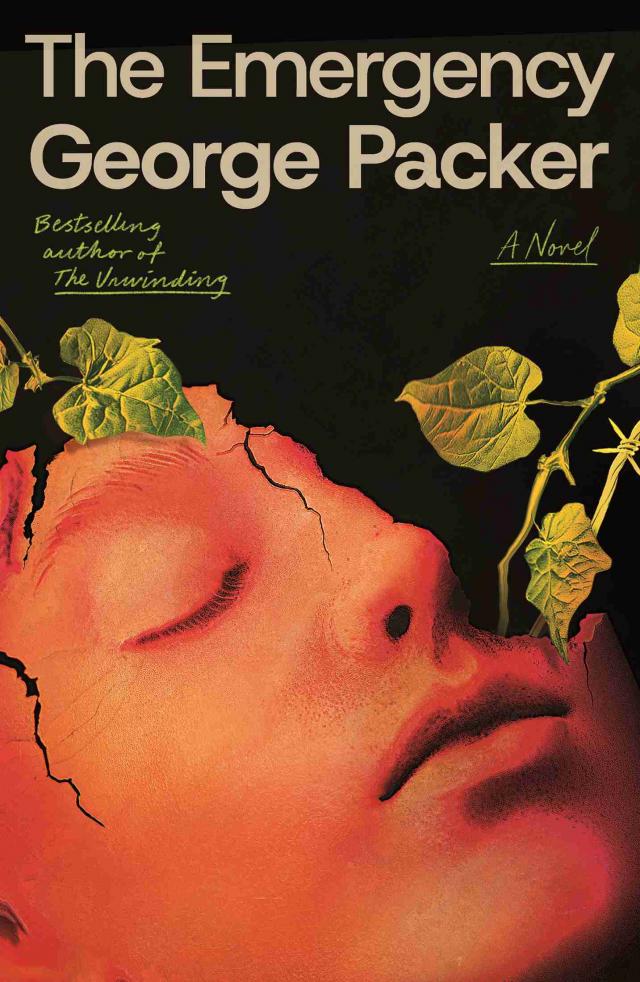
Anger flamed in Gandorig’s eyes. “No speeches!” He seized the machete and shook it at his prisoner. “Here’s some news for you. Last year the vines came to our village. No one ever saw them before—I asked the old councilors. The vines weren’t too bad, and we let them be. Seemed like winter killed them off. This spring, after what happened in the capital, we were too busy getting the village organized to notice at first. The vines came back alive. They started growing everywhere there was sunlight and a tree. Grew faster and thicker than we could keep up. Big as my arm.” Gandorig grabbed his wrist. “Cut ’em back, they keep coming. Wrapping around the trunks and branches, strangling the trees like giant constrictor snakes, pulling them down, killing all the fruit that keeps us alive. We spent so much time fighting the vines, we couldn’t take good care of our crops, and most of them failed.”
“If these vines—”
“If? You damn Burgher.” Gandorig displayed his injured hand. “Why the hell do you think I was chopping so hard I took off my own finger?”
Baard and Zorigt raised machetes and hands in solidarity with the Leader, though all their fingers seemed to be present.
“You talk as if it’s our fault,” Selva’s father said.
Gandorig sucked air from his nostrils into his chest, and his lips disappeared into his mouth. He looked from Baard to Zorigt.
“Guess he is a fool,” Zorigt said.
“Let’s get to the thing,” Baard said. “The punishment.”
Gandorig let out the breath. “First we need to know why they trespassed.”
“Leader Gandorig, please explain how the vines are our fault.”
“Funny how they think they’re so much smarter than us,” Baard said to the other two, “and he couldn’t find his ass in broad daylight.”
“He’s lying,” Zorigt said. “He knows all about the vines.”
“We never heard of them till now,” her father said. “Lots of things have happened in the city that you probably never heard of. Do you know about Better Humans?”
Selva felt a shock pass up her spine. She had never told her parents about Better Humans. She was willing for them to know about every other new thing that got her out of bed and filled her days so that she didn’t have to check her pulse every hour: self-orgs, We Are One, the Wide Awakes—even the Suicide Spot. But her Better Human was her private business, the secret poised between her deepest shame and wildest hope.
“We know about worse humans,” Baard said. “Know all about lying, cheating, stealing humans. They’re called Burghers.”
“Our communities no longer trust each other,” her father went on. “You’ve stopped selling us your goods, and we’ve stopped taking your sick and wounded. At my hospital a few weeks ago I operated on a Yeoman boy—that couldn’t happen today. It’s hurting everyone.”
“Whose fault is that?” Gandorig shot back.
“It’s an unfortunate result of the Emergency. We have to find a way to communicate again.”
“You must think we’re dumber than farm animals.”
“Tell us what we did to you.”
Eyes fixed on his prisoner, the Leader explained how, several years ago, Burghers had imported vines from overseas to plant in their little city gardens; how Burghers prized the vines for their pretty autumn berries, yellow and red; how migrating birds ate the berries and then flew over the countryside, spreading the seeds; how the seeds found perfect soil in the farmland of the foothills, and the vines found perfect hosts in the region’s forests and fruit orchards.
As the Leader talked, Selva stole glances at her father: the thick, graying hair; the bland, handsome face; lips slightly parted in a reflexive smile; bright, straight teeth; hand cupping chin in attentive listening. This was her father and always had been, but she felt as if she was seeing him for the first time and through Yeomen’s eyes: he was a disembodied head, refined and calm, all mind. Yet inside the head, she knew he was laboring to make sense of it, to think at all.
“Just try to deny it.” The story had filled the Leader with fresh outrage.
“Then it’s the birds’ fault,” her father said. “And some ignorant city people. I plant my backyard with native shrubs and flowers.”
“You planned it,” Gandorig said, jabbing the air with his machete. The other two made loud noises of agreement and hit the table with their fists. “Burghers could never beat Yeomen in a fair fight, so you found a coward’s way. And you timed it for when the trouble started. Every Yeoman knows this.”
Selva, thinking of the empty road behind them and the city’s half-empty markets, asked, “Is that why you stopped your trucks?” The farmers didn’t answer—she was too unimportant—so she insisted: “Did you stop your trucks because you didn’t have enough food for yourselves?”
“That was at first.” Gandorig still addressed her father, as if Selva hadn’t spoken. “We had to hold back some meat and produce, and there was no fruit to ship. Then we put two and two together. Why go on feeding people that are trying to kill us off?”
She said, “People in our city think you’re trying to kill us off.”
Gandorig gave a disgusted laugh. “Burghers mean nothing to us. We do all the work in this empire. We grow the food, we fight the wars. We don’t need you people. You’re like those vines, choking us. You’re—Brother, what’s the word you said the other day?”
Gandorig looked at Baard, but Baard was unable to help. Then Gandorig had it.
“Parasites.” His voice made the same noise over and over, hammering like a machine tool, driving its object to submission.
“This is the Conspiracy?” her father asked. Gandorig gave a firm nod. “But why?”
“You hate our way of life. You don’t even think we’re human. You want to starve us into slavery and live on the fruits of our labor and take over the empire. But you don’t know what you’ve started.”
Her father slumped in his seat as if he was succumbing to the gloomy light, the moldy smell, the hardness of the bench, the Leader’s voice, the new reality too fantastical to resist.
“Moving on to the punishment,” Gandorig said.
From outside the hall came the sound of voices, low murmurs with jags of cursing or laughter. It was the noise of an excited crowd trying to keep quiet, like in the main square on the morning of exam results. Selva turned around and saw, pressed up against the windows on either side of the entrance doors, a mass of faces—open mouths of eager children, blank stares of grown men.
“Lucky for you they respect our authority,” Gandorig said, “or there’s no telling what they’d do.”
Selva cleared her throat. “I wish to inform the committee that you still don’t know why we came here. Without a motive, how can you determine our punishment?”
Her father pressed his thigh against hers—a caution. She moved her leg away. The men on the platform were looking at one another with shades of humor and confusion.
“The little girl is smarter than her papa,” Gandorig said. “All right, then. Tell us why you came here.”
“To spy on us,” Baard said.
“And laugh at us,” Zorigt said.
“We came here because of what my father said.” The story emerged all at once, clear and logical. “A Yeoman boy was brought to the hospital with gunshot wounds. My father saved his life. Now the boy is back in his village, and he needs follow-up care. One of the bullets is still in him, right, Papa?” Her father was slow to nod. “The hospital changed its policy because of anti-Yeoman sentiment, and now they won’t take the boy. My father disagrees with that. He came out here to fulfill his professional duty, and he brought me along as his nurse. It’s a humanitarian mission. Show them our pass, Papa.”
From his leather billfold her father pulled out the hospital’s letter of appreciation.
“The other one, Papa.” When he produced the right document, Selva took it from him and stood up. “Request permission to approach the committee.” Without waiting for permission she marched up to the platform and unfolded the document on the table before the Leader. She tapped a finger on the bottom of the page. “See? ‘Humanitarian mission.’”
The men leaned together over the paper while Selva stood by. Something in the room had shifted. She hadn’t softened them with her tale of this doctor’s goodness, but her confidence had taken away a little of their power.
“What’s this?” Gandorig held up the paper and pointed at the image of hand-holding, cutout silhouettes.
“That, Mr. Leader, is the symbol of self-government in our city. It stands for togetherness.”
“Looks like something a child drew.”
“‘Listen to the young’—that’s one of our principles. It’s a symbol of the common bond between all human beings.”
“Let’s get on with the punishment,” Baard said. Her words seemed to anger him.
“Just wait a minute, Brother Baard.” Gandorig turned back to Selva, who stood before the platform with her hands clasped behind her back like a student facing her guild examination board. “You’re a smart girl”—she was no longer little—“so tell me how this works. We’re all human beings, but a Yeoman boy can’t go to your hospital?”
“That’s the tragedy of this situation,” Selva said solemnly. “We’re torn between our principles and our safety.”
Gandorig chuckled, and the furrows between his eyebrows faded. “That’s a shame. Around here we’re not torn up at all. You know why? Our principles is our safety.”
“That’s interesting, Mr. Leader. I was just wondering how you decided your form of self-government after the Emergency.”
“Conspiracy,” Baard growled.
“The councilors were all too old,” Gandorig said, warming to their exchange. “We called the village together right in this hall, and they chose us three as having the deepest roots here. My family goes back seven generations.”
“What about your ideas? Your governing values?”
“Same as before. Hard work, honesty, respect for the way things were always done. We’re not going to start the world over like some farm boys around here think they can do.” A thought made him frown, deepening the furrows. “Survival. That’s our number-one value.”
“I noticed you took down the imperial plaques outside, and replaced them with animal heads.”
“That was just something a few young folks did.” The subject seemed to make Gandorig uneasy. Selva stood before the platform until, with a gesture, he sent her back to the bench.
Zorigt was starting to look bored. Baard, his jowly face sunk unhappily into his neck, aimed a question at Selva’s father. “What’s the boy’s name?”
“The boy?”
“With the gunshots.”
He hesitated. “Kask.”
“Kask? What Kask?”
“I don’t know his other name.”
“Half the people around here are named Kask. Brother Zorigt’s sister is married to a Kask. What village did you say he’s in?”
Selva didn’t wait for her father to answer. She named the settlement, a mile or two from the Place, near where Mr. Monge’s son had last been seen, and where the family of pig farmers named Cronk lived. She wasn’t sure if she’d come up with a brilliant ruse or set herself an idiotic trap, but she felt certain that she was thinking faster than her father.
The three men conferred in low voices. Baard did most of the talking, and as he talked his flat face with wide-set eyes turned the color of a local plum. Gandorig replied in terse phrases. Finally he picked up his machete and sliced the air to end the discussion.
This old tool cut vines and fingers and maybe heads, but at least it contained the Leader’s authority, like a judge’s gavel or emperor’s scepter. That was better than the faces at the windows. Selva thought of We Are One: how in the main square no one was in charge, everyone got a say, and the final decision was not only the right one but the one that left everyone happy. That was the best way to run things—far better than this committee of farmers about to deliver a verdict based on rumor and fantasy. But she would rather face Gandorig than a Yeoman We Are One.
“We’ve reached our decision,” the Leader announced. The committee had heard the news of a boy with gunshot wounds. It was an unfortunate example of the youthful wildness that was all too common in the region as a result of the Conspiracy—though not in this village, where the adults were still in charge and the rules were strict. By unanimous verdict, the father and daughter would be allowed to continue their humanitarian mission (Brother Baard was glaring at a point above their heads), but being Burghers, they would need a special pass to travel safely through Yeoman land. Their city pass would remain in the committee’s hands. It would be returned on completion of their mission, when they passed through the village on their way home.
What Gandorig handed over was not a document but a bone almost a foot long, jagged at either end, part of a large animal’s leg or even a human femur. Along one side was a carved image of what appeared to be the blade and handle of a machete.
“Show this at checkpoints—they’ll know,” Gandorig said. “If you lose it, you’re on your own.” He remained seated, as if he were reluctant to let them go. “Don’t try to fool us. We’ll find you. All of us look out for each other.”
The crowd out front had grown large and restless. The farmers hustled Selva and her father behind the platform through a small rear door, so low they had to duck. They came out onto a patch of overgrown grass. Beyond it stood the forest, as gloomy as the hall, green density receding into denser darkness. The trees were the height of mature cedars, but it was impossible to tell what kind of trees they were, for their shapes were lumpy and all flowed together. As Selva’s eye followed them upward she realized that she was seeing not the trees themselves but swarming masses of shiny oval leaves, thickening as they climbed trunks and branches, luxuriating like plush velvet drapery. Most of the trees had disappeared inside their stranglers and only poked out at the top as bare, dead wood. Near a relatively free evergreen, a ropy vine grew out of the dirt unsupported through midair thirty feet up on a straight path to seize the nearest branch. Next to it, an oak was collapsing like an elephant pulled to the ground by lines and nets.
“You see?” Gandorig said.
Zeus was waiting where they had left him. His tail raised a greeting of dust. Selva had been fighting off a vision of his head hanging from a door, eyes wide in soulful surprise.
3
“I’m sailing across the deep blue sea,” she sang as they drove out of the village. She sang because she felt giddy with triumph, until a strange choking sound—part laugh, part gasp—exploded from her chest. “That was crazy! I can’t believe they let us go.”
“It wasn’t a good idea to lie to them, Selva. Spies lie. We might not be so lucky at the next village.”
“We weren’t lucky.” She was annoyed not to be profusely thanked. If her father had been on his own, right now he’d be locked in a wooden cage in the middle of the village, hog-tied and flogged, mauled by trained wolves. He appeared to be less equipped for their mission than his fourteen-year-old child. Inside the hall he’d fallen into a daze from which she’d had to save them both. “You were going to let them punish us.”
“No.”
“Then what?”
His hands tightened on the wheel. “I was going to tell them about Mr. Monge’s son. I was going to appeal to them as fathers.”
She laughed again, but this was false laughter, tight and forced. “Oh, a Stranger—that would have worked! The farmer who was about to have a stroke? I don’t think so.”
The road dipped and climbed and wound uphill, past a half-mown hayfield and a bitten-down pasture where a dozen sheep grazed behind a broken split-rail fence. Her father’s window filled with the western glare. The sun of late afternoon didn’t frighten her; it wasn’t the indifferent eye of midday; its melting light spread over her like a soft embrace. They had lost more than an hour, and it would soon be getting dark. Normally a prudent driver, her father accelerated into bends, spinning up dirt, making the hauler cough and shudder. Selva leaned out her window and breathed the rich smell of soil and manure.
Now she saw the vines everywhere. Some trees were healthy on one side and sick on the other. Some evergreens had lost all their needles and stood dead in the clutch of a rope curtain that was also dying. The vines had an appetite for anything vertical, even human structures. A grain silo was completely wrapped in greenery, and a barn stood abandoned in a sunlit field while vines crept up the sides and entered hollow windows, ran along the eaves, climbed the roof, punched through its shingles, and ate the exposed rafters, so that the entire barn was collapsing in on itself.


