

Forging Latino Power, page 1


Praise for Forging Latino Power
“Forging Latino Power is a major contribution to Latina/o political science. With their unique ringside views and firsthand experiences in helping shape what they call the “Latina/o political empowerment project,” Ayón and Pla have established themselves as the preeminent scholars of Latina/o American political development. To understand the historical and contemporary ebbs and flows of progressive Latina/o politics, read this book!”
—Chris Zepeda-Millán, UCLA Labor Studies Program Chair, Associate Professor of Public Policy and Chicana/o & Central American Studies, Strategic Research Lab Faculty Director, author of Latino Mass Mobilization: Immigration, Racialization, and Activism
“Forging Latino Power spotlights the changemakers who have taken brave steps to speak up for Latino communities and have used their newfound political power to right the wrongs of history, creating generational change for marginalized communities in the process. The political landscape has been forever changed for the better because of the inclusion of Latino voices. I thank George and David for taking up the task to document and share this history.”
—Karen Bass, Mayor of Los Angeles
“Forging Latino Power is a testament to the enduring strength, vision, and influence of Latino leaders in American democracy. From their unique insider vantage point, Ayón and Pla illuminate the strategies and unwavering courage with which Latinos have insisted on justice, resisted marginalization, and persisted in shaping the nation’s future. This compelling work is essential reading for anyone seeking to understand the heart of US history and the promise of its political future.
—G. Cristina Mora, Chancellor’s Professor of Sociology, Co-Director of the Institute of Governmental Studies at the University of California Berkeley, and author of Making Hispanics: How Activists, Bureaucrats, and Media Constructed a New American
“For a rising generation of Latinos, this book is a mirror, a map, and a movement—all in one. It’s a bold, unapologetic celebration of Latino identity, civic rise, and resistance in the face of exclusion. For every young person who has ever felt unseen or underestimated, this book says: you belong in the rooms where decisions are made.”
—Dr. Mike Muñoz, Superintendent-President, Long Beach City College
“As a Mexican diplomat who has had the privilege of serving in California over the past three decades, I have witnessed firsthand the remarkable evolution of Latino political power in this state, its growing impact on the national stage, and its critical role in US-Mexico relations. With clarity, depth, and historical perspective, George Pla and David Ayón once again deliver a landmark book. Forging Latino Power is a compelling chronicle of how Latino political influence has taken shape, adapted, and expanded. It is also a timely reminder that progress is never linear. As this powerful narrative reveals, every advance has been hard-won, every breakthrough met with backlash, and every setback answered with renewed determination and audacity. A must-read for anyone seeking to understand the evolving role of Latinos in American democracy.”
—Ambassador Carlos González Gutiérrez, Consul General of Mexico in Los Angeles
“Forging Latino Power is an exquisitely nuanced follow-up to the seminal book, Power Shift. Once again, Pla and Ayón skillfully remind their audience of the possibilities that exist within and across the Latino political, ideological, generational, and demographic diaspora. In this compelling narrative, the authors highlight the critical convergences of opportunity and acts of informed resistance that continue to define the ongoing political evolution of Latinas/os, underscoring their growing influence and enduring promise for the future of the American enterprise.”
—Juan Sánchez Muñoz, Chancellor of the University of California Merced
“Forging Latino Power is an important new book, meticulously tracing the rise of Latino political empowerment from its complex rural and urban lineages in California to its florescence in the nation’s capital, Washington, D.C. The authors take us from farm-labor organizing and consumer boycotts to immigration reforms and voting rights in the diverse sites throughout the United States that forged Latino political power.”
—Ramón A. Gutiérrez, MacArthur Fellow, Professor Emeritus of US History at the University of Chicago, coeditor, The New Latino Studies Reader: A Twenty-First Century Perspective
FORGING LATINO POWER
Books in the Power Shift Series
Power Shift: How Latinos in California
Transformed Politics in America
(Berkeley Public Policy Press, 2018)
FORGING
LATINO
POWER
The Politics of Inclusion,
Backlash, and Resistance
David R. Ayón and George L. Pla
Berkeley Public Policy Press
Institute of Governmental Studies
University of California, Berkeley
2025
© 2025 by David R. Ayón and George L. Pla.
All rights reserved.
Forging Latino Power : The Politics of Inclusion, Backlash, and Resistance
978-0-87772-463-6 (hardcover)
978-0-87772-464-3 (paperback)
978-0-87772-465-0 (eBook)
Publisher’s Cataloging-in-Publication
(Provided by Cassidy Cataloguing Services, Inc.)
Names: Ayón, David R., author. | Pla, George L., author. | Schiff, Adam B., writer of foreword.
Title: Forging Latino power : the politics of inclusion, backlash, and resistance / David R. Ayón and George L. Pla ; [foreword by Senator Adam Schiff].
Description: Berkeley [California] : Berkeley Public Policy Press, Institute of Governmental Studies, University of California, Berkeley, 2025. | Includes bibliographical references and index.
Identifiers: ISBN: 9780877724636 (hardcover) | 9780877724643 (paperback) | 9780877724650 (ebook)
Subjects: LCSH: Hispanic Americans--Political activity--California--Los Angeles. | Hispanic Americans--California--Los Angeles--Social conditions. | Power (Social sciences)--California--Los Angeles. | Social integration--California--Los Angeles. | Los Angeles (Calif.)--Politics and government. | United States--Politics and government. | BISAC: BIOGRAPHY & AUTOBIOGRAPHY / Hispanic & Latino. | POLITICAL SCIENCE / Political Process / Campaigns & Elections. | SOCIAL SCIENCE / Cultural & Ethnic Studies / American / Hispanic & Latino Studies.
Classification: LCC: F869.L89 S75 2025 | DDC: 979.4/9400468--dc23
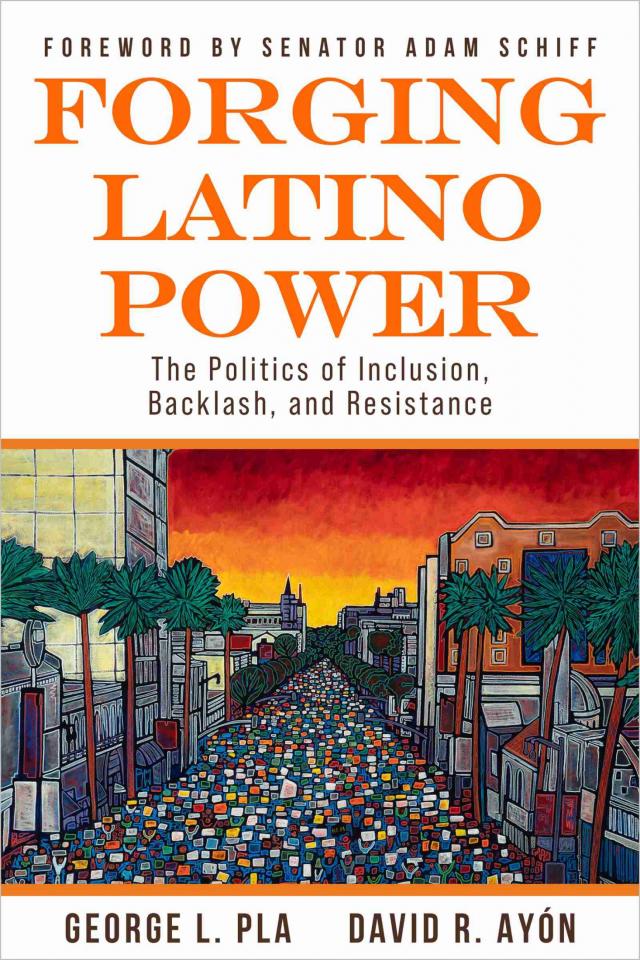
Marcha, 2021 cover art by Jose Ramirez, ramirezart.com.
No part of this book may be reproduced or transmitted in any form or by any means, electronic or mechanical, including photocopying and recording, or in any information storage or retrieval system, without the prior written permission of the authors.
Who lives, who dies, who tells your story?
— Lin-Manuel Miranda, Hamilton
In memory of the Power Shift pioneers
we lost during our work on this book,
Richard Alatorre and Gloria Molina.
Contents
Foreword
Preface Latino Politics in Transition
Introduction Worlds in Collision
Part I Worlds of Invisibility and Erasure
Chapter 1 Where to Begin: Decentering the Barrio
Chapter 2 Building an Electorate and the Dream of Empowerment
Chapter 3 Plotting La Causa: The Farmworker Revolution
Part II Going National: From LA to DC and Back
Chapter 4 Representation in DC and Pivot to Immigrant Rights
Chapter 5 Forging the Latino Lobby
Chapter 6 Inclusion Unbound: Legalizing Millions
Part III After IRCA: New Advances, Backlash, Resistance, and Breakthroughs
Chapter 7 Democratizing LA and Facing the Backlash of the ’90s
Chapter 8 Expansion, Diversification . . . and Comeback
Chapter 9 New-Century Action: Sactown Hearings to National Megamarches
Part IV Always Another “Final Battle”
Chapter 10 From ¡Ya Es Hora! to “Yes We Can”
Chapter 11 Empowered Latinos
Chapter 12 Collision, Defeat, Resistance, Comeback
Chapter 13 We Had Next—Briefly
Epilogue After the Transition
Postscript Los Angeles, June
Notes
Acknowledgments
Abbreviations
References
Index
About the Authors
Foreword
BY ADAM B. SCHIFF
OVER THE LAST DECADE, DEMOCRACY has come under unprecedented strain. Time and again, America’s core institutions have been attacked and our fundamental values and principles violated. When I was elected to the US Senate in 2024, I joined my colleague Alex Padilla on the Judiciary Committee—our nation’s first line of defense of the Constitution, the rule of law, and our democracy—with these well-known challenges clearly in mind. Even so, I was genuinely shocked, as was most of the country, when on June 12, 2025, Senator Padilla was forcibly removed from a press conference held by the Secretary of Homeland Security in a federal building in Los Angeles—the senator’s hometown—and pushed to the floor.
If there is any image that captures the enormous progress of Latino empowerment in the last century, and the fierce backlash it has prompted, it is this: a Latino US senator from the largest state in the union on the floor with his hands cuffed behind his back. That this son of immigrants, themselves a short-order cook and a housekeeper, would graduate from MIT, become the youngest City Council president in LA history, and later the state’s first Latino US senator, is a story only possible in America. But his treatment by the current administration is all too familiar in repressive regimes anywhere. It is also a harbinger of a dangerous and difficult new period that the Latino community—and the country—is struggling to overcome.
As George Pla and David Ayón detail in Forging Latino Power, the story of Latino political empowerment in California and the country is one that cycles through periods of tremendous advancement and intense backlash, realignment, and then empowerment again. It is also the story of the diversity of the Latino community, which is often painted with the same broad brush. The authors reveal communities that are deeply complex, and where personal paths to power are as dissimilar as they are woven tightly together.
When I ran for the California State Assembly in 1994, I shared a political consultant with a young and energetic labor organizer named Antonio Villaraigosa, who was also running for the state legislature. His district was overwhelmingly Democratic, while mine was lean-Republican. He won. I lost. Nationally, it was a very strong GOP year, but in California, there was more to the Republican surge than a national trend. Proposition 187—a deeply xenophobic and anti-immigrant ballot measure—was Republican Governor Pete Wilson’s ticket to reelection. I opposed it, and I vividly recall the sensation of standing on railroad tracks, my feet tied to the rails, and recognizing this train was going to run over me. The proposition passed by a large margin. Wilson won his reelection, but the long-term consequences for the GOP were severe. If supporting civil rights legislation in the 1960s cost Democrats the South, Republicans’ support for rolling back Latinos’ rights cost them the West Coast.
I was elected to the state Senate two years after my abortive run for the Assembly, and Villaraigosa went on to become Assembly Speaker and then mayor of Los Angeles. In my time in the California Senate, the US House of Representatives, and now the US Senate, I’ve been blessed to work with many of the people whose stories fill these pages. What was often a lonely journey through the corridors of power for early Latino leaders is not so lonely now. Their ranks are filled with talented representatives from all over the state and country, and no longer confined to a handful of Latino districts or neighborhoods. As recounted in Forging Latino Power, so many of the political leaders chronicled here came of age in the 1980s, ’90s, and early 2000s. They came from Southern California and the Valley, the Coast and Northern California, rising from often humble beginnings to challenge the establishment, disrupt the status quo, reframe how issues were discussed, and bring much needed change to the halls of power. The issues that they champion go well beyond traditional concerns over immigration, to the whole panoply of challenges facing the community and country.
I became active in politics just as some of the original power brokers of the Latino community were handing over the reins to a new generation of leaders who have redefined what it means to be a Latino leader in California. That generation has given way to yet another, like Pete Aguilar, a young mayor from Redlands whom I once helped persuade to run for Congress, and who is now the third-ranking Democrat in the House of Representatives. Or Robert Rivas, the grandson of farmworkers who emigrated from Mexico in search of the California Dream, and who now serves as California Assembly Speaker. Their stories inspire, but they also demonstrate the power that Latinos have built in Sacramento and Washington, and the ability to turn that power into real legislative victories.
The struggles chronicled in Forging Latino Power are uniquely Latino, but they also tell a broader story about the pluralistic nature of our democracy and how the accomplishments of our predecessors build on each other. And while their origin stories differ, they are deeply familiar to me—not just because I know many of these leaders personally. My grandparents fled Eastern Europe at the turn of the century; some of the family who stayed behind were lost during the Holocaust. When they arrived in the new world, they were not always welcomed at universities, in social clubs, at workplaces, in housing, or in politics. But early Jewish political leaders emerged and paved the way for others to follow. Sharing that common experience of immigration, discrimination, and hardship, it should come as no surprise that the early generation of Jewish political leaders so often found common cause and friendship with their Latino counterparts. That tradition proudly continues. And given the tremendous challenges facing both communities, it needs to, more than ever.
As this book shows, it took a century for Latinos in California to establish an electoral foothold, initially based on the sustained organization and mobilization of a single community. From there, one community after another was empowered, until Latinas and Latinos developed the leadership and built the clout needed to make government address their needs. As we organize to overcome current and future backlashes, their stories of struggle and achievement give me confidence that we will succeed.
***
ADAM B. SCHIFF serves as a US senator for California, is former chair of the House Intelligence Committee, and led the first impeachment trial of Donald J. Trump. Schiff previously served as a California state senator and as an assistant US attorney in Los Angeles. He is the author of the best-selling book Midnight in Washington: How We Almost Lost Our Democracy and Still Could.
Preface
Latino Politics in Transition
THIS BOOK IS OUR SECOND “deep dive” into the US Latina/o political-empowerment experience, emphasizing roles of community, leadership, participation, representation, and policy achievement.i Sustained Latino empowerment had multiple, independent origins across the country, at different times and in varying circumstances.ii Here, however, as before, we trace the current of American political development that we argue most shaped Latino politics—and especially Latina/o political leadership—over the last half century. That current emerged in a diverse Eastside barrio of Los Angeles in the late 1940s, evolved in significant ways over time, and contributed fundamentally to empowerment in the state and beyond. Top-tier California Latina/o leadership in the last decade, however, has transitioned away from those distant barrio origins to second and third generations predominantly not from LA, and it is now confronting unprecedented national political challenges.
To take into account key recent inflections in Latino politics, we had to reframe this book following the 2024 elections—much as we had to reframe our first collaboration after the elections of 2016. We started on that previous title, Power Shift: How Latinos in California Transformed Politics in America, early in Barack Obama’s first presidential term and Antonio Villaraigosa’s second term as mayor of LA—both historic and seemingly definitive breakthroughs.iii Power Shift highlighted the origins, rise, and contributions of a “top ten” selection of LA-based Latina/o leaders we dubbed Los Diez, who pioneered their community’s politics of inclusion at every level.iv From that perspective, the story of Latino empowerment was of a people who through a lifetime of struggles acquired a “civic voice” in Los Angeles, supported the formation of a professional political leadership class in California, and triumphed over systemic exclusion and invisibility in the US.v
As we neared completion of that project, however, Donald Trump was elected president. We adapted to that challenging turn by emphasizing at the book’s outset that Latina/o political empowerment has been marked by recurring cycles of progress, backlash, and resistance, with progress eventually resumed. Indeed, we noted that effective politics of resistance has also spurred substantial progress, as we saw in the 1994 experience with the anti-immigrant California Proposition 187, which passed in a landslide but was followed in 1996 by a dramatic Latino-led comeback that helped fundamentally change state politics.vi
We undertook this follow-up book amid the social and political upheavals of 2020 to further document consequential advances in Latina/o empowerment. Generally speaking, greater Latino representation and organization strengthened the capacity of leaders, their communities, and ultimately the state to resist policies contrary to “California values,” and to continue making further social and political progress.vii More specifically, they contributed to the Democrats retaking control of the US House of Representatives in 2018 and to the efforts to recover the presidency. Those developments, combined with the growing importance of Latina and Latino leaders besides the Los Diez pioneers, provided ample need and motivation for another book. Success in helping end the first Trump presidency, accompanied by unprecedented LA Latino representation in the new cabinet and US Senate, strongly confirmed that effective resistance can result in historic progress. These achievements consolidated the understanding that Democratic governing coalitions at both state and national levels must include a major role for Latinos.


