

Locked Out, page 1


Locked Out
Geoffrey Stokes
Austin Macauley Publishers
Table of Contents
Cover
Title Page
Locked Out
About the Author
Copyright Information ©
Acknowledgement
Introduction
Chapter 1 Wedding Bells Buck’s Night
The Shower
The Big Day
Chapter 2 Storm Clouds Brewing
Chapter 3 Double-Dealing
Chapter 4 Divided Opinion
Chapter 5 Conflicting Resolutions
Chapter 6 The Unlawful Assembly Act
Chapter 7 Life and Death
Chapter 8 Reign of Terror
Chapter 9 The Wall Street Crash
Chapter 10 The Ultimate Betrayal
Chapter 11 Tactical Shift
Chapter 12 The Day Before the Storm
Chapter 13 The Fateful Day
Chapter 14 In the Months That Followed
Chapter 15 Henry’s Parents’ Passing
Chapter 16 Through the Recession
Chapter 17 Jo’s Struggle
Chapter 18 Wynnie’s Betrayal of Henry
Chapter 19 Billy’s Demise
Chapter 20 Wynnie’s Lament
Chapter 21 Jimmy’s Confession
References
Guide
Cover
Title Page
Table of Contents
About the Author
Copyright Information ©
Acknowledgement
Introduction
start of content
List of Pages
1
2
3
4
5
6
7
8
9
10
11
12
13
14
15
16
17
18
19
20
21
22
23
24
25
26
27
28
29
30
31
32
33
34
35
36
37
38
39
40
41
42
43
44
45
46
47
48
49
50
51
52
53
54
55
56
57
58
59
60
61
62
63
64
65
66
67
68
69
70
71
72
73
74
75
76
77
78
79
80
81
82
83
84
85
86
87
88
89
90
91
92
93
94
95
96
97
98
99
100
101
102
103
104
105
106
107
108
109
110
111
112
113
114
115
116
117
118
119
120
121
122
123
124
125
126
127
128
129
130
131
132
133
134
135
136
137
138
139
140
141
142
143
144
145
146
147
148
149
150
151
152
153
154
155
156
157
158
159
160
161
162
163
164
165
166
167
168
169
170
171
172
173
174
175
176
177
178
179
180
181
182
183
184
185
186
187
188
189
190
191
192
193
194
195
196
197
198
199
Locked Out
Cover Art
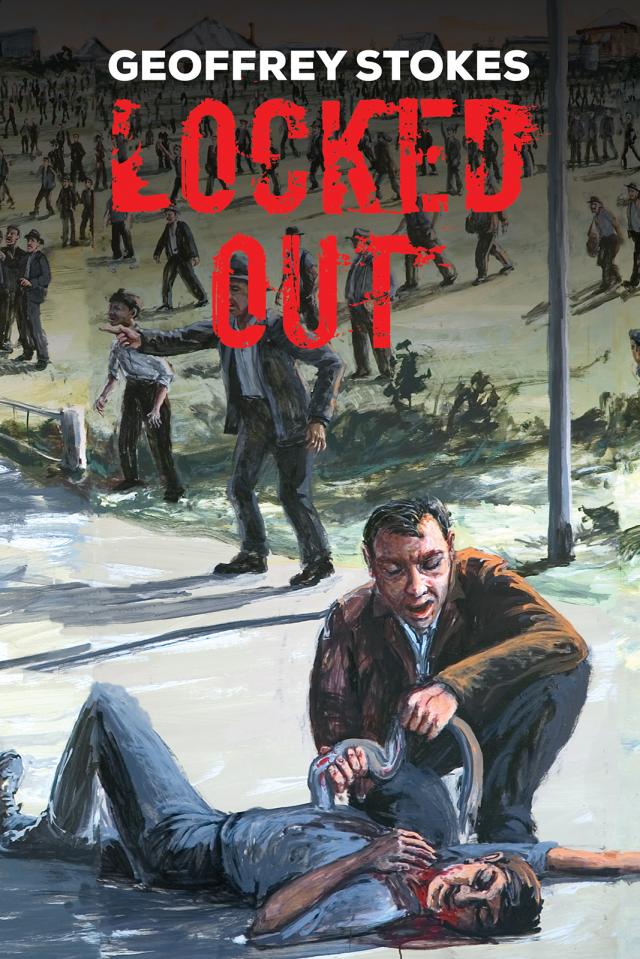
Rothbury Riot Mural
By Chris Fussell
The mural Rothbury Riot was painted by Chris Fussell, an artist located in Pokolbin, in the Hunter Valley. Comprising 13 separate panels, it was commissioned as part of a murals project which originated in 2003 as part of the Towns with Hearts project, in Kurri Kurri, NSW.
Having researched the background surrounding the events of 16 December 1929, Chris was able to depict the chaotic and violent nature of the so-called riot, encapsulating emotions from all sides of the conflict. The Rothbury Riot mural transports the viewer directly to the sidelines of this infamous incident.
About the Author
Geoffrey Stokes hails from Cessnock, New South Wales. As a young man, he was well known for his active participation in various sporting pursuits. Following school, he took a position with Coal & Allied Industries Ltd. formerly J. & A. Brown, a large coal mining company, in their newly established central computer office. The job involved the development and utilisation of a specialised computer system to run and maintain functions previously done by hand.
Following the death of his son, he resigned to follow his strong desire to learn to fly aeroplanes. He later left the Hunter Valley. During this period, he worked in various marketing and management positions. Discontentment eventually drove him to enrol in full-time university study, which culminated in his attainment of the awards: BCom, BCom (Hons), GradDipLegStuds, and Juris Doctor (JD).
The university experience reignited his passion for storytelling, which developed at a very young age, and took him back to Cessnock to set him on his path as an author.
He currently lives and writes in the much cooler climate of Young on the Southwest Slopes of New South Wales.
Publications to date include:
La Plume
Matthew’s Tears
Contact Details:
Phone: 0448484923
Email: gsauthor2@gmail.com.au
Copyright Information ©
Geoffrey Stokes 2025
The right of Geoffrey Stokes to be identified as the author of this work has been asserted by the author in accordance with sections 77 and 78 of the Copyright, Designs and Patents Act 1988.
All rights reserved. No part of this publication may be reproduced, stored in a retrieval system, or transmitted in any form or by any means, electronic, mechanical, photocopying, recording, or otherwise, without the prior permission of the publishers.
Any person who commits any unauthorised act in relation to this publication may be liable to criminal prosecution and civil claims for damages.
This is a work of fiction. Names, characters, businesses, places, events, locales, and incidents are either the products of the author’s imagination or used in a fictitious manner. Any resemblance to actual persons, living or dead, or actual events is purely coincidental.
A CIP catalogue record for this title is available from the British Library.
ISBN 9781035883967 (Paperback)
ISBN 9781035883974 (ePub e-book)
www.austinmacauley.com
First Published 2025
Austin Macauley Publishers Ltd®1 Canada Square
Canary Wharf
London
E14 5AA
Acknowledgement
I thank the following for their part in bringing this book to fruition:
Chris Fussell, the artist who graciously allowed me to use a copy of his mural, Rothbury Riot, which appears on the cover of this book.
I would like to thank Austin Macauley for making this book a reality.
Susan Rolfe, my wife, for her help and assistance in the proofreading of this manuscript and her positive encouragement and support along the way.
My friends, you know who you are, for their positive feedback during the writing process.
Introduction
The Sydney Daily Telegra
It happened on a day when the New South Wales Bavin Conservative government, under the guise of its newly passed Unlawful Assembly Act, let four hundred police officers loose, some on horseback, to attack four thousand striking miners with batons and revolvers, outside the Rothbury Colliery gates. The miners, led by a pipe band, had marched to the pit in protest at their lockout and to resist the coal mine owners from employing scab labour to replace them.
This incident was sparked on 14 February 1929 when the Northern Collieries Proprietors Association, or NCPA, led by John “the Baron” Brown sought to impose a new set of pay and conditions, which the Miner’s Federation, on behalf of the miners, refused to accept. Also, on 2 March 1929, the miners were “locked out”.
A bitter string of events followed the lockout, with neither side willing to give an inch until the New South Wales government, in an effort to force the union’s hand, introduced the Unlawful Assembly Act in September 1929, which threatened to starve them into submission. In a further effort to break the miner’s resolve, police “basher gangs” were given a free hand to attack union officials and families at will.
Following the National election in October 1929 that brought the Labour Party to power, the ten thousand Northern NSW miners were dealt a further blow with the new Federal Government’s refusal to break the deadlock.
This brought it to a head at the gates of Rothbury Colliery on 16 December 1929 where the vicious attack by the police resulted in the death of one miner, Norman Brown, while three other miners were critically injured and forty-two others sustained injuries that required medical attention.
The Miner’s Federation capitulated in May 1930 and the twelve and a half per cent reduction in mineworker’s pay was imposed upon all NSW mineworkers. However, against all government expectations, this failed to spare Australia from the worldwide Depression, during which one-third of all Australian workers were filling the unemployment cues by 1931.
This publication depicts the plight of two families caught up in the struggle and the devastation that it caused them and many other families.
The Rothbury Colliery closed in 1974 and today visitors can view the site where a permanent memorial has been erected in honour of those killed and injured in 1929.
Chapter 1
Wedding Bells
Buck’s Night
On the cool, spring night of Friday, 29 September 1928, a group of coal miners and farmers were gathering in the main bar of Tattersalls Hotel on High Street, Greta, a small town in the Hunter Valley of New South Wales. They were there to celebrate Henry Evan’s last day of freedom before his wedding the following day.
Positioned just inside the bar door, Henry greeted each invitee as they entered. Also, following the obligatory teasing from the last of them to arrive, he quickly joined his brothers, Don and Mal, and his father, Bill, close to the open fireplace at the far side of the room to enjoy the warmth from the blazing wood-burning fire.
Henry was a nineteen-year-old local lad and was to be married to the petite eighteen-year-old Wynnie Spencer from the neighbouring coal mining village of Rothbury. They met on 23 December 1925 at the Rothbury mineworker’s Christmas picnic day, funded each year by the Miner’s Federation with funds taken from the mineworker’s mandatory union contributions. They were introduced by Wynnie’s father, Jo, who at the time was Rothbury’s lodge secretary. They had been going steady ever since.
Henry’s parents owned a dairy farm on the outskirts of Greta, where he and his two older brothers were brought up. Don was the eldest and Malcolm, or Mal, was two years younger than Don and only eleven months older than Henry. Before and after school hours, the three boys were schooled in dairy farming by their father with the expectation that they would join him as each of them attained the age of fifteen years.
Dairy farming had become a family tradition. Henry’s father, William, or Bill to his friends, was a quiet man who had spent all of his life on the dairy farm. Bill’s father purchased it originally and upon his passing, it went to his only son, Bill. However, in 1925, when the time came for Henry to leave school, Bill realised that the farm could not financially sustain all three of his sons. So, Henry, the youngest, was sent to work in the underground colliery at Rothbury.
Wynnie’s elder brother, John, also worked with their father, Joseph, or Jo as he was known, at the Rothbury Colliery. Her youngest brother, Billy, was only fourteen years old and busting to get a start to work alongside his brother, father, and soon-to-be brother-in-law, Henry. Wynnie’s mother, Florence, or Flo, was the backbone of their family and toiled day and night in order to provide her men’s needs to sustain them day after day labouring underground.
‘You still have time to back out,’ Don said as he handed Henry his first pint of black beer.
‘I think Jo would hunt me down if I back out now. Besides I’m looking forward to marrying Wynnie and starting our life together in Rothbury,’ Henry anxiously replied.
Jo, who was standing with two other men just behind the two brothers and was quietly listening to every word, interrupted, ‘Did I just hear my name mentioned?’
Jo’s voice immediately startled Henry as he didn’t realise that Jo was listening in on his conversation with his brother. After taking several moments to compose himself, he replied, ‘Yes, I was just telling Don that if you hadn’t stood as my guarantor, I wouldn’t have got the loan for our house through the union’s Star Bouget fund.’
‘In accordance with the rules, your name was placed in a jar with all the others who joined at the same time as you, and your name was drawn,’ Jo muttered with a cheeky grin.
‘But I’m still only on contract rates at the pit,’ Henry mumbled while looking down to hide his embarrassment.
‘You will be offered the day wage rate once you and Wynnie are married and living so close to the mine,’ Jo assured him.
‘Yes, we were lucky, as the house we bought had just come onto the market. It will be good to be able to walk to work,’ Henry responded.
‘It helps to live close to the pit…at least for the first few years of your marriage,’ Jo muttered.
‘Why, Jo?’ Henry asked.
‘Well, it grounds you as a married couple. You are lucky in a sense because Wynnie was brought up in a coalminer’s household. A coalminer’s wife must ensure that her husband is able to get up each day and face another day down the hole. Without a good wife, a miner can lose his way,’ Jo responded.
‘What do you mean by grounds you, Jo?’ Henry asked.
‘There is no pub in Rothbury, only the pit. Living across the road from it, you and Wynnie will develop a routine that revolves around your work. You won’t get distracted,’ Jo explained.
‘Wynnie wants to fix the place up; you know, buy some nice furniture and get a Singer sewing machine to make new curtains and stuff,’ Henry said.
‘That’s okay, but I do warn you, Henry, take care not to miss a mortgage payment. Also, as hard as it will be with a new wife wanting to create a homely feel in your new home together, make sure that you set aside some of your pay each week for the unexpected,’ Jo advised.
‘What do you mean, Jo? We don’t earn enough to save money,’ Henry bemoaned.
‘Well, it’s not going to get much better. The prime minister, Stanley Bruce, and his Conservatives, down in their new Parliament House in Canberra, seem determined to attack the working-class living standard. They introduced a new Transport Workers Act which has been dubbed the “Dog Collar Act” in an attempt to break the wharfie strikes. The Act allows the use of casuals and non-union workers to be employed on the waterfront. This has only strengthened the waterfront union’s resolve to maintain their wages and conditions, and recently, resulted in three of their striking members being shot in Melbourne by police.’
‘But if the government get control there, you can rest assured the coal miners will be next. I fear that Bavin’s New South Wales Conservatives are of a similar mind to their Federal counterparts,’ Jo explained.
‘Why, Jo? Why are the employers and governments trying to lower workers’ wages and conditions?’ Henry asked.
‘The employers maintain that wages are driving their costs too high and costing them business. The governments rely on businesses to provide domestic growth and increase taxes. It’s a simple marriage of mutual support,’ Jo replied.
‘We pay taxes,’ Henry muttered.
‘Our taxes are only a very small part of the government’s annual revenue. But if the colliery owners or any business…like the wharves right now…can reduce their costs by lowering wages, they would expect to increase their market share, and as a consequence, they would increase their profits. If the businesses increase their profits, the government will receive more corporate tax to run the country,’ Jo explained.


