

The Sheriff Takes a Bride, page 1


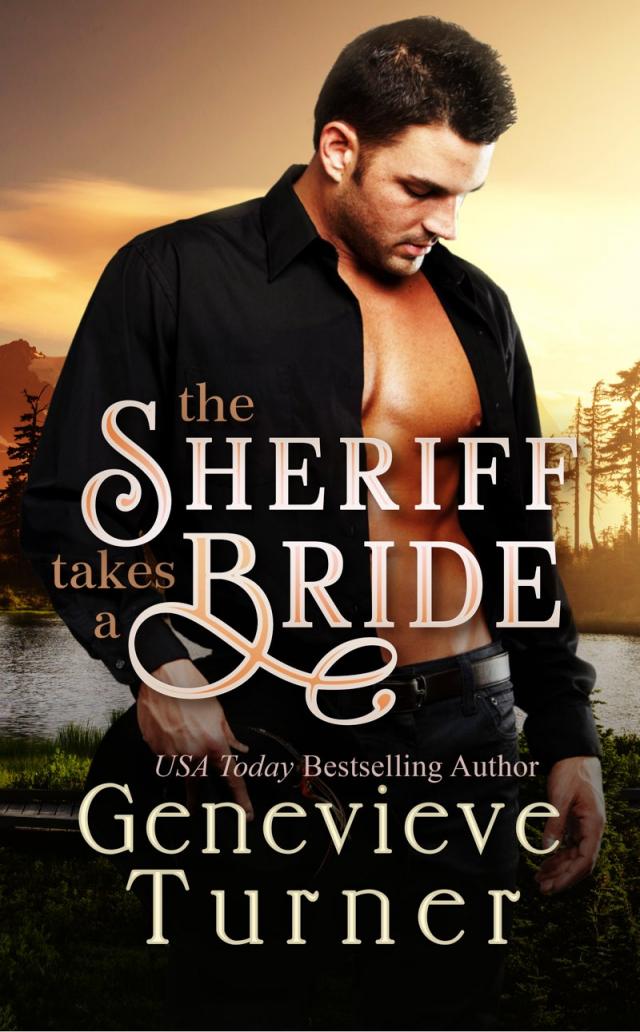
The Sheriff Takes a Bride
When a surly sheriff butts heads with an unstoppable woman, sparks fly.
* * *
When an outlaw’s bullet ends his career—and almost takes his life—Sheriff Joaquin Obregon locks himself away from the rest of the world. But when a stubborn woman comes into his life, refusing to take no for an answer, he finds himself wanting to say yes…to her.
* * *
Mary Margaret McCallahan is proud of her skills as a nurse, but she’s never had a patient as difficult as this gruff, handsome sheriff. She’s going to bring him back into the world no matter how much he grumbles—or how attractive she finds him.
* * *
The battle lines are drawn, and only love can win.
This is a work of fiction. The names, characters, places, and incidents are either products of the author’s imagination or used fictitiously. Any resemblance to actual persons, living or dead, business establishments, events, or locales is entirely coincidental.
Copyright © 2015 by Genevieve Turner
ISBN: 978-0-9906298-4-9
Digital Version 1.0
Cover photographs © Hot Damn Stock | hotdamnstock.com and Galyna Andrushko | shutterstock.com
All rights reserved.
Chapter One
San Jacinto Mountains, California
Autumn, 1899
The bedpan hitting the floor was the first indication that Mary Margaret McCallahan’s teatime was about to be interrupted.
She knew it was a bedpan by the deep metallic clatter as it bounced across the hardwood floors. You didn’t spend two years working in a sanatorium—and five as a nurse—without learning to recognize that sound. The depth of it suggested the bedpan was empty. Thank the Lord for small mercies.
Mae set down her tea and looked at Sally across the table in the nurses’ parlor. Sally’s gaze never lifted from her book as Mae took another bite. Roast beef. Very nice.
“I think that came from Mr. Obregon’s room,” she said between bites.
Sally kept her eyes on the page. “It’s your turn to deal with him.”
Mae sighed. It was her turn, but of all the thankless tasks a nurse had at the Pine Ridge Sanatorium dealing with Joaquin Obregon was, in her opinion, the most thankless. A man as handsome as all that shouldn’t be so infuriating.
Well, he’d just have to wait. The first thing she’d learned in childhood was to fill her belly when she could. Mae could never ignore a lesson taught so often and so well.
It wasn’t as if Mr. Obregon needed any help, truly. Personally, she thought the only thing afflicting Mr. Obregon was his own sense of self-pity. Certainly a year ago, when he’d first come to the sanatorium, he’d been grievously wounded. But there was nothing wrong with him now that a little more activity and a little less sullenness wouldn’t cure.
But the nurses at the most exclusive sanatorium in Southern California weren’t paid to give their true opinion of their patients. They were expected to give the patients exactly what they wanted.
Mae set aside her cooling tea and rose, the keys at her belt jingling. Sally never once looked up—she must be at a good part.
With one last glance in the mirror to ensure her starched white cap was in its proper place, Mae went off to check on her least favorite patient.
She sailed down the halls at a fair clip, taking note of the general condition of the place. The walls hadn’t even the slightest smudge, the floors were bright with a fresh waxing, and there wasn’t a hint of dust. Exactly as the nursing textbooks recommended.
Keeping the sanatorium running in the most perfect manner possible wasn’t solely her duty—it was also her pride. The better she displayed her capability here, the sooner she’d be offered the chance to leave.
Mae stopped dead when a bit of cold passed across her skin. Was that a draft? Proper airflow was of the utmost importance—drafts were to be eliminated immediately. But no more chilled air slid over her. Nothing to worry over then.
As she approached Mr. Obregon’s room, a tall, rather severe-looking lady hurried out of it. It took Mae a moment to realize it was his fiancée, dressed almost too fancily and wearing a hat that likely cost more than Mae made in a month.
A full year with no sign of this fiancée, and now she was back. How do you like that?
Mae never had liked her. First, the woman had made poor Mr. Obregon leave his bed when he was only just recovering in order to stop a lynching. Considering that the mob was about to string up the very man who’d shot Mr. Obregon, Mae thought that a rather severe request to make of him, his condition notwithstanding. And after Mr. Obregon had risked his life in her mad scheme, the woman had had the gall to move off to San Francisco.
The fiancée stumbled out and down the hall without even a glance toward Mae. Typical. Mae might have been a rather annoying piece of furniture for all the consideration the woman had ever given her. And now she was throwing bedpans and expecting Mae to clean them up. Well, fie on her.
Mae bustled into his room, putting on her mask of nursely efficiency. “Is everything all right?” Her voice was all sunny sincerity, not a hint of annoyance in it. She couldn’t afford to display her true feelings—she wasn’t wealthy enough to toss bedpans in a fit of temper.
Mr. Obregon sat on the bed, his face turned toward the wall and away from the afternoon sunlight coming through the window. The quality of light in California never ceased to amaze her, so different from that in New York. She couldn’t help but stare at times.
Her patient didn’t bother to acknowledge her, simply kept his head averted. His mood was as dark as his hair today, it seemed.
Although his mood was dark most days.
She spied the bedpan in a corner on the floor. “I’ll just take this away,” she chirped, sweet as a little bird. “You’ve no need of a bedpan. You haven’t for quite some time.”
She’d squatted down, her fingers curling around the cold enamel, when she heard him speak from behind her.
“My fiancée is getting married.” Such a lovely, deep voice he had, and so ruined by the character of the man using it.
“Oh?” she answered as she straightened. “Has she taken up with the Mormons in San Bernardino? I always thought it was one man, many wives for their kind, but perhaps they’re branching out into one woman, many husbands.”
“My former fiancée,” he amended without turning from the wall.
She suddenly felt a right fool, holding a bedpan and talking to a man’s back about such intimate things and making jokes about Mormons.
“Who is she marrying?” she asked gently. She ought to leave, but he did look so vulnerable. She’d learned in nursing school that compassion must always be tempered by practicality. A nurse who lavished too much compassion on each patient soon found herself without any compassion left.
But she found she had more than enough for him at the moment.
“Do you remember when we stopped that mob a year back?” Deliberate. Weighted.
Her limbs tightened. Did she remember? It was only the most terrifying memory of her adult life. Growing up destitute in the slums of New York had been frightening enough, but she’d never had to face down an armed mob with a man recently snatched from near death.
“Yes.”
“Do you remember the lawman? That marshal?”
She couldn’t forget him either. “The one holding them off with a shotgun? The one who was shot?”
It had been a terrible night in every respect. Mr. Obregon and that fiancée of his—former fiancée—had driven off the mob with a clever ruse after the men had threatened to hang both the outlaw and the marshal. That outlaw had shot the marshal anyway once the mob was gone. Mae had only just gotten the marshal back to the sanatorium and into the doctor’s hands in time to prevent him from bleeding to death.
Her fingers trembled on the cold enamel of the basin at the memory, although her hands had been rock steady that night as she’d saved the marshal.
“The very same.” Mr. Obregon turned a little toward her, revealing a freshly shaved cheek the color of varnished oak. “She’s marrying that man. Is already married to that man.”
“But how?” Mae couldn’t hold on to that exclamation.
She remembered the fiancée’s screams tearing through the dark of that night as the marshal had fallen. Mae had surmised the woman was simply prone to hysterics, but now she read something deeper.
“I don’t understand,” she said as she frowned down at the bedpan. “Wasn’t he at the trial a month back? And she in San Francisco?”
“He was.” As wearily spoken as the set of Mr. Obregon’s shoulders.
Mr. Obregon had been there as well, testifying as the outlaw was tried for the attempted murder of the marshal. The man had been given twenty years in prison for it.
“That marshal,” he continued, “went all the way to Mexico to capture that man. He brought him back to face justice. And the entire time I was here.” A soft exhale. “He snatched up the fugitive, and now he’s snatched up Isabel.”
Mae felt a surprising surge of anger. After all he’d done for that woman—taking a bullet, stopping a mob—and she was now marrying the very man who’d protected that scum from the vigilantes? Mr. Obregon might have also wished to stop the mob, but that didn’t mean his fiancée had to marry that other man.
“Another lawman? She must like those.” She didn’t bother to keep the disdain out of her voice.
“I suppose.” The defeat in
She wished with all her heart that Sally had put down her stupid book and come to handle this because she was about to do something very reckless—reveal her true feelings on the matter.
“Well, she’s a sly bit, make no mistake.” She gestured with the bedpan to illustrate just how sly. “No better than she has to be. That woman ought to have stood by you.”
He turned and her traitorous heart skipped a beat. As it usually did.
Thick black hair topped a face that could have come straight from a men’s fashion plate with eyes the color of oversteeped tea, a commanding nose, and a well-sculpted mouth unobscured by a mustache.
Too bad his personality wasn’t nearly as handsome as his face.
“You do know that I was the one to break off the engagement?” He sounded as if this were common knowledge, something she ought to have learned in primary school. As if she were stupid.
Her face flamed, and she regretted her words even more. “No, and how was I supposed to know? I’m a nurse, not some small-town gossip.”
One of his fine eyebrows quirked up. “They don’t gossip in New York?”
She wasn’t discussing New York with this spoiled pretty boy. This was what happened when you tried to be nice to him—he went nasty on you.
“Is there anything else you require, sir?” she chirped, acid burning her tongue.
He turned back to the wall. “No. You may leave.”
The little nurse was correct: he didn’t need the bedpan any longer. Hadn’t for some time, actually.
Joaquin Obregon studied the painting on his wall, the same painting he’d been staring at for a year. It was an indifferent sketch of some daisies in a vase, no doubt done in a fit of boredom by one of the lady patients. Not quite ugly enough to throw out, so one of the nurses must have stuck it here simply to do something with it.
What was that little nurse’s name again? Not her family name—that he knew. Nurse McCallahan. He’d overheard the other nurses using her first name—Maria? Margarita?
No, those names were Spanish, and the nurse was most certainly not—not with her skin as pale as snow, hair nearly as white, and eyes the color of frost. Had she been tall and regal, she might have been the winter queen come to life. But short and stout as she was, she could be called nothing kinder than colorless.
Except for when he caught glimpses of what lurked behind those blue eyes and nursely expression. When she looked at Stan, the consumptive so far gone he wasn’t like to see another winter, Joaquin saw a compassion so profound it stole his breath. And when she helped Mrs. Hansen, the hysteric broken by too many lost children, the patience in those eyes looked boundless.
But there wasn’t compassion or patience when she looked at him. There was only annoyance and the same bitter spark he saw in his family’s eyes: grief that he hadn’t had the sense to die as a hero, that he lingered here as useless as a paralytic arm. The golden son of the family who’d proved instead to be the basest of metals.
He rubbed his fingertips together although there was nothing there. Perhaps they were right—his family, the nurse, Isabel—all of them. He certainly felt as if he were rotting from the inside out. He wouldn’t be at all surprised to find a spreading blackness on his skin one morning.
Mae. That was the nurse’s name. But not like the month—it was short for something else, a name he didn’t know.
He stood stiffly, the scar tissue running all along his left side making the task slow and stupid. He began to pace the room, hoping the pain would ease as he moved. It usually only came on at certain times, such as when he was tired or when he’d been still too long. At least that was true of the bad pain, the kind that swallowed all his thoughts and twisted his body into a knot of agony.
But today there was merely discomfort.
He’d become a connoisseur of pain, having tasted agony in nearly all its forms since that outlaw had shot him in the gut and left him for dead. When he’d first awoken, the pain had been all consuming, a screaming agony enveloping him, a never-ceasing whistle of suffering swamping his body and brain.
When Isabel had come to see him after the attack, he’d felt as if he were shouting at her from the end of a tunnel, barely able to make himself heard. Her familiar face had been wide-open with fear and anxiety, so unlike the dauntless woman he’d known all those years. And when she opened her mouth to speak in her ruined voice, the marks on her throat still darkly purple, the tunnel had broadened into an abyss.
He knew then he could not ask her to share in that terrible pain—to have her spend the rest of her life trying to shout through it to him. He loved her but wasn’t in love with her. She deserved better.
Still, news of her marriage stung. A new kind of pain, that. Perhaps he hadn’t tasted all the flavors of agony yet.
He rubbed a hand over his face, trying to scrub away some of the ache, but kept at his pacing, commanding his left side to move, to cut through the hurt and go forward. Men did not admit to pain. Even in the moments when they seemed to be composed of nothing but pain.
He and Isabel had thought themselves so clever, so much smarter than everyone else, in choosing a partner based on mutual respect and sensibility. They would marry and move together to Los Angeles to live among smart, fashionable people. Dusty little Cabrillo was no place for the two of them.
But life and a trio of outlaws had completely upended them.
Except Isabel had taken her upended self and moved on. Gone forward.
Seeing her in her smart dress with that ridiculously fashionable hat, hearing her talk of her life in San Francisco and her marriage to that marshal while he was in the exact same room he’d been in for the past year—watching her mouth move, listening to her entirely unscathed voice, seeing her more animated than he’d ever known—he realized how well and truly stuck he was. A bug trapped in sap, struggling to break free but only sinking deeper with each flail.
He slowly, stiffly sat back onto the bed. Thanks to his little exercise of will, his left side was now thrumming angrily, a smolder beginning there.
He couldn’t, shouldn’t, begrudge Isabel her new life, her new happiness.
But that marshal… He’d tracked down the outlaw twice, and he was marrying Isabel as well, like some kind of dime novel hero.
If this story really were a dime novel, Joaquin would have died: the tragic former love sacrificed so that the hero and heroine might have their happy ending.
Too bad for all of them he’d survived and ruined the story.
His fingers found the ridge of scar tissue in his belly and began to knead. The sensation wasn’t exactly comfortable, but at least it was something different.
When Isabel had said she was already married—and to that man—Joaquin’s spike of anger had been so surprising he hadn’t even thought to rein it in. His arm had shot out, catching the bedpan and sending it crashing to the floor, the rattle of it quite like the rattle within himself.
Joaquin hadn’t felt anger like that in a long time.
The marshal had been shot yet he didn’t limp. When that outlaw had been tried for Joaquin’s attempted murder, he’d been found not guilty. But when he’d been tried for the marshal’s attempted murder? Well, that had been worth twenty years in Folsom.
And now the marshal had married Isabel. It was as if Joaquin and the marshal were mirror images—the marshal the straight and upstanding one and Joaquin the twisted, bent, fun-house version.
As the bedpan hit the floor, Isabel had gasped, her eyes going wide behind her spectacles. She’d given him that schoolmarm look, the one he’d always enjoyed seeing her turn on others.
But when she turned it on him… He’d tossed her out, rage making all of him as tight as the scar along his left side.
The anger was gone now, replaced by… by what? It wasn’t truly jealousy stirring in him. It was discontent and ennui and…
He blinked. He couldn’t even name all of it, but it made him tired and nauseous. Much like everything else in his life these days.
So he sat, staring at that same insipid painting and wondering if he even could change his surroundings now or if it was too late. If he were already too stuck to break free.


