

The Rise and Fall of the Neoliberal Order, page 1


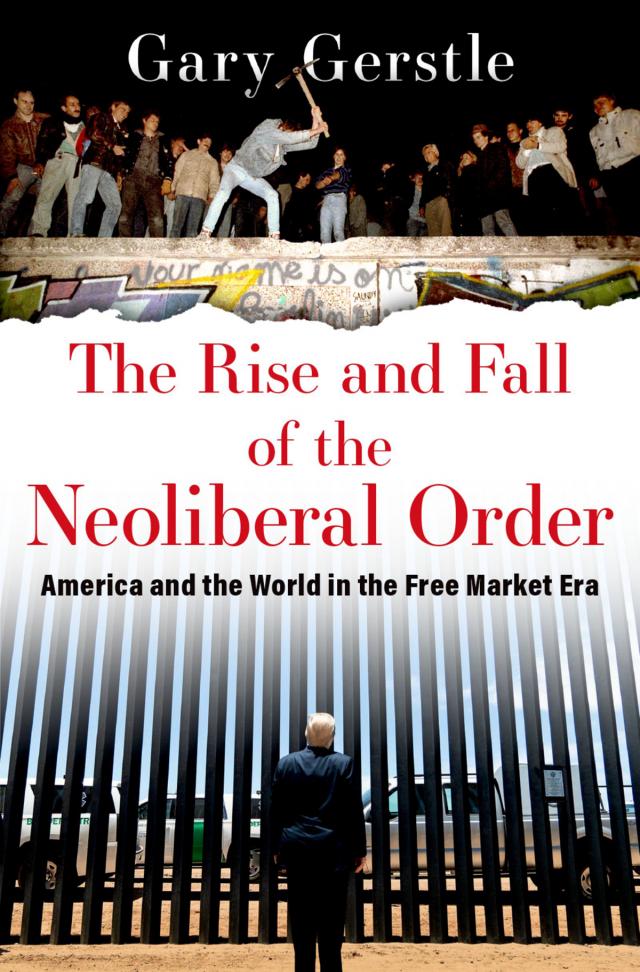
The Rise and Fall of the Neoliberal Order
Advance Praise for The Rise and Fall of the Neoliberal Order
“Gary Gerstle offers a brilliant, engaging, and provocative first-draft history of the last half century, a period sorely in need of scrutiny. With characteristic big-think flair, he shows that the neoliberal wisdom of that era—that markets would bring democracy, that the age of big government was over—emerged from specific historical forces and circumstances. He also suggests that many of those ideas can and should now be consigned to the past.”
—Beverly Gage, Yale University
“Just beneath the surface of our fractured and polarized polity, Gary Gerstle argues that there has been a Neoliberal Order under which both parties worked in the 1990s and early 2000s. Even as they bitterly disagreed, the nation’s political debate moved far away from the class-based pillars of the New Deal. In another of his characteristically eye-opening analyses, Gerstle takes readers through the rise and fall of the political order that has shaped our leaders and electorate—that is, until powerful forces over the past decade, on the right and left, have opened the door to a new era.”
—Julian Zelizer, Princeton University
The Rise and Fall of the Neoliberal Order
AMERICA AND THE WORLD IN THE FREE MARKET ERA
Gary Gerstle
Oxford University Press is a department of the University of Oxford. It furthers the University’s objective of excellence in research, scholarship, and education by publishing worldwide. Oxford is a registered trade mark of Oxford University Press in the UK and certain other countries.
Published in the United States of America by Oxford University Press
198 Madison Avenue, New York, NY 10016, United States of America.
© Gary Gerstle 2022
All rights reserved. No part of this publication may be reproduced, stored in a retrieval system, or transmitted, in any form or by any means, without the prior permission in writing of Oxford University Press, or as expressly permitted by law, by license, or under terms agreed with the appropriate reproduction rights organization. Inquiries concerning reproduction outside the scope of the above should be sent to the Rights Department, Oxford University Press, at the address above.
You must not circulate this work in any other form and you must impose this same condition on any acquirer.
Library of Congress Cataloging-in-Publication Data
Names: Gerstle, Gary, 1954– author.
Title: The rise and fall of the neoliberal order : America and the world in
the free market era / Gary Gerstle.
Description: New York, NY : Oxford University Press, 2022. |
Includes bibliographical references and index.
Identifiers: LCCN 2021056521 (print) | LCCN 2021056522 (ebook) |
ISBN 9780197519646 (hardcover) | ISBN 9780197519660 (epub) |
ISBN 9780197628751
Subjects: LCSH: Neoliberalism—United States—History. |
Conservatism—United States—History. | Capitalism—Political aspects—
United States—History. | Free enterprise—United States. |
United States—Foreign economic relations. | United States—
Foreign relations—1945–1989. | United States—Foreign relations—1989–
Classification: LCC JC573.2.U6 G485 (print) | LCC JC573.2.U6 (ebook) |
DDC 320.510973—dc23/eng/20220105
LC record available at https://lccn.loc.gov/2021056521
LC ebook record available at https://lccn.loc.gov/2021056522
DOI: 10.1093/oso/9780197519646.001.0001
For the Dinner Crew
Contents
Acknowledgments
Introduction
Part I. The New Deal Order, 1930–1980
1.Rise
2.Fall
Part II. The Neoliberal Order, 1970–2020
3.Beginnings
4.Ascent
5.Triumph
6.Hubris
7.Coming Apart
8.The End
Notes
Index
Acknowledgments
this idea for this book was born at a 2015 University of California, Santa Barbara, conference to mark the 25th anniversary of The Rise and Fall of the New Deal Order, 1930–1980. The book took further shape across a series of Cambridge-Oxford-Harvard workshops on work and inequality in 2016–2017. It acquired depth in a 2018–2019 graduate student–faculty neoliberalism study group at Cambridge. And it received critical inspiration at a 2018 Seattle conference that dared to imagine a politics lying beyond the neoliberal era. I owe a great deal to the organizers of these events—Nelson Lichtenstein, Alice O’Connor, Jennifer Hochschild, Desmond King, Daniel Coleman, Richard Saich, Angus Burgin, Steven Teles, and Heather Boushey (and the Center for Equitable Growth).
I debuted my own thinking on The Rise and Fall of the Neoliberal Order in a lecture to the Royal Historical Society in 2017 and then refined that thinking for two keynote addresses, one at Oxford and another at the University of Chicago. The feedback I received from these lectures and on the publications that issued from them was incredibly helpful and encouraging. For that feedback, I wish to thank, in particular, Sven Beckert, Margot Canaday, Liz Clemens, Liz Cohen, Nancy Cott, Gareth Davies, Steve Fraser, Art Goldhammer, Joel Isaac, Alex Jacobs, Ira Katznelson, Russ Kazal, Desmond King, Robert Kuttner, Jonathan Lear, Jon Levy, Nelson Lichtenstein, Peter Mandler, Lisa McGirr, William Novak, Alice O’Connor, Christopher Phelps, Daniel Rowe, Barbara Savage, Steve Sawyer, Stephen Skowronek, Adam Smith, and Jim Sparrow. I also wish to acknowledge the generous Cambridge University Press policy that has allowed me to reproduce in this book portions of an article that first appeared in the 2018 Transactions of the Royal Historical Society.
I intended to debut a key chapter of this book (Chapter 3) at the 2020 Annual Meeting of the Organization of American Historians. When the pandemic made that presentation impossible, three of the commentators who had signed on for the session kindly agreed to carry out a private Zoom workshop with me. Angus Burgin, Melinda Cooper, and Quinn Slobodian delivered commentaries that were learned and penetrating. Margot Canaday and Ira Katznelson later weighed in with their own insightful readings of the chapter. I’m not sure I have addressed all of these readers’ concerns, but their comments helped me to lift my thinking on the genealogy of liberalism and neoliberalism to a higher level.
At Cambridge, I have been privileged to be part of a remarkably robust and engaged group of Americanists, including Andrew Preston, Sarah Pearsall (recently departed for Johns Hopkins), Nick Guyatt, Julia Guarneri, Bobby Lee and John Thompson; visiting Pitt professors Margaret Jacobs, Barry Eichengreen, Ira Katznelson, Heather Thompson, Naomi Lamoreaux, Kathleen Brown, and Theresa Singleton; Mellon fellows Stephen Mawdsley, Seth Archer, Emma Teitelman, and Emily Snyder; a talented array of junior research fellows who year-in and year-out enliven and replenish our ranks; and the spirited Cambridge American History Seminar that has persisted through strikes, storms, and a pandemic.
Beyond the ranks of American historians, I wish to thank these Cambridge colleagues: Peter Mandler, my stalwart friend and comrade; Joel Isaac (now at the University of Chicago), Saul Dubow, and Eugenio Biagini, co-editors and co-authors on projects addressing themes similar to those I explore here; David Runciman, Helen Thompson, and Catherine Carr, all of Talking Politics, with whom I have spent many stimulating hours puzzling through the mysteries and paradoxes of American politics; and the fellows and staff of Sidney Sussex College, who have welcomed me into their community these past eight years.
I also wish to salute my Cambridge undergraduate and MPhil students, whose challenging questions and sophisticated writing about American history have kept me on my toes. Every member of my stellar group of past and present Cambridge PhD students deserves to be named: Sveinn Jóhannesson, Katherine Ballantyne, Eric Cervini, Merve Fejzula, Ruth Lawlor, Huw Batts, Rob Bates, Clemency Hinton, Lewis Defrates, Jeanine Quené, Yasmin Dualeh, Richard Saich, Daniel Coleman, Kristian Dekatris, Marie Puységgur, Rob O’Sullivan, Sybill Chen, Fergus Games, and Hugh Wood. Some of these young historians have already begun to make their mark on the profession; more will do so soon. Richard Saich deserves a special thanks for giving me timely and essential help in meeting key publisher deadlines.
My longtime assistant, Jonathan Goodwin, has provided this project with years of indispensable research and feedback. Jonathan, I can’t thank you enough for helping me in so many ways, large and small.
At several points in this book’s history, Angus Burgin has stepped up in a major way to offer me the benefits of his expertise, insight, and critical acumen. Andrew Preston brought his foreign relations expertise to bear on Chapter 6. A long discussion with Joseph Stiglitz about his time in the Clinton Administration deepened my understanding of politics in 1990s America. I also wish to thank Andrew Marantz of the New Yorker and Amana Fortunella-Khan of The Guardian for introducing my work on neoliberalism and political orders to a broader public, thus generating valuable commentary that has left its mark on this book.
I am deeply grateful to my agent, Sarah Chalfant. Her professional skills are formidable. Her incisive and thoughtful feedback on my chapters helped me to shrink the distance between what I was writing and what I wanted the book to be. Every phase of this project has benefited from her involvement. Thanks go as well to her associates at Wylie, Rebecca Nagel and Emma Smith.
Dave McBride has been a superb editor. His erudition is immense, his judgment sure, his editorial interventions on the mark. At key moments in the book’s gestation and development, he has acted decisively and efficaciously. Dave is a busy man at Oxford, yet his door was always open to me. He has helped me to make this a much better book.
I owe a big thanks, too, to the rest of the transatlantic Oxford team: to production coordinator Emily Benitez, production editor Jeremy Toynbee, copyeditor Patterson Lamb, senior art director Brady McNamara, director of publicity and trade marketing Jocelyn Cordova, and publicists Amy Packard Ferro and Kate Shepherd.
I would be remiss if I didn’t register my appreciation for the seven anonymous reviews I received via Oxford—four on the original book proposal and three on a near finished version of the entire manuscript. To the authors of these reviews: I hope that you will discern in this finished book the difference your commentary has made.
Steve Fraser and I first met in 1986 at a midtown Manhattan restaurant; by the time we finished our two-hour lunch and celebrated the fleeting success of our cursed Queens baseball team, we had sketched out the book that would become TheRise and Fall of the New Deal Order. Without that meeting, that book, and decades of collaboration and friendship that issued from both, The Rise and Fall of the Neoliberal Order would have been much harder to imagine and write.
Several other longtime friends have also made notable contributions to this book. David Casey, Chuck Lane, and Michael Kazin gave me feedback on core ideas, saved me from potentially embarrassing errors, and helped me to push this manuscript across the finish line. I am grateful most of all for their friendship, for the fierceness of their intellects, and for discussions of American history and politics that have spanned decades.
My greatest debt is to my family, or “Gary’s Dinner Crew”: to my lifelong love Liz (the Crew’s irrepressible dynamo), to my sons Danny and Sam, to my daughters-in-law Aimee and Aliza, and to the family pooch, Oliver. During the first terrible year of the pandemic, our summer cottage became a family refuge, a place where we gathered to live, work, talk, hike, watch movies, read, write, cycle, cook and eat, and cook and eat some more. I thank every member of this crew for their love, energy, passion, and insight. And for revealing to me on a daily basis a new world—and a better American future—taking shape. This book is for them and for that future.
The Rise and Fall of the Neoliberal Order
Introduction
Across the second decade of the twenty-first century, the tectonic plates structuring American politics and life began to shift. Even before the pandemic struck, developments that ten years earlier would have seemed inconceivable now dominated politics and popular consciousness: the election of Donald Trump and the launch of a presidency like no other; the rise of Bernie Sanders and the resurrection of a socialist left; the sudden and deep questioning of open borders and free trade; the surge of populism and ethnonationalism and the castigation of once-celebrated globalizing elites; the decline of Barack Obama’s stature and the transformational promise that his presidency once embodied for so many; and the widening conviction that the American political system was no longer working, and that American democracy was in crisis—a crisis that the January 6, 2021, assault by a mob on the Capitol so shockingly dramatized.
In this dizzying array of political developments, I discern the fall—or at least the fracturing—of a political order that took shape in the 1970s and 1980s and achieved dominance in the 1990s and first decade of the twenty-first century. I call this political formation a neoliberal order. Ronald Reagan was its ideological architect; Bill Clinton was its key facilitator. This book is a history of this political order’s rise and fall. It offers a history of our times.
The phrase “political order” is meant to connote a constellation of ideologies, policies, and constituencies that shape American politics in ways that endure beyond the two-, four-, and six-year election cycles. In the last hundred years, America has had two political orders: the New Deal order that arose in the 1930s and 1940s, crested in the 1950s and 1960s, and fell in the 1970s; and the neoliberal order that arose in the 1970s and 1980s, crested in the 1990s and 2000s, and fell in the 2010s.
At the heart of each of these two political orders stood a distinctive program of political economy. The New Deal order was founded on the conviction that capitalism left to its own devices spelled economic disaster. It had to be managed by a strong central state able to govern the economic system in the public interest. The neoliberal order, by contrast, was grounded in the belief that market forces had to be liberated from government regulatory controls that were stymieing growth, innovation, and freedom. The architects of the neoliberal order set out in the 1980s and 1990s to dismantle everything that the New Deal order had built across its forty-year span. Now it, too, is being dismantled.
Establishing a political order demands far more than winning an election or two. It requires deep-pocketed donors (and political action committees) to invest in promising candidates over the long term; the establishment of think tanks and policy networks to turn political ideas into actionable programs; a rising political party able to consistently win over multiple electoral constituencies; a capacity to shape political opinion both at the highest levels (the Supreme Court) and across popular print and broadcast media; and a moral perspective able to inspire voters with visions of the good life. Political orders, in other words, are complex projects that require advances across a broad front. New ones do not arise very often; usually they appear when an older order founders amid an economic crisis that then precipitates a governing crisis. “Stagflation” precipitated the fall of the New Deal order in the 1970s; the Great Recession of 2008–2009 triggered the fracturing of the neoliberal order in the 2010s.
A key attribute of a political order is the ability of its ideologically dominant party to bend the opposition party to its will. Bending of this sort comes to be perceived as necessary within the ranks of politicians competing for the top prizes in American politics—the presidency and control of Congress. Thus, the Republican Party of Dwight D. Eisenhower acquiesced to the core principles of the New Deal order in the 1950s, and the Democratic Party of Bill Clinton accepted the central principles of the neoliberal order in the 1990s. Acceptance is never complete; there are always points of tension and vulnerability in a polity as fissiparous as the American one. And yet, the success of a political order depends on its proficiency in shaping what broad majorities of elected officials and voters on both sides of the partisan divide regard as politically possible and desirable. By the same token, losing the capacity to exercise ideological hegemony signals a political order’s decline. In these moments of decline, political ideas and programs formerly regarded as radical, heterodox, or unworkable, or dismissed as the product of the overheated imaginations of fringe groups on the right and left, are able to move from the margins into the mainstream. This happened in the 1970s, when the breakup of the New Deal order allowed long-scorned neoliberal ideas for reorganizing the economy to take root; it happened again in the 2010s, when the coming apart of the neoliberal order opened up space for Trump-style authoritarianism and Sanders-style socialism to flourish.
Steve Fraser and I introduced the concept of political order in a 1989 book that we coedited, The Rise and Fall of the New Deal Order, 1930–1980. Since that time, the phrase “New Deal order” has become a popular one for underscoring the dominance that the New Deal and the Democratic Party exercised in American politics from the 1930s through the 1960s. I begin this book with an account of how that earlier political order rose to prominence in the 1930s and 1940s, and how it fell apart in the 1960s and 1970s. This is no simple retelling of the history contained in the Fraser-Gerstle collection; rather, this narrative incorporates my own rethinking of key elements of that story. Reaching back to the New Deal order at the beginning of this book also serves the useful purpose of throwing into sharp relief how much the neoliberal order of recent times has differed from what preceded it.1


