

Sir Hereward and Mister Fitz, page 1


Other books by Garth Nix
THE OLD KINGDOM series
Sabriel
Lirael
Abhorsen
Clariel
Goldenhand
Terciel and Elinor
To Hold the Bridge: A Tale of the Old Kingdom and Other Stories Across the Wall: Tales of the Old Kingdom and Beyond
The Sinister Booksellers of Bath The Left-Handed Booksellers of London
Angel Mage
Frogkisser!
Newt’s Emerald
A Confusion of Princes
Shade’s Children
One Beastly Beast
THE KEYS TO THE KINGDOM series
TROUBLETWISTERS series, with Sean Williams
HAVE SWORD, WILL TRAVEL series, with Sean Williams
This collection started with individual stories.
Here are the original editors’ thoughts on Sir Hereward and Mister Fitz.
‘Sir Hereward and Mister Fitz are one of the most unusual and fun sword and sorcery duos to arise since Fafhrd and the Gray Mouser. The papier-mâché-headed puppet has haunted me ever since I first read of him and his artillerist knight companion and student. These tales are brilliantly imaginative and as fantastical as you’d expect from master storyteller Garth Nix. I’m delighted they’re being collected in one volume and couldn’t recommend them enough.’
—Lou Anders, co-editor of ‘A Suitable Present for a Sorcerous Puppet’
‘A rollicking good time filled with intrigue and mind-blowing surprises. Classically inclined, but outrageously original.’
—Ann and Jeff VanderMeer, co-editors of ‘Beyond the Sea Gate of the Scholar-Pirates of Sarsköe’
‘It was my friend and co-editor Gardner Dozois who first brought Garth Nix to my attention when we were doing Rogues. I was so glad that he did. “A Cargo of Ivories” was one of the best stories in an anthology jam-packed with terrific work, and I loved making the acquaintance of Sir Hereward and Mister Fitz. If you haven’t met them yet, you are in for a treat. They are the best partnership in the world of fantasy since Fafhrd and the Gray Mouser.’
—George R.R. Martin, co-editor ‘A Cargo of Ivories’
‘We asked Garth Nix to write a story for us because we wanted beauty, heart, and sharp wit, and with “Losing Her Divinity” we got all that, plus a dose of delightful strangeness.’
—Tim Pratt and Melissa Marr, co-editors of ‘Losing Her Divinity’
‘I love adventure stories and I love swords and sorcery stories. I grew up with Fritz Leiber’s Fafhrd and the Gray Mouser and always wanted more. Garth Nix’s stunning stories of Sir Hereward and Mister Fitz capture all of the magic and the mayhem of swords and sorcery at its best, which is why I am so delighted to see this book coming out now.’
—Jonathan Strahan, co-editor of ‘A Suitable Present for a Sorcerous Puppet’ and editor of ‘Home is the Haunter’ and ‘Cut Me Another Quill, Mister Fitz’
First published by Allen & Unwin in 2023
Copyright © Garth Nix, 2023
Stories originally published in the following publications: ‘Sir Hereward and Mister Fitz Go to War Again’, ‘Jim Baen’s Universe’ edited by Eric Flint, 2007; ‘Beyond the Sea Gate of the Scholar-Pirates of Sarsköe’, Fast Ships, Black Sails edited by Ann Vandermeer and Jeff Vandermeer, 2008; ‘A Suitable Present for a Sorcerous Puppet’, Swords and Dark Magic edited by Jonathan Strahan and Lou Anders, 2010; ‘Losing Her Divinity’, Rags and Bones edited by Melissa Marr and Tim Pratt, 2013; ‘A Cargo of Ivories’, Rogues edited by G.R.R. Martin and Gardner Dozois, 2014; ‘Home Is the Haunter’, Fearsome Magics edited by Jonathan Strahan, 2014; ‘A Long, Cold Trail’, The Book of Swords edited by Gardner Dozois, 2017; ‘Cut Me Another Quill, Mister Fitz’, The Book of Dragons edited by Jonathan Strahan, 2020.
All rights reserved. No part of this book may be reproduced or transmitted in any form or by any means, electronic or mechanical, including photocopying, recording or by any information storage and retrieval system, without prior permission in writing from the publisher. The Australian Copyright Act 1968 (the Act) allows a maximum of one chapter or ten per cent of this book, whichever is the greater, to be photocopied by any educational institution for its educational purposes provided that the educational institution (or body that administers it) has given a remuneration notice to the Copyright Agency (Australia) under the Act.
Allen & Unwin
Cammeraygal Country
83 Alexander Street
Crows Nest NSW 2065
Australia
Phone: (61 2) 8425 0100
Email: info@allenandunwin.com
Web: www.allenandunwin.com
Allen & Unwin acknowledges the Traditional Owners of the Country on which we live and work. We pay our respects to all Aboriginal and Torres Strait Islander Elders, past and present.
ISBN 978 1 76106 839 3
eISBN 978 1 76118 724 7
For teaching resources, explore www.allenandunwin.com/resources/for-teachers
Cover design by damonza.com
Text design by Sandra Nobes
Map illustration by Mike Hall
Set by Midland Typesetters, Australia
To Eric Flint, in memoriam.
He published the first of these stories; without his encouragement there might never have been more.
&
To Anna, Thomas, Edward and all my family and friends.
CONTENTS
Introduction
Sir Hereward and Mister Fitz Go to War Again
Beyond the Sea Gate of the Scholar-Pirates of Sarsköe
A Suitable Present for a Sorcerous Puppet
Losing Her Divinity
A Cargo of Ivories
Home Is the Haunter
A Long, Cold Trail
Cut Me Another Quill, Mister Fitz
The Field of Fallen Foe
Acknowledgements
Credits
INTRODUCTION
IT IS ALWAYS difficult to look back and identify the genesis of a story. I can’t recall what prompted me to begin the first ‘Sir H and Mister F’ story (as I tend to call them). A lot of the short fiction I write is in response to a particular invitation, when an editor asks me to submit something for consideration, usually to a themed anthology. But ‘Sir Hereward and Mister Fitz Go to War Again’ was not written for any particular anthology or editor.
Looking back through my emails and files (not all of which have survived multiple migrations over the last seventeen years or so), it seems I wrote the first story in late 2005 and early 2006 and then didn’t know what to do with it.
But I had earlier sold an SF story called ‘Dog Soldier’ to Eric Flint for the then new online magazine Jim Baen’s Universe. He had expressed a general interest in seeing more from me, and I liked both his own work and what he was doing with the magazine. It struck me that this new story might well be right up his alley. So on Wednesday, 2nd August 2006, I sent an email to Eric, which included this key passage:
I have an approx. 11,000 word new fantasy story called SIR HEREWARD AND MISTER FITZ GO TO WAR AGAIN which I think is a Jim Baen’s Universe kind of story, and I wondered if you’d like to see it. It’s kind of a pike and shot sword and sorcery heroic military fantasy, I guess. If you do want to see it I can e-mail it over. Or not, as the case may be.
‘Kind of a pike and shot sword and sorcery heroic military fantasy’ is perhaps not my strongest sales pitch ever, but it does capture some of the essence of what I was trying to achieve, and it also gives some clues to the genesis of that story.
A literary DNA test would very quickly identify some obvious ancestors, including the ‘Fafhrd and Gray Mouser’ stories by Fritz Leiber; Don Quixote by Cervantes; and books and stories by Rafael Sabatini; Robert Louis Stevenson; Alexandre Dumas; Michael Moorcock; Edgar Rice Burroughs; and many others.
However, any such test would not reveal another very important influence from my childhood: papier-mâché and puppet-making. My mother, Katharine Nix, a papermaker and artist, made many puppets for and with my brothers and I (and numerous costumes which were often essentially child-inhabited puppets). I have vivid memories of the painstaking application of torn paper and glue to a balloon, over and over again in layers, to make the head of a puppet. Once we even made the head of a giant, on a chicken wire frame, for a fifth-grade production of The Amiable Giant. It was a three-child puppet; I operated the left arm. The extensive papier-mâché–making apprenticeship of my primary school years is, I am sure, where the first faint idea of someone like Mister Fitz was implanted in my subconscious.
Back to that first story. Eric’s response was immediate:
Yes, I would very much like to see it. I’m generally not buying for the moment, but I do have a slot open for a lead fantasy story in the sixth issue, coming out next April. I was wondering how I was going to fill it … :)
I sent Eric the story. He said he didn’t have time to read it because he was off to Anaheim for the 2006 Worldcon the next week. Coincidentally, I was too; it was the first Worldcon for me outside Australia, and only my second Worldcon at all. We arranged to catch up and say hello, and I had no expectation he would have read the story. I presumed it would simply wait its turn in the queue until he got back.
I caught up with Eric on the Sunday morning. He told me he read the story on the flight over, he loved it and he wanted to publish it in Jim Baen’s Universe. I’d sent it in three weeks earlier, it was one of the fastest acceptances e
I didn’t write the story expressly for Eric, but without his immediate enthusiasm simply to see the story and then his swift embrace of it, it is likely the first outing of Sir Hereward and Mister Fitz would have taken much longer to find a home, or perhaps might never even have been published, and then the others would not have been written either.
After that first story, I found the duo often in my thoughts when I wanted to write a new story. When asked to write something for a pirate anthology for Ann and Jeff Vandermeer, Hereward and Fitz immediately popped up on the horizon in their skiff. Similarly, when Jonathan Strahan and Lou Anders approached me for Swords and Dark Magic, the title instantly said to me ‘Sir H and Mister F’; and so it went on, for what is now nine stories. I suspect any editorial querying in my direction that mentions ‘sorcery’, ‘swords’, ‘gunpowder’, ‘godslaying’, ‘swashbuckling’, or improbably ‘papier-mâché’, would have me once again summoning these two companions in arms to the forefront of my writing mind.
SIR HEREWARD AND MISTER FITZ GO TO WAR AGAIN
‘DO YOU EVER wonder about the nature of the world, Mister Fitz?’ asked the foremost of the two riders, raising the three-barred visor of his helmet so that his words might more clearly cross the several feet of space that separated him from his companion, who rode not quite at his side.
‘I take it much as it presents itself, for good or ill, Sir Hereward,’ replied Mister Fitz. He had no need to raise a visor, for he wore a tall, lacquered hat rather than a helmet. It had once been taller and had come to a peak, before encountering something sharp in the last battle but two the pair had found themselves engaged in.
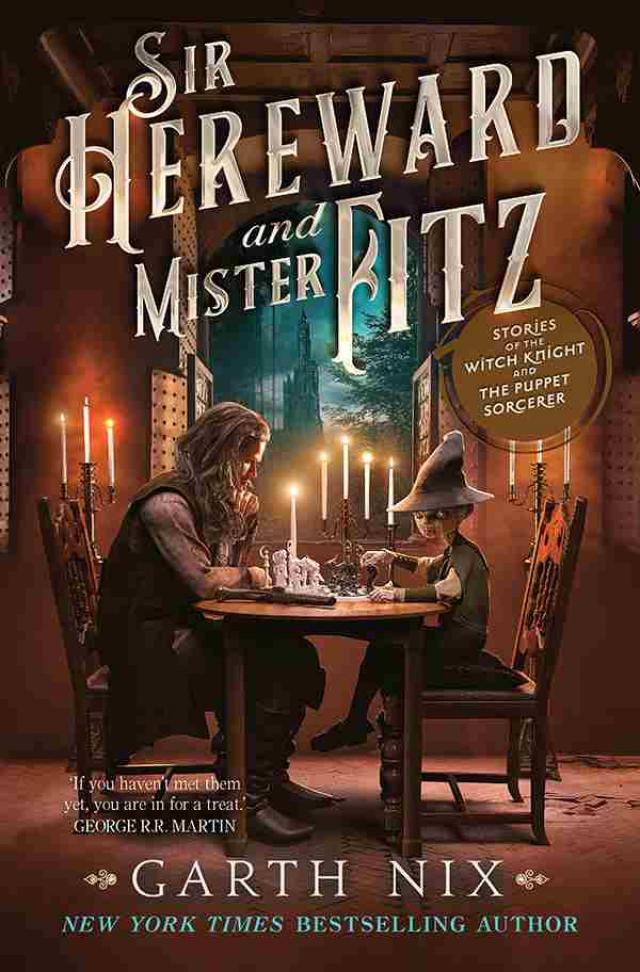
This did not particularly bother Mister Fitz, for he was not human. He was a wooden puppet given the semblance of life by an ancient sorcery. By dint of propinquity, over many centuries a considerable essence of humanity had been absorbed into his fine-grained body, but attention to his own appearance or indeed vanity of any sort was still not part of his persona.
Sir Hereward, for the other part, had a good measure of vanity and in fact the raising of the three-barred visor of his helmet almost certainly had more to do with an approaching apple seller of comely appearance than it did with a desire for clear communication to Mister Fitz.
The duo were riding south on a road that had once been paved and gloried in the name of the Southwest Toll Extension of the Lesser Trunk. But its heyday was long ago, the road being even older than Mister Fitz. Few paved stretches remained, but the tightly compacted understructure still provided a better surface than the rough soil of the fields to either side.
The political identification of these fallow pastures and the occasional once-coppiced wood they passed was not clear to either Sir Hereward or Mister Fitz, despite several attempts to ascertain said identification from the few travellers they had encountered since leaving the city of Rhool several days before. To all intents and purposes, the land appeared to be both uninhabited and untroubled by soldiery or tax collectors and was thus a void in the sociopolitical map that Hereward held uneasily, and Fitz exactly, in their respective heads.
A quick exchange with the apple seller provided only a little further information, and also lessened Hereward’s hope of some minor flirtation, for her physical beauty was sullied by a surly and depressive manner. In a voice as sullen as a three-day drizzle, the woman told them she was taking the apples to a large house that lay out of sight beyond the nearer overgrown wood. She had come from a town called Lettique or Letiki that was located beyond the lumpy ridge of blackish shale they could see a mile or so to the south. The apples in question had come from farther south still, and were not in keeping with their carrier, being particularly fine examples of a variety Mister Fitz correctly identified as emerald brights. There was no call for local apples, the young woman reluctantly explained. The fruits and vegetables from the distant oasis of Shûme were always preferred, if they could be obtained. Which, for the right price, they nearly always could be, regardless of season.
Hereward and Fitz rode in silence for a few minutes after parting company with the apple seller, the young knight looking back not once but twice as if he could not believe that such a vision of loveliness could house such an unfriendly soul. Finding the young woman did not bother to look back at all, Hereward cleared his throat and, without raising his visor, spoke.
‘It appears we are on the right road, though she spoke of Shumey and not Shome.’
Fitz looked up at the sky, where the sun was beginning to lose its distinct shape and ooze red into the shabby grey clouds that covered the horizon.
‘A minor variation in pronunciation,’ he said. ‘Should we stop in Lettique for the night, or ride on?’
‘Stop,’ said Hereward. ‘My rear is not polished sandalwood, and it needs soaking in a very hot bath enhanced with several soothing essences … ah … That was one of your leading questions, wasn’t it?’
‘The newspaper in Rhool spoke of an alliance against Shûme,’ said Mister Fitz carefully, in a manner that confirmed Hereward’s suspicion that didactic discourse had already begun. ‘It is likely that Lettique will be one of the towns arrayed against Shûme. Should the townsfolk discover we ride to Shûme in hope of employment, we might find ourselves wishing for the quiet of the fields in the night, the lack of mattresses, ale, and roasted capons there notwithstanding.’
‘Bah!’ exclaimed Hereward, whose youth and temperament made him tend towards careless optimism. ‘Why should they suspect us of seeking to sign on with the burghers of Shûme?’
Mister Fitz’s pumpkin-sized papier-mâché head rotated on his spindly neck, and the blobs of blue paint that marked the pupils of his eyes looked up and down, taking in Sir Hereward from toe to head: from his gilt-spurred boots to his gold-chased helmet. In between boots and helm were Hereward’s second-best buff coat, the sleeves still embroidered with the complicated silver tracery that proclaimed him as the Master Artillerist of the city of Jeminero. Not that said city was any longer in existence, as for the past three years it had been no more than a mass grave sealed with the rubble of its once-famous walls. Around the coat was a frayed but still quite golden sash, over that a rare and expensive Carnithian leather baldric and belt with two beautifully ornamented (but no less functional for that) wheel-lock pistols thrust through said belt. Hereward’s longer-barrelled and only slightly less ornamented cavalry pistols were holstered on either side of his saddle horn, his sabre with its sharkskin grip and gleaming hilt of gilt brass hung in its scabbard from the rear left quarter of his saddle, and his sighting telescope was secured inside its leather case on the right rear quarter.
Mister Fitz’s mount, of course, carried all the more mundane items required by their travels. All three feet six and a half inches of him (four foot three with the hat) was perched upon a yoke across his mount’s back that secured the two large panniers that were needed to transport tent and bedding, washing and shaving gear and a large assortment of outdoor kitchen utensils. Not to mention the small but surprisingly expandable sewing desk that contained the tools and devices of Mister Fitz’s own peculiar art.
‘Shûme is a city, and rich,’ said Fitz patiently. ‘The surrounding settlements are mere towns, both smaller and poorer, who are reportedly planning to go to war against their wealthy neighbour. You are obviously a soldier for hire, and a self-evidently expensive one at that. Therefore, you must be en route to Shûme.’
Hereward did not answer immediately, as was his way, while he worked at overcoming his resentment at being told what to do. He worked at it because Mister Fitz had been telling him what to do since he was four years old and also because he knew that, as usual, Fitz was right. It would be foolish to stop in Lettique.
‘I suppose that they might even attempt to hire us,’ he said, as they topped the low ridge, shale crunching under their mounts’ talons.


