

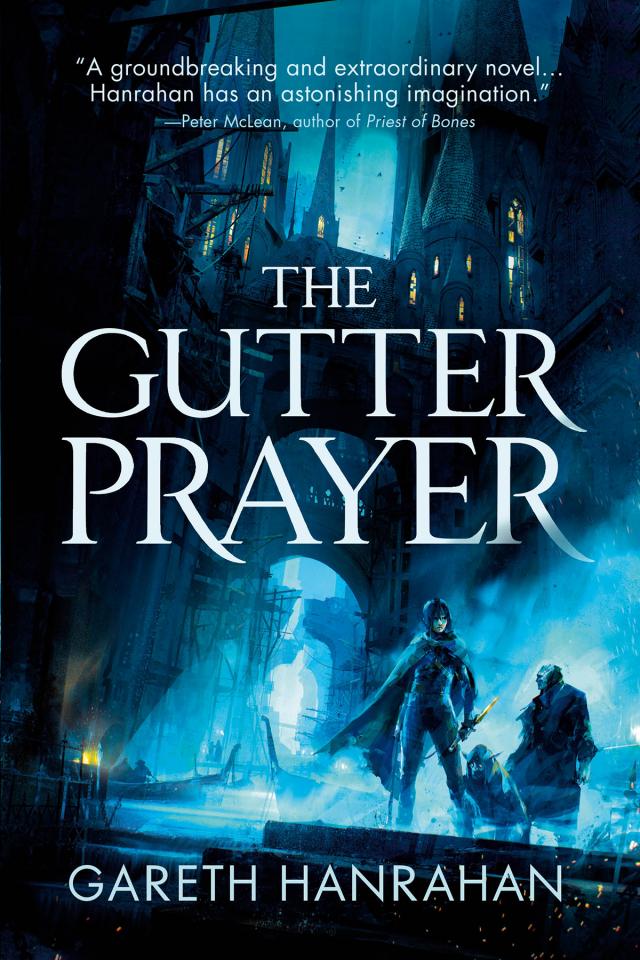
The Gutter Prayer, page 47


Eladora cannot be sure if these things are happening in the same room as her body, or somewhere far away. The visions have smashed her sense of self. Now, she sees a road. A carriage has crashed here, the raptequines having turned and run head-first into the wall (Did I do that? she wonders, and wonders at the thought). The carriage is smashed, overturned, and in the wreckage lies a small man.
And here, approaching him, walking with a jerky stumble, is a Tallowman.
This Tallowman is old-young-old. Old for the tallow vats. Most of those condemned to be rendered are young, but he was old, in his forties or fifties. He can’t remember. Young, because he’s only two days old. And old, because he’s been burnt and blasted and scarred since then, and needs to return to the vats to be remade again.
If you asked him why he was here, when every other Tallowman in the city is back in the Wash fighting the Ravellers, he would be unable to answer you. His mind is a flickering candle flame, burning within the waxy hollow of his skull, but the answer isn’t to be found there. It’s engrained into his flesh and bone, or whatever’s left of flesh and bone after the vats.
He stops and scratches at his beard, which leaves scars in his moulded face. He stares at the encrusted brown-grey wax beneath his fingernails, then laughs to himself. This is wrong, the Tallowman thinks, even if he doesn’t know why.
His knife—that’s wrong. What he needs is a staff. A long staff, six feet long, almost as tall as he is. Shod in iron. There’s an iron railing nearby, part of a fence that was damaged when the carriage crashed. It’ll do. He drops the knife in the middle of the road and pulls a railing free. It feels familiar in the Tallowman’s hand.
Tap tap tap as he approaches the wreckage. He uses the railing to probe the debris. He finds the first body immediately. The coach driver, guesses the Tallowman, his neck broken in the crash. Searching, he finds a bloody handprint on one wall, and bootprints in the mud. One of the passengers survived and got away, stumbling down this alleyway. He puts his drooping nose to the handprint and inhales, then licks it with a half-melted tongue. A woman, and the tingle of sorcery, too.
The Tallowman returns to the wreckage. Large parts of the carriage are still intact, and he hears moaning from beneath one of them. Tap tap tap. He finds he’s relishing this, in a way that’s quite foreign to how he was made. He’s supposed to delight in following orders and inflicting pain. This is cruelty, yes, but with a different purpose. His distorted features twist into a smile as he reaches down and lifts off the wreckage.
Beneath he discovers a little man, still alive. Two broken legs, though, and other injuries. Crushed, guesses the Tallowman, by the heavy chest that must have been on the seat beside him. When the carriage crashed, the chest went flying, and crushed the little man. Many, many broken ribs. Perhaps he’s dying.
Perhaps he’s dead? No. The eyes open, then widen in terror at the sight of the Tallowman.
“Help me,” pleads Heinreil. “Bring me to Rosha.”
The Tallowman finds his voice. It’s not a pleasant one. “You. Can. Thank. Me. Later.”
He scoops up Heinreil like a father carries a child, and starts walking towards the blue light in the distance.
“South, you dolt! You’re going the wrong way!” Heinreil twists and tries to resist arrest, but the Tallowman’s grip has solidified again in the rain and is unbreakable.
Step by step, the Tallowman that was Jere Taphson takes the thief to the sleepy city watch station in Bryn Avane.
For Aleena, every step closer to the Herald takes her back in time and magnifies the power that flows through her.
One step, and she’s young again. How young she was! Still unsteady on her feet, still unused to her unexpected ascension from farm girl to the youngest of the chosen champions of the Kept Gods. She’s descending the stairs of the tomb, but in the eyes of the Kept Gods she’s also walking into the foyer of the Thay mansion in Bryn Avane. She thought it was a holy mission that night, a righteous purpose that the Thays should be exterminated. She was the youngest and least experienced of the saints, but, still, she walked at the head of the company. The others knew the horrors of sainthood, of being taken up and used by vast, inhuman forces that were coldly impersonal or raving mad or both, but she was still innocent then, and that innocence gave her strength. She was never so powerful as she was that night, when all the Thays’ bodyguards and magical defences fell before her like wheat before the scythe.
Another step, and it’s three hundred years ago or more, and she’s riding into the city of the damned. Guerdon has fallen to the vile cult of the Black Iron Gods, and she is some other saint, some previous weapon of the gods—but these are not the frail and nervous Kept Gods that Aleena knows. No, these are the gods as they used to be, when they had all the souls of their faithful to fortify them. They are giants of molten sunlight, and they ride with her as she charges down Mercy Street.
Her lance is a beam of sunlight that blazes so bright it makes Ravellers explode in flame with the slightest touch. Her shield is the dawn horizon, as inviolate and glorious as the sky. She is a war-saint in full wrath, and this is gods war. She knows her enemy awaits her in the gigantic domed temple ahead, and she knows that he is more powerful yet. He has the full force of a pantheon behind him, and his gods are dark thunderheads, dark celestial mountains in the shadows ahead of her. She can hear the screaming of the victims as the gods feast, gathering power for the confrontation.
But she is too quick. She was too quick, will be too quick. Aleena remembers how she—how another saint—killed the High Priest before he could let loose his power, work his terrible miracles. And gods cannot be destroyed, so all that stored power went nowhere, stayed locked up in the suddenly dismayed Black Iron Gods. Stayed locked up even when the victorious Keepers turned those dark statues into prisons.
Back in the present, Aleena grows in stature, echoing that triumphant ride down Mercy Street. Her sword becomes a lance, and Crawling Ones burn just as well as Ravellers. There is a shield in her hand where there was none before, and it is proof against all sorcery. Their spells cannot harm her. She is invincible.
She bursts into the inner chamber. There is the Herald—no, she reminds herself, shaking her mind free of the Kept Gods’ delusions of omniscience, there’s wee Eladora Duttin, because shitty Sinter couldn’t keep her safe for one bloody night. And there is Jermas Thay. He shrieks when he recognises her, loses control of his woven body and half collapses into a writhing pile of disassociated worms. He struggles to rebuild himself as she approaches.
“JERMAS THAY!” roars the saint, and her voice is Judgement, “HOW MANY FUCKING TIMES DO I HAVE TO KILL YOU? AND WHAT DID YOU DO TO THIS POOR GIRL!”
Aleena breathes a prayer of healing and transfers a portion of her overbrimming strength to Eladora. Wounds close, bones reknit, as the child is healed.
“YOU LET THE RAVELLERS BACK IN THE CITY, YOU ASSHOLE” cry a chorus of angels in Aleena’s throat. The lance flares, brighter than the sun, and Jermas Thay—every one of him, all the thousands of worms that fed from him—burns. Some of his constituent worm-fragments slither into cracks and holes in the walls, screeching as the light scorches them, but the rest are consumed in the fire of Aleena’s wrath. The gold mask burns like cheap paper.
It’s done. The Kept Gods withdraw from her. The divine pressure, palpable to even the surviving thieves, departs. Aleena leans on her sword, which is just a sword again. She’s mortally tired, all of a sudden, and really just wants to rest. There’s one last thing to do. She plucks the amulet from Eladora’s throat and hands it to Miren.
Rat follows behind the wrathful Saint Aleena, loping after her like a dog. When necessary, he stops to counter the Crawling One’s sorcery—to an elder ghoul, there’s little distinction between the physical and spiritual realms. He can claw their spells apart, bite the throats of their incantations. He conserves his own power where he can; even if they are victorious here, there will be other battles tomorrow. The city will be reshaped by these events, and he has a responsibility to ghoul kind. A generation ago—as humans reckon time—the ghouls were restricted from coming to the surface by day and from holding any sort of job in the city. Things changed, and they will change again after tonight. Rat intends to be among the victors, for the sake of his ghouls.
He laughs. The elder ghoul in him is trapped, outmanoeuvred by Rat. He can’t just sink back into the underworld to squat on a pedestal and contemplate occult secrets. No, as the last surviving elder, he speaks for the ghouls and there will be councils aplenty on the surface in days to come. Spar would be proud, thinks Rat, to learn that all those talks about politics weren’t completely in vain.
There’s a blaze of light as Aleena destroys the Crawling One chieftain. Rat licks his lips—the Crawling Ones are responsible for this crime against the city. Everyone in Guerdon will turn on them, above and below. The ghoul kingdom was terribly wounded by the Crawling Ones’ attack, but their revenge will be complete. Not a single grave-worm will be permitted to survive, and that thought is pleasing to the elder.
He casts around for a voice to express his triumph. Miren is the closest. He reaches out, smirking at the thought of humiliating the disagreeable boy. His mind brushes against that of Miren, and he sees the boy’s intent.
Rat lunges forward, howling, trying to grab the boy before he teleports away with the amulet. He’s too slow. His claws close on empty air.
CHAPTER FORTY-ONE
Like a conjured demon, Miren appears, materialising next to Spar on the stone spur that juts out from the ledge. He’s bloodied, scorched, but alive, and in one hand he holds Cari’s amulet. In the other, his knife.
“Go on,” shouts Spar, “command them!”
Cari stretches out her hand for the amulet. He’ll have to throw it, she thinks. It’s only a few feet, but if I drop it …
Miren throws it with a smooth motion, hurling it across the abyss, right into Ongent’s waiting hands. He continues that same balletic spin, a dancer on the edge of the precipice, whirling around so he can drive his knife with full force into Spar’s back.
Spar roars, slips, and Miren hits him again, the thin blade slipping between the rocky plates to draw blood. Spar loses his grip and falls, tumbling head over heels into the air. Falling into the vast void of the dome, falling hopelessly out of reach. Cari watches helplessly as he tumbles down, past the bell, past the Ravellers, past everything, to crash like a fallen star on the hard ground far far below.
Stone dead. Nothing could survive that.
Everything stops—she can’t breathe, can’t think, her heart might not even be beating. Even the pressure of the Black Iron Gods in her mind is gone. There’s nothing in her except shock and grief and …
And she’s going to kill Miren. She draws her knife and tenses, a split-second prelude to throwing herself across that same void—or into that same void—and killing Miren. He murdered Spar. He murdered her friend for no fucking reason, the bastard, and she’s going to kill him. It’s all she can think of, but Ongent’s spell catches her before she can move, and she’s frozen. Immobilised, like a fucking statue.
Ongent takes the amulet and places it around her paralysed neck. “Let’s try this again,” he says. “Properly, this time.”
She can’t move a muscle. The spell has her locked in place so tightly she can barely breathe. All she can think to do is topple forward, to follow Spar down to the killing floor below. She tries, but, before she can fall, Miren appears next to her and steadies her. His slim hands grip her as strongly as his father’s spell.
The Ravellers freeze in place, then start to crawl back down. Some sprout black membranous wings to glide down, circling inside the building to land in the midst of the crowd of victims below. Most clamber back the way they came, crawling along the inside of the dome. Cari sees all this; she can’t even blink. Her gaze is locked on the grey and red splatter mark on the floor below that used to be Spar.
“I worked with your grandfather,” whispers Ongent in her ear. “He was a remarkable fellow, but no respecter of tradition. He saw history like some great engineering project, a process that could be improved on. Gods of trade and justice and profit, marching towards infinity! An accountant’s utopia!”
He’s lecturing her. Here and now, of all places, he falls into lecturing. “A student of history sees that there is no process, no great purpose. Empires rise and fall, kingdoms come and go. War and disease and time make mockeries of all grand projects. Everything made by mortals comes to dust. I could see Jermas making a grubby sort of golden age for the city—Effro Kelkin writ across the heavens, perhaps—but I knew it would come to nothing in the end, even if he succeeded. A few decades of prosperity, feh!”
Locked inside the prison of her own flesh, Cari screams silently. She tries to reach out with her mind, to stab at him like she struck at Heinreil’s carriage, but his spell holds her trapped in the spiritual realm, too. She thrashes and spits, but nothing happens.
“The Black Iron Gods—they were unlucky. The Keeper’s rebellion should have failed. A bunch of plucky farmers and a few rural harvest deities from the hinterlands try rebelling against a pantheon of fiercely competitive deities? It should have been a slaughter. It was a slaughter, only some Keeper saint got lucky and killed the High Priest. Mischance, nothing more. Empires come and go, but the Empire of Black Iron should have lasted hundreds of years, not just a few decades!
“All I’m doing here is putting history back on its natural course. And I shall see it all.”
Ongent inches away from her, carefully feeling his way back along the ledge towards the spur of stone. He risks a glance down at the floor below, gulping in terror.
He reaches the spur and walks gingerly along it. He talks to allay his nervousness. “I thought I’d lost you. I suggested to Jermas that he send you away for safekeeping, just before I told Effro Kelkin—anonymously of course—about all his blasphemies. I intended to be your godfather, your tutor, to prepare you for this. But you ran away. Miren was my backup plan—I tried recreating Jermas’ work, although I didn’t have a Raveller to work with. Still, there were some successes. He’s nearly a copy of you in their eyes. From here, he might be able to serve as Herald—but with you here, he doesn’t need to.”
Cari tries to struggle. Tries to speak. Tries to stab. Nothing works. She can’t even run. She’s utterly immobilised, as stuck as a Stone Man. Her helplessness is complete.
“I see the charm in Pilgrin’s, at the last,” says Ongent to himself. “‘They swallowed the hosts of the living, and offered up their souls to the black iron gods.’”
He shoves the bell with all his might.
It swings, gathering speed of its own accord, and sounds a single note, a signal to the Ravellers below.
The sacrifice begins.
There are hundreds of Ravellers in the crowd, and every one of them is a hundred knives. Razor-edged tentacles whip through flesh and bone; blood sprays drench the floor, which becomes a red lake in an instant. And Carillon sees each death as a burst of energy that is swallowed before it can bloom, as the soul is captured and consumed by the Raveller, to be given to the Black Iron Gods.
Given through her.
She can’t stop it. She feels the power building around her. If she stood against this flow of power, she’d be annihilated in an instant. It’d be like standing against a tidal wave. She’d be burnt away, leaving only the thing they made her to be, the Herald. Magic rushes through her and into the bell in front of her. It cracks and begins to change. Metal flows and twists, and it begins to take on the outline of its true form. The physical shape of the thing is nightmarish, but Cari can see the spiritual realm, too—see the cage of Ongent’s spell, see the bonds connecting her to Ongent, and to the amulet, and to the Black Iron Gods. And now she can see the Black Iron Gods, too. All across the city, they’re returning.
The strength from the slaughter in the temple below will remake them, and then they’ll have access to their stored power, their tenfold reserves from decades of similar atrocities. And there is a whole city now, three hundred years of growth and change, thousands more souls to feed their hungers.
Two steps more, and she’d have been right under the Tower of Law when it fell. She’d have been crushed to death, and none of this would be happening. She tries again to fall from the ledge, to kill herself that way, but Miren won’t let her go. He’s kissing her even as she’s trying to scream.
Ongent rises. A dark halo of power manifests around him. Years fall from his face, and he steps out into the empty air, levitating. Lightning crackles around his hands. He’s crowned with black iron, High Priest of a monstrous pantheon.
BRING THEM BACK, he commands her. His voice is the tolling of a great dolorous bell. There’s no way to resist his command, no way she can stand against the power of the gods.
Standing still is death. A thief runs, a thief dodges. A thief steals.
It’s like stealing fruit in the market, she thinks. You make a big show of taking one, the fruit seller chases you, and then your partner grabs the apples.
She looks for the thread of magic connecting her to Spar. It’s still there, frail and fading. The remnant of the healing spell Ongent cast, fuelled by magic stolen from the Black Iron Gods.
Carillon can’t move, but she can still do sleight-of-hand.
She concentrates on that skein of sorcery and opens the gates.
CHAPTER FORTY-TWO
Rat screeches in frustration and grabs the mind of the nearest thief. Roughly, heedless of the damage. The man staggers forward and falls to his knees before the elder ghoul.


