

The New Space Opera, page 1


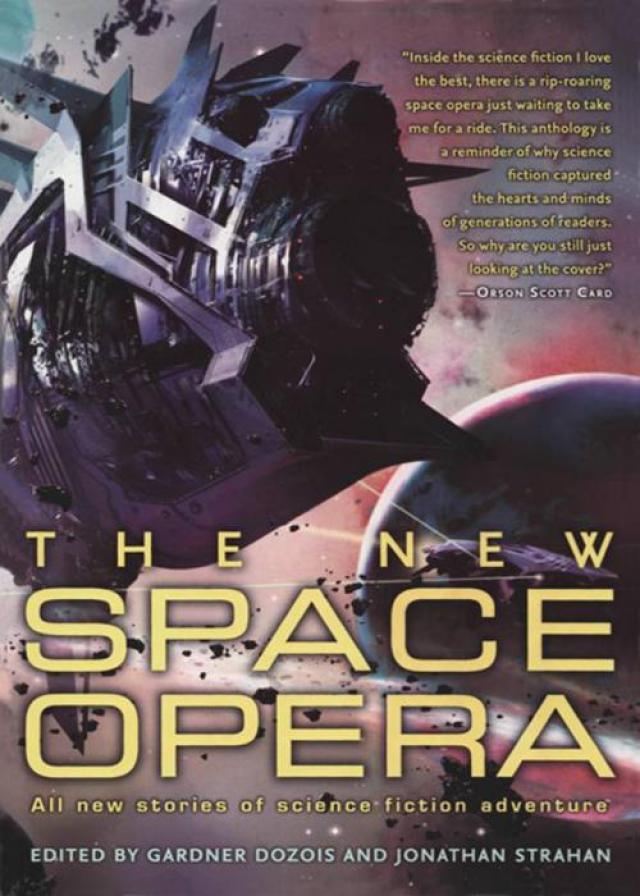
The New Space Opera
Edited By Gardner Dozois & Jonathan Strahan
2007
SAVING TIAMAAT by Gwyneth Jones
VERTHANDI’S RING by Ian McDonald
HATCH by Robert Reed
WINNING PEACE by Paul J. McAuley
GLORY by Greg Egan
MAELSTROM by Kage Baker
BLESSED BY AN ANGEL by Peter F. Hamilton
WHO’S AFRAID OF WOLF 359? by Ken Macleod
THE VALLEY OF THE GARDENS by Tony Daniel
DIVIDING THE SUSTAIN by James Patrick Kelly
MINLA’S FLOWERS by Alastair Reynolds
SPLINTERS OF GLASS by Mary Rosenblum
REMEMBERANCE by Stephen Baxter
THE EMPEROR AND THE MAULA by Robert Silverberg
THE WORM TURNS by Gregory Benford
SEND THEM FLOWERS by Walter Jon Williams
ART OF WAR by Nancy Kress
MUSE OF FIRE by Dan Simmons
SAVING TIAMAAT
Gwyneth Jones
One of the most acclaimed British writers of her generation, Gwyneth Jones was a cowinner of the James Tiptree Jr. Memorial Award for work exploring genre issues in science fiction, with her 1991 novel White Queen, and has also won the Arthur C. Clarke Award, with her novel Bold as Love, as well as receiving two World Fantasy Awards—for her story “The Grass Princess” and her collection Seven Tales and a Fable. Her other books include the novels North Wind, Flowerdust, Escape Plans, Divine Endurance, Phoenix Cafe, Castles Made of Sand, Stone Free, Midnight Lamp, Kairos, Life, Water in the Air, The Influence of Ironwood, The Exhange, Dear Hill, and The Hidden Ones, as well as more than sixteen young adult novels published under the name Ann Halam. Her too-infrequent short fiction has appeared in Interzone, Asimov’s Science Fiction, Off Limits, and in other magazines and anthologies, and has been collected in Identifying the Object: A Collection of Short Stories, as well as Seven Tales and a Fable. She is also the author of the critical study Deconstructing the Starships: Science Fiction and Reality. Her most recent book is a new novel, Rainbow Bridge. She lives in Brighton, England, with her husband, her son, and a Burmese cat.
In the vivid and compelling story that follows, she proves that coming to really know your enemy may make your problems harder rather than easier to solve.
I had reached the station in the depth of Left Speranza’s night; I had not slept. Fogged in the confabulation of the transit, I groped through crushing eons to my favorite breakfast kiosk: unsure if the soaring concourse outside Parliament was ceramic and carbon or a metaphor; a cloudy internal warning—
Now what was the message in the mirror? Something pitiless. Some blank-eyed, slow-thinking, long-grinned crocodile—
“Debra!”
It was my partner. “Don’t do that,” I moaned. The internal crocodile shattered, the concourse lost its freight of hyperdetermined meaning, too suddenly for comfort. “Don’t you know you should never startle a sleepwalker?”
He grinned; he knew when I’d arrived, and the state I was likely to be in. I hadn’t met Pelé Leonidas Iza Quinatoa in the flesh before, but we’d worked together, we liked each other. “Ayayay, so good you can’t bear to lose it?”
“Of course not. Only innocent, beautiful souls have sweet dreams.”
He touched my cheek: collecting a teardrop. I hadn’t realized I was crying. “You should use the dreamtime, Debra. There must be some game you want to play.”
“I’ve tried, it’s worse. If I don’t take my punishment, I’m sick for days.”
The intimacy of his gesture (skin on skin) was an invitation and a promise; it made me smile. We walked into the Parliament Building together, buoyant in the knocked-down gravity that I love although I know it’s bad for you.
In the Foyer, we met the rest of the company, identified by the Diaspora Parliament’s latest adventure in biometrics, the aura tag. To our vision, the KiAn Working Party was striated orange/yellow, nice cheerful implications, nothing too deep. The pervasive systems were seeing a lot more, but that didn’t bother Pelé or me; we had no secrets from Speranza.
The KiAn problem had been a matter of concern since their world had been “discovered” by a Balas/Shet prospector, and joined the minuscule roster of populated planets linked by instantaneous transit. Questions had been raised then, over the grave social imbalance: the tiny international ruling caste, the exploited masses. But neither the Ki nor the An would accept arbitration (why the hell should they?).The noninterference lobby is the weakest faction in the Chamber, quarantine-until-they’re-civilized was not considered an option. Inevitably, around thirty local years after first contact, the Ki had risen against their overlords, as often in the past. Inevitably, this time they had modern weapons. They had not succeeded in wiping out the An, but they had pretty much rendered the shared planet uninhabitable.
We were here to negotiate a rescue package. We’d done the damage, we had to fix it, that was the DP’s line. The Ki and the An no doubt had their own ideas as to what was going on: they were new to the Interstellar Diaspora, not to politics.
But they were here, at least; so that seemed hopeful.
The Ki Federation delegates were unremarkable. There were five of them, they conformed to the “sentient biped” bodyplan that unites the diaspora. Three were wearing Balas business suits in shades of brown, two were in gray military uniform. The young coleaders of the An were better dressed, and one of the two, in particular, was much better looking. Whatever you believe about the origins of the “diaspora” (Strong theory, Weak theory, something between) it’s strange how many measures of beauty are common to us all. He was tall, past two meters: he had large eyes, a mane of rich brown head-hair, an open, strong-boned face, poreless bronze skin, and a glorious smile. He would be my charge. His coleader, the subordinate partner, slight and small, almost as dowdy as the Ki, would be Pelé’s.
They were codenamed Baal and Tiamaat, the names I will use in this account. The designations Ki and An are also codenames.
We moved off to a briefing room. Joset Moricherri, one of the Blue Permanent Secretaries, made introductory remarks. A Green Belt Colonel, Shamaz Haa’agaan, gave a talk on station security. A slightly less high-ranking DP administrator got down to basics: standard time conventions, shopping allowances, access to the elevators, restricted areas, housekeeping…Those who hadn’t provided their own breakfast raided the culturally neutral trolley. I sipped my Mocha/Colombian, took my carbs in the form of a crisp cherry-jam tartine; and let the day’s agenda wash over me, as I reviewed what I knew about Baal and Tiamaat’s relationship.
They were not related by blood, except in the sense that the An gene pool was very restricted: showing signs of other population crashes in the past. They were not “married” either. The Ki and the An seemed to be sexually dimorphic on the Blue model (though they could yet surprise us!); and they liked opposite-sex partnerships. But they did not marry. Tiamaat’s family had been swift to embrace the changes, she’d been educated on Balas/Shet. Baal had left KiAn for the first time when war broke out. They’d lost family members, and they’d certainly seen the horrific transmissions smuggled off KiAn before the end. Yet here they were, with the genocidal Ki: thrown together, suddenly appointed the rulers of their shattered nation, and bound to each other for life. Tiamaat looked as if she were feeling the strain. She sat with her eyes lowered, drawn in on herself, her body occupying the minimum of space. Beside her, Baal devoured a culturally neutral doughnut, elbows sprawled, with a child’s calm greed. I wondered how much my alien perception of a timid young woman and a big bold young man was distorting my view. I wondered how all that fine physicality translated into mind. Who are you, Baal? How will it feel to know you?
From the meeting we proceeded to a DP reception and lunch, from thence to a concert in the Nebula Immersion Chamber: a Blue Planet symphony orchestra on virtual tour, the Diaspora Chorus in the flesh, singing a famous masque; a solemn dance drama troupe bilocating from Neuendan. Pelé and I, humble Social Support officers, were in the background for these events. But the An had grasped that we were their advocates: as was proved when they pounced on us, eagerly, after the concert. They wanted to meet “the nice quiet people with the pretty curly faces—”
They spoke English, language of diplomacy and displacement. They’d both taken the express, neurotech route to fluency: but we had trouble pinning this request down. It turned out they were asking to be introduced to a bowl of orchids.
Appearances can be deceptive; these two young people were neither calm nor cowed. They had been born in a medieval world, and swept away from home as to the safety of a rich neighbor’s house: all they knew of the interstellar age was the inside of a transit lounge. The Ki problem they knew only too well: Speranza was a thrilling bombardment. With much laughter (they laughed like Blue teenagers, to cover embarrassment), we explained that they would not be meeting any bizarre life-forms. No tentacles, no petals, no intelligent gas clouds here; not yet!
“You have to look after us!” cried Baal. He grabbed my arm, softly but I felt the power. “Save us from making fools of ourselves, dear Debra and Pelé!”
Tiamaat stood back a pace, hiding her giggles behind her hand.
The last event scheduled on that first day was a live transmission walkabout from the Ki refugee camp, in the Customized Shelter Sector. In the planning stages, some of us had expressed doubts about this stunt. If anything went wrong it’d sour the whole negotiation. But the Ki an
At the gates of the CSS, deep in Speranza’s hollow heart, there was a delay. The Customized Shelter Police wanted us in armored glass-tops, they felt that if we needed a walkabout we could fake it… Pelé chatted with Tiamaat, stooping from his lean black height to catch her soft voice. Baal stared at the banners on two display screens. The KiAn understood flags, we hadn’t taught them that concept. Green and gold quarters for the Ki, a center section crosshatched with the emblems of all the nations. Purple tracery on vivid bronze for the An.
Poor kid, I thought, it’s not a magic gateway to your lost home. Don’t get your hopes up. That’s the door to a cage in a conservation zoo.
He noticed my attention, and showed his white teeth. “Are there other peoples living in exile on this floor?”
I nodded. “Yes. But mostly the people sheltered here are old spacers who can’t return to full gravity. Or failed colonist communities, likewise: people who’ve tried to settle on empty moons and planets and been defeated by the conditions. There are no other populated-planet exiles. It hasn’t been, er, necessary.”
“We are a first for you.”
I wondered if that was ironic; if he was capable of irony.
A compromise was reached. We entered on foot, with the glass-tops and CSP closed cars trailing behind. The Ki domain wasn’t bad, for a displaced-persons camp wrapped in the bleak embrace of a giant space station. Between the living-space capsule towers the refugees could glimpse their own shade of sky; and a facsimile of their primary sun, with its partner, the blue-rayed daystar. They had sanitation, hygiene, regular meals; leisure facilities, even employment. We stopped at an adult retraining center; we briefly inspected a hydroponic farm. We visited a kindergarten, where the teaching staff told us (and the flying cams!) how all the nations of the Ki were gathered here in harmony, learning to be good Diaspora citizens.
The children stared at Baal and Tiamaat. They’d probably been born in the camp, and never seen An in the flesh before. Baal fidgeted, seeming indignant under their scrutiny. Tiamaat stared back with equal curiosity. I saw her reach a tentative hand through the shielding, as if to touch a Ki child: but she thought better of it.
After the classroom tour, there was a reception, with speeches, dance, and choral singing. Ki community leaders and the An couple didn’t literally “shake hands”; but the gesture was accomplished. Here the live trans, ended, and most of our party stayed behind. The An leaders and the Ki delegates went on alone, with a police escort, for a private visit to “Hopes and Dreams Park”—a facsimile of one of the Sacred Groves (as near as the term translates) central to KiAn spirituality.
Pelé and I went with them.
The enclave of woodland was artfully designed. The “trees” were like self-supporting kelp, leathery succulents—lignin is native only to the Blue Planet—but they were tall, and planted close enough to block all sight of the packed towers. Their sheets of foliage made a honeyed shade, we seemed alone in a gently managed wilderness. The Ki and the An kept their distance from each other now that the cams weren’t in sight. The police moved outward to maintain a cordon around the group, and I began to feel uneasy. I should have been paying attention instead of savoring my breakfast, I had not grasped that “Hopes and Dreams Park” would be like this. I kept hearing voices, seeing flitting shadows; although the park area was supposed to have been cleared. I’d mentioned the weak shielding; I hoped it had been fixed—
“Are religious ceremonies held here?” I asked Tiamaat.
She drew back her head, the gesture for “no.” “Most KiAn have not followed religion for a long time. It’s just a place sacred to ourselves, to nature.”
“But it’s fine for the Shelter Police, and Pelé and me, to be with you?”
“You are advocates.”
We entered a clearing dotted with thickets. At our feet smaller plants had the character of woodland turf, starred with bronze and purple flowers. Above us the primary sun dipped toward its false horizon, lighting the bloodred veins in the foliage. The blue daystar had set. Baal and Tiamaat were walking together: I heard him whisper, in the An language, “now it’s our time.”
“And these are the lucky ones,” muttered one of the Ki delegates to me, her “English” mediated by a throat-mike processor that gave her a teddy-bear growl. “Anyone who reached Speranza had contacts, money. Many millions of our people are trying to survive on a flayed, poisoned bombsite—”
And whose fault is that?
I nodded, vaguely. It was not my place to take sides—
Something flew by me, big and solid. Astonished, I realized it had been Baal. He had moved so fast, it was so totally unexpected. He had plunged right through the cordon of armed police, through the shield. He was gone, vanished. I leaped in pursuit at once, yelling: “Hold your fire!” I was flung back, thrown down into zinging stars and blackness. The shield had been strengthened, but not enough.
Shelter Police, bending over me, cried: what happened, ma’am, are you hit?
My conviction that we had company in here fused into certainty—
“Oh, God! Get after him. After him!”
I ran with the police, Pelé stayed with Tiamaat and the Ki: on our shared frequency I heard him alerting Colonel Shamaz. We cast to and fro through the twilight wood, held together by the invisible strands and globules of our shield, taunted by rustles of movement, the CSP muttering to each other about refugee assassins, homemade weapons. But the young leader of the An was unharmed when we found him, having followed the sounds of a scuffle and a terrified cry. He crouched, in his sleek tailoring, over his prey. Dark blood trickled from the victim’s nostrils, high-placed in a narrow face. Dark eyes were open, fixed and wide.
I remembered the children in that school, staring up in disbelief at the ogres.
Baal rose, wiping his mouth with the back of his hand. “What are you looking at?” he inquired haughtily, in his neighbors’ language. The rest of our party had caught up: he was speaking to the Ki. “What did you expect? You know who I am.”
Tiamaat fell to her knees, with a wail of despair, pressing her hands to either side of her head. “He has a right! Ki territory is An territory, he has a right to behave as if we were at home. And the Others knew it, don’t you see? They knew!”
The CSP officer yelled something inexcusable and lunged at the killer. Pelé grabbed him by the shoulders and hauled him back, talking urgent sense. The Ki said nothing, but I thought Tiamaat was right. They’d known what the Diaspora’s pet monster would do in here; and he hadn’t let them down.
Perfectly unconcerned, Baal stood guard over the body until Colonel Haa’agaan arrived with the closed cars. Then he picked it up and slung it over his shoulder. I traveled with him and his booty, and the protection of four Green Belts, to the elevator. Another blacked-out car waited for us on Parliament level. What a nightmare journey! We delivered him to the service entrance of his suite in the Sensitive Visitors Facility, and saw him drop the body insouciantly into the arms of one of his aides—a domestic, lesser specimen of those rare and dangerous animals, the An.
The soldiers looked at each other, looked at me. “You’d better stay,” I said. “And get yourselves reinforced, there might be reprisals planned.”
Baal’s tawny eyes in my mind: challenging me, trusting me—
The debriefing was in closed session; although there would be a transcript on record. It took a painfully long time, but we managed to exonerate everyone, including Baal. Mistakes had been made, signals had been misread. We knew the facts of the KiAn problem, we had only the most rudimentary grasp of the cultures involved. Baal and Tiamaat, who were not present, had made no further comment. The Ki (who were not present either) had offered a swift deposition. They wanted the incident treated with utmost discretion: they did not see it as a bar to negotiation. The Balas/Shet party argued that Baal’s kill had been unique, an “extraordinary ritual” that we had to sanction. And we knew this was nonsense, but it was the best we could do.


