

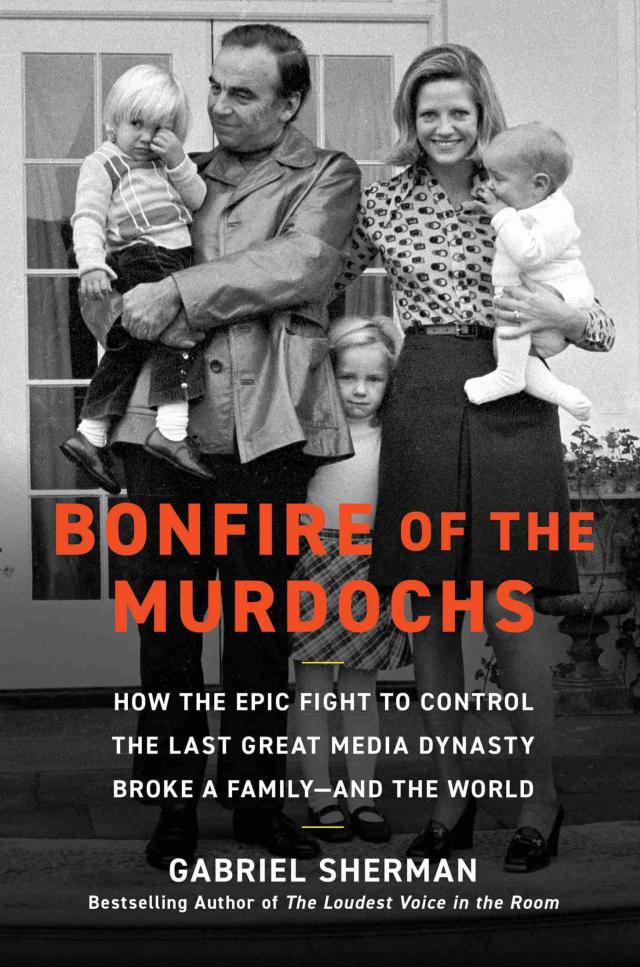
Bonfire of the Murdochs, page 1


Thank you for downloading this Simon & Schuster ebook.
Get a FREE ebook when you join our mailing list. Plus, get updates on new releases, deals, recommended reads, and more from Simon & Schuster. Click below to sign up and see terms and conditions.
CLICK HERE TO SIGN UP
Already a subscriber? Provide your email again so we can register this ebook and send you more of what you like to read. You will continue to receive exclusive offers in your inbox.
For Jennifer
For a son dishonors his father,
a daughter rises up against her mother,
a daughter-in-law against her mother-in-law—
a man’s enemies are the members of his own household.
—Micah 7:6
PROLOGUE
ON THE MORNING OF SEPTEMBER 16, 2024, a convoy of black SUVs carrying the most powerful media dynasty in the world snaked through the Nevada high desert like a funeral procession, which in some ways it was. Rupert Murdoch had destroyed his family in pursuit of his lifelong dream of anointing firstborn son, Lachlan, his successor. The final resting place was not a cemetery but the Washoe County Courthouse in Reno.
The reckoning had been nine months in the making. On December 6, 2023, Murdoch put forth a motion to amend the irrevocable family trust to cement Lachlan’s control over a right-wing media empire that had shaped politics on three continents for the last half century. Murdoch’s adult children from his first marriages—Prudence, Elisabeth, and James—united to stop him. The roots of the family war stretched back much further. From birth, Murdoch had pitted his children against one another in a Darwinian struggle to determine who would run News Corp, the global conglomerate Murdoch built out of a single Australian newspaper he inherited from his father. The rivalry played out in pull-up contests James and Lachlan did as children and in the competitive games of charades the family played at Christmas. This was much more than a boardroom battle: it was a blood feud to win a father’s love.
Around 8:00 a.m., the first vehicle pulled to the curb and was surrounded by journalists: Prudence and her husband, Alasdair MacLeod, a longtime News Corp executive. At sixty-six, Prudence was dressed entirely in solemn black, which contrasted sharply with her shoulder-length platinum hair. Prue was the only child from Murdoch’s first marriage to Australian flight attendant Patricia Booker. As the oldest sibling, Prue kept the greatest distance from the business and never entered the succession race. She settled into her outsider status after it caused deep pain. Years ago, Prue was devastated when Murdoch didn’t mention her when he named his children in an interview about the succession. She called Murdoch screaming.
A moment later, Murdoch’s second daughter, Liz, exited the SUV with her husband, the artist Keith Tyson. At fifty-six, Liz wore a beige suit with the poise of a businesswoman who spent decades fighting to be taken seriously. She was by many accounts the sharpest, but Murdoch subscribed to old-fashioned primogeniture and dismissed the child many considered to be the most worthy successor. Liz quit the family business in 2000 and launched her own phenomenally successful television production company. Despite this injustice, Liz didn’t express bitterness. She tried to maintain close relationships with her dad and Lachlan. In the family geography, Liz thought of herself as Switzerland. The Nevada trust case forced her to finally choose a side.
Last came the person most responsible for this legal reckoning: James. He clasped his wife Kathryn’s hand as they approached the domed courthouse steps. James, fifty-one, wore a dark suit and slim tie—a corporate look he once rejected. The family rebel, James was the moody kid with bleached hair, tattoos, and piercings who loved archeology and dropped out of Harvard to start a hip-hop music label. But Murdoch was the sun upon which this family orbited, and his gravitational pull was too powerful to escape. James returned to the business in the mid-1990s. He adopted a ruthless persona and ascended to become Murdoch’s heir apparent. But James’s centrist politics and desire to make News Corp respected in elite circles rankled Murdoch. In 2012, James presided over News Corp’s London tabloids when journalists working for Murdoch’s News of the World were caught illegally hacking the phones of thousands of people to land scoops. James denied knowing about the hacking, but nevertheless Rupert used the biggest scandal in the company’s history to demote him and promote Lachlan.
In exile, James’s resentments matured into a moral awakening. He and Kathryn, a climate activist, shared a conviction that Fox News was a threat to democracy. When Donald Trump supporters ransacked the Capitol on January 6, 2021, James declared publicly: “Those outlets that propagate lies to their audience have unleashed insidious and uncontrollable forces that will be with us for years.” To understand his father, James turned to Roman history. He memorized passages from Marguerite Yourcenar’s 1951 novel Memoirs of Hadrian about a dying legacy-obsessed ruler in search of an heir: “We were too different for him to find in me what most people who have wielded total authority seek desperately on their deathbeds, a docile successor pledged in advance to the same methods, and even to the same errors.” James had come to Reno to ensure history didn’t repeat itself.
Then came a gap—twenty minutes that spoke volumes about the family’s fractured dynamics. The arrivals had been carefully choreographed by advance teams to avoid a tense curbside encounter. A white Audi SUV stopped, and Rupert Murdoch stiffly climbed out with his fifth wife, Elena Zhukova, trailed by a phalanx of security guards. At ninety-three, Murdoch walked gingerly in a dark suit paired incongruously with running shoes. This diminished appearance belied the vast power he still wielded through ownership of Fox News, The Wall Street Journal, the Times of London, HarperCollins, and dozens of tabloids including The Sun and the New York Post. Murdoch built something beyond a conservative news empire: a fourth branch of government. His propaganda machine monetized outrage, spread conspiracy theories, and shaped the minds of millions across three continents. More than anyone, Murdoch’s media created the presidency of Donald J. Trump.
Behind Murdoch emerged Lachlan with his wife, Sarah, a former model and television host. At fifty-three, Lachlan was still boyishly handsome, though flecks of silver showed the passage of time. Commentators described the Murdoch family war as “Shakespearean.” In this framework, Lachlan was Hamlet. In 2005, he quit the business after being abused by Murdoch’s courtiers and returned to Australia to build his own media business. Only after a decade of his father’s relentless courtship did Lachlan accept his chosen-son status. That morning, Lachlan walked into the courthouse fully committed to carrying forth the Murdoch legacy. When Liz made one final appeal to him last fall before the lawsuits flew, Lachlan’s response had been resolute: Rewriting the trust was about “dad’s wishes… It shouldn’t be difficult or controversial.”
The courtroom doors shut and the Murdochs disappeared from view. This was how Murdoch wanted it. He had incorporated his trust in Nevada because the state offered the most generous privacy rules. No reporters or cameras would be allowed inside. Even the existence of the court battle was supposed to be secret. The Washoe County docket referred to the case simply as “In the Matter of Doe 1 Trust.” Murdoch amassed his fortune shaping narratives and was determined to control his own.
Once seated, the Murdochs waited for Washoe County Probate Commissioner Edmund Gorman to call the hearing to order. Family members exchanged furtive glances, noting the subtle passage of time on their faces. It had been two years since they gathered in one room. In that period, a family had disintegrated. But to understand how the most successful media mogul in history had engineered his own family’s demise, the story begins almost a century earlier in Australia, when a lonely boy sought to win the affection of a domineering father in a place called Cruden Farm.
PART ONE CONQUEST
CHAPTER ONE THE BOY PUBLISHER
IT WAS INEVITABLE THAT RUPERT would see his family torn apart by a succession drama—his own father had imbued him with a sense of destiny seventy years earlier. Keith Arthur Murdoch was a brooding Scot with an anvil-shaped nose, furrowed brow, and deep-set eyes who understood that journalism shaped events every bit as much as politicians in the halls of power. The exploits that made him Australia’s most infamous journalist would teach his only son two enduring lessons: rules are meant to be broken, and newspapers are power.
Keith suffered from a debilitating stutter as a child. It was sometimes so bad that he couldn’t buy a train ticket and instead had to scribble his destination on a piece of paper and show it to the stationmaster. Perhaps because of this disability, he rejected a career behind the pulpit and set out to become a journalist. Keith gained fame during the First World War as a thirty-year-old foreign correspondent for the Melbourne Age. In 1915, the paper sent him to cover the British invasion of Turkey’s Gallipoli peninsula. Keith was appalled to witness aristocratic British officers using Australian soldiers as cannon fodder in a hapless campaign to march on Constantinople. Keith evaded military censors and delivered an eight-thousand-word account of the “ghastly and costly fiasco” to Australia’s prime minister. This dispatch would become known as Keith’s “Gallipoli letter.” His writing style crackled with righteous outrage, life-and-death stakes, swooping egos, and starkly defined heroes and villains—essential tabloid ingredients. “It depicted a very idealized sense of the Australian soldier being sent to slaughter by the gin-and-tonic-swilling Brits three miles off the shore,” Rupert later recalled. The sensationalized scoop spurred Britain’s prime minister, Herbert Asquith, to withdraw ninety thousand troops, thereby saving countless Australian lives. “It may not have been fair, but it changed history,” Rupert later said of his father’s report.
For the rest of the war, Keith remained in London mastering the dark art of tabloid journalism from the reigning Godfather of Fleet Street: the round-faced press baron Alfred Harmsworth, better known as Lord Northcliffe. (His enemies dubbed him “Napoleon of Fleet Street.” To his staff he was simply “The Chief.”) The notorious publisher ran the Daily Mail and Daily Mirror on the belief that journalism was about profit, not public service. “A newspaper is to be made to pay… Let it give the public what it wants,” Northcliffe declared. “The three things that are always news are health things, sex things and money things,” he told his staff. To that end, Northcliffe filled his papers with lurid stories of crime, sex, and trivia. In 1905, Northcliffe scandalized the British establishment by buying the prestigious Observer. Three years later, he incited elite panic when he snapped up the money-losing Times of London.
By 1914, Northcliffe controlled 40 percent of the morning newspaper market and 45 percent of evening circulation, a concentration of press power never seen before or since. Northcliffe used his vast influence to whip up anti-German sentiment among the British public before the outbreak of the First World War. He was also a rabid anti-Semite and published headlines such as “Why Jews Don’t Ride Bicycles.” But Northcliffe’s power was waning when Keith arrived at his knee. The press magnate was increasingly paranoid and erratic. He brandished a pistol in the newsroom and told people Germans were trying to murder him with poisoned ice cream. In 1922, Northcliffe died at the age of fifty-seven, perhaps from syphilis. By then, Keith had returned to Australia and, with Northcliffe connections, assumed the editorship of the Melbourne Herald.
Keith revitalized the struggling evening broadsheet with the Northcliffe formula: short articles, sharper headlines, and contests. Melbourne society dubbed Keith “Lord Southcliffe.” But readers approved: the Herald’s circulation jumped 40 percent within a year of Keith’s takeover. The board promoted him to managing director. Keith bought rival papers, magazines, and radio stations across Australia to create the country’s first national media conglomerate. As successful as Keith was, the board refused to grant him significant equity in the Herald, which was a point of resentment. So Keith quietly used his wealth to buy personal stakes in newspapers in Brisbane and Adelaide.
By the late 1920s, Keith was among the country’s wealthiest businessmen. He lived in a twenty-room Georgian manor that he decorated with antique Chinese porcelain. “I know you despise me for my love of money,” he told an employee as he showed off the collection, “but how else do you think you could acquire such beautiful things as these?” The one thing Keith did not yet have was a wife. In 1927, at the age of forty-two, Keith noticed a photograph in a society magazine of an eighteen-year-old, almond-eyed debutante named Elisabeth Greene. A year later, they married. Keith purchased a ninety-acre property thirty miles south of Melbourne as a wedding gift. There, they built an antebellum-style mansion at the end of a long gravel drive lined with lemon-scented gum trees. Keith named his idyll Cruden Farm after the Aberdeenshire village of his Scottish clergyman father, Patrick. At midnight on March 11, 1931, Elisabeth gave birth to a son: Keith Rupert Murdoch. Everyone called the boy Rupert.
* * *
BY MOST ACCOUNTS, RUPERT was a lonely child. He spent many friendless hours on the farm hunting rabbits, shoveling manure, and riding his Shetland pony named Joy Boy. Sir Keith—he was knighted in 1933—was an absentee father to Rupert and his three sisters, Helen, Anne, and Janet. When Sir Keith did return home, he was often morose and withdrawn. “Keith had little patience with Rupert and perpetually gave the impression of being disappointed,” a childhood acquaintance said. Rupert discovered one subject earned his father’s approval: newspapers. Rupert began hanging around the Herald’s newsroom. The fresh-ink smell, clattering typewriters, and rumbling presses enchanted him. On weekends, Rupert lounged on his father’s bed as Sir Keith edited articles with a pen. “The life of a publisher is about the best life in the whole world,” Rupert later said.
Whereas Sir Keith was aloof, Elisabeth was overbearing. Rupert recalled that his mother taught him to swim by throwing him in the pool of a cruise ship during a voyage to England. “I had to dog-paddle to the side, and I was screaming,” he said. Another time, Elisabeth made Rupert sleep in a hut on the farm to “toughen him up.” “Maybe they thought I was an old monster in those days,” Elisabeth conceded. At other moments, though, Elisabeth indulged her son. She encouraged Rupert to spend time with her rakish father, Rupert “Pop” Greene, a hard-drinking wool trader and gambler. “He was always gambling on horses and cards… and had no idea of responsibility,” Elisabeth said. Pop spoiled Rupert with ice cream and let him drive his car before his feet could reach the pedals. Sir Keith despised his father-in-law’s corrupting influence. “It was one of my father’s nightmares that I’d turn out like my grandfather, which I probably did, a bit,” Rupert said. But Elisabeth also had standards—she would later be horrified by Rupert’s tabloid sensationalism.
When Rupert was ten, Elisabeth shipped him off to the prestigious Geelong Grammar boarding school, Australia’s analog to Eton. Rupert despised it. He was pudgy at a school that valorized competitive sports. Off the field, Rupert’s wealthy classmates ostracized him. Rupert blamed the humiliation on his father’s lowbrow newspapers. “I felt a loner at school, probably because of my father’s position,” Rupert recalled. Rupert also chafed under Geelong’s strict military rules. He stashed a motorcycle off campus and snuck out to gamble on horses. Teachers flogged him with a cane when he got caught. “I can remember one particular Fascist type who let me have it with special brutal delight,” Rupert said. The teacher’s beating kindled in Rupert a general desire for retribution he later deployed against his media rivals.
Perhaps to fit in, Rupert rejected his father’s conservatism and adopted the socialist politics in vogue among upper-class youth. Classmates mocked him as “Comrade Rupert.” “Nobody took him seriously,” said Richard Searby, a Geelong classmate who would spend decades working for Rupert. “It seemed incongruous that Sir Keith Murdoch’s son could be a rampant socialist. It was, everyone agreed, just a boyhood aberration.”
Rupert graduated in the spring of 1950. He wanted to skip college and work for the Herald immediately. Keith dismissed the plan and pulled strings to get Rupert into Oxford’s Worcester College. Rupert was enraged. “My only palpable goal at that time was to change the world. And avoid going to Oxford,” Rupert said. Rupert continued his left-wing rebellion there. He famously displayed a bust of Lenin on his dorm room mantelpiece, earning the nickname “Red Rupe.” In letters to his father, Rupert lauded Lenin as “The Great Thinker.” Once, Rupert found himself locked out of his Oxford dorm after attending a Daily Worker rally in London, so he slept in the local Communist Party office. A worker with a red-star cap entered and greeted Rupert: “morning, Comrade.”
Rupert may have mastered Das Kapital, but he devoted little time to actual coursework in his chosen major of politics and economics. “I was impatient by then to get back home and start doing newspaper work,” he recalled. At the end of his freshman year, Keith threatened to drag him back to Australia in disgrace.
Keith relented only when Elisabeth insisted he give Rupert a second chance. She warned her son he would lose her “last shred of respect” if he didn’t shape up.
By this point, Keith had suffered two heart attacks and prostate cancer. He expressed fear that his callow only son wouldn’t be ready to inherit three newspapers—the Brisbane Courier-Mail, and the Adelaide News and Sunday Mail—that Keith acquired through a holding company called Cruden Investments. “I can’t afford to die. I’ve got to see my son established, not leave him like a lamb to be destroyed,” Keith confided in a friend. In January 1948, Sir Keith dictated his last will and testament: “I desire that my said son Keith Rupert Murdoch should have the great opportunity of spending a useful altruistic and full life in newspaper and broadcasting activities and of ultimately occupying a position of high responsibility in that field with the support of my trustees if they consider him worthy of that support.”


