

Night's Black Agents, page 1


05-04-2023
Three thousand copies of this book have been printed from Intertype Garamond
on white Winnebago Eggshell. The binding cloth is Holliston Black Novelex.
FRITZ LEIBER, Jr.
NIGHT’S BLACK
AGENTS
1947
ARKHAM HOUSE
Sauk City, Wisconsin
Copyright, 1947
By Fritz Leiber, Jr.
No part of this book may be reprinted without the permission of the publishers:
Arkham House, Sauk City, Wisconsin. Printed in the United States of America....
Smoke Ghost, copyright 1941, by Street & Smith Publishing Company for
Unknown Worlds, October, 1941.
The Automatic Pistol, copyright 1940, by Weird Tales for Weird Tales, May, 1940.
The Inheritance, copyright 1942, by Weird Tales for Weird Tales, January, 1942.
The Hill and the Hole, copyright, 1942, by Street & Smith Publishing Company for
Unknown Worlds, August, 1942.
The Hound, copyright 1942, by Weird Tales for Weird Tales, November, 1942.
The Sunken Land, copyright, 1942, by Street & Smith Publishing Company for
Unknown Worlds, February, 1942.
Contents :-
Foreword
Smoke Ghost
The Automatic Pistol
The Inheritance
The Hill and the Hole
The Dreams of Albert Moreland
The Hound
Diary in the Snow
The Man Who Never Grew Young
The Sunken Land
Adept's Gambit
Though this is Fritz Leiber, Jr.'s first book, it is sale to say that it will not be his last. The stories in this volume generally fall into two classification*, one of which he calls “Modern Horrors,'* including such well-known titles as Smoke Ghost, The Automatic Pistol, andThe Hill and the Hole, the other, “Ancient Adventures," featuring Fafhred and the Grey Mouser, two characters whose exploits helped to distinguished the pages of Unknown, during the lamentably short life of that magazine.
Most of Mr. Leiner’s “Modern Horrors" are those of the horrors lurking in the modern city, la Jules Romaics' Men of Good Will, Jallcz says of Chicago: “I found Chicago fascinating; all the more terrifying aspects of the modern world have there assumed enormous proportions and seem on the point of exploding into beauty." That, says Fritz Leiber, Jr., conveys his feelings about the city more adequately than any other description he knows. “It is the American metropolis, jammed with iron and stone, that sets oil my sense of the horrible and beautiful—grimy roofs in Smoke Ghost, railroad yards in The Inheritance, brownstones and grit in The Dreams of Albert Moreland, the clamoring absence of the city in Diary in the Snow. Things like the buzz of a defective neon sign, the black framework of the elevated, muttering of machinery one cannot identify—there are terrors in the modern city, in comparison to which the darks of Gothic castles and haunted woods are light."
His “Ancient Adventures" are colorful, exciting fantasies in the great tradition of fantastic adventures. “Some day I hope the Fafhred cycle will get into print," wrote H. P. Lovecraft after reading the manuscript of the novel herewith, “leading off with Adepts Gambit."
Here then are nine short stories and a novel in the first collection of Fritz Leiber, Jr.s, short stories, which Arkham House is proud to bring to aficionados.
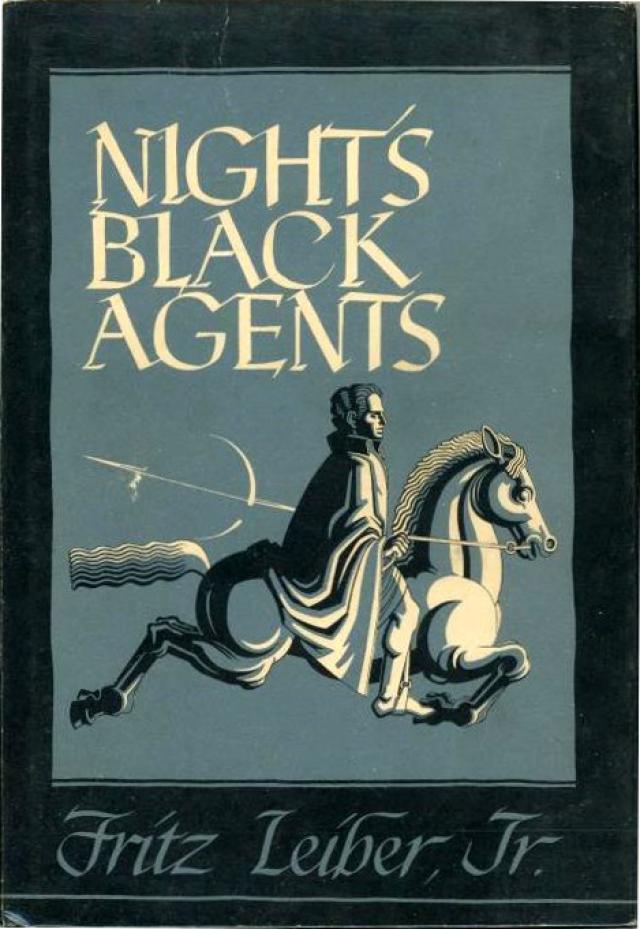
The jacket is the work of Ronald Clyne.
With the exception of the Introduction, this is a complete photographic reprint of a work first published in New York by Berkley Publishing Corporation in 1978. The trim size of the original paperback edition was 4 by 6% inches.
Text copyright © 1947,1978 by Fritz Leiber, Jr. Acknowledgments: “Forward” © 1947, by Fritz Leiber, Jr.; “The Sunken Land” © 1942, by Street and Smith Publishing Company; “Adept’s Gambit” © 1947, by Fritz Leiber, Jr.; “The Man Who Never Grew Young” © 1947, by Fritz Leiber, Jr.; “Smoke Ghost” © 1941, by Street and Smith Publishing Company;
“The Automatic Pistol” © 1940, by Weird Tales:; “The Inheritance” © 1942, by Weird Tales; “The Hill and the Hole” © 1942, by Street and Smith Publishing Company; “The Dreams of Albert Moreland” © 1947, by Fritz Leiber, Jr.; “The Hound” © 1942, by Weird Tales, “Diary in the Snow” © 1947, by Fritz Leiber, Jr.; “The Girl with the Hungry Eyes” © 1949, by Avon Book Company, Inc.; “Bit of the Dark World” © 1962, by Ziff-Davis Publishing Company. First appeared in the February 1962 issue of Fantastic.
Reprinted by arrangement with Arkham House Publishers, Inc., and with the cooperation of Fritz Leiber.
Introduction copyright © 1980 by Richard Gid Powers.
Frontispiece is a photograph of the author by Jay Kay Klein.
Printed on permanent/durable acid-free paper and bound in the United States of America.
Republished in 1980 by Gregg Press, A Division of G.K. Hall & Co., 70 Lincoln St., Boston, Massachusetts 02111
First Printing, September, 1980
Library of Congress Cataloging in Publication Data
Leiber, Fritz, 1910-Night’s black agents.
(The Gregg Press science fiction series)
Reprint of the ed. published by Berkley Pub. Corp., New York. CONTENTS: Ancient adventures: The sunken land.
Adept’s gambit.—Transition: The man who never grew young.—Modern horrors: Smoke ghost.—[etc.]
1. Horror tales, American. 2. Fantastic fiction, American.
I. Title. II. Series: Gregg Press science fiction series.
PZ3.L5293Ni 1980 [PS3523.E4583] 813'.54 80-17010
ISBN 0-8398-2640-0
For Jonquil
My Wife
Foreword
The section of this book subtitled Ancient Adventures has a history.
More than ten years ago I opened a letter from Harry Fischer, wondering what strange conceit was now in store. The Elder Gods had been pretty well worked through. Even the overweening Wischmeiers, destined to be immortalized by a more trenchant pen, were temporarily exhausted.
Sandwiched in the many pages of text, I came upon the following fragment:
“For all do fear the one known as the Gray Mouser. He walks with swagger ’mongst the bravos, though he’s but the stature of a child. His costume is all of gray, from gauntlets to boots and spurs of steel. His flat, swart face is shadowed by a peaked cap of mouse-skin and his garments are of silk, strangely soft and coarse of weave. His weapons: one called Cat’s Claw, for it kills in the dark unerringly, and his longer sword, curved up, he terms the Scalpel, for it lets the heart’s blood as neatly as a surgeon. And this one was well feared, for he was sly as a wolverine, and while a great cheat and hard to engage in a fair quarrel, yet did not fear to die and preferred great odds to single combat. And his style of fencing was peculiar, intermixed with strange sidesteps and glides and always an attack wavering and elusive, and the sudden end at the upward flash of Scalpel from the very air it seemed. And many who claimed enmity to this one were found strangely strangled, as by their own hands. So the Gray Mouser was feared and only drunken bravos dared a quarrel and they dissuaded quickly by wiser companions.
“Until one night, the market night, the huxters all acry and horns blaring wares and smoky, stinking torches flared yellow-red in the foggy air—for the walled city of the Tuatha De Danaan called Lankhmar was built on the edge of the Great Salt Marsh—there strode into the group of lounging bravos a pair of monstrous men. The one who laughed the merrier was full seven feet in height. His light chestnut hair was bound in a ringlet of pure gold, engraved with runes. His eyes, wide-set, were proud and of fearless mien. His wrist between gauntlet and mail was white as milk and thick as a hero’s ankle. His features were clean cut and his mouth smiled as he fingered the ponderous hilt of a huge longsword with long and nimble fingers. But ne’er the less…
“Anyhow, they met, and the saga of how the Gray Mouser and Fafhrd of the Blue Eyes came to the innermost vaults of the City of the Forbidden God and there met death in the moment of victory in no common fashion, was begun.”
My imagination was enthralled and I responded with a fragment hinting at some further exploits of the two strange ruffians. With subsequent letters, the saga grew.
Fafhrd and the Mouser went outside Lankhmar to meet their flesh-and-blood and supernatural adversaries. They traversed the green forests of the Land of the Seven Cities. They were shipwrecked on the Bleak Shore. They shivered on the Cold Waste. They sought to cross the Sinking Land and were engulfed. They were drawn into the deadly intrigues of the subterranean kingdom of Quarmal. They became acquainted with Sheelba of the Eyeless Face.
They ventured from periods outside recorded history into the times of the first Caesars and the Macedonian Empires.
Episodes took form, such as Conquest Among the Baldest Rats, The Seventh Eye of Ningauble, The Adventure of the Grain Ships.
Eventually a very few of these got actually completed and found their way into print.
Two, recorded by my own hand, are included in this book.
But the saga continues and the innermost vaults of the City of the Forbidden God still seem far away.
Fritz Leiber, Jr.
2 January 1946 Chicago, Illinois
Smoke Ghost
Miss Millick wondered just what had happened to Mr. Wran. He kept making the strangest remarks when she took dictation. Just this morning he had quickly turned around and asked, “Have you ever seen a ghost, Miss Millick?” And
He’d never been like this before. Of course he might be joking, but it didn’t sound that way. Vaguely Miss Millick wondered whether he mightn’t be seeking some sort of sympathy from her. Of course, Mr. Wran was married and had a little child, but that didn’t prevent her from having daydreams. The daydreams were not very exciting, still they helped fill up her mind. But now he was asking her another of those unprecedented questions.
“Have you ever thought what a ghost of our times would look like, Miss Millick? Just picture it. A smoky composite face with the hungry anxiety of the unemployed, the neurotic restlessness of the person without purpose, the jerky tension of the high-pressure metropolitan worker, the uneasy resentment of the striker, the callous opportunism of the scab, the aggressive whine of the panhandler, the inhibited terror of the bombed civilian, and a thousand other twisted emotional patterns. Each one overlying and yet blending with the other, like a pile of semitransparent masks?”
Miss Millick gave a little self-conscious shiver and said, “That would be terrible. What an awful thing to think of.”
She peered furtively across the desk. She remembered having heard that there had been something impressively abnormal about Mr. Wran’s childhood, but she couldn’t recall what it was. If only she could do something—laugh at his mood or ask him what was really wrong. She shifted the extra pencils in her left hand and mechanically traced over some of the shorthand curlicues in her notebook.
“Yet, that’s just what such a ghost or vitalized projection would look like, Miss Millick,” he continued, smiling in a tight way. “It would grow out of the real world. It would reflect the tangled, sordid, vicious things. All the loose ends. And it would be very grimy. I don’t think it would seem white or wispy, or favor graveyards. It wouldn’t moan. But it would mutter unintelligibly, and twitch at your sleeve. Like a sick, surly ape. What would such a thing want from a person, Miss Millick? Sacrifice? Worship? Or just fear? What could you do to stop it from troubling you?”
Miss Millick giggled nervously. There was an expression beyond her powers of definition in Mr. Wran’s ordinary, flatcheeked, thirtyish face, silhouetted against the dusty window. He turned away and stared out into the gray downtown atmosphere that rolled in from the railroad yards and the mills. When he spoke again his voice sounded far away.
“Of course, being immaterial, it couldn’t hurt you physically—at first. You’d have to be peculiarly sensitive to see it, or be aware of it at all. But it would begin to influence your actions. Make you do this. Stop you from doing that. Although only a projection, it would gradually get its hooks into the world of things as they are. Might even get control of suitably vacuous minds. Then it could hurt whomever it wanted.”
Miss Millick squirmed and read back her shorthand, like the books said you should do when there was a pause. She became aware of the failing light and wished Mr. Wran would ask her to turn on the overhead. She felt scratchy, as if soot were sifting down on to her skin.
“It’s a rotten world, Miss Millick” said Mr. Wran, talking at the window. “Fit for another morbid growth of superstition. It’s time the ghosts, or whatever you call them, took over and began a rule of fear. They’d be no worse than men.”
“But”—Miss Millick’s diaphragm jerked, making her titter inanely—“of course, there aren’t any such things as ghosts.”
Mr. Wran turned around.
“Of course there aren’t, Miss Millick,” he said in a loud, patronizing voice, as if she had been doing the talking rather than he. “Science and common sense and psychiatry all go to prove it.”
She hung her head and might even have blushed if she hadn’t felt so all at sea. Her leg muscles twitched, making her stand up, although she hadn’t intended to. She aimlessly rubbed her hand along the edge of the desk.
“Why, Mr. Wran, look what I got off your desk,” she said, showing him a heavy smudge. There was a note of clumsily playful reproof in her voice. “No wonder the copy I bring you always gets so black. Somebody ought to talk to those scrubwomen. They’re skimping on your room.”
She wished he would make some normal joking reply. But instead he drew back and his face hardened.
“Well, to get back,” he rapped out harshly, and began to dictate.
When she was gone, he jumped up, dabbed his finger experimentally at the smudged part of the desk, frowned worriedly at the almost inky smears. He jerked open a drawer, snatched out a rag, hastily swabbed off the desk, crumpled the rag into a ball and tossed it back. There were three or four other rags in the drawer, each impregnated with soot.
Then he went over to the window and peered out anxiously through the dusk, his eyes searching the panorama of roofs, fixing on each chimney and water tank.
“It’s a neurosis. Must be. Compulsions. Hallucinations,” he muttered to himself in a tired, distraught voice that would have made Miss Millick gasp. “It’s that damned mental abnormality cropping up in a new form. Can’t be any other explanation. But it’s so damned real. Even the soot. Good thing I’m seeing the psychiatrist. I don’t think I could force myself to get on the elevated tonight.” His voice trailed off, he rubbed his eyes, and his memory automatically started to grind.
It had all begun on the elevated. There was a particular little sea of roofs he had grown into the habit of glancing at just as the packed car carrying him homeward lurched around a turn. A dingy, melancholy little world of tar-paper, tarred gravel, and smoky brick. Rusty tin chimneys with odd conical hats suggested abandoned listening posts. There was a washed-out advertisement of some ancient patent medicine on the nearest wall. Superficially it was like ten thousand other drab city roofs. But he always saw it around dusk, either in the smoky half-light, or tinged with red by the flat rays of a dirty sunset, or covered by ghostly windblown white sheets of rain-splash, or patched with blackish snow; and it seemed unusually bleak and suggestive; almost beautifully ugly though in no sense picturesque; dreary, but meaningful. Unconsciously it came to symbolize for Catesby Wran certain disagreeable aspects of the frustrated, frightened century in which he lived, the jangled century of hate and heavy industry and total wars. The quick daily glance into the half darkness became an integral part of his life. Oddly, he never saw it in the morning, for it was then his habit to sit on the other side of the car, his head buried in the paper.
One evening toward winter he noticed what seemed to be a shapeless black sack lying on the third roof from the tracks. He did not think about it. It merely registered as an addition to the well-known scene and his memory stored away the impression for further reference. Next evening, however, he decided he had been mistaken in one detail. The object was a roof nearer than he had thought. Its color and texture, and the grimy stains around it, suggested that it was filled with coal dust, which was hardly reasonable. Then, too, the following evening it seemed to have been blown against a rusty ventilator by the wind—which could hardly have happened if it were at all heavy. Perhaps it was filled with leaves. Catesby was surprised to find himself anticipating his next daily glance with a minor note of apprehension. There was something unwholesome in the posture of the thing that stuck in his mind—a bulge in the sacking that suggested a misshaped head peering around the ventilator. And his apprehension was justified, for that evening the thing was on the nearest roof, though on the farther side, looking as if it had just flopped down over the low brick parapet.


