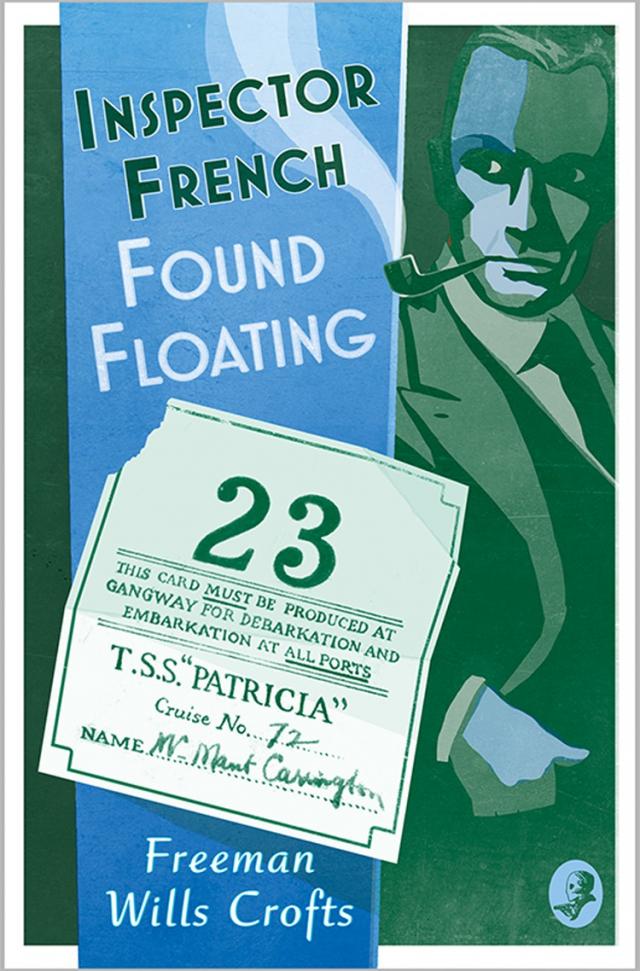
Found Floating, page 23


French next went in search of Mant’s cabin steward. It was unlikely this man would have anything to tell him, still he might reveal something which might help.
But here once again he was disappointed. Andrew M‘Leod proved a smart young man who seemed to know his job and who answered French’s questions promptly, but he had nothing to tell which very much advanced French’s knowledge.
It appeared that the cabins of five of the party—Mant, William, Jim, Eva and Luke—were close together. All were outside cabins, close to the stern on the starboard side of B Deck. Leading off the second transverse passage from the stern were cabins 217 and 209, occupied by William and by Mant and Jim respectively. The doors of these cabins faced one another, and William’s was a single berth and the other a two-berth. The adjoining outside cabin, No. 203, was also a two-berth one and was occupied by Luke and Eva. It was reached from the next transverse alleyway. Katherine and Jellicoe, French learnt later, occupied the halves of two two-berth cabins on the port and starboard sides of A Deck respectively.
M‘Leod, it was evident to French, thought well of the five members of the party he had attended. He said all were pleasant spoken and gave no unnecessary trouble. Old Mr William, of course, gave more than the others, but that was because he had been ill and he couldn’t help it. Mr Jim was a very pleasant gentleman: he liked Mr Jim. Mr Mant was ‘all right’ also, but it was clear that about him the steward was less enthusiastic. He appeared to be also benevolently disposed towards Luke Dugdale and was obviously overwhelmed with admiration for Eva.
About the evening of the disappearance M‘Leod had little to say. He had laid out the clothes and brought the hot water before dinner as usual, and while the party were at dinner he had cleared up the cabins and left them all ready for the night. In the normal course he would not have had to visit them again that night, but Mr William had rung for him shortly after half-past nine. He had gone to the cabin to find Mr William in bed and the old gentleman had told him he was not well, and had asked him to fetch Dr Jellicoe. He had done so. Later, Mr William had been sick, and he had done what was necessary. The doctor had told him to watch out in case Mr William rang for him again, but he had not been required. He had seen nothing which threw any light on what had occurred, nor had he found anything unusual in the cabin.
Owing to the evening turning cold, M‘Leod had closed the portholes of the cabins in his charge. He had finished up about eleven, but about twelve he was called up by the cruise manager and asked to find out if Mr Mant was in his cabin. Later, he was sent to call Mr William and Mr and Mrs Dugdale to a meeting in the drawing room. Mr Jim was not in his cabin at the time. Mr Mant was wearing a soft black hat and a thin black overcoat when he disappeared.
French’s next business was in the dining-saloon, and there he found the waiter who attended the party, or rather the same five members, for Katherine and Jellicoe sat together in another part of the room. The five sat at a six-seat table, one seat remaining vacant. It was a narrow table with three seats along each side, and William and Mant faced each other in the middle seats. At the end next the door Eva sat opposite to Jim, Eva beside William, and Jim beside Mant. Luke occupied the seat on the other side of William.
French was a good deal interested in the seating. The arrangement was natural enough, but it happened to lend itself to what he had had in mind. William on the door side of Luke, who sat alone at that end of the table. If Eva had suddenly called attention to someone entering or leaving the saloon, all would have turned in that direction, and nothing would have been easier than for Luke, in following suit, to have slipped some powder over William’s food. Nor, as it happened, was it likely that anyone could have seen Luke do such a thing, as in front of him was the side of a staircase and not another table.
It seemed scarcely likely to French that such doping had been done, and yet it was possible and must therefore be kept in view. He wondered whether Jellicoe had noticed anything suspicious, and decided to ask him. It was impossible to do so at the moment, as the first bugle had gone and people were already dressing for dinner. All French did, therefore, before knocking off was to put a notice on the board asking anyone who had seen Mant after dinner on the night of his disappearance kindly to inform the purser.
Next day Patricia was at sea, running between Ajaccio and Malta. When French went on deck he found the morning was fine, with a bright though rather thin sunshine pouring down from a sky of the lightest and clearest blue. A gentle breeze blew from the south, slightly rippling the sea. Except for this there was a flat calm and Patricia floated absolutely steadily, even her forward movement imperceptible save when revealed by the passing water. Neither land nor other vessel was in sight: nothing but the sea bounded in every direction by the hard clear line of the horizon. French congratulated himself as he looked forward to a day of such ideal travel.
But business could not be entirely neglected. After breakfast he waylaid Jellicoe and inveigled him to the deserted forward well-deck.
‘I wanted to ask you confidentially a little more about Mr William Carrington’s illness on last Saturday evening,’ he began. ‘Would you tell me whether you were entirely satisfied about it?’
‘I don’t follow you, chief inspector,’ Jellicoe replied sharply. ‘How do you mean, “satisfied”?’
‘Was it quite natural?’
The doctor stared. ‘Natural? Still I don’t know that I understand.’
‘Yes, you do, doctor,’ French returned good-humouredly. ‘Look here. If Mr William had gone ashore with Mr Mant, as was intended, the murder could not have been carried out. Was it therefore necessary to someone that Mr William should stay on board? Now you see?’
That this was a new idea to Jellicoe seemed clear to French. For a moment the man continued staring, then his expression grew uneasy and he said, ‘That never occurred to me, but I do see what you mean. A very disquieting suggestion, I’m sure. And you really think that someone—well, doped him?’
‘I have considered the possibility,’ French admitted, ‘but I have come to no conclusion. I wondered could you help me?’
‘I help you?’ He shrugged. ‘No, I know nothing about it.’
‘It would be a help to me to know whether you thought Mr William’s illness that night quite natural.’
Jellicoe hesitated, while his uneasiness grew more pronounced. ‘Rather a nasty question,’ he said at last. ‘I admit, since you put it to me directly, that I was not entirely satisfied about it, though I never suspected what you suggest.’
‘You suspected something else?’
‘No, I didn’t. I supposed it must have been natural. Mr Carrington had been ill off and on for two or three days, but that evening after tea he seemed all right. Then after dinner this attack came on. I confess it surprised me. Not that he should be a bit knocked up after dinner: he ought to have had special food, and apparently just took what was on the menu. But I was surprised how ill he was. He was actually sick two or three times and very much upset. I admit I was unable to account for it.’
‘But if he had been given something to prevent him going ashore?’
Jellicoe was now evidently acutely distressed. He shook his head. ‘I can’t tell you any more, chief inspector. I really cannot. I believe it possible that his upset may have resulted from his dinner and from nothing else.’
‘Though not very likely?’
The doctor shrugged and sat staring silently before him.
‘It’s too late to make any tests now, I suppose?’ French went on.
Jellicoe roused himself. ‘Oh, yes,’ he agreed. ‘I can’t do anything now.’
French smiled suddenly. ‘Right, doctor; if you can’t, you can’t. Thank you very much. What you’ve told me has been a help.’
It was clear to French that Jellicoe was more than suspicious. But he had no proof and therefore wouldn’t commit himself. But French thought his suspicion supported his own theory powerfully enough to make its truth a practical certainty.
He was settling down to reconsider its bearing on the case as a whole when a steward came up, followed by one of the passengers, a tall man with a spiky nose whom he had seen several times, but never spoken to.
‘The purser’s compliments, sir,’ the steward said, ‘and he thought you would like to meet Mr Rodgers.’
The newcomer nodded, as the steward discreetly vanished. ‘I’ve heard who you are, Mr French,’ he said. ‘I went to see the purser about the notice which was posted last night, and he told me. I had no idea the affair was looked on so seriously as all this.’
‘Won’t you sit down, Mr Rodgers?’ French got up and drew forward the chair Jellicoe had pushed back. ‘We don’t know how serious the matter is, except that the possibility of murder cannot be excluded. And the murder of a passenger on a cruise must be cleared up. Both owners and cruise agents think it would be bad for business to leave it a mystery.’
Rodgers nodded, his nose sawing the air like the jib of a cutter in a head sea. ‘And so it would,’ he agreed. ‘Perhaps I shouldn’t ask, but have you—have you any idea of what—er—happened?’
French smiled. ‘None,’ he declared heartily. ‘Why, I’ve only just got on the job. Very nice of you to think we work miracles at the Yard, but I assure you we don’t.’
Again the cutter pitched. ‘Of course, of course. I was perhaps premature. Still—murder, you know.’
‘Quite,’ agreed French, and indicated that he would be interested to know in what way Mr Rodgers thought he could help him.
‘Not at all, I’m afraid,’ the man answered, ‘but the notice asked anyone who had seen Mr Carrington after dinner on the evening of his disappearance to communicate with the purser. I had seen him and therefore I did so.’
‘Thank you,’ said French cheerily. ‘I wish everyone acted as you have. Now perhaps you’d tell me just what you saw.’
‘Nothing of any importance unfortunately. My daughter and I were going ashore after dinner, but she wasn’t ready at once and I had to wait for her. You know what ladies are.’ He shrugged delicately and French indicated that he too …
‘She had to throw a wrap round her shoulders,’ Rodgers went on, ‘and it took something like half an hour. When at last she was ready and we were walking to the ladder to go ashore, we met Mr Carrington, or rather when we turned into the alleyway from the main staircase he was just coming along the alleyway. I had spoken to him once before—just to say good morning. So I called “Good evening. Are you going ashore?” just like that. He said, “Yes, just for a short stroll.” “So are we,” I said, and made as if to join him. He at once dropped in beside us and made some remark about a breath of air before bed being pleasant. I agreed. By this time we had reached the embarkation room, and my daughter went in. I stood aside to let Mr Carrington follow her, but he suddenly put his hand to his chest and said, “By Jove, I’ve forgotten my landing card. So sorry. Don’t wait,” he went on, “I shall overtake you.” He gave a short nod and turned back the way he had come.’
‘And did he overtake you?’ French asked.
‘No, that was the last we saw of him.’
‘Which alleyway did he come along?’
‘The one on the port side of B Deck. It’s not really a passenger alleyway at all, though you can get to it from aft on B Deck. I expect you know it; just the steel plates painted a sort of dull brown and no carpets.’
‘I know it. The engineer’s and purser’s offices are off it.’
‘That’s it.’
‘Then you were with Mr Carrington only for a few seconds? It’s not many feet from the main staircase to the embarkation hall.’
‘Yes, that’s all.’
French felt that Rodgers was right in saying that his story would be of no use to him. He was about to thank him and bring the interview to a close, but he thought he recognised a certain hesitation in the man’s manner, as if there was more to come.
‘And what did you think of all that, Mr Rodgers?’ he asked.
Still the other hesitated. ‘Well, you know,’ he said at last, ‘I thought, and my daughter agreed with me, that it was simply a polite shake off. As a matter of fact I happened to look at his chest when he put his hand up, and I distinctly saw the bulge of a pocketbook on the cloth.’
‘It mightn’t have contained the landing card.’
‘Of course I realise that. But I thought it from his manner as well. And so did my daughter. She hadn’t seen him put his hand up, and she spoke to me about it first.’
The story, French thought, was suggestive, though unconvincing. Rodgers might easily have been mistaken about that bulge. And Mant might well have forgotten to transfer his card to his evening clothes. Or he might have had it in his pocket and simply not have wished for company on his stroll. There was probably nothing whatever in the affair.
Yet this was not certain. Did Mant really wish to be alone for some definite reason? And—a further idea—had he worked out a plan to ensure it, first, by arranging to go with William in order that he would thus be separated from the others, and secondly, by himself, giving William the dose to prevent him accompanying him?
Here was another possibility, and one which would have to be looked into pretty thoroughly. It was easy to suggest a motive. Had Mant arranged an interview with someone ashore? If so, that someone would have, if possible, to be found. French suddenly grew rigid. Could it have been Eva? Or if Mant were that sort of man, some other woman on board? Or again, some woman whom he had met during the excursion to Tetuan?
French lay back in his chair and gave free rein to his imagination. Suppose Mant had met some woman at Tetuan? Perhaps even a native: some of them were very attractive? Suppose he arranged a further meeting for the evening? Suppose the woman’s husband or brother got to know? Suppose they laid a trap for Mant? Would that not account for the whole thing?
French thought it would. Whether it was very likely or not, he thought it was a possibility, and as such must be gone into. If he were right about a native woman, she would probably have been done in also. One matter for the Ceuta police to find out would be whether any woman had disappeared about the same time.
And if it had been Eva or some woman on board? Well, if it had, he would find it out himself. That was what he was here for.
He made it his business to ask each member of the party privately whether he or she knew anything of an appointment which Mant might have made ashore.
All denied such knowledge, Eva as convincingly as the rest. All the same, French felt that with a woman you could never be quite sure. They were all, or most of them, born actresses.
During the remainder of that day several people sought French out and told him they had seen Mant in the A Deck saloon after dinner. He had dropped films into the photographer’s box, and had talked to the New Zealander, Bradstreet. The photographer also came forward to say that he had found a roll of films belonging to Mant in his box, None of this testimony, of course, advanced the case in any way.
When he went to bed French remained puzzled and with a completely open mind as to what really had taken place.
18
The Suggestion of Mackintosh
French had something of a thrill next morning when he went on deck and found they were lying at anchor in the Grand Harbour at Valetta. Malta was a place he had always longed to see, and here at last his dream was being realised. Eagerly he walked round the deck, gazing first at one side and then at the other.
The harbour was much finer than he had anticipated, and the town was larger and had better buildings. It was indeed a splendid sheet of water that was fringed by the low quays with their rows of clean looking flat-roofed buildings, backed by the huge cliff-like walls of what seemed to be forts. There was a deal of shipping in the port, but what he admired most were the rowboats, which had their stem and stern posts carried up some three or four feet, the stem post higher and cut off at an angle, and the stern post square. They looked to him like embryo gondolas and were rowed by the oarsman standing and pushing forward. He had attended the lecture on Malta on the previous evening, and was now hoping against hope that he should have time to go ashore with the party to see at least the cathedral and some of the streets of steps, even if he could not manage the longer excursions.
The mail had just come aboard and he was presently handed a carefully sealed package. He retired to his cabin to open it.
The Gibraltar police, he soon saw, had done their job well. There were seemingly exhaustive reports, admirable photographs, as well as a short length of rope. He settled down to study the lot.
The first report was from Captain Holmes of the Tyne Maiden. He was proceeding from Alexandria to Gibraltar in ballast, and about 8.30 a.m. on the Sunday had noticed the body of a man in the sea. He was then some thirteen sea miles east-by-north of Europa Point. He had stopped and picked up the body, brought it into Gib, and handed it over to the harbour authorities. The left leg was missing from half-way below the knee.
The next was a document headed ‘Preliminary Report’ from Inspector Costello of the Gibraltar police to his superior officer. ‘At 10.45 a.m. on Sunday, 1st March,’ wrote the inspector, ‘as a result of a telephone call, I proceeded with Sergeant Gordon to the Harbour Office. I was there shown the body of a man which, I was informed, had just been landed from the tramp steamer Tyne Maiden.’ Here Costello gave particulars of the Tyne Maiden and of the finding of the body in the sea.
‘The remains,’ the report went on, ‘were those of a well-built man of about thirty-five, six feet one inch in height, with strongly marked features, blue eyes, and light coloured hair. They were clothed in evening dress—a dinner jacket and black tie—covered with a thin black overcoat. There was no apparent injury to the body except to the legs. The left leg was missing from a little below the knee. It had been taken off as if by a sloping cut, which had also torn away the trouser leg. Round the right ankle was a fairly loose loop of rope, the knot of which had been drawn very tight, and the two ends torn off some nine inches from the knot. The loop seemed to have been at some time drawn tightly against the ankle, for it had cut into it on the outside almost to the bone. The rope was about one inch circumference, of fine and very good quality hemp. Photographs as follows: Exhibits 17, 18, and 19—the body; Exhibits 20 and 21—the end of the cut-off leg; Exhibit 22—the rope mark on right ankle.