The Lenient Beast, page 17


I took my own chair again and moved the book aside. Then I asked him what I could do for him.
He paused a moment before answering as though choosing his words, deciding how to begin. Then he said, “If you don't mind, I'd just like to talk to you a while. Not on police business. In fact, you can have my job taken away from me if you wish simply by telling Captain Pettijohn that I came here. I was forbidden to talk to you.”
“I see,” I said, although I didn't. “May I ask, are you feeling well, Mr. Ramos? You look a bit upset.”
He smiled, but it wasn't too straight a smile. “I'm afraid I am. I had quite a day. I killed a man. I was shot. My wife left me.”
“You say you were shot?” Startling as the two other things were I picked on that one because if it were true he shouldn't be out walking around; he should be in a hospital. “You mean wounded?”
He gestured with his right hand, and then winced. “Just a flesh wound, upper arm. I'll get over it much sooner than the other things.”
I said, “I'm glad to learn that it was not serious. And I'm sorry to hear about the other things. Is the man you killed the one who shot you?”
“As it happened, no. My being shot was an accident But the man whom I shot — Good Lord, it just occurs to me that I don't know his name; I never asked. I killed him almost twelve hours ago and I still don't know his name.”
“A name doesn't matter,” I said. “But you interrupted yourself. You were saying that the man whom you shot—?
“Had a gun pointed at me,” he said. “So the fact that I shot him shouldn't bother me. But it does. I'll get over it, but it bothers me. But not as much as losing my wife.”
“Perhaps she'll realize she made a mistake and come back to you.”
“No,” he said “If she'd just run away from me, yes. But she ran away with another man. Even if she should break with him she'd never come back, since she knows that I know that.”
“Did you love her very deeply?”
“Yes,” he said, and because he said it so simply I knew that it was so.
Then he smiled again. “But I didn't come to unload my troubles on you, Mr. Medley. Nor to ask you to help me out of them as you helped Kurt. I'll get over my troubles and be whole again. Perhaps you were right that Kurt would not have.”
He knows. Or is he taking a shot in the dark?
“You really think that I killed that boy?”
“Yes,” he said. “I don't expect you to admit it. I didn't come here to try to trap you into a confession. And even if you did decide to talk freely, it would be your word against mine if you changed your story later. Your house isn't bugged.
“Bugged?”
“Planted with microphones. This is a personal and private conversation. Though I'll understand if you don't believe me on that.”
“I believe you,” I told him. “But I'm curious why-? But wait, may I offer you a glass of wine? Or have you been—?”
“Have I been drinking? Not for some hours. I started belting a bottle this afternoon but I saw it wasn't going to help, so I stopped. I've walked most of the time since, and it's worn off. Yes, I'll have a glass of wine. If you're having one, that is; I'm not going to drink alone.”
“Of course. Would you prefer a dry or a sweet wine? I restocked today and have both.”
He said he would prefer dry, so I went into the kitchen and opened a bottle of Burgundy, brought in the bottle and two glasses. I moved a small table between our chairs and poured the wine in his sight so he could see that I was adding nothing to his.
Then I sat back down and when we picked up our glasses, I lifted mine. I said, “To your recovery from your wound. From all your wounds.”
He touched my glass with his. “And to your recovery from yours.”
Does he know about — Dierdre? Has he traced me that far back, learned of the accident, and guessed the truth? No, he cannot have; he is guessing. All men bear wounds.
I said, “Mr. Ramos, will you tell me exactly why you came here tonight? You suspect me of murder, yet you say — and I believe you — that your visit is unofficial. If I had killed that boy, you'd hardly expect me to confess, casually, would you? Why did you come here, really?”
He took a thoughtful sip at his wine, as though seriously considering his answer. He put down the glass. “I'm going away tonight. I may never come back; that's something I'0 work out wherever I go. But I've got enough other things to think out and I don't want you on my mind. Mr. Medley, I simply want to know whether I'm right or wrong about you, or whether Cap and Red are right in thinking I'm crazy.”
“Whereas you think that I am — crazy?”
“Forget I used the word. It has no legal meaning. I think you killed Kurt Stiffler — and if him, probably others — out of mercy. For the same reason you killed the poisoned dog. I think you told us about the dog in such detail because it was the one thing you could tell us safely. I think it would make you much less unhappy if you could tell about the others.”
“Go on,” I said. I could not tell this man the truth, but neither, suddenly, could I lie to him. Nor did I wish to.
“No, I don't think you'll confess to me, and in a way I hope you don't. It would put me in a spot if you did.” He took another sip of his wine. “I'm trying to understand,” he said. “Mr. Medley, do you believe in God?”
“Of course I do.”
“Would you do anything He ordered you to do, by word or by sign?”
“Would not anyone who believed in Him?”
He sighed deeply. He took another sip from the glass he held and I saw it had been emptied. I picked up the bottle in a gesture of invitation for him to hold out his glass. He hesitated. “I wonder,” he said, “if I might have a glass of the sweet wine you said you also had. This is good but somehow I don't believe I'd care for another glass of the dry.”
“Of course,” I said.
I went to the kitchen and opened a bottle of Tokay, brought it back and filled his glass. He said, “Thanks. Do you mind if I go on speculating?”
“Not at all,” I told him. “You are a very strange man, Frank Ramos.”
He smiled, and his smile was more natural. He was forgetting his own troubles for the moment. He said, “I am a very dull man. But I am wondering why a man might think-or think he knows — that God wants to use him as an instrument of mercy. I think it might be because he so badly wants that very kind of mercy for himself. He himself wants to die, but for some reason he cannot. He hopes to be caught, too. Why did you leave Kurt's body on your own property when you could easily have put it elsewhere unless you — or at least your subconscious mind — wanted the police to be led to you, this time?”
This is a clever man. Almost, I begin to be afraid of him. And of myself. My tongue wants so badly to loosen, confession would be so blessed a relief. Yet he is right there too; I cannot. I cannot for thereby I would end my usefulness to God before he has signified that he is ready for me to. I make no answer.
Frank Ramos' eyes frighten me because they look at me kindly.
“But things start somewhere. Usually, things like this, in guilt. Mr. Medley, did you ever kill anyone not out of mercy, not on an order from God? Perhaps someone you loved very much?”
It was out of mercy! It was because I loved her and not — not because I could not stand seeing her that way and hearing the sound of her screams. It was out of mercy, even if God had not ordered it, even if then I was a Godless man. It was mercy, I tell you.
Had I shouted that aloud? No, only in my mind. For my hands were covering my face, hiding my eyes, for I do not want him to see the torture in them.
I could take no more.
I lowered my hands and I said, “I'm afraid I don't want to talk any more tonight, Mr. Ramos. You'll forgive me if I seem rude, but I must ask you to leave.”
He left very quietly.
I pace the floor, thinking. Why do I not admit to myself and to God that I killed Dierdre selfishly and not out of mercy? If mercy had been the reason, why should I need exculpation? And if I shall at last admit the fullness of my guilt, might not God fully forgive it, and extend His mercy even unto me?
I pray best kneeling beside my bed, so I enter the bedroom and turn on the lamp on the night stand. There under it lie a dozen — two dozen — green capsules. And I know what they are, for they are the kind I took to that poor man with tuberculosis of the stomach.
And a deep peace comes into my heart, for this is the sign I have waited for. Yes, Ramos put them there when he made the excuse of wanting a different wine and sent me into the kitchen, but God put it into his heart and his mind to leave them; God would have stopped him had not God known what was to happen, that tonight I should finally see and admit before Him the fullness of my guilt. I am forgiven, and God calls me.
I shall pray and give my thanks to God, but there will be time after I have taken them. I shall need a glass of water.
SIXTEEN
WALTER PETTIJOHN
Frank Ramos stuck his head into my office and asked, “Busy, Cap?”
“Come in, Frank,” I said. “Sit down. Back a day early, huh?”
“Yeah. Had some personal business to attend to and wanted to take care of it before I start in. How's everything?”
“Quiet. You're looking fine, Frank.” He was; he was looking better than I'd seen him look in a long time. And happier.
“I feel fine,” he said. “Maybe I should get shot oftener.”
That reminded me. “How is the arm? Sure you're ready to start work again?”
“It's okay,” he said, and flexed it. “A little twinge once in a while, but it healed nicely. Yes, I'm ready.”
“Where did you go?”
“Drove down into Mexico, as far as Torin.”
I asked him where that was and he said just past Guaymas.
“On the coast, then,” I said. “Do any fishing?”
“Some, the past week. The first few days I just soaked up sun on the beach, and rested.”
“Is it better than Guaymas?”
“Much smaller and quieter. I like it better, but you probably wouldn't. You can get by in Guaymas without speaking Spanish, but you might have trouble in Torin. How's Red?”
“On his honeymoon. He wanted his vacation early and I gave it to him. He got married a few days after you left. He'll be back Monday.”
“You're going to keep us teamed, aren't you, Cap?”
“Sure. But till next Monday you can work with Carl Davis. Jerry's down with flu, but he ought to be back by then. Say, the boys are chipping in to buy Red a present; happened too suddenly for us to get one before he took off. Want to chip in?”
Frank said, “Think I should do better than that and get him one on my own. After all, he's my partner.”
“Good idea. Say, Frank, you wouldn't have been seeing the Tucson papers down there, would you?”
“Nope. Been out of touch. Why?”
“Funny thing happened. John Medley committed suicide. Sleeping capsules.”
“The hell,” Frank said. “When did it happen?”
“Probably the night of the day you left. His body wasn't found for three days, though. Red's mother-in-law, next door, got worried when she hadn't seen him around for a while and his car stayed in the carport, so Red went over and looked in the windows and saw him. On the bed, but fully dressed. You know, Frank, I did some thinking and I wonder if you could be right about him. About his maybe having killed Stiffler — and maybe some others. He could have been a psychopath. I didn't think he was, but you can't always tell them.”
“I'd about decided I was wrong,” Frank said. “But it does seem odd that he killed himself. Did he leave a note?”
“No, he didn't. Well, there had to be an inquest of course, so we went through his possessions, all his papers. But we didn't find anything — except we learned one thing that was just a little odd. He had been married. His wife had died seven years ago in an auto accident, not too long before he moved here.”
“It is a little odd. But I suppose he could have had some innocent reason for telling us he'd never been married.”
I said, “I suppose so. One other thing, could have been just coincidence and probably was. The capsules he took were dormison and they're not too common. Remember the Winkelman case? Woman we thought was accessory to suicide because she took her husband sleeping capsules in the hospital? They were dormison too. If Medley was a psychopathic mercy-killer, that's just the kind of thing he'd be likely to do, and I wonder.”
“Medley could have had any one of a hundred other reasons for lolling himself, Cap.”
“Yes,” I said. “But I wish he'd left a note. If he had, we might be able to wipe a few cases off our books.” I sighed. “Well, at least he won't be killing anybody else.”
“No,” Frank said. “I guess he won't.”
Also By Fredric Brown
Mitkey Astromouse (1941)
The Fabulous Clipjoint (1947)
The Dead Ringer (1948)
Murder Can Be Fun (1948)
The Screaming Mimi (1949)
The Bloody Moonlight (1949)
Compliments of a Fiend (1950)
Here Comes a Candle (1950)
The Case of the Dancing Sandwiches (1951)
Death Has Many Doors (1951)
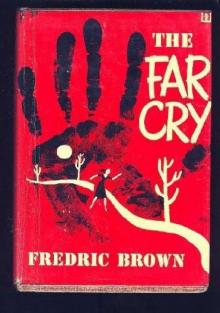
The Far Cry (1951)
Night of the Jabberwock (1951)
We All Killed Grandma (1952)
The Deep End (1952)
Madball (1953)
Project Jupiter (1953)
aka The Lights in the Sky Are Stars
His Name Was Death (1954)
Martians, Go Home (1955)
The Wench Is Dead (1955)
The Lenient Beast (1957)
Rogue in Space (1957)
One for the Road (1958)
The Office (1958)
Knock Three-One-Two (1959)
The Late Lamented (1959)
The Mind Thing (1961)
The Murderers (1961)
The Five-Day Nightmare (1962)
Mrs Murphy's Underpants (1963)
Before She Kills (1984)
Homicide Sanitarium (1984)
The Freak Show Murders: Fredric Brown Pulp Detective Series, Vol. 5 (1987)
Thirty Corpses Every Thursday (1987)
Pardon My Ghoulish Laughter: Fredric Brown Pulp Detective Series, Vol. 7 (1987)
Red Is the Hue of Hell (1990)
Fredric Brown, The Lenient Beast