Homicide Sanitarium, page 1


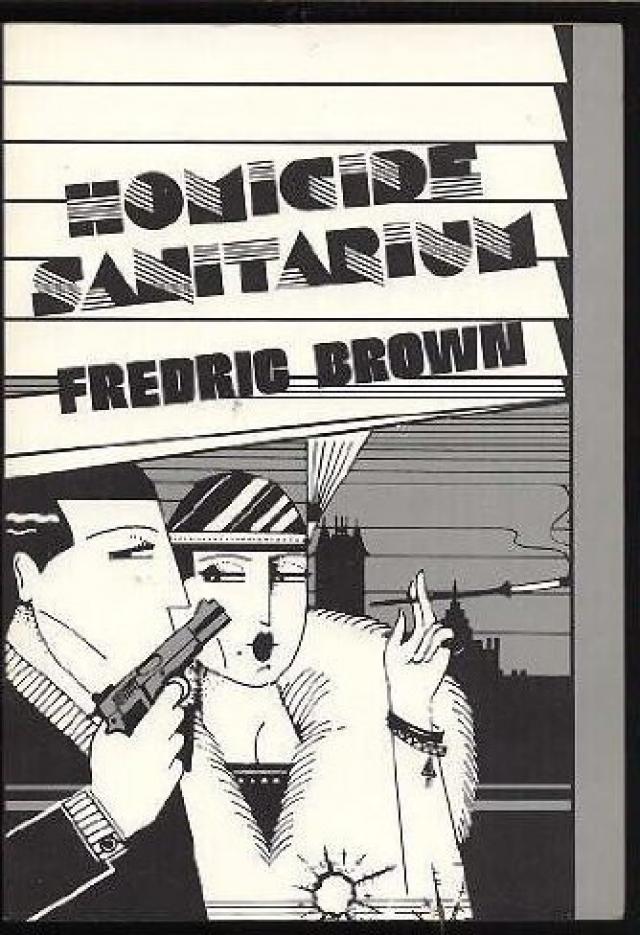
HOMICIDE SANITARIUM
FREDRIC BROWN
IN THE
DETECTIVE PULPS
VOLUME 1
1984
Homicide Sanitarium (collection) copyright ®1984 by Elizabeth C. Brown. All rights reserved.
"Introduction," copyright ®1984 by Bill Pronzini.
"The Moon for a Nickel," Street & Smith's Detective Story Magazine, March 1938, copyright ®1938 by Street & Smith Publications.
"Homicide Sanitarium," Thrilling Detective, May 1941, copyright ® by Standard Magazines, 1941.
"Listen to the Mocking Bird," G-Man Detective, November 1941, copyright ® by Standard Magazines, 1941.
"The Cat from Siam," Popular Detective, September 1949, copyright ® by Standard Magazines, 1949.
"Red-Hot and Hunted," Detective Tales, November 1948, copyright ® by Popular Publications. Copyright renewed ® 1976 by Popular Publications.
"Suite for Flute and Tommy-gun," Street & Smith's Detective Story Magazine, June 1942, copyright ® 1942 by Street & Smith Publications.
"The Spherical Ghoul," Thrilling Mystery, January 1943, copyright ® by Standard Magazines,. 1943.
Cover design by William L. McMillan
FIRST PAPERBACK EDITION
Published November, 1985
Dennis McMillan Publications
401N. 6th
Belen, New Mexico 87002
CONTENTS
Introduction
Red-Hot and Hunted
The Spherical Ghoul
Homicide Sanitarium
The Moon for a Nickel
Suite for Flute and Tommy-gun
The Cat from Siam
Listen to the Mocking Bird
INTRODUCTION
The pulps, those gaudy-covered, cheap-paper, jack-of-all-fiction magazines that flourished during the first half of this cen-tury, provided a training ground for dozens of writers who even-tually went on to bigger and better literary endeavors.
William E. Barrett, Theodore Dreiser, Sinclair Lewis, Horace McCoy, and Tennessee Williams wrote for them. So did Isaac Asimov, Ray Bradbury, Max Brand, Edgar Rice Burroughs, Zane Grey, Robert Heinlein, John Jakes, Louis L'Amour. And so did John Dickson Carr, Raymond Chandler, Erie Stanley Gardner, Dashiell Hammett, John D. MacDonald, Rex Stout, Cornell Woolrich--and Fredric Brown.
Brown was working as a proofreader for the Milwaukee Journal when he sold his first pulp story, "The Moon for a Nickel," to Street & Smith's Detective Story Magazine in 1938. This first taste of success was all the impetus he needed; before long he was selling regularly to a wide variety of pulp markets--crime stories to Clues, Detective Fiction Weekly, Detective Tales, Dime Mystery, Phantom Detec-tive, Popular Detective, The Shadow, Strange Detective Mysteries, Ten Detective Aces, Thrilling Mystery; science fiction and fantasy stories in Astounding, Captain Future, Planet Stories, Thrilling Wonder Stories, Unknown, Weird Tales; even a couple of westerns to Western Short Stories. By 1948, his success in the pulp marketplace--coupled with the novels he had begun to publish in 1947 with The Fabulous Clipjoint, winner of the Mystery Writers of America Edgar as Best First Novel of that year--allowed him to devote his full time to writing.
He continued to sell to the pulps until their paperback original- and TV-induced demise in the early 50s--in all, pub-lishing more than 150 stories in that voracious medium. Although fantasy and science fiction were his professed first love, the bulk of his output was in the mystery and detective field: upward of 100
stories. Some three-score of these were reprinted in his two hardcover mystery collections, Mostly Murder (1953) and The Shaggy Dog and Other Murders (1963). Several others--novelettes and novellas, for the most part--were later expanded or combined into novels. For instance, "The Santa Claus Murders"
(Detective Story, October 1942) became Murder Can Be Fun (1948); "The Gibbering Night" (Detective Tales, July 1944) and "The Jabberwocky Murders"
(Thrilling Mystery, Summer 1944) were combined into Night of the Jabberwock (1950); "Compliments of a Fiend" (Thrilling Detective, July 1945) was developed into 1949's The Bloody Moonlight (not into the 1950 novel also called Compliments of a Fiend, as some people suppose); and "Obit for Obie" (Mystery Book, October 1946) became The Deep End (1952).
But there are still more than 60 of Fredric Brown's pulp stories that have never been reprinted anywhere since their original magazine publications, or have only appeared in obscure anthol-ogies or in digest crime magazines in the 50s and 60s.
To be sure, some of these stories are badly dated; and others, written hurried-ly for money and under deadline pressure, are of mediocre or poor quality. Still, more than a few have merit, some considerably so. Minor Brown they may be, but they are nonetheless deserving of disinterment from their crumbling pulp tombs for the enjoy-ment of modern readers. Seven of these comprise this long-overdue book--the first but not, Dennis McMillan and I both hope, the last such collection.
My personal favorite here is "The Spherical Ghoul" (Thrilling Mystery, January 1943), which has a typically wild and wonderful Brown plot--its ingredients include a morgue at night, a horribly disfigured corpse, mayhem aplenty, and a classic locked-room mystery--and one of the cleverest (if outrageous) central gimmicks you're likely to come across anywhere. It puzzles me why Brown failed to include it in either of his own collections. And why no one (except The Saint Magazine in 1962, and yours truly in a 1981 horror anthology called The Arbor House Necropolis) has ever bothered to reprint it.
The lead story, "Red-Hot and Hunted" (Detective Tales, Novem-ber 1948), is also very good Brown. It utilizes one of his favorite themes: the madness, or apparent madness, of either the protago-nist or another main character--in this case, a stage actor named Wayne Dixon who may or may not have murdered his wife. The hallmark of any Brown story, aside from its unusual plot, is the maintenance of a high level of suspense; "Red-Hot and Hunted" has this quality in abundance.
"The Cat from Siam" (Popular Detective, September 1949) is another variation on the madness theme, with that same quality of suspense and a beautifully eerie tone. What Brown does with the Siamese cat of the title, and with such simple devices as a chess game, some gunshots in the dark, and a new kind of rats-bane, should provide a frisson or two.
"Listen to the Mocking Bird" (G-Man Detective, November 1941) makes use--as does another of my favorite Brown shorts, "Whis-tler's Murder" (reprinted in The Shaggy Dog and Other Murders)-- of old Vaudevillean characters; in this story, a mimic who special-izes in bird calls. Its plot is both solidly plausible and satisfying, making the story one of his pre-World War II best.
The flute was Fred Brown's favorite musical instrument; he played it often if not well, for pleasure and relaxation. His love for the flute and for music in general are evident in "Suite for Flute and Tommy-gun" (Detective Story, June 1942). Again, a clever plot and an unusual blending of its various components make this an above-average story.
"The Moon for a Nickel" is hardly one of Brown's strongest yarns, but the fact that it was his first published fiction makes it important from the historical point of view. It also demonstrates that from the very first, he had all the tools that would later make him so successful--the fast-paced storyline, the wry style, the eye, ear, and feel for the unusual.
Brown wrote relatively few stories featuring private detec-tives--prior, that is, to his creation of the team of Ed and Am Hunter in The Fabulous Clipjoint.
"Homicide Sanitarium" ( Thrilling Detective, May 1944) is one of those few, and another neglected gem. Any number of fictional private eyes have taken undercover jobs in sanitariums, but none for quite the same reason as pint-sized and newly married Eddie Anderson: he's hunting an escaped homicidal maniac, and what better place for a lunatic to hide, after all, than in a private loony-bin that allows its patients to come and go as they please? The plot twists are numerous and baffling, and the delightful surprise Brown springs on the final page is surprising indeed.
Fredric Brown was one of the best storytellers of his time. These seven vintage tales from his pulp years may be minor, as noted earlier, but that doesn't diminish their value in any way. They're pure entertainment, from a writer who understood the meaning of that word as well as--if not better than--any pro-ducer of popular culture.
What more could a reader ask?
Bill Pronzini
San Francisco, California
January 1984
RED, HOT, & HUNTED
Murder Role
My back was pushing against the door, but the doorway was shallow and the yellow glow of the street light across the way caught me full in the face.
Adrian Carr saw me; he stopped theatrically. Everything Adrian Carr does he does theatrically. Adrian has never spoken a line on stage, but he has more ham in him than any odd dozen of the actors he hires. And more money than the hundred most successful actors in the business, if there are that many successful actors on the legitimate stage.
His eyebrows went up half an inch and he stood there, arms akimbo under his opera cape. He said, "Trying to avoid me, Wayne?"
I laughed a little, trying to make it sound convincingly uncon-vincing. I said,
"Not you, Adrian. The police."
"Oh," he said, "the police. That I can believe. But an actor trying to avoid a producer . . ." He shook his massive head. "Maybe it's just as well, Wayne. I haven't a part you'd fit."
"You're still type-casting, then," I said.
"If you were casting I suppose you'd hire Henry Morgan to play Othello."
He smiled, "Touché. I believe Henry would, at that. I chose the wrong example. Ah--what was that line about avoiding the police? They don't jail one for debts nowadays, my boy. Or have you done something more serious?"
I said, "I have just killed my wife."
His eyes lighted. "Excellent, my boy, excellent. I've often thought that you should, but it would have been indelicate to suggest it, would it not? Ah--let's see--I haven't seen Lola for weeks. Did you commit the deed recently?"
"An hour ago," I told him.
"Better late than never, if I may coin a phrase. I presume that you strangled her?"
"No," I said. "I used a gun."
I took it out of my pocket and showed it to him. It was a nickel-plated .32
revolver.
From somewhere, blocks away in the night, came the sound of a siren. I don't know whether it was that sound or the sight of the gun, but I saw a startled look cross Adrian Carr's face. I don't know how my own face looked, but I ducked back into the doorway. The sound got louder.
He laughed heartily as he peered in the direction from which the sound came, and then turned back to me. He said, "It's all right; it just crossed this street two blocks up. Not coming this way."
I stepped back down to the sidewalk. I said, "That was foolish of me; I shouldn't call attention to myself by ducking that way, I know. Probably they aren't after me yet. It's too soon."
He leaned forward and whispered, "Haven't they found the body?"
"I don't think they have."
"Where did you shoot her?"
"In Central Park," I told him.
He clapped me on the shoulder with a heavy hand. "Perfect, my boy, perfect.
I can't think of a more fatal spot. Ah--you did a good job? You're sure she's dead?"
"Very sure. The bullet went into her right breast, but at an angle. It must have gone through her heart. She died instanta-neously."
"Capital. Shall we have a drink to celebrate? I was going home, but--"
"I could use one," I admitted. "But at some quiet place where I'm not known."
"Around the corner at Mike's?"
"I don't know it--so they don't know me. That'll be fine."
Mike's turned out to be a place whose neon sign proclaimed it to be The Hotspot, but despite that boast, it was quiet. There was a juke box in the rear, silent at the moment.
We sat at the bar and ordered martinis. Adrian Carr said, "You live near here, Wayne. Why not call up Lola, if she's home, to come around and have a drink with us?"
"Why?" I asked. "You don't like her."
"I admit that. But she's good company. And she's beautiful. Just maybe, Wayne, she's the most beautiful woman in New York."
I said, "I don't think I'll call her, Adrian."
"Why not?"
"She's dead. I killed her tonight." I glanced at my wrist watch. "An hour and a quarter ago. In Central Park. With a gun. Remember?"
He nodded. "Of course, Wayne. It had slipped my mind. As one grows older--How old are you, Wayne?"
"As an actor, twenty-eight. Thirty-seven, off the record."
"A callow youth. At forty-nine one begins to mellow. At any rate, I'm beginning. And how old is Lola now? Wait, let me figure it out. She was--ah--twenty-two when she was with Billy Rose and that was ten years ago. I knew her pretty well, then."
"I know that," I said, "but let's not go into it. That's past, long past."
"And let the dead past bury its dead. How wise of you, Wayne. But--" he held up an impressive forefinger--"the present. Do you mind when I talk to you like a Dutch uncle?"
"Yes," I said.
"I know you do. But don't you see that that woman has ruined your career as an actor? You might have gone places, boy. You still might. I can't give you the role I know you want, but--"
"Why not? In words of one syllable, Adrian, why not?"
"Damn it, Wayne. I know your arguments about type-casting, and maybe you're right. But then, too, maybe I am, and I'm the one of us who does the picking.
I'm the one who loses my shirt if that play isn't cast right."
"I haven't read the play. Heard only a bit about it. Just what does the role take?"
"You've heard enough about it, my fine friend. You're acting the lead role to the hilt, or trying to. Try to tell me you don't even know it's a Bluebeard theme, a man who kills his wife."
"I knew that," I admitted. "But still I ask, what does the role take?"
"A nice touch. A touch you haven't quite got, Wayne. I'm sorry." He made wet circles on the bar with his martini glass. "Remember Arsenic and Old Lace and how howlingly funny it made murder seem? Well, this--although it's a different theme--starts out with the same light approach, but we're experimenting. The whole thing is a gradual change of pace--starts like a comedy drama and ends in sheer horror, with a gradual build-up in between."
"Do you think that will carry?"
"I don't know. It's a hell of a gamble, to be honest with you.
But I like it. I'm going to give it every break, including the best casting I can do--and friendship ends there, Wayne. I'm sorry."
"I understand that," I told him. "I don't want it unless you think I can handle it.
But it happens I can. I lied to you before. I have read the play. Lola's a friend of Taggert; he lent her a carbon of it and I read it. I think it needs a stronger third act, but I like the first two. The first is definitely good: this mild-mannered guy, a little off the beam, trying to convince people he's killed his wife and not being believed--I can handle that. You still don't believe I killed Lola tonight, do you, Adrian?"
"Let's drop the gag, boy. You've milked it, but it's wearing thin. What I don't think you can do, and do right, is the second part of it--from the point in the middle of the second act where the other characters--and the audience--begin to wonder."
I said, "This has just been the first act--of tonight. I can make you begin to wonder."
"Look, boy, I'd like to give you the part."
I put my martini glass down on the bar, and turned a little on the stool to look at him squarely. I waited until I caught his eye.
I said, "Adrian, I am pulling your leg--about the part in your play. I won't be able to take it."
"I'm glad you feel that way about it, Wayne. Because--well, I did hate to turn you down. Got another engagement?"
"I may have," I said. "With a chair, Adrian. You see--I wasn't kidding about the other thing. I killed Lola tonight."
He stared at me for what must have been ten seconds before his face changed and he started to laugh, that hearty booming laughter that one always associates with Adrian Carr.
He clapped me on the shoulder again and I almost lost my precarious balance on the bar stool.
He called out "Mike!" and the bartender shambled toward us behind the bar.
Adrian said, "Two more martinis, Mike, and use that special vermouth you've got.
You didn't on those last two ones, did you?"
"Sorry, Mr. Carr, I forgot. Coming up."
"And have one with us, Mike, while you're mixing them. Mike, I want you to meet a pretty good actor who's trying to pretend he's a pretty bad actor. Wayne Dixon, Mike. He just killed his wife."
I reached across the bar to shake hands with Mike. I said, "Glad to know you, Mike."
"Likewise, Mr. Dixon."
He put ice in the mixer glass and three jiggers of gin. He said, "Always wanted to kill mine, Mr. Dixon. How'd you do it?"
"With a gun," I said. "You've got a nice place here, Mike. I live only five or six blocks away. How come I never discovered it?"
"Dunno. Been here three years. But then there are a lot of bars in a radius of five or six blocks in New York. Yeah, we run a nice place. Quiet tonight, though."
"Way I like it," I told him. "And if you start that juke box I'll shoot you."
He looked back at it and frowned. "Me? No. Got to have one for the customers who want it, but me, I never touch the thing. I like music. Say, there's one good record on there, though, if you get in the mood. An early Harry James, before he went commercial."
"Later, maybe. Which one?"
"That one he plays straight trumpet solo and blue as they come. Sleepy Time Gal."
Something twisted inside me; I hadn't been set for it. It had been Lola's favorite tune. I could still hear her humming it in that low throaty voice. Mike put the glasses in front of us and filled them from the mixer. He'd guessed short, but that didn't matter because he filled his own last and a bartender always drinks them short.