

Six Figures (Harvest Book), page 1


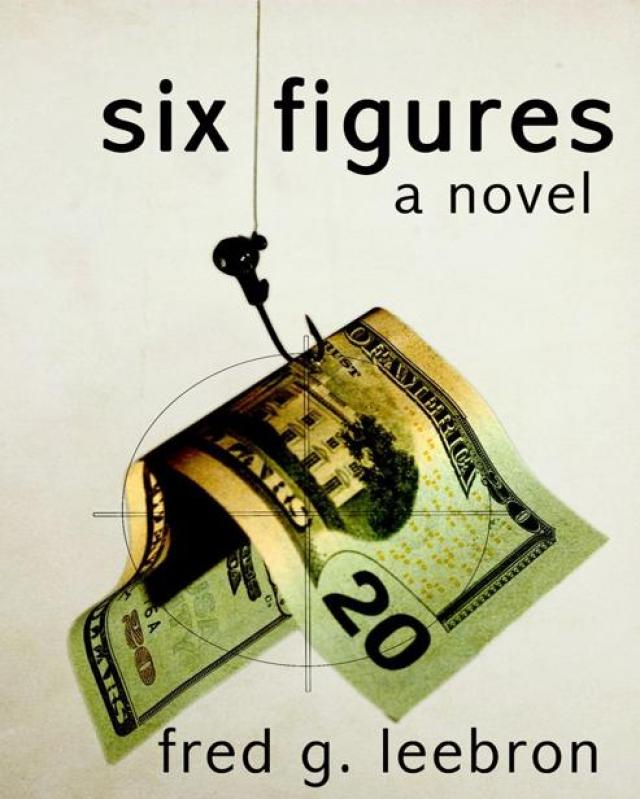
Six Figures
Fred G. Leebron
Dzanc Books
Dzanc Books
1334 Woodbourne Street
Westland, MI 48186
www.dzancbooks.org
Copyright © 2000 Fred G. Leebron
All rights reserved, except for brief quotations in critical articles or reviews. No part of this book may be reproduced in any manner without prior written permission from the publisher.
Published 2013 by Dzanc Books
A Dzanc Books rEprint Series Selection
eBooks ISBN-13: 978-1-938103-95-7
eBook Cover by Awarding Book Covers
The characters and events in this book are fictitious. Any similarity to real persons, living or dead, is coincidental and not intended by the author.
For Kathryn, Cade, and Jacob
and
Barry Wolfman
… desires do not split themselves up, there is one desire touching the many things, and it is continuous.
—ROBERT HASS, “NATURAL THEOLOGY”
ACKNOWLEDGMENTS
Many, many thanks to Jennifer Rudolph Walsh, Steve Rinehart, and Ethan Hawke for their early support and encouragement. I’m also grateful to Sonny Mehta, Leyla Aker, Amanda Urban, and the incomparable J.D. Dolan for their diligence, wisdom, and generosity. Thanks as well to Roger S killings, Andre Bernard, Bruce Tracy, Jay Mandel, Andrew Levy, Don Lee, Debby and Arnie Johnston, Bob Fredrickson, Deb West, Peter Ho Davies, and Geoff Becker for their kindness and tolerance.
Special thanks to Ray and Linda Owens, Barry and Chris Wolfman, Christie Taylor and David Perlmutt, Tommy and Debbie George, Steve and Dawn Ballenger, Henry and Judy Goldman, Wolfman Pizza, the Hodges Taylor Gallery, and Pasta & Provisions for all their help and friendship in Charlotte. Thanks also to the Rhetts of Charleston, South Carolina.
I am especially indebted to Larry Rogers, M.D., for his advice in all matters medical and otherwise.
For support during the writing of this book, thanks to Western Michigan University, Gettysburg College, and the University of North Carolina at Charlotte.
I am most grateful to Kathryn Rhett, for her editorial expertise, patience, and kindness.
Six Figures
Mornings
The line for the polling booths at Charlotte Baptist Church was more than a hundred people long, and Warner Lutz rocked the unsettled baby in his arms while studying the diverse messages posted around Fellowship Hall. Pray for God to bring the lost and hurting people from your community to himself. Anger is just one letter from Danger. Every half minute a blue light blinked, and the next person would enter a vacated stall, drawing the curtain closed. At the far end of the auditorium, uniformed children paraded across a stage under a green-and-white banner that said KIDS CAN VOTE, TOO! A handful of Girl Scouts guarded a cardboard ballot box, cheerfully distributing sharpened yellow pencils with pink eraser tips. In Boston, Warner and Megan had voted at a public elementary school, in San Francisco in a row-house garage. The other day a monied pastor had told him that Charlotte liked to view herself as a conservative town who loved her churches on every street corner, and Warner had felt the Jew in him cringe in a kind of fear and the atheist in him vow to do something anarchic about it. From the start, he and Megan had been torn between blending in and pushing out, but he was feeling increasingly damned if he was going to assume his born-into religion just because everybody around him seemed to put so much stock in theirs. All along the length of the hall his neighbors chatted quietly as they smoothed the minor fault lines in the creases of their business suits or sweater sets, double-checked the coordination of their wristwatches and cuff links or necklaces and earrings. Behind him was Megan in her faded jeans and baby-stained cardigan. She leaned forward and lightly breathed into his ear. “He’s asleep.”
The little wobbly head was already imprinting an island of drool above Warner’s heart. He felt the familiar surge in his throat of gratitude and awe at the unearthly ripeness of the boy’s cheeks, the tender narrowness of his neck. How hard he had fought against having him, and now look at the baby and Sophie. Sometimes when he was at the office fielding phone calls from the trustees he understood that his only real reason for living was five o’clock, when he could go home to sit in the beige puddle of their living room and build stacks of blocks to the strains of heartfelt songs from various Disney animated classics. He bent carefully, held his nose close to Daniel’s partly open bow of a mouth, and took in the milky breathing.
Megan reached and stroked the baby’s hair. “What a cuddlebug.” Then she felt Warner’s shoulders. “You’re still mad? You could wait in the car.”
He nodded at the high windows. “It’s pouring.”
“Everyone should vote,” she said. “It’s only an hour. You shouldn’t resent it so much.” She unfolded a pamphlet on bond issues and began to read. “Look, there’s education and highways and sidewalks, all that stuff we always talk about—”
“—and everyone votes on,” he said quietly, “out of ignorance.” The baby stirred, and Warner began to sway him back and forth.
“You want me to hold him?”
He shook his head. The boy’s bunched knees pressed gently against Warner’s rib cage, and his head lolled in the contour of his shoulder. He was six months old, a native Bostonian. Sophie was a Californian. Warner was a Pennsylvanian, and Megan a New Yorker. They’d begun in graduate school, where he was getting a master’s in public affairs and she was earning one in art history. She’d said near the end of their first afternoon together, at a graduate student happy hour, that he was the most negative person she’d ever met. He wondered if that were still true. He supposed it was. He rested his head against the baby’s head and shut his eyes to a pearled old woman navigating her way into a booth with the aid of a walker and an attendant dressed in white. He wished he had a cell phone so he could check in with the office. He’d denied their request for an electoral day off, and now he himself would be late. Everyone at MORE—he hated the acronym and pushed to get them to answer the phone with M-O-R-E—was from the North or Midwest. Privately, they called themselves nonprofit carpetbaggers and liked to imagine their roles as ideological descendants of the sixties integrationists. But the Metrolina Organization for Resource Exchange was a networker, a facilitator, a broker—all the eighties-nineties tautology that said what you actually did was as close to nothing as doing something could be. Not that he didn’t believe in MORE: as its director, he was obligated to. Before his time the organization had helped create the Nonprofit Housing Coalition, the Emergency Food and Drug Delivery System, and the Educational Access Network. It was all paper. He was a technocrat. In Charlotte, who wasn’t? But he knew what those other people were making—not that it was only about money, but it was always at least partly about money—and this distinction between them and him made him boil.
“Look where we could be,” Megan liked to say.
And of course he looked—because he could and he had to, it was part of his job—at what lay under the trapdoor. The poor. The poor poor, the working poor, the criminal poor. The there-but-for-the-grace-of-birth-and-circumstances-go-I poor. The outhouse, crackhouse, madhouse, jailhouse poor. The people-he-thought-he-worked-for-every-day poor. The goddamn-he-was-lucky-he-wasn’t-one-of-them poor. Yet he still wanted more. Every morning when he drove Sophie in their shitcan hundred-thousand-plus-mile Honda with the guardrail crease down one side to the private but only $175-a-month preschool and he saw the other parents in their new Volvos and minivans and Suburbans, he wanted more. Every noon when he stood in line at the vegetarian take-out for his cup of soup and can of diet cola while in a nearby café the gray suits and sleek dresses milled between garden salads and poached salmon, he wanted more. And in the evenings when he drew up to the cramped redbrick town-house apartments of Crape Myrtle Hill, having passed the magic dust mansions of the growing rank-and-file rich with their screened-in porches and their two-story great rooms and their eat-in kitchens and their master bedroom baths with built-in saunas, he wanted more. He snuggled the sweet, warm baby draped on his shoulder, and wondered if he would ever understand what enough was, and if so, whether he would recognize when he himself had achieved it. Not twenty feet in front of him was a guy in a sweater more ragged than Warner’s, wearing pants with a baggier ass than his. The man turned and offered up a slightly grayer face, halved by unfashionable prescription glasses that sat crookedly on his nose, and showed a set of browning teeth. UnderWarner. He ducked into a polling booth, seemingly holding his breath, and drew the curtain closed.
Daniel pushed at Warner’s chest and examined his eyes, his own expression neutral after the abbreviated nap. As they straggled forward in line, Megan reread the pamphlet, her head down, slight shimmers of silver in her hair streaking the shades of brown. Warner loved the gray hair. It made him feel as if they’d endured something together. Now his own glasses bit into the bridge of his nose and he stifled a yelp and snatched at Daniel’s tightening fist.
“No,” Warner said. “Honey, no.” He groped at the tiny wrist and found the pressure point. The baby released the glasses onto Warner’s nose. He turned to see if Megan was watching, and his glasses raked across his face, slashing his cheek, and sailed from Daniel’s hand, clattering to the hardwood floor. “Daniel! Goddamn—”
Around him was an instant intake of breath, a whispered oh my and a murmured if you please. He had to remember he was in a church.
“—Let me take him,” Megan
“No, no.” He knelt, hiding his red face, still holding the boy, and retrieved the metal frames. He bent them back into shape and fit them on again, trying to ignore a fresh pebbled crack in the lower corner of one of the lenses. “It’s all right.”
Again, the baby reached for the glasses, clawing at Warner’s face. Warner held him out above the floor, the baby giggling and cooing. The underWarner came out from his booth, clutching his neck as if under an invisible burden. Warner felt his own shoulders straighten.
Megan rubbed his back. “You don’t mind taking him in with you?”
“Of course not.” Maybe for once he’d write in a name or choose Libertarian even though it didn’t ultimately mean as much liberty for everybody as he wished it meant. A blue light flashed, and Megan pushed him ahead. In a tight space not unlike an airplane lavatory, an electronic panel glowed yellow under a strip of fluorescent lighting. He saw the name of the Democrat whom socially conscious people like himself were supposed to vote for, and Daniel clawed at him in the metallic closeness. “Okay,” he murmured. “Okay.” His finger wavered above the choice, and he bent back a switch at what he thought was Libertarian, only to discover that it was the guy he was supposed to choose, the guy with the soft gut and the pursed-lip imperiousness. He tried to flick the switch back but it wouldn’t click. He voted the rest of the ticket and then diligently chose positions on the various bond issues. At the last page he saw the word CANCEL and he swiped at the lever and missed as Daniel reached for his face. Now the baby was drooling down his neck and flailing his arms. He hit PROCESS and let it go.
In the car the windows fogged from the rain, the baby began to scream, and Warner kept looking sideways at Megan.
“Should I take him out?” she said. “You think I should take him out, don’t you?”
Daniel’s roaring shrieked like a chain saw against very hard wood. Along the road Warner could see a filled sign-board sitting at the edge of a brown churchyard. THE OBJECTIVE OF LOVE IS TO SERVE, NOT WIN.
“Take him out!” Warner shouted.
She climbed into the back, undid the five-point straps, and pulled the baby from the car seat. Almost immediately, he stopped crying.
“Whew,” Warner said.
“He needs another car seat.” Megan held the baby close.
Warner swallowed a yawn. They’d both been up most of the night, attending to a sore ridge of Daniel’s circumcision, where it had somehow recently reattached to a fold and the doctor, at yesterday’s checkup, while looking accusingly at Warner, had pulled the skin back from itself and then dabbed on Vaseline. Now whenever the baby peed it stung, and whenever they changed him it took so long to apply the jelly that he squirted the wall and soaked himself. It was Warner who had insisted on the circumcision. “So he can suffer the way you did?” Megan had asked. No, he’d said. He had a theory that being Jewish was like being a minority, and that a child who felt this pressure was likely to be a child who grew up without prejudice, but people rarely believed this. He wanted to argue that a son should be like his father, that there shouldn’t be any public shower scenes where the difference would make either uncomfortable, but that point struck him as pathetically self-referential. As penance those first days, he had had to tend to the wound, unraveling the blood-crusted gauze as the baby wailed hysterically and Warner’s forehead broke out in an enormous sweat, and then spool on the fresh bandage while trying to maintain the wanted shape of the remaining skin. Undoubtedly he was the cause of the delayed disfigurement. He wondered what other trials awaited.
“We’ll get him a new car seat,” he said.
At Discovery Place on Veterans Day, Sophie and another little girl stood by the rock pool and ran their hands through the water, while Warner and the girl’s mother watched over them. A five-year-old in a red dress with a white collar skipped in, her straight blond hair parted and barretted, and hopped up to the edge. She watched the two girls, in their scuffed leggings and generic T-shirts, and held her hands tight behind her back. Two men strolled up, official badges stuck to their chests. One toted a thick camera bag, the other a tripod. Quickly they examined the three girls, then the man with the bag pointed to the five-year-old in the red dress. “Would you like to have your picture taken?”
“Sure.”
“Where’s your mommy?”
“Upstairs.”
“Well, let’s go find her and get her permission.” He held out his hand and she took it and they hurried together from the room.
Sophie and the other little girl glanced at each other quietly, then went back to touching the water. Warner couldn’t look at the mother. At the top of the escalator he could see the perfect little girl, and a woman with expensive hair negotiating with the photographers.
“We could go to the play room,” he called to Sophie.
“I want to stay here,” she said.
While she picked through the rocks and shells in the pond he tried not to watch the shoot. The little girl in the red dress pretended to feed the mechanical dinosaurs, the little girl in the red dress knelt to examine a live snake, the little girl in the red dress tapped on the glass wall of an aquarium of neon fish. “Be natural,” the guy kept telling her. “Have fun.” Her mother watched with a mixture of impatience and pride.
The photographers stopped at the rock pool.
“Girls,” the one who always talked said.
The two little girls looked up expectantly.
“We need to take a picture or two of the rock pool. Would you mind moving away?”
Sophie and the other little girl started to climb down from the pool.
“Hey,” Warner heard himself say. His throat felt clogged, and he was blushing. “You can play where you are, honey,” he said.
Sophie stopped.
“Excuse me?” the photographer said, smiling.
“It’s still early in the day,” Warner said. He heard his voice and tried to erase any fury. “Can’t you do this another time?”
“It’s just one picture,” the guy said. “No big deal.”
“Exactly,” Warner said. He lowered his voice again. “Do it later.”
The photographer looked at his assistant and the little girl’s mother and the other mother. They were all staring at Warner as if he’d wriggled out from a crack in the aquarium and was flipping on the floor.
“Well, like you said, sir,” the photographer was still smiling, “it is early.” He nodded at his people, and they began to move on. The other little girl and her mother left with them.
Warner touched his hands together; they were clenched into fists. He looked at Sophie stroking the water. Beside the aquarium a dinosaur nodded its scaly elongated head as electronic sparks ricocheted in its mouth.
In the kitchen, as the weekend morning sun slid under the last slat of the venetian blind, he rested an empty coffee cup on the counter, opened the freezer, and brought out the iced bottle of Absolut Citron. He thought he heard something and paused, but there was no one on the stairs. He poured a double and a half, screwed the cap onto the bottle tightly, slipped the bottle back into its place in the freezer, and raised the cup to his lips. The vein in his forehead pulsed. He swirled the vodka with his tongue once in a farewell circuit, and swallowed. Upstairs the baby wailed while his wife quietly argued with their daughter about what to wear to the playground. He wondered what last iota of resistance kept him from drinking directly from the bottle.
“Are you down there?” Megan called over the baby and the child. “I could use a little help.”
Wearily he rose. In the cupboard was a single malt, on the refrigerator shelf a chardonnay. He was down there, all right, the flesh around his mouth beginning to numb, his fingertips tingling. He set the cup in the sink. The stairs went up into the havoc and struggle.
“I’m coming,” he said, his voice husky.
His daughter waited at the top. “I want to wear a dress.” She stamped the carpet with a foot. “Make Mommy let me wear a dress.”





