The Invasive Species, page 1
part #4 of Professor Molly Mysteries Series


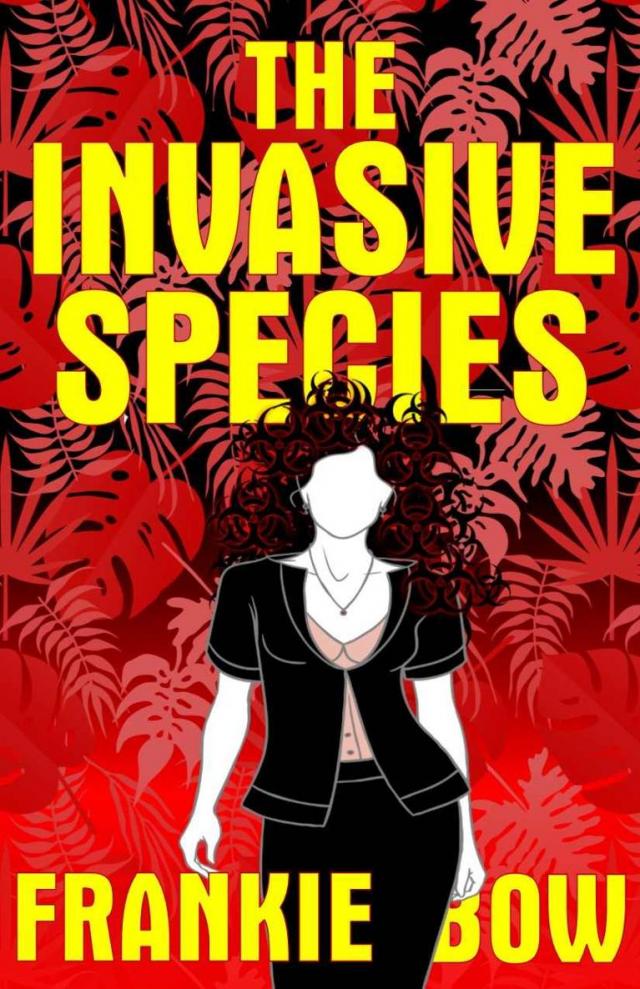
The Invasive Species
Frankie Bow
Contents
Acknowledgments
Chapter 1
Chapter 2
Chapter 3
Chapter 4
Chapter 5
Chapter 6
Chapter 7
Chapter 8
Chapter 9
Chapter 10
Chapter 11
Chapter 12
Chapter 13
Chapter 14
Chapter 15
Chapter 16
Chapter 17
Chapter 18
Chapter 19
Chapter 20
Chapter 21
Chapter 22
Chapter 23
Chapter 24
Chapter 25
Chapter 26
Chapter 27
Chapter 28
Chapter 29
Chapter 30
Chapter 31
Chapter 32
Chapter 33
Chapter 34
Chapter 35
Chapter 36
Chapter 37
Chapter 38
Chapter 39
Chapter 40
Chapter 41
Chapter 42
Chapter 43
Chapter 44
Chapter 45
Chapter 46
Chapter 47
Chapter 48
Chapter 49
Chapter 50
Chapter 51
Chapter 52
About the Author
The Invasive Species
Copyright © 2016 by Frankie Bow
Published by Hawaiian Heritage Press
All rights reserved. No part of this book may be used or reproduced by any means, graphic, electronic, or mechanical, including photocopying, recording, taping or by any information storage retrieval system without the written permission of the authors except in the case of brief quotations embodied in critical articles and reviews.
This novel is a work of fiction. Names, places, characters, and incidents are either the product of the author’s imagination or, if real, are used fictitiously.
Cover images: freepik.com
Edited by Lorna Collins
Library of Congress Control Number 2016938849
To my endemic and our two little hybrids.
Acknowledgments
I could not have written this without the tireless support of my family. Thank you.
Chapter One
“Careful!” I yelled.
“I’m always careful, Molly.” Emma accelerated around the battered Subaru that had been impeding our progress and veered back into our lane just in time to avoid going head-on into the lifted black truck hurtling toward us from the opposite direction.
“Geez,” Emma declared. “People need to learn how to drive.”
We were headed through a thickly forested section of unincorporated Kuewa, down to the Farm Lots subdivision to meet Art Lam. I was excited and a little apprehensive about conducting our first interview with a prominent farmer. Like most of the business owners I had met in Mahina, Art was outspoken and prickly.
The jungle around us looked deceptively calm. Only the top branches of the green canopy overhead flailed and tossed.
“I thought they said the hurricane was supposed to pass us by,” I said. “I hope we don’t get blown off the road. Donnie was worried about us driving down. If anything bad happens, he’s going to be all, ‘I told you so.’ Oh, he said to watch out for the antis.”
“You mean the eco-loonies? Pfft. What are they gonna do to us? All rickety, frail vegans, those guys.”
“I was a vegan for a few months in grad school. It didn’t make me rickety and frail. It made me fat and grouchy.”
“Oh, but Molly. Didn’t you tell Donnie this was for our grant?”
“He was impressed by my being a co-investigator on a federal grant until he realized it was going to mean extra work for me and no extra money. He was like, ‘Oh, so you’ll be even busier than usual, which means I’ll get to see you less. You’ll be more stressed-out when I do see you, and we won’t have any more money coming in. Tell me again why I should be happy about this?’”
“What did you say?”
“The only way I could explain it was, ‘This is who I am. This is what I do.’”
“Right on,” Emma said.
“I told him, ‘I ask questions. I find answers, and I help to advance knowledge. Even when it means driving through a hurricane to interview a grumpy farmer.’”
A blast of wind jolted Emma’s car and spattered her windshield with droplets. Emma swore and switched on the wipers.
“Having a grant keeps you mobile,” Emma said. “It looks good on your CV in case you want to go somewhere else. Especially in your discipline. I mean, how many business communication professors have grants?”
“I would never mention staying mobile to Donnie. He’s already paranoid about it. I don’t know why. He’s afraid maybe deep down I’m planning to leave Mahina and move back to the mainland.”
“It’s a pretty common fear. It’s the reason it takes us a while to warm up to you people.”
“You people?”
“Malihini. Mainland transplants. Immigrants. Invasive species. You move here. You make friends. You decide you can’t hack it here, and you end up leaving us.”
“I’m not going anywhere. Did you just call me an invasive species?”
“So what then? He’s gonna give you a hard time about the grant?”
“No. He said he still didn’t understand why I was doing it, but the most important thing was to have a happy wife. Happy wife, happy life.”
“He actually said, ‘Happy wife, happy life?’”
“I know. It sounds kind of condescending. But I don’t mind so much. It means he and I have congruent goals, right? I can work with that. Are you sure we’re going the right way? This road isn’t even two lanes wide anymore.”
“Speaking of invasive species,” Emma said. “All this stuff that’s crowding us on the sides of the road? This is all strawberry guava. And those trees overhead? Those are Albizia. They’re a menace.”
“The tall ones making a canopy over the road? They look nice.”
“They grow fast, and they’re top-heavy, but they have a shallow root system. So they’re the first thing to fall over in a high wind.”
“Good to know since we’re driving down a road lined with them on a windy morning.”
“I think I saw a couple on your property,” Emma said.
“Oh, Albizia. I knew the name sounded familiar. Donnie’s been after me to get those taken out. But if I do that, my carport and the whole front of my house won’t have any shade.”
“How long have you been married now?” Emma snorted. “You’re still living in your own separate houses?”
“Separate houses are the key to marital peace.”
“I bet that’s not what Donnie thinks. Well, here we are. Art Lam’s place should be up ahead.”
“Emma, what happened over there? Did the wind do that?”
Emma slowed the car and pulled over to the side of the road, where the patchy asphalt disappeared into the jungle. She got out, and I scooted over the center console to exit on her side. We approached the damaged area of the orchard. It looked uglier the closer we got.
“That’s not wind,” Emma said. “Those look like clean cuts.”
I pulled up my tablet and started to snap photographs. I could see the hacked up vegetation used to be a papaya grove. The chopped trees lay askew, their clusters of bulbous fruit still intact.
“They left all of the papayas,” I said. “What was the point?”
“Not theft. Vandalism.”
I continued to snap pictures, turning in a slow circle. Even with the cloud cover, it was too bright for me to see what was on the screen. I’d have to trust I was getting what I wanted. Whoever was responsible for the destruction had started at the side of the road, and made a small incursion into the papaya grove. Further in, the trees stood intact. Maybe the vandals got scared, or caught, before they could finish the job.
“Does this have to do with the biotech debate?” I asked Emma. “Are these papayas transgenic?”
“Probably. Pretty much all the commercially grown papayas in this state are. And have been, since the late 1990s. Funny how everyone’s getting upset about it now. Where were we supposed to meet Art?”
“In the house. I wonder if he knows about this.”
“Molly. Over here.”
I turned toward her, still taking pictures. To give the users an analog experience, the tablet’s designers had built in reassuring shutter-click and film-advance noises. Click, whir. Click, whir. Click—I lowered the tablet slowly.
Emma and I stared at a boot. Which was on the end of a leg. Which had been separated, recently and rather violently, from its owner.
Chapter Two
We sprinted down the road toward Art Lam’s farmhouse, the only building visible on the stretch of narrow road. “Farmhouse” was probably too grandiose name for it. The building was a single-story kit home with battered sand-colored siding and a rust-splotched white metal roof.
Emma and I knocked and rang the doorbell, then tried the front door. It didn’t budge.
“It’s locked,” I said stupidly.
“Of course it’s locked,” Emma scoffed. “Where do you think we are, Mayberry?”
“I can’t get a signal here.” I pressed buttons on my cell phone, fina
“My carrier doesn’t even pretend to get reception way out here. Maybe we should go back and wait by the car till someone drives by and flag them down.”
“Out here? No way. I don’t want to end up with my head in someone’s freezer.”
“Maybe there’s a phone in the house,” Emma said. “I’m gonna look for a way in. What? You get any better ideas?”
Emma disappeared around the corner of the house. I didn’t like the prospect of breaking and entering, but our only other option was to leave the scene without calling anyone, and that didn’t seem right either. I set off after Emma. On the side of the house, access to the two small windows was blocked by heaps of black plastic plant pots and macadamia nut husks. (A byproduct of local mac nut production, the husks apparently make a wonderful mulch for phosphorus-depleted soil. I’d learned all about it in my gardening club.)
“Hey, Emma,” I called. “Maybe we should just drive back up to town until we get a signal—”
A vitreous crash interrupted me.
“Got it,” Emma yelled. I ran around to the back of the house to see Emma’s stubby leg disappearing through a window.
“Emma, what did you do?”
She poked her head back out.
“It was stuck. I hadda break it. Go back around to the front.”
“Where did you learn how to do that?” I followed Emma into the house. It smelled like cigarettes, pine cleaner, and stale coffee.
“Those jalousie windows are way too flimsy. An’ you leave a paint bucket right under the window, you’re just asking to get broken into. Hello?” Emma called out.
We crossed the living room en route to the kitchen.
“Hello?” I echoed. No answer. The house was empty, as far as we could tell.
We finally found a phone, a wall-mounted, rotary dial model.
Emma picked up the receiver and listened, then dialed.
The nine took an excruciatingly long time to ease back to its home position. The two ones, which followed, went much faster.
“Hello?” Emma said. “Eh, we get one emergency. Nah, too late. Address?”
I scrambled to dig through my bag in search of the address, with no success.
“We’re down at Art Lam’s place,” Emma said. “You know Art Lam, right? So there’s a dead body. No, I didn’t ID him. Actually, I don’t know. We’re not sure it’s a whole body.”
I made a face, and Emma shrugged as if to say, “Sorry.”
“We didn’t take a close look,” she continued. “Yes. Yes, I do. No, I’m not. Okay, we’ll wait.”
Emma replaced the receiver.
“They’ll be here as soon as they can.”
“Looks like the eco-loonies mean business,” I said. We were silent for a moment, contemplating Art Lam’s green and gold shag carpet.
“All right,” Emma said. “Let’s get those panes back in the window before the cops get here. As far as they know, we found the door unlocked. Right?”
Chapter Three
By the time the emergency responders showed up, Emma and I were back in her car, quietly watching raindrops streak across the windows. Detective Ka`imi Medeiros rapped on the driver’s side window and signaled us to get out.
Detective Medeiros was a big man. Fortunately, he was equipped with a big umbrella. The three of us stood sheltered from the rain as a uniformed officer and a paramedic, both gloved, poked through the hacked-up papaya trees. Then they stopped. The officer took a photo, and the paramedic crouched down to do something. I turned away, not wanting to see what happened next.
“Professor Barda.” Detective Medeiros scowled at me.
“Detective.”
“You’re a long way from home.”
Ka`imi Medeiros and I had become acquainted the previous summer when a houseguest of mine met a nasty end. Medeiros has known my husband, Donnie, since second grade or thereabouts. Somehow, the familiarity wasn’t translating to any kind of warmth on his part. It was almost as if he believed Emma and I were responsible for the grisly scene in front of us. Our explanation, that we were conducting research, didn’t seem to thaw him.
“Who knew you were coming down here to interview Art Lam?” Medeiros asked.
“Our Institutional Research Board has a copy of our scheduled interviews,” I said.
“Art could’ve told someone,” Emma added.
“Do you know if Art Lam had any enemies?”
“Based on today’s events, my guess would be yes,” Emma said. “Who’d want to kill a papaya farmer, though?”
“Until we ID the remains,” Medeiros cautioned, “we can’t make any assumptions as to the identity of the victim.”
“Art Lam wasn’t in his hou—” I began, cutting it short when I felt Emma’s foot treading firmly on mine.
“Officer, we need to get back to campus.” Emma stepped toward her car. “Will this take long?”
“Just a few more questions,” Medeiros said.
Emma sighed.
After a good hour of relentless and, in my opinion, needlessly repetitive interviewing, I had to say something.
“Detective, my class starts in half an hour.”
“If you’re late to class because of a murder investigation,” Medeiros said, “I’m sure your students will forgive you.”
“Not her accounting majors,” Emma said.
“She’s right, Detective.”
Medeiros sighed.
“Okay, go. But don’t leave the island. We’re going to want to talk to you again.”
On the drive back, the wind intensified, bouncing branches around and pummeling Emma’s little car.
“What a morning. And now I get to teach for three solid hours.”
“Seriously?” Emma said. “What idiot gave you that schedule?”
“Well, I’m the interim department chair. So apparently I’m the idiot.”
“Oh. I almost forgot. What are we gonna put in our notes for today’s interview?”
“Shoot, I don’t know. Remember what Medeiros said? They’re not even sure it was Art Lam.”
“Yeah, hard to recognize him without his head.”
“Emma!”
“Sorry.”
“I don’t want to talk about it anymore. Do you mind?”
“Fine. Hey, so how’s it going with your never-shuts-up student? You have him today, right?”
“Oh, Lars Suzuki. I don’t know what his deal is. Maybe he has some kind of condition.”
“Look it up,” Emma said.
I turned on my phone. “Still no signal. We’ll have to wait till we’re closer to town. Lars is probably waiting for me at my office already, ready to walk me to class and talk my ear off.”
“He does that every time?” Emma asked.
“Pretty much. He seems like a nice kid. He’s just so up. He wears me out. Like an energetic puppy. He would be great to have at a dinner party, though. You’d never lack for conversation.”
When Emma and I got to campus, I took a deep breath and switched to teacher mode, readying myself for an afternoon of what Arlie Hochschild calls “emotional labor.” I had to be upbeat for my students. It wasn’t their fault I’d almost tripped over a dismembered body earlier. They didn’t have to know how I yearned to drive straight home, take a hot shower, climb into my fluffy spa bathrobe, and wait out the storm with a lightweight mystery and a big glass of red wine.