Wish You Were Here (Instead of Me), page 1


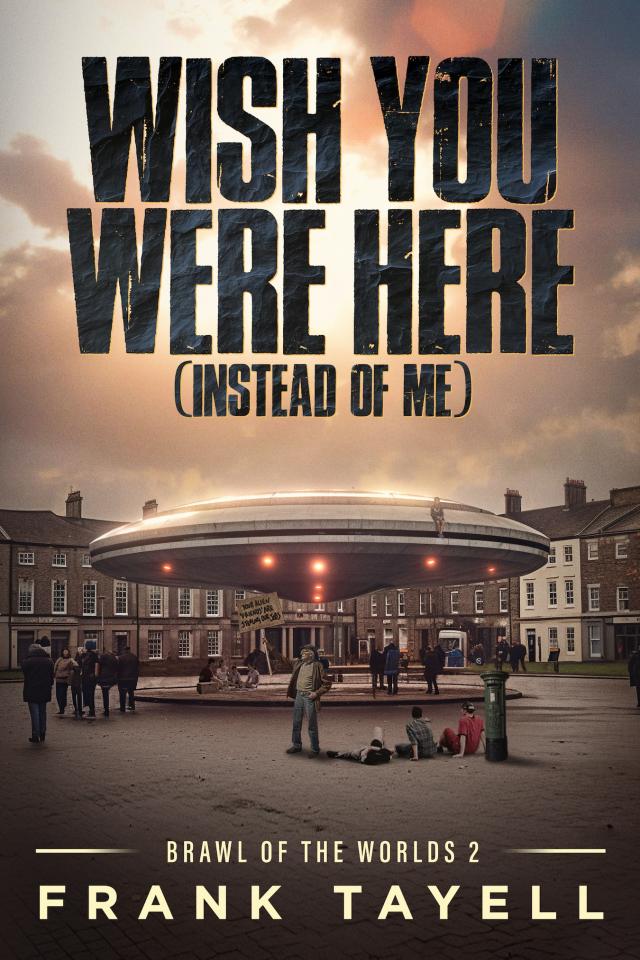
Wish You Were Here (Instead of Me)
Brawl of the Worlds 2
Frank Tayell
Reading Order & Copyright
Where we’ve been is never as important as where we’re going.
Brawl of the Worlds 2: Wish You Were Here (Instead of Me)
Published by Frank Tayell
Copyright 2023
All rights reserved
All people, places, and events are entirely real, though some names have been changed to protect alien hermits currently hiding on Earth.
Science Fiction
Brawl of the Worlds 1: First Contact
Brawl of the Worlds 2: Wish You Were Here (Instead of Me)
Work. Rest. Repeat.
Strike a Match - A Post-Apocalyptic Detective Series
1. Serious Crimes
2. Counterfeit Conspiracy
3. Endangered Nation
4. Over By Christmas
5: Thin Ice
Surviving The Evacuation / Here We Stand / Life Goes On
Book 1: London
Book 2: Wasteland
Zombies vs the Living Dead
Book 3: Family
Book 4: Unsafe Haven
Book 5: Reunion
Book 6: Harvest
Book 7: Home
Here We Stand 1: Infected
Here We Stand 2: Divided
Book 8: Anglesey
Book 9: Ireland
Book 10: The Last Candidate
Book 11: Search and Rescue
Book 12: Britain’s End
Book 13: Future’s Beginning
Book 14: Mort Vivant
Book 15: Where There’s Hope
Book 16: Unwanted Visitors, Unwelcome Guests
Life Goes On 1: Outback Outbreak
Life Goes On 2: No More News
Life Goes On 3: While the Lights Are On
Life Goes On 4: If Not Us
Life Goes On 5: No Turning Back
Book 17: There We Stood
Book 18: Rebuilt in a Day
Book 19: Welcome to the End of the Earth
Book 20: Small Cogs in the Survival Machine
To join the mailing list, and be among the first to know about new titles, click here:
http://eepurl.com/brl1A1
For more information, visit:
http://www.FrankTayell.com
http://www.facebook.com/FrankTayell
Synopsis
Eight weeks after first contact, the people of Earth are handling the news of extra-terrestrial life rather well. Sure, there’d been some petty rioting, light stockpiling, and hasty coups, but not more so than during the pandemic-years.
In Oxfordshire, tourists flock to the exclusion zone set up around the crashed battle-station. Nearby, in the newly named RAF Space Command, Harold Godwin has settled into his new job as a liaison between the British government and the friendly alien federation, known as the Valley. Aside from giving occasional tours to visiting dignitaries, the work isn’t arduous until the search for a missing dog leads to the capture of a hostile alien mercenary.
In Ireland, Serene and Tempest are working as liaisons, too. On the outskirts of Cork, an international conference has begun. The diplomats’ task is straightforward enough, select twenty humans to represent Earth on a ceremonial trip to Towan III. After two months of bickering, they’re still arguing over the conference’s seating arrangements.
Patience among the Valley leadership is wearing thin. In the intergalactic borderlands between the Valley and the remains of the old empire, the Voytay, two fleets are in a stand-off. The Voytay have denied any involvement in the Oxfordshire Incident, but Earth is increasingly looking like the spark that will reignite the century-old conflict. The only hope for peace is to find the remaining enemy agents, both human and alien. That task falls to Sean O’Malley and Greta tol Hakon. Not long into the investigation, a link is found between the recent attack and the discovery of a spaceship on the outskirts of London in 1895, the invasion of Iraq in 2003, and a tunnel beneath the ruins of Nineveh that predates any calendar.
Alien anchorites and ancient prophecies collide, on Earth and in the furthest corners of the galaxy, as the race to stop the war continues.
Table of Contents
First Contact So Far
Prologue - Caves, Tunnels, and Whales
Part 1 - RAF Space Command
Chapter 1 - No Tips for the Tour Guide
Chapter 2 - Through a Scanner Brightly
Chapter 3 - A Waiting Watchdog
Chapter 4 - Dr Griffin
Chapter 5 - Prisoners of War
Chapter 6 - It’s Usually Stalin
Chapter 7 - Area-51
Chapter 8 - One Deal on the Table
Chapter 9 - Spilled Coffee
Part 2 - International Disagreement
Chapter 10 - Diplomacy for Dummies
Chapter 11 - Front Row Seats to a Sermon
Part 3 - The Turning Point in the Civil War
Chapter 12 - Fishing for Mines
Chapter 13 - No Time for a Holiday
Part 4 - The Intergalactic Anchorite
Chapter 14 - Living Saints
Chapter 15 - Jack’s Return
Part 5 - The Revolutionary Returns Home
Chapter 16 - Promises Kept
Chapter 17 - Opened Letters
Chapter 18 - Herbert and the Retired Horse Watchers
Chapter 19 - The Toff and the General
Chapter 20 - A Ship on a Dry Lake
Chapter 21 - The Many Faces of Jack the Ripper
Chapter 22 - The Fundamental Difference Between a Sapiens and a Towani
Part 6 - Disrupting a Funeral
Chapter 23 - Remembering the Dead
Chapter 24 - Gathering Evidence
Chapter 25 - A Shining Beacon on a Runway
Chapter 26 - No Weapons in a Prison
Chapter 27 - What a Difference Twenty Metres Makes
Part 7 - In Our Galaxy, but Still Far, Far Away
Chapter 28 - Imperial Justice
Chapter 29 - Arrival
Chapter 30 - Short Days, Shorter Nights
Chapter 31 - The Best Teeth for Fishing
Chapter 32 - Monochrome Meals and Missing Medicine
Chapter 33 - Waste Not, Want Not
Chapter 34 - On the Thirty-Ninth Day…
Chapter 35 - To Boldly Go
Chapter 36 - The Doors Beneath Our Feet
Chapter 37 - The First Prophet’s Last Prophecy
Epilogue - Chance, Destiny, or a Meticulously Orchestrated Plan
First Contact So Far
20th August 2022, Four Days After First Contact
A man in a suit so deeply black it seemed to absorb the soft glare from the streetlights, and a woman in blue and green motorbike leathers, gloves, and a helmet whose visor was currently down, strolled along the terraced street of Harbour View, Cobh.
“Evening,” the besuited man, Sean O’Malley, said to an elderly couple, then repeated it to the Gardaí officer sipping a mug of tea outside number five.
“No visitors unless you’re expected,” the police officer said.
“Over to you, dear,” Sean said.
The woman slid the visor of her helmet up so the officer could see the grey skin beneath. “I’m Greta tol Hakon, chief of security for this solar system, and I’m pleased to meet you.” She held out her hand, but the officer was too busy staring at her face to notice it.
“What’s your name, lad?” Sean asked.
“T… T… Tony Cullen.”
“I’m Sean O’Malley. She’s here on official business, but we’re trying to keep it a little quieter than on her first visit.”
The officer finally managed a nod and stepped aside.
“Nice house, and with a bit of a sea view,” Sean said. “You know, I think this used to be where old Mr Donovan lived.”
“Can we reminisce later?” Greta said. “This motorbike helmet is pinching in all the wrong places.”
Sean rang the bell. Heavy feet ominously clumped to the door. It was opened by a scowling man in sauce-stained chef whites who was brandishing a long knife.
“Why did you ring the bell?” the chef demanded as if no viler act had ever been committed.
“Hello, Padraig. I’m Sean O’Malley, and we’re related.”
“You might know me,” Greta said, sliding her helmet’s visor up again to reveal her grey face.
Padraig dropped the knife. It speared the carpet and thunked into the floor, vibrating almost in time with his opening and closing mouth.
“Can we come in?” Sean asked.
Padraig slowly nodded. He stepped back, regained his composure, and called for the cousin with whom he shared the house. “Niamh, there’s people!”
“It’s a nice home you have,” Sean said as he stepped into the brightly painted hall.
“It’s not mine,” Padraig said. “It’s Niamh’s mother’s, my aunt.”
Greta pulled the knife from the floor so she could close the door. Thus, when Padraig’s cousin, Niamh O’Keefe, came out of the living room and saw a knife-wielding motorcyclist, it was only natural that she screamed.
“Sorry, sorry, it’s me,” Greta said, putting the knife in the letter rack on the nearby table so she could remove her helmet and reveal her grey face and straw-yellow hair streaked with blue.
“You,” Niamh managed.
“It’s the alien,” Padraig said unnecessarily.
“I can see that,” Niamh said. “Hello. What’s happened? Is something wrong?”
“We’re here to offer you a job,” Sean said. “Both of you. Perhaps we could sit down?”
“Of course. Come in,” Niamh said and gestured towards the living room. Sean and Greta stepped into a room mostly furnished with stout. Pallets of canned beer were stacked against each wall, beneath the table, and in front of the armchair where, with a cushion on top, they were being used as a footstool.
“Are you planning a party?” Greta asked.
“It’s crowded enough already in here,” Padraig said, having retrieved his knife before following them in.
“Would you put that knife where it belongs?” Niamh said. “Every brewery in the land sent beer in case you were to visit again. Help yourself, please.”
“As much as I’d love to, we’re on the clock,” Sean said.
“Sorry, who are you?”
“Sean O’Malley. I’m a distant cousin of yours. Of both of you,” he added as Padraig returned, this time empty-handed.
“Is it tea, or is it coffee?” the chef asked in a tone that suggested there was a correct answer and an answer which would have him return with the knife.
“Tea, please,” Greta said.
“D’you have tea in space?” Niamh asked.
“Of a sort. Most food is synthesised. Printed, in effect.”
“D’ya have milk?” Padraig asked, each syllable laden with menace.
“Cows are unique to Earth,” Greta said. “But there are plenty of other quadrupeds.”
“In your tea! D’ya have milk in your tea?”
“Oh, no, thank you,” Greta said.
“Sorry about Padraig,” Niamh said as the chef stomped to the kitchen. “The part of his brain which processes manners is instead filled with recipes.”
“He’s not the first in our family like that,” Sean said.
“How have things been for you since we last met?” Greta asked.
“Swings and roundabouts, and seesaws, too,” Niamh said. “They’ve restricted the number of visitors to Cobh and have kicked out most of the press. I’m a teacher, and I had a lot of parents, and some colleagues, complain about the lesson me handing you a pint sends. I said that since it wasn’t a lesson I was being paid for, it was none of their business, but that only made things worse. On a sunnier note, the bidding for my life’s story has reached six figures.”
“Don’t accept anything less than eight,” Sean said. “I think your story is about to get much more interesting. Are you still teaching?”
“I am. The children need the routine now that everything is so chaotic. So do I.”
Padraig brought in a tray with a teapot, four cups, and a tray of freshly baked cakes.
“You’ll eat these,” he said with utter certainty.
“When we first met, you didn’t speak,” Niamh said. “Your accent is Irish, and the other… the other towani, the man who gave the television interviews, his is German.”
“It’s all to do with from whom we learned the language,” Greta said. “I learned it from Sean. The ambassador, Johann, learned English and German from a German archaeologist.”
“Johann’s not an alien name,” Padraig said.
“He took the name Johann soon after he settled here. He is Johann tol Davir. Tol means formerly known as. I am Greta tol Hakon. My brother is Gunther tol Dannan. Most Valley citizens who visit this system take an Earth name.”
“The ambassador, in his interview, said you’re descended from Neanderthals,” Niamh said.
“We are. Fifty thousand years ago, five tribes of Neanderthals were enslaved. The legend, the scripture, says that they volunteered to leave so that the other members of the species would be spared annihilation. They were put aboard five ships controlled by monstrous beings who wore the vessels like they were armour. For a thousand years, our ancestors were bred as warrior slaves. Some think those captors might have genetically altered our DNA.”
“And turned you grey?”
“Probably not. We think that occurred after our ancestors settled on Towan I. For a thousand years, they fought. We don’t know who. We don’t know why. But, eventually, they rebelled. Nowan, the first prophet, led the rebellion. After the battle, four of the ships were deliberately crashed on a habitable planet in that system, which they named Towan I in honour of the prophet. The fifth ship, captained by Nowan, left the system in search of our ancestral home.”
“You mean here, Earth?” Niamh said.
“Did he find it?” Padraig asked.
“They. Nowan was non-binary. Many of our people were and are. Our ancestors developed very different social structures during their enslavement in deep space, where they could be moved from cell to cell or ship to ship, without warning. But no, Nowan was never heard from again. Some think they returned to their ancestral home, and searching Earth for evidence of the ancient ship will be a priority for our scientists. Those who crashed their ships on Towan I put everything they had into building new spacefaring vessels. They had to develop mathematics, farming, metallurgy, computing, and so much more. What they didn’t learn until it was too late was what environmental damage this rapid industrialisation would wreak. After a few hundred years, and we’re not sure how many, they were able to return to the stars, but Towan I was, by then, uninhabitable.”
“It still is,” Sean added.
“They began looking for a new home,” Greta said. “Instead of finding one new habitable planet, they found many, and some were occupied. Our ancestors hadn’t forgotten their violent past, and so created a planet-spanning empire. They called their new homeworld Towan II. Empires rise, and empires fall, and so did theirs. Towan II was devastated by war. A different imperial family rose to power and selected a new planet as the new capital, Towan III, which remains the capital today.”
“But it’s not an empire anymore?” Niamh said. “Didn’t the ambassador tell the reporters it was a federal democracy?”
“It is, though our politics is a little more complicated than that. Our federation is called the Valley and comprises two hundred and forty-seven inhabited star systems, many of which have many nations. There are many independent asteroids, moons, and space-stations, too, but democracy, in one form or another, is a pre-requisite for membership of the Valley.”
“Then Earth won’t be able to join,” Niamh said.
“It will, in time,” Sean said.
“A few thousand years ago, a terrible plague wiped out the entire imperial family and billions of others. Four of the most powerful families declared a regency. They created a council with five members. Each member represented one of the five tribes.”
“You said four families. Four is never the same as five,” Padraig said.
“Yes, because one seat on the council was reserved for the lost tribe, the descendants of Nowan. The council allowed any citizen who wished to propose a change in legislation to submit it. With only four on the council, two would always vote for a proposal, and two would vote against it. In the event of a tie, the status quo remained. Under the regents, nothing ever changed. Progress stalled. From spaceship design to taxation, unless it directly benefited the regents, very little happened. The regents were autocratic, tyrannical, and unjust. This sowed the seeds for the revolution.”
“Yes, because the ambassador said that happened in 1888,” Niamh said.
“Which is where and when I enter the story,” Sean said.
“Who are ya?” Padraig asked.
“I’m your uncle.”
“You’re not,” Niamh said.
“I was born in 1868.”
“Get away!”
“I’m nearly two hundred,” Greta said. “Johann, the ambassador, is over seven hundred, which is old, even for towani. Our ancestors cracked cellular rejuvenation technology millennia ago. We think it was developed on Towan I from equipment from those original starships.”
“When I was still just a kid, I went to London to seek work,” Sean said. “My older brother, Liam, was married to Maeve, and they had three children. Two girls and a boy. Liam died. Maeve remarried and took her new husband’s name, and changed that of her children. Her second husband was Peter O’Keefe.”