

The Entity, page 1


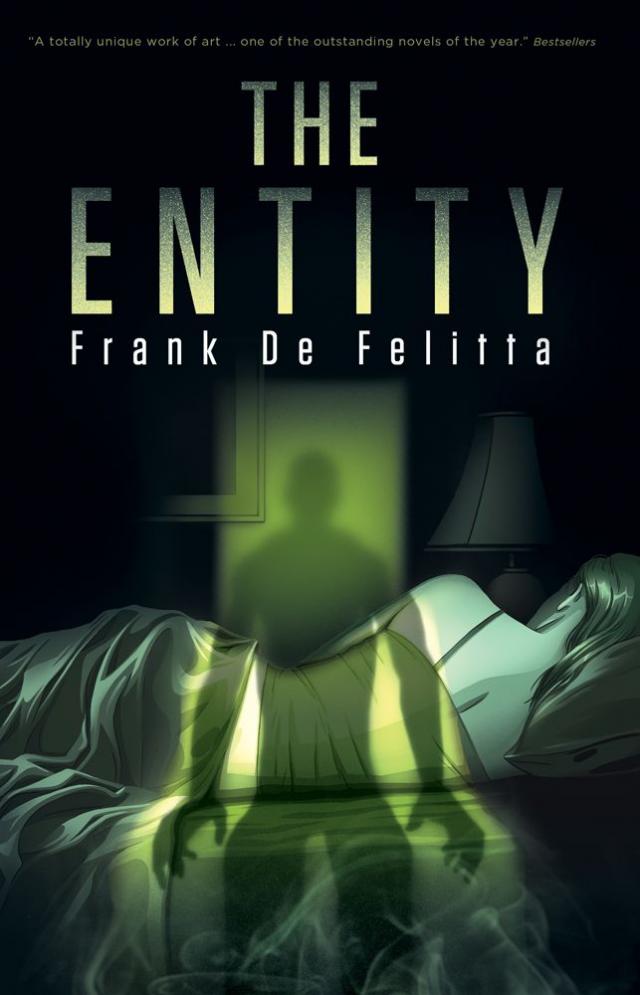
THE ENTITY
Frank De Felitta was born in New York in 1921. He served as a pilot in World War II and in 1945 returned to New York, where he began to write scripts. His first effort, for the weekly radio program The Whistler, a popular thriller series, earned him $350 and started him on his writing career. He continued to write radio scripts before turning to television, in which medium he was successful as a writer, producer, and director, winning Emmy nominations in 1963 and 1968 for his documentaries as well as a Peabody Award and several Writers Guild nominations.
De Felitta’s first novel, Oktoberfest (1973), a thriller, though not a bestseller nonetheless earned him enough to finance the year and a half he devoted to his next—and most famous—book, Audrey Rose (1975). This novel, a horror story involving reincarnation, was a smash bestseller, selling more than 2.5 million copies and spawning a successful 1977 film adaptation (scripted by De Felitta) and a sequel, For Love of Audrey Rose (1982). The Entity (1978), based on the real-life case of a woman named Doris Bither who claimed to have been haunted by a spectral rapist, was also a bestseller and was adapted by De Felitta for a 1982 film starring Barbara Hershey. Other successes include the novel Golgotha Falls (1984) and the cult classic horror film Dark Night of the Scarecrow (1981), directed by De Felitta.
Frank De Felitta’s most recent work is L’Opera Italiano, published as an e-book in 2012. He lives in Los Angeles.
Gemma Files, a former film critic and teacher turned award-winning horror author, is best known for her Hexslinger series (A Book of Tongues, A Rope of Thorns and A Tree of Bones, all from ChiZine Publications), which has just been collected in an omnibus e-book edition. She has also released two collections of short fiction and two chapbooks of poetry. Her next book will be We Will All Go Down Together.
by frank de felitta
Oktoberfest (1973)
Audrey Rose (1975)
The Entity (1978)
Sea Trial (1980)
For Love of Audrey Rose (1982)
Golgotha Falls (1984)
Funeral March (1991)
A Swift Death to Critics (2000)
Inch: A Dark Fable (2006)
L’Opera Italiano (2012)
THE ENTITY
A Novel
by
FRANK DE FELITTA
With a new introduction by
GEMMA FILES
VALANCOURT BOOKS
The Entity by Frank De Felitta
First published New York: G. P. Putnam’s Sons, 1978
First Valancourt Books edition, 2014
Copyright © 1978 by Frank De Felitta
Introduction © 2014 by Gemma Files
Published by Valancourt Books, Richmond, Virginia
Publisher & Editor: James D. Jenkins
20th Century Series Editor: Simon Stern, University of Toronto
http://www.valancourtbooks.com
All rights reserved. The use of any part of this publication reproduced, transmitted in any form or by any means, electronic, mechanical, photocopying, recording, or otherwise, or stored in a retrieval system, without prior written consent of the publisher, constitutes an infringement of the copyright law.
isbn 978-1-939140-92-0 (trade paperback)
Also available as an electronic book.
All Valancourt Books publications are printed on acid free paper that meets all ANSI standards for archival quality paper.
Cover by M. S. Corley
Set in Dante MT 10.5/12.9
INTRODUCTION[1]
[1]Publisher’s note: As the Introduction discusses the ending of the novel, readers unfamiliar with the story may wish to return to it after finishing the book.
Back in the day (1974, to be exact), a woman named Doris Bither moved into a house in Culver City, California, where she apparently began to be subjected to a prolonged series of poltergeist attacks that included a repetitive, violent sexual component . . . something those chronicling the case would later call “spectral rape,” but which mimicked the medieval legend of obsession and harassment via incubus almost exactly. Part of the fascination inherent in Bither’s sufferings almost certainly lay in the idea that all this weird parapsychological drama was playing out within the setting of an otherwise modern neighborhood, as well as the fact that Bither was a complicated woman whose intensely private life—about which she consistently refused to be forthcoming, to the point of refusing even to tell investigators her correct age—already faced a horde of challenges: she was a working-class single mother of four who had survived at least one abusive relationship but continued to date, refusing to discard the sexual component of her life entirely, and though already receiving public assistance, she was attempting to bootstrap her way into a better-paying job by attending secretarial school at night.
In many ways, therefore, though the words feminism or consciousness-raising might not have been part of her everyday vocabulary, Doris Bither—so determined to seize control of her future, to make herself independent first financially, then in every other way—clearly embodied a sizeable segment of the changing face of 1970s American womanhood. So for such a woman to be suddenly literally beaten down by a malign, invisible yet undoubtedly male force on a daily/nightly basis was like seeing some parable of patriarchy in action played out, with all the added horror of anything impossible to quantify physically. Was this her own mind turning on her, or the devil, or God? Some sort of (super)natural law seeking to rebalance the gender-role equation? And what, by extension, did the spectacle of the Passion of Doris Bither bode for everyone around her, whether female or male?
These were the questions that attracted author Frank De Felitta—best known for his 1975 novel Audrey Rose, a similarly “fact-based” tale of reincarnation—to Bither’s case, driving him to reframe it as the subject of The Entity, published in 1978. A former World War II pilot turned radio scriptwriter, De Felitta had already graduated to a career as a TV writer, producer and director by the time he decided to try his hand at novel writing, producing the thriller Oktoberfest, which paid for him to take a year off and write Audrey Rose. After that, he settled into a comfortable routine, intermittently writing successful novels which often served as sales pitches for equally successful movie adaptations; predictably, De Felitta would write the screenplays for these adaptations and was often also involved as a producer.
No exception to this rule, The Entity too went on to become a film, directed by genre stalwart Sidney J. Furie, starring the brilliant and beautiful Barbara Hershey as Carlotta “Carla” Moran, De Felitta’s Bither character. As usual, Hershey delivers a powerhouse performance, though one which would unfortunately be overshadowed by what most critics considered the inherently exploitative content of the film’s premise, as well as some truly unsettling special effects. While comparing the film and the novel which inspired it, however, it’s interesting to note some structural changes that have taken place on the journey from page to screen—especially since it must have been De Felitta who decided to initiate said changes, which alter the tone and climax of the story considerably.
As I’ve said, both versions of The Entity can easily be read as parables about the many ways in which patriarchal energy—both literal and metaphorical—combine to deform one woman’s life, robbing her of her own agency. This is brought to the fore less through the titular creature’s physically damaging attacks than through the well-intentioned yet equally destructive actions of psychologist Doctor Sneidermann (played in the movie by a very young Ron Silver), who Carlotta/Carla connects with through the local university, which offers free counseling to people on welfare. Sneidermann soon forms very definite ideas about where Carlotta/Carla’s problems stem from, none of which have anything to do with a mysterious interdimensional rapist, and are only exacerbated by his own growing attraction to her. He’s sure he knows this stubborn, sexy woman better than she knows herself, and is perfectly willing to threaten to take away her freedom in order to prove it.
In the considerably more optimistic movie, Hershey’s Carla refuses to allow either Sneidermann or the entity to dictate the shape of her life. The former she can simply move away from, and does, but though the latter never does leave her alone, she’s also never defeated by it: victimized, but not a victim. The book’s Carlotta, on the other hand, ends up catatonic and committed, under Doctor Sneidermann’s care—by the final chapter, he has her exactly where he’s always wanted her, and is able to rebuild her entire life around his white-knight fantasies of “rescuing” a damaged woman who literally doesn’t understand her own mind. Worse still, unlike Ron Silver’s version, the book’s Sneidermann never really seems to understand his own motivations; he’s sure he’s the hero, sure he’s doing the right thing, and that if Carlotta refuses to “cooperate” with her own treatment, the onus for his failure will rest entirely on her.
So does De Felitta see the mental health industry as an inherently victimizing structure as well, one which “cures” people by breaking them? In the book, Carlotta’s breakdown does seem to imply Doctor Sneidermann has been right all along, and she really has been manufacturing this incubus as a way to relinquish responsibility for her own sexuality: that she longs to be overborne by an irresistible masculine presence, that she resents her own children enough to reframe them as being complicit in her attacks (the invisible creatures she perceives as aiding the entity, “t
Hershey’s Carla, however, rejects all these aspects of her Doctor Sneidermann’s diagnosis outright, and even though the film certainly doesn’t end up privileging parapsychology over psychology—there’s no outright happy ending here, or final solution of Carla’s problems; the entity remains a factor in her world throughout, probably only ceasing to harass her when she dies—it does very much appear to support this decision. Just as the entity is really only concerned with Carla, De Felitta’s screenplay implies, only Carla’s opinions about the entity are valid, contextually. The situation reduces everything and everyone around her to nothing but potential collateral damage, which probably explains why nothing anyone else thinks seems to have any sort of practical bearing on the matter at hand.
On the one hand, it’s more than a little depressing to realize just how easily The Entity—either version—could translate from 1978 to today, since the socio-political aspects of its narrative are just as relevant as ever, if not even more firmly entrenched and toxically damaging. But then again, this may be why De Felitta’s novel retains its original faux-documentary power, still managing to shock, dismay and create a grinding, growing atmosphere of dread, while also creating a very different (and necessary) sort of role model. Carlotta Moran is a woman—a person—beset by unspeakable powers and pitted against impossible odds, but it’s her innately human qualities of strength masked as fragility, her capacity for adaptation and ability to deal with pain that endear her to us. Like any saint or martyr, she shows us what we can only hope might be the same sort of grace under pressure we too would be capable of, in similar circumstances.
Gemma Files
Toronto
December 26, 2013
THE ENTITY
For Raymond, my son
en-ti-ty (ML entitas) BEING, EXISTENCE: something that has separate and distinct existence, real or imagined.
Acknowledgments
A number of people helped me in one important way or another to write this book. These people are Steven Weiner, who worked on all of it; Barry Taff, Kerry Gaynor, and Doris D., whose lives inspired part of it; Dr. Jean Ritvo and Dr. Edward Ritvo, who generously shared their knowledge and imagination; Dr. Donald Schwartz, who contributed helpful information; Barbara Ryan, whose unique and special insights provided encouragement; Ivy Jones, for her skill at dramatic re-creations; Michael E. Marcus, Tim Seldes, and Peter Saphier, for their continuing support and cogent input; William Targ, my editor, whose perceptive criticism helped to make this a much better book than it was; and Dorothy, my wife, for her constant faith, love, and cheerful good nature.
I would also like to express my gratitude to Dr. Thelma Moss, whose distinguished writings and seminars in parapsychology gently led me through the looking glass and made of me a firm believer in the probability of the impossible.
CONTENTS
INTRODUCTION[1]
THE ENTITY
PART ONE
PART TWO
PART THREE
PART FOUR
EPILOGUE
Addenda
March 23, 1977—Statement made by suspect, Jorge (Jerry) Rodriguez, booked on first degree assault charge, taped in the presence of Officer John Flynn, #1730522.
R: Yeah, look, look, I’m finished. We’re finished. I mean, that was too much, I didn’t dream it. There was something . . . something going on with Carlotta. Something was going on in that room. I . . . what do I tell you? I didn’t see, exactly, something. But I saw what it was doing to her. And you’ve got to understand she was . . . she was in the bed . . . I just came from the bedroom and I was . . . getting ready, you know, I was getting ready to go to bed with her. I turned around and I saw her . . . first I heard her; I heard her first, and she was . . . you know, moaning . . . she’s making noises like, love noises but scared too, like she’s not liking what she’s feeling, I don’t think, and I turn and I think it’s a put-on, like a put-on for me, you know, like “I’m ready for you, poppa.” We were very, very close, we had a good relationship always. So I turn around and I look and . . . I see this . . . like something is pressing her . . . now . . . uh, understand what I’m saying here, it’s pushing . . . her . . . she’s got no clothes on, and I can see her breasts, they’re being . . . touched . . . now, how do I say it, like, it’s not her own hands, you understand, and I think I’m going bugs. I look at this and I say, Jesus Christ, what has she got me, crazy? All of this crazy talk with those kids from the university, am I seeing something? Am I dreaming? So I shake my head, you know, and I look a little closer, I say, you know, this is a put-on, this is a put-on. It’s something she’s doing. I say, “Hey Carlotta, Carlotta . . .” But she doesn’t answer, and her moans are growing louder, and she’s like . . . in pain . . . more pain, and I look closer and I see that . . . that her breasts, they’re being pressed and squeezed, by fingers . . . only I can’t see the fingers, the fingers are pressing them, you know, the nipples are being pressed down, I see her body, like . . . uh . . . you know, it’s jumping, as if someone is on her, pumping away. Oh, my God, I say, Jesus Christ, what the hell is going on here? Then I see her legs, ripped open, pushed open, they’re pulled apart, and she starts screaming, but all the while she’s holding . . . holding . . . someone . . . or something. Her arms are around something. Well, by now, I say, Jesus Christ Almighty, she’s being attacked. I can’t see it, but she’s being attacked. I’m half out of my skull. I don’t know what to think. You know, believe me, I didn’t know what I was doing . . . uh . . . the first thing that come to my hand, I . . . suddenly I find myself standing over her with. The . . . the . . . I went over there with this wooden chair and I smashed it . . . I had to get this thing off her, I had to save her. You gotta understand I love her, at least . . . I loved her. I didn’t want to hurt Carlotta, but it’s that thing, that thing that was on her, that was pressing on her, okay, that was screwing, fucking her. And she making all those noises, and I . . . brought the chair down on them. I smashed it. (Weeps.) I swear to God, as God is my witness, that’s what happened. I saw something. At least I saw something that she was feeling. Something on top of her. I couldn’t see it with my eyes, but there was something there, you gotta believe me, there was something there. I tell you, I’m out of my mind. (Weeps.) If I ever get outta this mess, I tell you I’m gonna take the hell off. She was a great girl, Carlotta . . . I liked her. We had something going for a while. But . . . she’s got something there . . . something there with her. I tell you she’s in trouble . . . She’s in bad trouble. Something’s got hold of her. Something. I don’t know what it is, but . . . Carlotta is in trouble.
Ends
PART ONE
Carlotta Moran
. . . Come, you spirits
That tend on mortal thoughts, unsex me here,
And fill me from the crown to the toe, top-full


