

Redfalcon, page 1


PRAISE FOR THE RICHARD HANNAY RETURNS SERIES
‘Riveting . . . The can-do spirit of Mr Harris’s book evokes a time when it seemed the fate of the world might hinge on the acts of a handful of brave souls. The Thirty-One Kings is old-fashioned in many ways – which is what makes it such a reassuring pleasure to read’
Wall Street Journal
‘The plot whips along, embellished by dogfights, perilous car journeys, personal vendettas and plenty of derring-do – plus a whiff of enjoyable parody’
Daily Mail
‘A loving tribute to Buchan . . . and thoroughly good fun’
The Scotsman
‘This fast-moving tale will delight Buchan fans . . . gripping and fun’
Country Life
‘Harris revives the lost art of the atmospheric, erudite, page-turning adventure story’
Anthony O’Neill
A NOTE ON THE AUTHOR
Robert J. Harris was born in Dundee and studied at the University of St Andrews, graduating with a first-class honours degree in Latin. He is the designer of the best-selling fantasy board game Talisman and has written numerous children’s books including the Artie Conan Doyle Mysteries, a series featuring the youthful adventures of the creator of Sherlock Holmes. His Richard Hannay series has been acclaimed by critics and readers alike. The Thirty-One Kings was listed by The Scotsman as one of the fifty best books of 2017. The second book in the series, Castle Macnab, was published two years later. Robert lives in St Andrews with his wife Debby.
ROBERT J. HARRIS
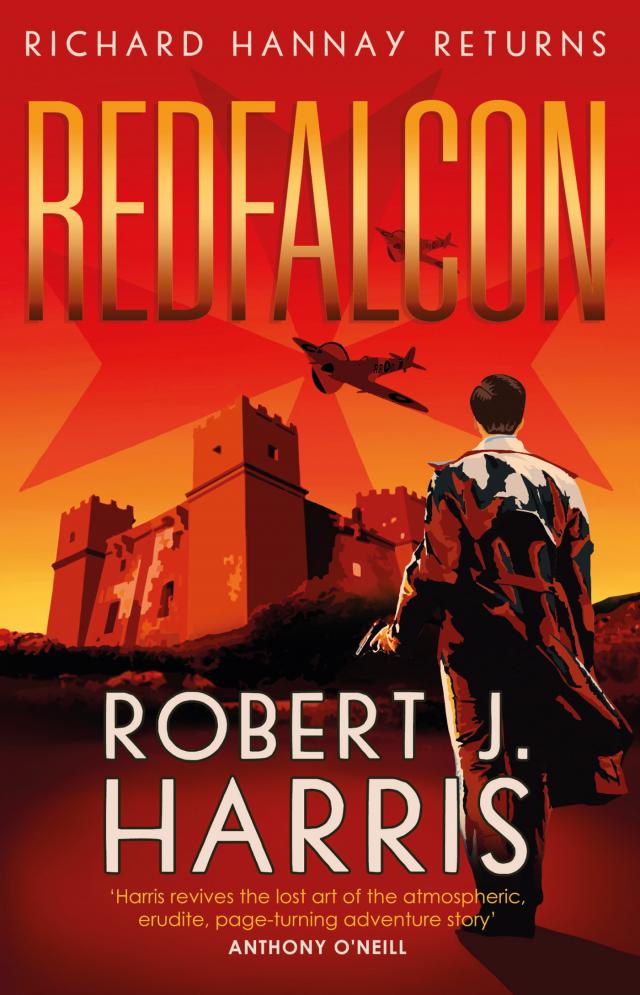
REDFALCON
Richard Hannay Returns
First published in Great Britain in 2024 by Polygon, an imprint of Birlinn Ltd.
Birlinn Ltd
West Newington House
10 Newington Road
Edinburgh
EH9 1QS
www.polygonbooks.co.uk
Copyright © Robert J. Harris 2024
The right of Robert J. Harris to be identified as the author of this work has been asserted in accordance with the Copyright, Design and Patent Act 1988.
All rights reserved.
ISBN 978 1 84697 485 4
eBook ISBN 978 1 78885 661 4
Typeset by 3btype.com, Edinburgh
To Fiona, the Great Woman
CONTENTS
Preface
PART ONE: THE MISSION
1 A Meeting with Lazarus
2 A Surprising Invitation
3 The Red Hawk
4 Footsteps in the Dark
5 A Rogue for Hire
6 A Close Pursuit
7 The Jacobite Rising
8 Glasgow Belongs to Me
9 A Devil’s Bargain
10 The Knights’ Secret
PART TWO: THE ROCK
11 HMS Gibraltar
12 An Encounter with Artemis
13 A Thief in the Night
14 The Warriors of God
15 The Fourth Knave
16 The Cross of Lorraine
PART THREE: THE REFUGE
17 The Shores of Barbary
18 Casablanca
19 The Blue Paradise
20 Antiques and Curios
21 The Game Players
22 The Plagues of Egypt
23 ‘You Are a Gazelle’
24 The Pillars of Heaven
25 The Way to Kedesh
26 Holy Ground
27 The Message
PART FOUR: THE FORTRESS
28 The Lifeline
29 The Adversary
30 The Turn of the Cards
31 Knights of the Air
32 The Besieged
33 The Spark of Hope
34 The Path of Salvation
35 The Face of the Enemy
36 Safe Harbour
Author’s Note
PREFACE
This novel was inspired by the immortal characters and classic stories of John Buchan, particularly the adventures of Richard Hannay and the Gorbals Die-Hards. It was also inspired by the real-life courage of the defenders of Malta, both in 1565 and in 1942.
PART ONE
THE MISSION
1
A MEETING WITH LAZARUS
I suppose every man at some point in his life wonders what he has got left in him. With a wealth of experience behind him and a shortening future to the fore, he must make certain decisions, whether past achievements have given him the right to leisure and contentment or he is honour-bound to strive against the odds up to his very last breath. There had been a period in my life when I had found peace and fulfilment in running my small country estate while enjoying the love of my wife Mary and the occasional company of good friends, but outside events had broken in on my idyll.
First there was the affair of the three hostages, in which Mary played a crucial role, then the business in the Norlands, where our son Peter John, though still in his teens, found himself at the centre of the action. Finally, with the coming of the war, all thoughts of peace and comfort had to be set aside as I was summoned to action once more.
I had returned home wounded from my mission to Paris in 1940, barely escaping the advancing German army. More grievous than any personal injury was the loss of my friend Sandy Clanroyden on that mission, but I knew that his was just one of the many sacrifices our country would have to make if we were to overcome a foe who appeared at that stage to be all but invincible.
Stiffened by the resolve of Prime Minister Churchill, the country stood firm and the threat of invasion was turned aside by our brave pilots, who drove the Luftwaffe from the skies. Peter John, now a grown man, was one of those fliers, his boyhood love of falconry evolving into an obsession with flight that had led him to join the RAF at the first opportunity.
For me, my contribution to the war effort now took the form of a desk job as a special intelligence consultant. It was a high-sounding title, but it meant being shut in my Whitehall office day after day, studying intelligence reports gathered from agents overseas as well as from the government’s secret decoding station, the location of which was known only to a few. I was to review this bewildering array of information and pass on my assessment of enemy intentions, possible infiltration and potential targets.
It didn’t sit well with me to be occupied in safety and comfort while other men were out there taking all the risks. Granted that my speed and physical stamina were somewhat diminished, I still felt that my ability to endure hardship and battle my way out of the most hazardous corner was as strong as ever. I consoled myself with the thought that over the years I had seen more than my fair share of action, and if this was how Richard Hannay could best serve his country, then I would carry out these desk-bound duties with all the determination of a soldier fighting to hold the front line.
All that was about to change when I entered my office on a particularly overcast July morning. It was now 1942 and I had in my pocket a letter from Peter John which had arrived the previous day. In February he and his squadron had been sent to Malta to defend that beleaguered outpost. He was forbidden, of course, to touch directly upon military matters in his correspondence, but even reading between the lines it was clear that things were very rough out there.
The dull weather had cast the office into such a deep gloom that I was forced to switch on the overhead light in order to find my way around. I saw at once a fresh pile of folders heaped high on my desk, a sight which drew a sigh of resignation. I sat down in my chair and glanced at the photograph of Mary which sat off to my left.
She too was now in uniform, heading up the newly formed Royal Nursing Auxiliary. I was one of the few who knew that as well as its genuine medical duties, that organisation also acted as a cover for certain activities of the Special Operations Executive. Churchill had ordered the SOE to ‘set Europe ablaze’, hitting the Germans hard with acts of sabotage and local resistance until such time as we could turn the tide of battle by more direct means.
Mary’s role became especially crucial when the bold and controversial decision was made to train women as agents who would be dropped into occupied France to organise and encourage resistance there. With her back-ground in military intelligence during the last war, she was the ideal person to supervise the training of these new female operatives. She was based now at the SOE’s heavily protected centre at Foxton Castle in Norfolk, and it had been weeks since we had been together. How I longed for the day when all three of us could be reunited once more.
Setting such thoughts aside, I turned my attention to work, massaging a crick in my neck while I reached for the topmost folder. During the night my sleep had been disturbed by the noise of planes passing overhead and one or two distant detonations. My dreams thereafter had been the sort that leave a man tense and unrefreshed in the morning.
I had barely scanned the first page of the file when one of my aides, young Corporal Howell, entered my office and saluted smartly.
‘A message has come in for you, sir.’ He added meaningfully, ‘On the blue phone.’
I was well aware that particular telephone number was known to only a select few. ‘A message from whom?’
‘The caller didn’t say, but he was very insistent that you go at once to this address.’
He handed me a piece of paper and I recognised the location at once. I pushed aside the stack of reports and stood up. ‘Fetch a car, please, Howell, and drive me there.’
Howell saluted again and hurried to obey the order.
Minutes later we were headed directly to Traill’s bookshop in Mayfair, which was owned by my American frie
As soon as we pulled up, I leapt from the car and felt my stomach lurch in shock at the horrifying sight. The bookshop had been utterly destroyed by a German bomb and in its place was a pile of shattered rubble. Somewhere under that heap would be the collapsed remains of the secret inner room where I had more than once met with my old friend to plot and plan. The breeze kicked up handfuls of charred pages from the burnt books and sent them twirling through the air like dead leaves. The area had been roped off and through a haze of dust I saw the rescue workers picking their way through the mound of bricks and mortar. It was clear from their weary movements and gloomy expressions that they held out no hope of finding anyone alive.
People passing in the street had witnessed so much destruction, and some of it much worse, that they scarcely spared a glance for this latest evidence of the ongoing enemy assault. One thin figure, however, stood alone on the other side of the road, his hands buried in his pockets, his eyes fixed upon the desolate scene. I recognised him at once as the austere clerk who looked after the shop and served as Blenkiron’s first line of security.
I dismissed Howell, telling him I would make my own way back to Whitehall. Then I approached the grim watcher. He recognised me at once and shook his head in glum resignation to the unkindness of fate.
‘Henry, isn’t it?’ I said by way of greeting.
He nodded. ‘A sad day, sir, a very sad day.’
I glanced over at the ruined bookshop and scarcely dared give voice to my fears. ‘Mr Blenkiron?’
‘He was working late last night, sir, at his confidential business. He would surely have been in his inner office when the bomb fell. I have been to his apartment to check, and he never returned home.’
Contemplating the shattered building, I clenched an angry fist. It seemed impossible that the enemy could be so precise in their bombing, and yet Blenkiron had long been a prime target for them. There was something not right about this, I felt, some sense of a deeper plot at work that made me uneasy.
I was stirred from my suspicions when Henry directed my attention to a café at the end of the street. ‘Might I suggest, sir, that we share a coffee, a sort of toast to Mr Blenkiron’s memory?’
This invitation from so austere a man was as welcome as it was unexpected and I readily agreed. The thought of going back to my office to work my way through an endless stream of complex reports did not appeal. In my present state of grief and frustration, my judgement was likely to be seriously impaired.
There were only a few customers in the café and none of them paid us any attention as we entered. The clatter of plates, the low murmur of conversation and the sharp hiss of a heated urn brought a comforting sensation of domesticity into this most solemn of mornings.
Henry directed me to be seated at a small wooden table while he fetched our beverages. He returned with two cups of hot black coffee which he set down as deftly as a waiter at the Ritz. Straightening, he appeared strangely hesitant to be seated when I waved him to the empty chair. ‘Perhaps we can share a few reminiscences,’ I suggested.
Henry answered with a strange expression on his hollow-cheeked face. ‘I don’t think that will be necessary, sir.’
I was quite baffled by this response, and then I heard a familiar sound behind me. It was the riffling of a thumb being drawn over the edge of a deck of cards and it immediately jogged an image in my memory.
The recognition prompted me to turn about sharply towards an adjacent table. Here I saw a large, stout man in an overcoat toying with a well-worn pack of playing cards. His features were initially concealed beneath the brim of his fedora, but now he looked up to reveal a face that, despite the lines of age, still retained that cherubic quality I knew so well.
‘Blenkiron!’ I gasped under my breath.
I was so relieved and delighted to see my old comrade alive, it was all I could do not to leap up and embrace him. I realised that his apparent death must be part of one of those devious schemes he was so fond of devising, and that the last thing I should do was draw attention to him.
With a mischievous twinkle in his lazy eyes, John Scantlebury Blenkiron hoisted up his substantial bulk and transferred it to the seat opposite me, bringing his coffee with him. Henry had already vanished without a sound.
My old friend laid the playing cards to one side. ‘I got through five games of solitaire waiting for you to show up,’ he drawled. ‘Here, let me sweeten that a bit.’
He pulled a hip flask from his pocket and added a dash of brandy to each of our cups. ‘I know it’s still early enough for the birds to be wiping the sleep out of their eyes, but this is in the nature of a farewell toast.’
‘I’m just relieved it’s not a wake,’ I said as we clinked cups and took a swallow. The bitter taste of the coffee was indeed much improved by the added ingredient. ‘So the bomb . . .’
‘. . . was an explosive I set myself before sneaking out the back way. Let’s face it, it’s pretty much how my detractors would have wanted me to go, blasted to smithereens by one of their five-hundred-pounders.’
‘I suppose it was you who made the phone call that brought me here,’ I guessed. ‘I must say it was a bit of a filthy trick, giving me a turn like that.’
‘It was,’ Blenkiron acknowledged, ‘but it guaranteed that anybody keeping watch on the shop to make sure I was dead would have taken your reaction as confirmation that I was a stone goner. I flattered myself that my friendship rides high enough in your estimation for my decease to hit you pretty hard.’
‘I should say so,’ I agreed ruefully.
‘So you’ll appreciate that I’ve kept your period of mourning to a bare minimum. Though I do need you to keep up a glum show for everybody else’s benefit. The fewer souls who know I’m walking around like Lazarus, the better.’
2
A SURPRISING INVITATION
‘But Henry was in on the trick all along,’ I surmised.
Blenkiron indulged in a low chortle. ‘Sure, but that stony face of his never gives anything away. Take my advice and never play poker with that gent.’
I tapped the side of my cup. ‘You said this was in the nature of a farewell toast.’
He took a swallow and smacked his lips. ‘You know better than anyone, Dick, that over the years I’ve done our enemies more than a few bad turns. Now that the gloves are off they’ve been itching to pay me back in spades, so it seemed like a smart move to make them think I’ve shuffled off this mortal coil.’
‘And where exactly are you shuffling off to?’
‘Well, not to Buffalo,’ he joked. ‘I’ll be on a flight to Washington tonight. Mr Roosevelt wants to pick my brains about how things stand here in Europe. He’s also mighty interested in any notions I have about stiffening up the security of our own country.’
‘You’re going to be a very busy man,’ I predicted.
‘Just like you, Dick. I hear they’ve loaded you with a job as a heavy thinker too.’
‘That just goes to show how fallible the military mind can be.’ I laughed.
Blenkiron scrutinised me through narrowed eyes. ‘It suits a fellow of my bulk well enough to just settle into an easy chair and put his brain through its paces, but I know it doesn’t sit well with a man like you.’
I gave a grunt of resignation. ‘You know what those sheafs of reports are like. It takes the patience of a saint and the eye of an eagle to pick out whatever’s worthwhile in them.’
‘Well, if you’re getting restless, I may have something for you.’ He slid an envelope across the table to me. On it was typed my name: Major-General Sir Richard Hannay.
As I laid a finger upon it, I felt a tingle of excitement, as though whatever was inside carried a perceptible electrical charge.


