Among the Stars: Fiction River Presents, Book 8, page 1


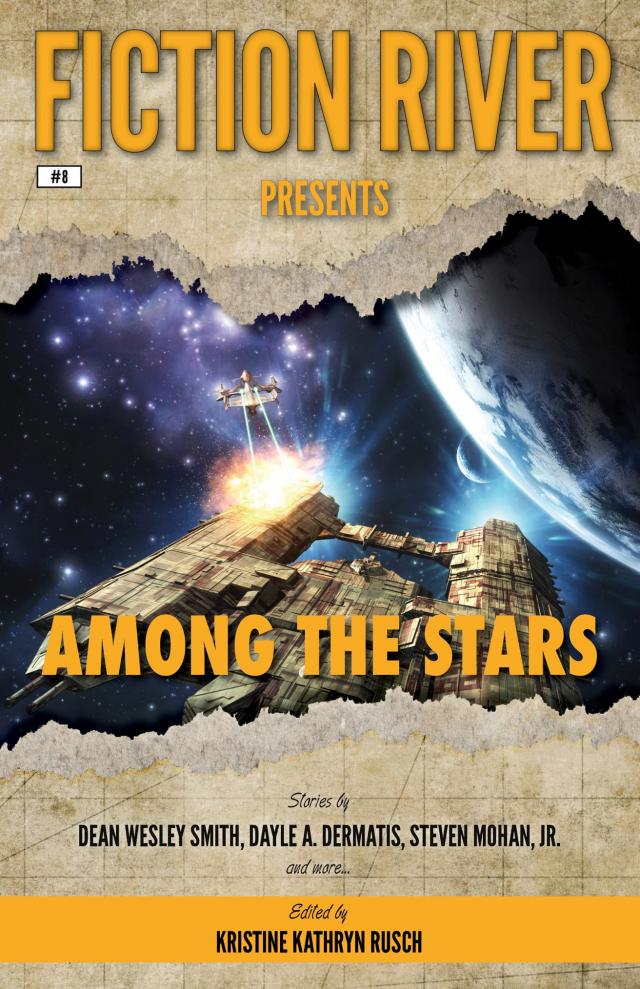
Fiction River Presents
Among the Stars
Edited by Kristine Kathryn Rusch
Series Editor
Allyson Longueira
Contents
Introduction
Dayle A. Dermatis
Get Inside
Kristine Kathryn Rusch
Sole Survivor
Jamie McNabb
The Mooring Buoy
Kim May
Schrodinger’s Bar
Brigid Collins
Upon_a_Starship.pgm
Louisa Swann
Jelly’s Heroes
Dean Wesley Smith
Dreams of a Moon
JC Andrijeski
Charlie Company
Steven Mohan, Jr.
H-Hour
About the Editor
Introduction
Whoosh!
Sometimes I label the space opera subgenre of science fiction as stories in which spaceships go whoosh! That’s not an entirely fair description, but people seem to understand it. We all know that spaceships make no audible noise as they travel through space, because there is no air in space, and what we hear as sound is actually vibrations in air.
I say the description isn’t fair because a lot of space opera is filled with silent spaceships and modern science. Military science fiction often gets lumped into space opera as well, because military sf is concerned more with the military tropes than the hard science tropes.
What I love about space opera is its inventiveness. It doesn’t shy away from whooshing spaceships—and might even come up with a way that spaceships would make that noise (maybe for the passengers inside the ship, if nothing else).
Space opera is more concerned with the adventure and the gosh-wow aspect of space travel than it is with the how-tos of space travel. If a space opera story has a group of colonists who are trying to get to a planet, we won’t read about how they put their ship together or the details of the colonization. We’ll probably read about the colonists trying to survive the trip when they get invaded by pirates or the colonists having a revolt on the ship.
Space opera is something adventurous and innovative, something that makes us want to go to space, rather than looking at space as something only the most brilliant and athletic among us can do.
I also like the problem aspect of space opera—what if teenagers go to space? Would they do teenage things to each other? What if there’s a nifty bar at a space station that everyone wants to go to? What if the best people to travel in space are the ones who can survive the time paradoxes created by relativity?
Those ideas and more fill this book. All of the stories come from Fiction River—different volumes of Fiction River, since Fiction River mixes genres a lot.
Fiction River also mixes moods, and so does this volume. From the pulse-pounding terror of Dayle A. Dermatis’s “Get Inside” to the darkness of JC Andrijeski’s “Charlie Company” to the sheer inventive joy of Louisa Swann’s “Jelly’s Heroes,” we pretty much cover the light and the dark of space. We have plausible military sf stories, like former Naval officer Steven Mohan, Jr’s “H-Hour” to wonderful wish-fulfillment like Dean Wesley Smith’s “Dream of a Moon.”
A number of other stories inspire or will make you smile. Or, at least, they made me smile.
So settle in your chair and prepare to join some marvelous folks on their journeys to the stars. You’ll have a great time.
I promise.
—Kristine Kathryn Rusch
Las Vegas, Nevada
February 24, 2019
Get Inside
Dayle A. Dermatis
Dayle A. Dermatis is one of Fiction River’s most popular authors. She writes beautifully in many genres, and because she does, she has appeared in eighteen volumes of Fiction River. This story first appeared in Feel The Fear, although I keep thinking it’s a Pulse Pounder story. (She has other stories in the Pulse Pounder volumes.) She has published hundreds of stories in a variety of genres, as well as one of my favorite novels, Ghosted. Check out her newsletter at www.DayleDermatis.com for a free story every month.
I started the volume with “Get Inside,” because it does everything I love about space opera. A protagonist who is inventive, but in over her head, something inexplicable, and space itself.
Get ready for a heck of a ride….
Very funny, guys.”
I could still hear the other kids’ laughter through my helmet comm as I tugged on the space station door they’d somehow wedged shut. Behind me, nothing but the vastness of dark and stars; Earth was on the other side of the station, the sun on the other side of Earth.
Then the giggling stopped, probably because they’d taken off their helmets. I was left alone with the rasp of my own breath and the insistent throb of my heartbeat in my eardrums, punctuated by the looming silence of space. I was used to being alone; you’d think this wouldn’t bother me.
It’s one thing to be ignored, or to be called Doody Judy (seriously. As if we were all still in kindergarten). It’s another to be locked outside in space.
I banged on the latch that was supposed to release the thick metal door. Nothing. Surely someone would come back and open it soon.
Right? “Guys, come on. Open the door.”
My words went nowhere. Bile rose in my throat, burned my tongue, as it occurred to me that the bunch of stupid teenagers, my supposed peers, who’d never much liked me anyway, could just as easily forget what they’d done. Or not care.
On paper, to the adults, shipping kids off to space for school—the most remote prep schools you can imagine—made sense. It cut down on Earth’s overcrowding. More importantly, it was a closed, safe environment for us. There was nowhere to run off and play hooky. There was no way to obtain drugs or alcohol; any contraband would be caught in the entry scanners. We all—girls and boys alike—received birth control shots, so even if we fooled around, there’d be no unfortunate physical byproduct.
Adults have no understanding of how creative teenagers can be when they want to act out. We will always find a way.
In this case, turning on our grav boots and playing tag on the outside of the space station had seemed like a grand idea. Bouncing around on the white metal, dodging around antennae and solar panels and sensor arrays, surrounded by all that space—that was more fun than running around in the gymnasium.
Until everyone else decided to lock the one they didn’t like outside.
Sweat trickled down my back, and my helmet filled with the stench of my perspiration, too strong for the air filters to handle. I pounded on the latch, and got nothing for my efforts but a sore fist. For safety’s sake, the door doesn’t lock from the outside, to keep one of us idiot teenagers from doing something radically stupid and getting ourselves killed. Which, given my predicament right now, made a certain amount of sense.
Oh, the inner door wouldn’t release until the outer door was sealed and the compression was equalized, but that was automated and there were checks and triple-checks to ensure that never failed.
I stopped my efforts, clung to the handgrip beside the door, clumsy in my gloves, and closed my eyes. Tried to steady my breathing. I was scared to look to see how much oxygen I had left.
“It’s not funny, guys,” I said, hating how weak and thin my voice sounded. “Hello?”
If they’d taken off their helmets, I was talking to myself. Brianne had jammed the comm signal between our helmets and the staff’s earpieces, so I couldn’t even contact a teacher for help.
Of course, if I did that, I’d be a pariah. The truth of our out-station shenanigans would be revealed, everyone would be punished, and I’d be more of an outcast than I already was.
Shunning, or death. Some choice.
The mental calming exercises my therapist had taught me weren’t really working, but I was able to step back from my panic just a tiny bit and look at the problem logically.
“Okay,” I murmured aloud, which is what I always did when I had to work through a problem. (I’d learned to do it without sound, but that still looks like you’re talking to yourself—see, e.g., outcast weird kid.) “Okay. They wouldn’t let you die.”
Would they? Honestly, I wouldn’t place a bet on that. They wouldn’t mean to, but they’d likely wait until the last minute, and any number of things could go wrong.
It was 2 a.m. ship time, thereabouts. Of course we’d snuck out at night. Brianne and James had rigged the sleeping quarters to indicate we were still inside, in case anyone checked the monitors. Like I said, never underestimate bored, creative teenagers—especially the cream of the crop, top of the intellectual heap.
Rise and shine was at seven a.m., with breakfast at eight and classes starting at nine. By then I’d definitely be noticed missing—maybe by breakfast—but by then I’d be a corpse stuck to the side of the space station by my gravity boots. Suits didn’t carry that much oxygen.
“Okay,” I said again, swallowing against the acid tickling my throat. Science wasn’t my strongest subject, but we’d been given safety precautions, right? And I was far from stupid, even though right now my brain felt like oatmeal.
They’d jammed the door somehow. I just needed to figure out how to unjam it.
It took a few moments for me to pry open the case next to the door, the fat fingers of my glove making every motion slow and clumsy.
I stared at the computer panel until my vision blurred from tears of frustration and despair. I blinked hard, screwing up my face, willing myself not to voice the sob that rose in my throat. I was kidding myself: I had no idea what to do. Brianne and James were the computer geniuses. If that’s how they’d jammed the door, I had no hope of figuring it out. If they’d jammed it physically, there was nothing I could do from out here.
Okay. Back to waiting it out. They weren’t stupid. They wouldn’t really let me die.
They wanted me to be afraid, and if I didn’t give them what they wanted, it would stop being fun for them.
“Right, guys. Like I said, really funny. You got me. This is what I get for being the last one to go inside. Anytime you’re ready, you can open the door. Can’t say I’ve got all night, given my oxygen levels, but hey, I—”
That’s when I knew.
That’s when I felt it. The tightness in my chest, making it hard for me to choke air into my lungs. A prickling on the back of my neck, not from my hair stuck to the sweat there, but from the incontrovertible, primal knowledge, dredged up from some subconscious ability—
There was something behind me.
It didn’t matter that there was no possible way anyone—anything—could be there. I just knew. Every nerve in my body screamed the truth at me.
I didn’t turn my head and look. I couldn’t. The muscles in my neck had locked down, pain flaring into the base of my skull as my jaw clenched shut.
My eyes squeezing shut, well, that was conscious on my part. If I didn’t look, I wouldn’t see…
No no no no no no…
There was no sound (there is no sound in space). There was nothing visible (I opened my eyes but kept them locked on the hatch, and with the sun behind the Earth, there could be no shadow, and nothing crept around the limited peripheral vision my helmet provided). No smell, no taste, no touch, but fuck that, I knew, and my entire body seized up, waiting for something to happen, something to touch me or slither around in front of me.
I was breathing too fast—using up my air far too quickly, which panicked me more, and my face shield was fogging up, starting around my mouth and nose. Sweat dripped off my forehead into my eyes, stinging, blurring my vision, so that even if I wanted to look (which I didn’t), I wasn’t going to see anything anyway.
Which made it worse.
And that was when I lost my shit.
I begged and screamed and pleaded until I was hoarse, pounding on the door until my hand hurt so bad I couldn’t stand it, but I still couldn’t stop.
Apparently I sounded insane enough that they let me in, and when I still wouldn’t stop screaming, the sound rough through my abraded vocal cords, even Brianne wasn’t stupid enough not to find a responsible adult.
Although it turned out adults were the last thing I needed.
Like the rest of the space station, Mr. Trask’s small office was white. The theory was that anything reminding us of Earth would make us homesick and maybe even claustrophobic, so there were no pictures of the ocean or photos of trees or even a nice potted plant anywhere. He had a small window, currently facing the stars as the hub slowly rotated, and shelves along two walls containing old printed books and a collection of antique little metal toy cars from, I don’t know, a thousand years ago.
Over his head was an abstract print in blues and greens. I saw a tiger. Or maybe a tree. It might have been some kind of test.
While his own chair was ergonomic, not decorative, the chair across from it was slightly oversized and padded to the point that you felt as if you were sinking into it. I couldn’t decide if the feeling was comforting or if it reminded me of being slowly eaten.
I resisted the urge to wrap my arms around myself. I hadn’t been able to get warm, really warm, since being locked outside.
My right hand was in a splint; I’d broken a few delicate bones hitting the door. My voice was still hoarse, but my throat was healing after several days of not being allowed to talk.
Mr. Trask was long and thin, even his nose, as if he’d been stretched. I wondered if he didn’t get enough exercise, which was crucial in space to prevent bone and muscle loss. I preferred Ms. Yang, my therapist back on Earth, who had the benefit of being female and thus seemed to understand my problems more astutely. Mr. Trask seemed overwhelmed and distracted, which made me wonder how many of us he counseled.
Privacy laws meant he couldn’t tell me, but if I had to guess? Probably all of us.
He smelled like garlic and basil, but then, probably so did I, and everyone else, because we’d had spaghetti Bolognese for lunch.
“Judith,” he said, folding his hands on his lap and leaning forward slightly. “How are you feeling?”
I’d realized pretty quickly that the school’s first priority was to cover its own ass. Making sure I was okay—and thus my parents wouldn’t sue—was the primary objective.
I couldn’t really fault that, honestly.
“I’m healing,” I said, lifting my splinted hand. “Has anyone gone outside to check for…anything unusual?”
Mr. Trask tried to keep the expression out of his watery blue eyes, but he failed. I saw that annoyance.
“All the sensors have been checked and double-checked, Judith,” he said.
“Sensors can be wrong,” I said. “Or maybe what was out there doesn’t register on our senses.”
“Then it’s not going to register for anyone who goes out there,” he said, his voice level and reasonable. He paused, then said, “Judith, what you experienced isn’t uncommon. Space amplifies agoraphobia—even for people who’ve never experienced agoraphobia. It’s perfectly normal that you panicked when you thought you were trapped outside.”
After I woke up from behind sedated, I’d done my best to mitigate the damage to my reputation by insisting that my being locked outside was my own fault. I’d lagged behind, I said, and it wasn’t anyone’s fault to notice I hadn’t been with them. And if the door had been jammed, it wasn’t deliberate—or maybe I’d just overreacted and thought it was jammed.
We’d all gotten demerits for being out after curfew and being outside of the space station—including me—but nobody had gotten in trouble for anything more than that. I’d seen relief on the face of every other kid who’d been out there with me, but they still shunned me.
At least they weren’t making fun of me.
They wouldn’t be making fun of me if they’d known what had happened to me out there. If they knew what was out there.
I reached for the clear plastic tumbler of water on the shelf next to me, took a sip to counteract the sudden dryness in my mouth, hoping my hand wasn’t shaking, hoping the fact that I’d just broken out in sweat wasn’t immediately obvious.
I wanted to go home, but I didn’t want to go home. I didn’t want to get on the shuttle back to Earth, because the shuttle felt way more vulnerable than the station.
What I really wanted was people to believe me, but it was clear that if I didn’t walk a fine line, I was going to get shipped home anyway. While medicated.
“I want to see the footage of when I was out there,” I said.
“I don’t think that’s a good idea,” Mr. Trask said. Now he frowned; my request had been unexpected. “It can only upset you…”
“No,” I lied, against the pounding of my heart in my eardrums, “if I don’t see anything, I’ll feel better, won’t I?”
But I didn’t believe I wouldn’t see anything.
And that scared the shit out of me.
In the end, the person who had the power to make the decision agreed. And I was back in Mr. Trask’s office. We’d had tamales for lunch, and the scent of onions seemed trapped in my hair; I could smell it even though I’d pulled my hair back in a ponytail.
And it still felt cold in here.
His work station slid out from the wall; a horizontal desk from which rose an angled screen. He let me sit in his office chair so I could scoot closer.