

Marry Me by Midnight, page 1


This book is a work of fiction. Names, characters, places, and incidents are the product of the author’s imagination or are used fictitiously. Any resemblance to actual events, locales, or persons, living or dead, is coincidental.
Copyright © 2023 by Felicia Grossman
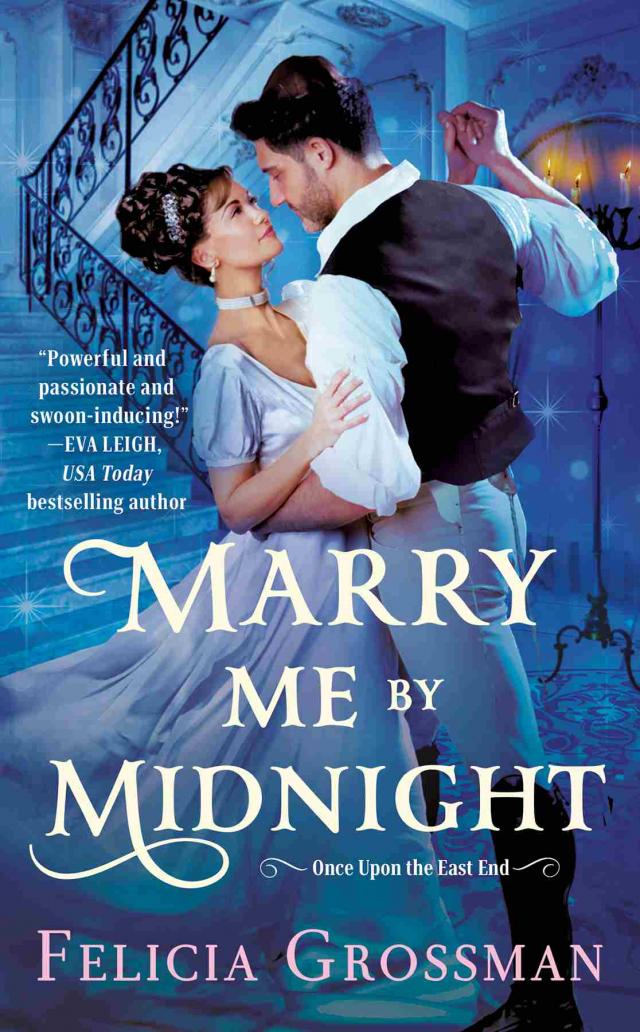
Cover art and design by Daniela Medina. Cover images © Shirley Green Photography. Cover copyright © 2023 by Hachette Book Group, Inc.
Hachette Book Group supports the right to free expression and the value of copyright. The purpose of copyright is to encourage writers and artists to produce the creative works that enrich our culture.
The scanning, uploading, and distribution of this book without permission is a theft of the author’s intellectual property. If you would like permission to use material from the book (other than for review purposes), please contact permissions@hbgusa.com. Thank you for your support of the author’s rights.
Forever
Hachette Book Group
1290 Avenue of the Americas, New York, NY 10104
read-forever.com
twitter.com/readforeverpub
First Edition: August 2023
Forever is an imprint of Grand Central Publishing. The Forever name and logo are trademarks of Hachette Book Group, Inc.
The publisher is not responsible for websites (or their content) that are not owned by the publisher.
The Hachette Speakers Bureau provides a wide range of authors for speaking events. To find out more, go to hachettespeakersbureau.com or email HachetteSpeakers@hbgusa.com.
Forever books may be purchased in bulk for business, educational, or promotional use. For information, please contact your local bookseller or the Hachette Book Group Special Markets Department at special.markets@hbgusa.com.
ISBNs: 9781538722541 (mass market), 9781538722558 (ebook)
E3-20230623-JV-NF-ORI
Contents
Cover
Title Page
Copyright
Content Guidance
Dedication
Chapter One
Chapter Two
Chapter Three
Chapter Four
Chapter Five
Chapter Six
Chapter Seven
Chapter Eight
Chapter Nine
Chapter Ten
Chapter Eleven
Chapter Twelve
Chapter Thirteen
Chapter Fourteen
Chapter Fifteen
Chapter Sixteen
Chapter Seventeen
Chapter Eighteen
Chapter Nineteen
Chapter Twenty
Chapter Twenty-One
Chapter Twenty-Two
Chapter Twenty-Three
Chapter Twenty-Four
Chapter Twenty-Five
Chapter Twenty-Six
Chapter Twenty-Seven
Chapter Twenty-Eight
Chapter Twenty-Nine
Chapter Thirty
Chapter Thirty-One
Chapter Thirty-Two
Chapter Thirty-Three
Chapter Thirty-Four
Acknowledgments
Discover More
Author’s Note
About the Author
Fall in Love with Felicia Grossman!
Content Guidance
This book contains grief, familial death (death of a parent), limited violence, and discussions of antisemitism.
For my dad: the self-anointed best-dressed man in Wilmington. The ride was far too short, but not one did it like you. You are and will always be loved and missed.
Explore book giveaways, sneak peeks, deals, and more.
Tap here to learn more.
April 1832
Aldgate, London, England
If one wanted to hide, the front row of the women’s balcony in the Great Synagogue at Duke’s Place was not where to do so. But hiding wasn’t part of the plan, no matter how tempting. Staying at the top of London’s Jewish community required a particular type of husband. And to land him, public perfection was required. Or at the very least, expertly feigned perfection.
Luckily, projecting an ideal image was—like for her father before her—Isabelle Lira’s specialty.
With deliberate angling, Isabelle raised her neatly bound, personally commissioned, English-transliterated prayer book. She held the volume high enough that the small metal sequins dotting her sleeves, which sparkled against the light streaming from the giant arched windows, drew every eye to her position.
“Performance time,” she whispered to herself as the murmurs echoed over the cantor’s voice.
Framed between the proud Ionic columns, she adjusted the velvet ribbon holding her bonnet in place, the dark blue chosen to make the black of her hair gleam, highlighting her best features.
Most who attended the Great Synagogue were not in the Liras’ social circle. Except for holidays—when her family made an appearance at Bevis Marks, the congregation long favored by the Sephardi side of the Jewish community—they mainly used the private synagogue in their Mayfair townhome.
But with leadership from the Sephardi and Ashkenazi sides now united, she’d be foolish not to at least give the appearance of considering their men for the husband she currently required. After all, thanks to several Ashkenazi’s rising fortunes, some gentiles were even willing to enter business relations with them now—despite their “newer” presence on English shores.
“Tip your chin a little,” her grandmother hissed against her ear. “Everyone is dying for a glimpse of your face, so let’s show it off to its best effect.”
“A good thing we maximized my physical charms, then.” Such was the purpose of the artfully applied soot and powder, as well as the beeswax she’d donned. Not that she needed to remind her grandmother—they’d already had a row over the enhancements earlier that morning. But given the approving murmurs from below, Isabelle had clearly been in the right.
Isabelle adjusted her ankles behind the metal crosshatched barrier further dividing the women from the men. “Everyone received the invitations for the festivals yesterday, guaranteeing we are at the forefront of their minds. It’s only polite to give people the gossip they crave.” Squaring her shoulders, she gazed over the covered, swaying heads of the men below. “And the gown is flawless.” She smoothed the navy and powder-blue silk stripes.
“We’ll have to work on your modesty.” Her grandmother gave her a pointed nudge.
Oof. Isabelle rubbed her side. How the woman’s sharp elbows always slipped between the whalebone was a miracle. “You taught me to be clever and charming, not modest or sincere.”
“We can still call this off. Work privately—with a matchmaker.” The older woman patted the evenly styled row of gray curls peeking from beneath her lace- and rosette-lined bonnet.
“We’re making a statement, blending gentile culture with our own traditions. The matchmaker you hired already scouted and gave us her thoughts. Our family, and whoever we decide is most suitable, will still come to an agreement, but we will have the façade of modernity.”
At least that was the story they’d woven for the London Commission of Delegates. The organization not only acted as a liaison to the Crown on the Jewish community’s behalf but also decided upon—and carried out—the community’s political objectives, all while assuring its safety, security, and continued legal presence within England.
Not to mention the tight control they exerted over the image the community presented to the outside world.
The Commission’s approval of the Liras’ public endeavors was, whil e not required, important. Especially considering her father’s seat on the Commission had remained vacant since his death. Given her family’s influence—and coffers—the tacit understanding among the delegates was that her husband would fill the role.
Provided he was suitable for such an appointment. All she needed was a man worthy of it.
Isabelle twisted the enormous square diamond buckle on her waist. “Besides, if we cancel now, everyone will be disappointed.”
Or worse, realize how desperate she and her grandmother truly were. How fragile their individual power was without her father. And how easily they could be dethroned, moneyed or not.
“I don’t care about them. I care about you.” With discreet fingers, her grandmother adjusted her own crisp pleated skirts. “You don’t need to rush. Your father’s first yahrzeit isn’t for another three weeks.”
And his death still felt like it had happened yesterday. But time had passed. Enough for the vultures to circle. Or to plot a coup d’état, as the French said.
The threat made by David Berab, the eldest of her father’s business partners, still echoed in Isabelle’s ears, as did his deadline—the day after Shavuot—which loomed now less than six weeks away.
“It’s time that I marry.” Isabelle squeezed the brass railing in front of her, the metal chilling her palm despite her gloves.
And she would. To a man who could force David Berab to accept her as her father’s successor in their company. A man who would assume her father’s communal role in a manner fitting her family’s reputation. A man who would see that none of them fell from their place of admiration and power. A man who’d be unwaveringly loyal to her and her family.
And, best of all, a man she would choose—and in such a way designed to entertain key prominent gentiles. The community’s permitted existence depended upon those people’s favor. Not to mention their interest was the best way to justify holding celebrations between P
“Three festivals in three weeks.” Her grandmother scoffed. “The timeline is understandable given the holidays. But inviting every eligible Jewish man in the city to parade before you and vie for your hand? At least the gentiles are more subtle with their Season and balls. One might call this presumptuous—or dare I say greedy?” The older woman’s eyebrows rose almost to her hairline.
“The merits of subtlety are greatly exaggerated. Besides, reviewing all my options isn’t greedy, it’s intelligent. The men on the matchmaker’s list are only suggestions. Good suggestions, but it would be foolish of me not to confirm that no one is being overlooked.” After all, why meet only six rather predictable men, when you could meet six hundred surprises? She turned back to her grandmother. “Who I choose must benefit the family, the business, and the community. His power, his contacts, and his loyalty to us must be superlative in every respect.”
“I would hope you’d prioritize his willingness to love and care for you,” her grandmother said with disapproval, as if her own marriage nearly fifty years prior hadn’t been calculated to raise her family’s communal status in exchange for a decent dowry and an uncommonly pretty face. Her fondness of Isabelle’s grandfather had been a happy accident. Until he succumbed to age, leaving sorrow and a deep longing that her grandmother thought Isabelle didn’t notice.
The older woman smoothed the edges of her own yellowed prayer book with her long, slender fingers.
Isabelle gave her best emulation of her grandmother’s vague, noncommittal tut to stave off the brewing argument. She would have a traditional marriage—two strong families pooling their resources and influence, with a common vision for the best future. A union that would enhance her abilities to achieve her goals, instead of subjecting herself and her family to the unnecessary risk of ephemeral emotion.
The ridge of her thick bracelet dug into Isabelle’s fingers as she clasped her wrist, trying to calm herself. She would succeed. Her future husband and his family would be in agreement, and her grandmother would acquiesce, despite her recent uncharacteristic sentimentality.
All too soon, the prayers concluded—unfortunately for her, with the Ashkenazi-favored “Yigdal” and not the rousing “Adon Olam” to which she was accustomed—so when she faced the crowd, she forced the most dazzling expression she could muster as she followed her grandmother through the throng of women, murmuring polite greetings. They spiraled downward, a heavy cloud of perfumes, florals and fruits and powders mixing and latching onto every pore in a nauseating crush. Isabelle clutched the rail in an effort not to swoon and crash into the hundreds of well-dressed ladies.
At the bottom, just outside the main sanctuary, her grandmother placed a hand on her puffed sleeve. “Are you all right?” she whispered.
“Why wouldn’t I be?” Isabelle asked to avoid a lie. Her skin itched beneath her collar as nerves swirled. Why was it so hard to breathe in such close quarters? “It’s just, I want to leave a little mystery for the festivals, build the anticipation.”
Always the worrier, her grandmother examined her face, searching for any sign she was upset and not merely tired.
“You’re just like your father, always so dramatic,” she said, seemingly satisfied. She pointed over Isabelle’s shoulder. “Stay over there until the majority leaves. I’ll do the greetings and hint at what’s to come—add some ‘anticipation,’ as you call it.”
Isabelle backed away to the outer wall, leaning beneath yet another set of impossibly high arched windows. As the sun trickled in through the glass, the crowd thinned until quite suddenly—she was alone in the stone corridor.
Well, almost alone.
A small wooden door to the side of the sanctuary creaked open. Out stumbled a dark-haired man wearing no coat or vest, merely a dusty shirt and trousers, with a group of small children following in his wake. They hurried past, near enough that the flannel beneath her skirt rustled but oblivious to her position between the massive columns.
The man paused in a nearby alcove, reaching into his pockets. Out came—she twisted to get a better view—lemon drops, deposited into tiny outstretched hands. Mercy, she could use something to settle her stomach. Pity she was no longer a child.
With his head bent, she could view only the stranger’s profile—soft, thick wavy hair; full lips; a firm, sculpted jaw; and a coarse stubble of hair dotting his cheeks and chin that somehow made him more, not less, attractive. He was young too. Most likely around her own age.
Though clearly without her heavy responsibilities.
“Tell us more of the story,” the smallest of the boys demanded in a soft but insistent voice, the early-afternoon sun setting his face aglow.
“I have work.” The man ruffled the child’s hair around his yarmulke. “And you have parents to mind, who will not take kindly to finding you here.”
Why not? Isabelle wondered. They were in a synagogue, for goodness’ sake. Isabelle craned her neck to get a better view.
“Please.” Another child tugged on his rumpled trouser leg. “Just a bit.”
The man glanced at a tatty broom leaning against the stone wall, as well as a large stack of books set haphazardly atop a cart, begging to be reshelved by—ah. A custodian. That was who he must be. This was the best entertainment the Great Synagogue could muster for its children?
“Please,” the tiny chorus resounded.
The stranger brushed a hand through his thick hair and held up a single finger. “Just a bissel more, but then you need to run along. You have real meals to eat.”
Isabelle’s lips twitched as a cheer rose and, in an instant, the small bodies made a circle around the taller figure.
“Where were we?” He crossed his legs and settled on the bare, probably freezing—not to mention dirty—stone floor without hesitation.
“The prince had come upon the tower with no windows and no doors,” a boy with curls so voluminous they nearly swallowed his yarmulke shouted out.
“A good place to start.” The man gave a serious nod, and Isabelle edged closer, despite her low expectations of the man’s tale-telling prowess. After all, who didn’t enjoy a good fairy story?
He beckoned his little group closer. “Just as the prince was about to search for an entrance, he heard footsteps approaching. And”—he scrambled back, crouching down to the level of his audience and lowering his voice—“Quick as a wink, he hid behind a tree. From that position, who did he see but—”
“The witch!” all the boys cried at once before devolving into hoots as the man threw the tail of his shirt over his head like a cloak.
“Rapunzel, Rapunzel, let down your hair,” he called in a warbled, cawing voice that had the boys doubling over. Even Isabelle had difficulty not giggling out loud. The custodian was actually entertaining—magnetic, even. Who’d have thought?
A pity he was performing menial tasks instead of performing on stage. He’d probably be enthralling.
“Morris,” a woman’s voice boomed over their merriment.
“Oh, no.” One of the children shot to his feet, dusting off his garments. “That’s my mother.”
The man gave a gentle nod and raked his fingers through his own hair once more. “Which means it’s time for you all to leave, lest you be found with me.”
The custodian smoothed and retucked his smock into his trousers. “Until next time.”
With the spell broken, the children, including the one called Morris, were off in different directions. Sighing, the storyteller adjusted his garments one last time before facing the broom and books, staring between them, until he hauled a stack of tomes into his arms, readying himself to descend into the cellar or wherever he was supposed to be working.
Which was for the best. She had more important things to do than trifle with a custodian. Besides, her grandmother had probably finished. But dust rose as she shifted forward to exit, tickling her nose until she cried out.
The sneeze reverberated through the domed corridor. The young man whirled, dark eyes falling right on her. Isabelle’s cheeks burned with embarrassment.
Ridiculous. It wasn’t her fault she’d sneezed. Someone should sweep better if he wanted to prevent that.
Besides, it wasn’t as if she was spying. She just happened to be in his vicinity.


