

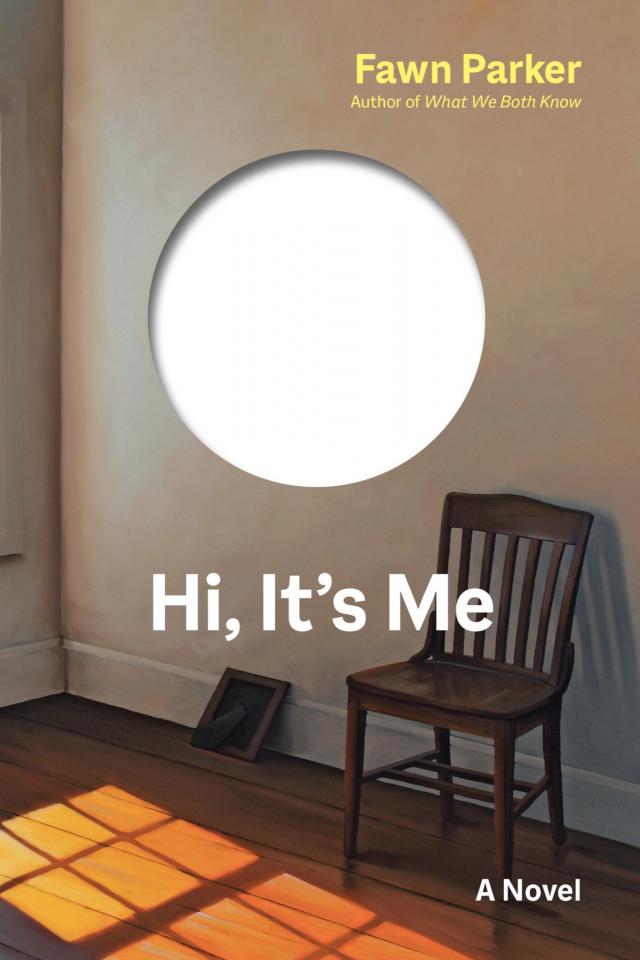
Hi, It's Me, page 1


Praise for Fawn Parker and Hi, It’s Me
“Exacting, prismatic, and brilliantly unafraid, Hi, It’s Me holds something of the soul in its pages. Mourning the death of her mother, Fawn Parker takes us into the hot and psychedelic center of her grief. Searching for clarity, for nearness, Parker must contend not only with the size of her unanswered love and wanting, but with how scarcely she knew her mother, and how scarcely she herself was known. Never sentimental, always true, Parker closes the distance between the reader and the word. A beautifully immersive and haunting novel produced by a sublime and original mind, Hi, It’s Me is a direct conversation with an everlasting absence, with the afterlife itself.”
—Claudia Dey, author of Daughter
“This book accomplishes something truly rare: After you’ve read it, you feel like you’ve spent time with a real person. It’s a devastating book on absence and grief, it’s a deeply complicated and felt story about womanhood, it’s so completely uninterested in bullshit. Fawn Parker is one of the smartest, most talented writers working right now. We’re lucky she’s around.”
—Casey Plett, author of A Dream of a Woman
“Fawn Parker writes beautiful prose, with wit, clarity, and precision. Hi, It’s Me packs so much into one single day, and leaves you with a lot to ponder about what makes a life.”
—Zoe Whittall, author of Wild Failure
ALSO BY FAWN PARKER
Novels
What We Both Know
Set-Point
Dumb-Show
Poetry
Soft Inheritance
Copyright © 2024 by Fawn Parker
Trade paperback edition published 2024
McClelland & Stewart and colophon are registered trademarks of Penguin Random House Canada Limited.
All rights reserved. The use of any part of this publication reproduced, transmitted in any form or by any means, electronic, mechanical, photocopying, recording, or otherwise, or stored in a retrieval system, without the prior written consent of the publisher—or, in case of photocopying or other reprographic copying, a licence from the Canadian Copyright Licensing Agency—is an infringement of the copyright law.
This is a work of fiction. Names, characters, places, and incidents either are the product of the author’s imagination or are used fictitiously. Any resemblance to actual persons, living or dead, events, or locales, is entirely coincidental.
Library and Archives Canada Cataloguing in Publication data is available upon request.
ISBN 9780771005152
ebook ISBN 9780771005169
The image on this page is the painting Saint Agathe (Francisco de Zurbarán). The image on this page is the painting Penelope (John Roddam Spencer Stanhope).
Book design by Emma Dolan, adapted for ebook
Cover art: Jim Holland
Typeset by Sean Tai, adapted for ebook
McClelland & Stewart,
a division of Penguin Random House Canada Limited,
a Penguin Random House Company
www.penguinrandomhouse.ca
a_prh_7.0a_148197864_c0_r0
Contents
Cover
Also by Fawn Parker
Title Page
Copyright
Dedication
MORNING
Chapter 1: AMOR MATRIS - 8:00 A.M.
Chapter 2: VENENUM - 9:00 A.M.
Chapter 3: INGRUO - 10:00 A.M.
Chapter 4: EXITIUM - 11:30 A.M.
AFTERNOON
Chapter 5: INITIA NOVA - 12:00 P.M.
Chapter 6: NUNTIUS - 1:00 P.M.
Chapter 7: RECEDO - 2:30 P.M.
Chapter 8: UTOPIA - 3:00 P.M.
Chapter 9: FEMINAE - 4:00 P.M.
Chapter 10: DEUS - 5:00 P.M.
Chapter 11: ECCLESIA - 6:00 P.M.
EVENING
Chapter 12: CREATIO - 7:00 P.M.
Chapter 13: THEATRUM - 8:00 P.M.
Chapter 14: POST VITAM - 9:00 P.M.
Chapter 15: SEPULTURA - 10:00 P.M.
Chapter 16: FRACTUS - -:-- P.M.
Chapter 17: FUNUS - 11:00 P.M.
Chapter 18: PURGO - 00:00 A.M.
Acknowledgments
About the Author
For E.
(Can you see this?)
MORNING
Chapter 1
AMOR MATRIS
8:00 A.M.
MEURSAULT SAID IT BEST: aujourd’hui, maman est morte.
Upstairs, I creep quietly into each bedroom to ensure that there is nobody unaccounted for in the house. I am almost disappointed, then relieved, not to find my mother up here. The rooms are tidy and bright, and dorm-like in their uniformity. Each has, more or less, a bed, a dresser, and some sort of desk or dressing table.
Downstairs is a fifth room where Mariam stays so she doesn’t have to climb the stairs more than she needs to, due to pain in her legs. The rest are upstairs: Andrea, Sue, and Lynn. I promise the names will sort themselves out. Facing out the front is my mother’s former bedroom, where there are two boxes of loose items of hers, collected from various common spaces in the house. The rest of the room has been left as is, excluding the bed, which has been made. Someone, at some point this morning, had to have made the bed, after my mother was removed from it. Each time I think of her I have to make the conscious choice to think my mother and not my mother’s body.
There is the smell of her in here. It is soft like cotton and butter. When I remove my bra at the end of a day, I smell her there, in the cups. Sometimes too in my arrangement of lotions and potions and creams, I smell her, but that is cheating. All women smell like their creams.
Before I begin the work of sorting and arranging, I take a tour of the smells of the room. I press my face into the bedspread, into the pillows, into the soft terry cloth robe hanging by the door. I open the drawer of her dressing table and stick my face in there. It’s not emotional, at least not the way I anticipated.
Orange oil, beeswax, a blood-red bottle of Opium perfume.
On top of the dressing table are a number of small boxes, stacked on other small boxes. Some of them are made of wood, some metal, some cardboard. Inside is all of her jewellery, which I will address later. Until I see it, I imagine it could even still be on her. Wherever she is, wearing it, all of it. But I don’t believe in the being-somewhere and the looking-down that is often talked about. If she is anywhere, she is doing something that has nothing to do with me. A person doesn’t stop being a person just because they’ve died. That is, if they are somewhere, anywhere.
It occurs to me that the least consumed with myself I’ve been is in this time I’ve spent consumed instead with a dead person. She is my first dead person, my mother. There is luck in that, if you ask anyone. I am twenty-nine. To live twenty-nine years and to not know death is a very lucky thing.
Plus it is a normal thing to lose a mother.
But losing my mother doesn’t feel how I imagine other lost mothers must feel, to those who lost them. I consume myself with the subject as if I have discovered something new. She’s not just dead, I want to tell them (them? who?), she’s gone. I am surrounded by mocking evidence of her inhabitancy of this room. Quickly, it is expiring. Today she was alive. When the day runs out that will no longer be true. Tomorrow I will be able to say that yesterday she was alive, at least. The next day, nothing. She will just be dead. The fact seems to be at its smallest now, growing with time. For now she is many things, and there are many places left to find her.
Eventually she will be nowhere at all and nothing but dead.
Are you more alive now, I wonder, because they have not yet burned your body, or are you more dead, because your body is still here on Earth, but without life? If death occurs to the body, what will you be once they have destroyed it? You, I keep thinking. What am I doing? I try to train myself to think she, but you always works its way in. The dead have no perspective. They are only a collection of past actions, remembered or marked. There is no continuation, no ebbing, changing, future-facing you. Just a catalogue of moments. You are a database. I am alive.
Why must it be this way?
And what about the objects? They have been moved, touched. The visible signs of wear and use are imprints of her on the world. Is not her imprint on me enough to keep her here, in some way? That’s how others grieve, no? I simply cannot be trusted to keep track of you. What if I forget something?
Now, trying to recall, I remember nothing. I cannot remember how you look(ed), how you sound(ed), nor a single memory from my childhood. I remember only the accessories, the peripherals. Me, in relation to you. I remember the hospital paraphernalia of recent years. The photos she (you) would send me of the machines and clips and wires she had to rent. Rent! It seems a cruel thing to rent life-supporting equipment, or at least to use that word of all words. At least let them feel it belongs to them. Offer a permanence to the state of dying. State is preferable to process. Life is a process but we must think of death as a state. Static. My mother, dead, in a state, in one place, forever. Metastatic then static. This I prefer to the transition. To consider that the dying began at one point, worked itself toward a close, and then closed. Now, the present. Not dying, but dead.
Where are you now? If yo
u are somewhere, where is it? Is it everywhere? We have so many ridiculous ideas about death, we the living. Even if a person does go somewhere, we figure it’s somewhere that is in some way connected to us. We figure everything is connected to us. We are unable to admit that nobody cares what we are doing at any given moment, and that it all amounts to nothing. The dead have better things to do. The living do, too, you know.
Anyway. There is paperwork to be dealt with. The phone plan needs to be cancelled and the device has to be sold, repurposed, or disposed of. I have to look through notebooks for passwords. I have to type up the obituary and bring it to the newspaper office—the women don’t trust it will be received by email. We have to tell various individuals in town what has happened. To bring a plant to a woman down the street who requested one, in memoriam. This last task in particular I find amusing. My mother was asked not long ago if she might donate one of her plants to the community garden, so that people in town could water it for her, to—I believe their phrasing was—“keep her spirit alive.”
“Oh, fuck off,” she said. “Let it die.”
I’ve been wanting to mourn properly this morning but I keep being interrupted by tasks. What about the fainting and crying? There is no chaise on which to throw myself, no one to count the days I go without so much as a sip of water. The theatrics would be useless without witness. There is so much business to be done. By the time it is done I will have passed through the seven stages, quietly and without proper attention.
I begin by cataloguing the furniture and other possessions so that they may be listed on the auction site. I start with the things that remind me most of my mother, to get them over with. I could keep some, and I may, but the noncommittal cataloguing feels as though I am taking some large stride forward in my healing process. Later, when it comes time for follow-through, I will discover the extent to which the grief has a hold on me.
These are the contents of the bedroom, but not in order of importance:
Bed frame[1]
Dressing table[2]
Upholstered bench
Two-door cabinet[3]
Notebooks[4]
Coats[5]
Bookshelf
3D-printed Elaine from Seinfeld pin[6]
Engagement ring from first marriage[7]
Engagement ring from my father[8]
Wedding band[9]
Book-shaped locket[10]
Heart-shaped locket[11]
Amethyst necklace
Various costume jewellery
Cosmetics bag
Sorel boots
Miu Miu pumps
Coach purse
Leather briefcase
Plastic business-card wallet
Full-sized wallet
Hand-sewn doll[12]
Photo album[13]
Books
Mirror[14]
I place the garnet engagement ring from my mother’s first marriage on my left ring finger. It is difficult for me to imagine ever wearing one like this for real.
The mirror reflected my mother so many times. Like millions of photographs, stacked in layers, or like its surface was worn away somehow by use. I wonder if the glass has some sort of personified knowledge, some memory. If on an atomic level it was changed by her.
I am surprised by my numbness in cataloguing the items. In a way I have already torn off the bandage, in that her house in the city has been sold. That was where her real life was, even if the inventory here is more personal. She seemed more comfortable, more alive in the cool professional interior design of the Tudor house in midtown Toronto.
The moral stance of these women and their collective seems to have been more a project for my mother. Though she appears to have kept a room like all the others, there is something missing: each of the others has proof of engagement with the physicality of the space. There is Andrea’s loom, Sue’s paints and charcoal and large taut canvases, Lynn’s needlework and candles and piano, and Mariam, who seems always to be up to something, fixing something, painting something, keeping everything together. Whereas my mother was many things, but all of them intellectual: a librarian first, then a lawyer, then a student of literature. Her being in the house was a preference, while she completed her studies from a distance. She brought her books, holed up in her bedroom. The others cannot live by the rules of this life just anywhere. The farm, for them, is a necessity. Admittedly, my mother’s constant movement caught up to her in recent years. There’d always seemed a sense of pride in her having split her time between urban and rural. In winter she’d go back to Toronto and inhabit that big extravagant house, shake cocktails for reputable academics, tell stories about the farm as if an absurd dream she’d had the night before. When she began living here full-time there was a visible drop in her posture. She wilted into her supposed insignificance. She didn’t believe in what the women of the farmhouse believe in, not all the way, but she stopped resisting their beliefs. She let herself become one of them. Men had let her down, too.
Mom—I know you broke their rule that one final time.
Mariam told me you talked to Dad for hours, after our goodbye. She said it as if it were a secret between us. The women’s rule system was expected to be held up even in the face of death. I guess that was the first time I realized how much they all really mean it.
But, anyway, this is what kept you from assimilating: the women moved to the farmhouse to begin new lives, and you moved here to die.
I find myself wanting an end like yours. I don’t want to die, and I don’t want to die in any specific way, for any specific reason, but I want for my life to fill out in the same shape as yours. What other sense of direction could I possibly have?
* * *
—
NO MATTER MY INDIFFERENCE to this process of cataloguing, I have a nagging preciousness about some of the things of my mother’s in the farmhouse: a pink upholstered armchair featured prominently in a photograph of my mother breastfeeding me, a garish and out-of-place (art nouveau, she insisted) Tiffany fruit lamp, and a regal white sofa where she spent much of her illness. The couch, especially, keeps me on edge. I scrutinize the way the women use it. It is so central in the living room, so exposed. They sprawl across its cushions in gardening overalls, dig their sharp elbows into its armrests, drink black coffee and red wine with abandon. During one of my previous visits I saw Sue bark with laughter over some overacted retelling of something that happened to Lynn, spilling a splash of black tea with milk onto one of my mother’s throws. I watched her ball it up and throw it wildly into the laundry sink, pummel it under the stream that exploded from the tap, and wring it out in big violent twists. It was as if she wanted it to suffer.
That’s why, now, I’ve taken refuge in the bedroom. I can’t stand to watch life go on.
I am lying flat on my back on the bed on top of its taut quilts. I can hear the sounds of the women doing various things throughout the house, like the rhythmic clinking of a machine. In an extended moment of anticipation I consider getting under the covers, but each time I go to move, I am closer to sleep, paralyzed by the heavy comfort of the muted light from the window and the warm air of the room.
I cannot locate myself. I am not awake, but am still thinking. Images appear and then disappear in my mind. They are simultaneously small, inside my head, and also somehow larger than my field of vision. I try to cast you there, but I cannot remember your details. I feel I would be able to if I could just pick one feature, but there are too many.
Clink of Tiffany bracelet,
telephone voice,
movement of hands tying robe,
smell of smoke, artificial rose,
one stiff flick to straighten the newspaper in the morning.
With a weight like lead I drag my body from the bed to the desk, light the small weak lamp against the greyness of the closed-curtained bedroom and start to transcribe them, as best I can, from memory, like emptying my bladder so I can go back to sleep.


